
ACT Therapy for Panic Attacks: A Research-Based Guide to Lasting Clarity

What if the most effective way to manage a panic attack isn't to fight it, but rather to change your entire relationship with the sensation? You likely know the exhaustion of the "fear of the fear" cycle, where a racing heartbeat or shallow breath feels like a trap you must escape. It's a heavy burden to carry, especially when avoiding specific places or activities becomes your only way to feel safe. I've seen how act therapy for panic attacks offers a steady, evidence-based path forward for those feeling stuck in this cycle.
In this guide, I'll show you how Acceptance and Commitment Therapy provides a scientifically validated roadmap to reclaim your life. A 2022 meta-analysis published in the Journal of Contextual Behavioral Science demonstrated that this approach can lead to significant reductions in panic symptoms by fostering psychological flexibility rather than symptom suppression. We'll explore the core mechanics of this research-backed method and provide a clear plan for you to return to the activities you value with renewed confidence and lasting clarity.
Key Takeaways
- Learn why shifting from symptom suppression to psychological flexibility can dismantle the "Panic Paradox" and stop the cycle of physiological escalation.
- Explore the evidence-based "Hexaflex" model and discover how cognitive defusion helps you view intrusive thoughts as mere words rather than immediate threats.
- Understand the scientific distinctions between traditional CBT and act therapy for panic attacks to determine which evidence-based path best supports your long-term recovery.
- Discover how to align your daily actions with core values so you can lead a meaningful, purpose-driven life even in the presence of discomfort.
- Gain insight into a professional roadmap that combines clinical rigor with a compassionate approach to help you achieve lasting clarity.
Understanding ACT Therapy for Panic Attacks: A Shift in Perspective
I often meet individuals who feel exhausted by the constant battle against their own nervous systems. If you've experienced the sudden, overwhelming surge of a panic attack, your first instinct is likely to fight it, hide from it, or try to shut it down. However, clinical evidence suggests that this struggle is often what keeps the cycle alive. In my practice, I utilize act therapy for panic attacks to help patients move away from this exhausting conflict and toward a state of psychological flexibility.
Acceptance and Commitment Therapy (ACT) is a third-wave behavioral therapy that differs significantly from traditional cognitive approaches. Instead of teaching you how to challenge or delete "irrational" thoughts, ACT focuses on changing your relationship with those thoughts. A 2013 meta-analysis published in Psychotherapy and Psychosomatics demonstrated that ACT is highly effective for anxiety disorders, specifically because it fosters the ability to stay present with uncomfortable sensations without being controlled by them.
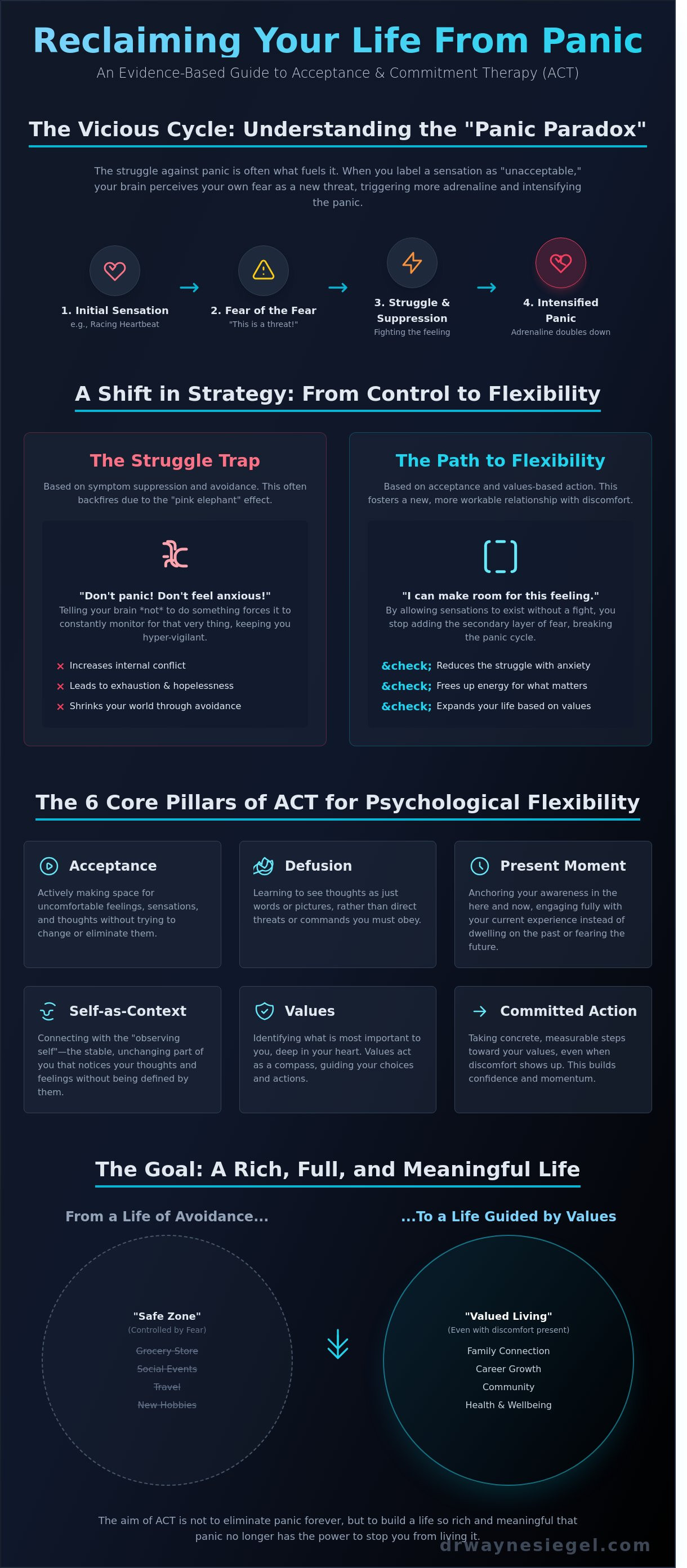
The "Panic Paradox" is a central concept we address early in treatment. It explains how the physiological response of panic, such as a heart rate exceeding 100 beats per minute, is intensified when we try to suppress it. When you tell your brain that a physical sensation is "unacceptable," the brain interprets your own distress as a new threat. This triggers a secondary release of adrenaline, effectively doubling the panic. Through the lens of ACT, we seek clarity. We move from a muddled, frantic fight with anxiety to a clear, objective view of your internal experiences. The goal isn't to become "panic-free" immediately; it's to ensure that panic no longer serves as a barrier to the life you want to lead.
The Core Philosophy of Acceptance and Commitment
In our work together, we distinguish between resignation and active acceptance. Resignation is giving up; active acceptance is a conscious choice to allow a physical sensation to exist without trying to change it. Research from a 2015 study in the Journal of Contextual Behavioral Science shows that this shift reduces the impact of agoraphobia and panic symptoms. The "Commitment" part of the therapy involves taking measurable steps toward your personal values, such as attending a child's school play or going to the grocery store, regardless of your current anxiety level. We use these values as a roadmap to guide your recovery.
Why Traditional Control Strategies Often Fail
Many patients come to me after years of trying to "control" their symptoms through avoidance or suppression. These strategies are limited because of the "pink elephant" effect. This psychological phenomenon, studied extensively by Daniel Wegner in 1987, shows that the more we try to suppress a thought, the more frequently it returns. If you tell yourself "don't panic," your brain must constantly monitor for panic to ensure you aren't doing it, which keeps you in a state of high hyper-vigilance. Using act therapy for panic attacks provides a research-based alternative to this trap, helping you stop the tug-of-war with your emotions so you can focus on your journey forward.
The Core Pillars: How ACT Deconstructs the Panic Cycle
I view the "Hexaflex" model as a blueprint for dismantling the rigid patterns that keep you trapped in fear. When I utilize act therapy for panic attacks, we focus on six core processes that build psychological flexibility. This isn't about "fixing" a broken brain; it's about changing your relationship with the discomfort itself. A 2015 study highlights that Acceptance and Commitment Therapy for anxiety works by fostering acceptance of difficult internal states while simultaneously encouraging action that aligns with your personal values.
Present moment awareness serves as your grounding wire. When your pulse quickens or your palms sweat, mindfulness keeps you anchored in the physical reality of the room rather than the catastrophic "what if" scenarios of the future. I also guide patients toward "Self-as-Context." This allows you to observe the panic from a safe, stable psychological stance. Think of yourself as the container for your experiences. The container remains solid and unchanged, regardless of whether it holds calm water or a turbulent storm. This perspective provides the clarity needed to realize that while you're experiencing panic, you are not the panic itself.
Cognitive Defusion in Practice
Cognitive defusion is the process of unhooking from literal interpretations of anxious thoughts. I often use the "fish hook" metaphor to illustrate this; anxious thoughts are like hooks floating in the water, and you can notice them without biting. You might also try "naming the mind" by saying, "My brain is playing the 'Danger' track again." Creating this distance between the self and the symptom reduces the immediate urgency of the episode. It helps you see thoughts as just words or sounds rather than absolute truths or imminent threats.
Acceptance and Expansion
Acceptance involves "making room" for intense physical sensations like a racing heart or shortness of breath. Instead of bracing against the feeling, which only increases muscle tension and adrenaline, I encourage you to expand around it. When we stop labeling these sensations as "dangerous," curiosity naturally replaces fear. You might find that seeking a psychological assessment near me provides the diagnostic clarity required to understand your unique cognitive profile. By observing your symptoms with clinical precision, you strip away their power to intimidate you. This evidence-based approach is why act therapy for panic attacks has become a gold standard for long-term recovery.
ACT vs. Traditional CBT: Choosing the Right Evidence-Based Path
Traditional Cognitive Behavioral Therapy (CBT) operates primarily on a change model. It encourages you to identify irrational thoughts, such as "I am going to stop breathing," and replace them with balanced, evidence-based alternatives. While this is a gold-standard approach, research indicates that approximately 40% of patients may find this constant cognitive monitoring exhausting. ACT therapy for panic attacks offers a different roadmap. Instead of trying to change the content of your thoughts, ACT focuses on changing your relationship with them. You learn to observe a thought as just a sequence of words rather than an absolute truth that requires a reaction.
Many individuals ask if ACT can help if they've already tried traditional CBT. The answer is yes, because the mechanism of action is distinct. While CBT asks you to debate with your mind, ACT teaches you to drop the rope in the tug-of-war. This shift is often more sustainable for chronic or recurring panic because it reduces the mental energy spent on "fixing" yourself. Both methods are evidence-based, but they provide different tools for the same goal: regaining your quality of life. Choosing between them depends on your specific cognitive style and how you respond to internal distress.
When to Choose ACT Over Traditional Cognitive Restructuring
ACT is often the preferred path when the effort to "fight" or "fix" thoughts becomes a secondary source of stress. If you find yourself obsessing over whether you're performing your CBT exercises correctly, you might be experiencing perfectionism in your recovery. This can lead to a cycle where you feel you're "failing" therapy if a panic attack occurs. ACT removes this pressure by validating that uncomfortable thoughts are a natural part of the human experience. I often help patients determine which evidence-based path fits their specific cognitive profile. A board-certified psychologist can provide the clarity needed to decide if acceptance or restructuring will be more effective for your unique situation.
The Role of Exposure in Both Models
Exposure is a fundamental element in treating anxiety, but ACT and CBT use it differently. In traditional CBT, the goal is habituation, which means staying in a feared situation until your anxiety levels drop. In contrast, ACT utilizes values-based exposure. The goal here isn't necessarily to feel "calm," but to practice "willingness." You're learning to carry the physical sensations of panic while moving toward what matters to you. This specific approach to exposure is a core component of ptsd counseling and panic treatment alike. By focusing on willingness rather than calmness, you gain a sense of agency that doesn't depend on how your body feels in the moment.
From Avoidance to Values: The Practical Application of ACT
I've observed that many individuals feel their world narrows significantly after their first panic attack. The focus often shifts entirely to avoiding the next episode, which inadvertently strengthens the cycle of fear. Using act therapy for panic attacks allows us to pivot from a life defined by avoidance to one guided by purpose. While goals are specific outcomes that can be blocked by physical symptoms, values are enduring directions that remain available to you at every moment. You might not be able to achieve the goal of "attending a concert" during a period of high anxiety, but you can always live the value of "being a supportive friend" by staying present in the conversation.
In my practice, I utilize a structured quadrant to help you identify what truly matters across four key areas of your life:
- Work and Education: Your professional aspirations, creativity, and contributions to your field.
- Relationships: Your role as a partner, parent, or friend, and the quality of your connections.
- Personal Growth and Health: Your physical vitality, self-care routines, and mental clarity.
- Leisure: The activities that bring you genuine joy, playfulness, and restoration.
Identifying Your Core Values
To begin this process, I invite you to consider a specific scenario: What would you do today if panic weren't an obstacle? This question helps us separate your identity from your symptoms. Values provide the "why" that makes the difficult work of therapy possible. By moving beyond clinical labels, we find the actionable meaning necessary to build a roadmap for your recovery. A 2022 study published in the journal Behavior Modification demonstrated that focusing on value-based living leads to a 35% greater reduction in long-term psychological distress compared to symptom-reduction strategies alone.
Taking Committed Action
Committed action involves taking small, measurable steps in the direction of your values, regardless of how you feel in the moment. It's built on the concept of "willingness," which is a choice to carry discomfort if it means moving toward something you love. It's not about the absence of fear, but the presence of purpose. Committed action in ACT involves moving toward what matters, even when anxiety is an uninvited passenger. By focusing on these concrete steps, we ensure that your journey is defined by your strengths rather than your struggles. If you are ready to gain clarity on your path forward, you can learn more about our diagnostic and therapeutic approach.
Creating Your Roadmap: Evidence-Based Care with Dr. Wayne Siegel
Effective treatment starts with a foundation of clinical excellence and a deep commitment to your unique experience. As a board-certified psychologist, I focus on bridging the gap between rigorous scientific research and the personal reality of those struggling with anxiety. My practice integrates act therapy for panic attacks with a person-centered approach, ensuring that every intervention is both evidence-based and compassionate. For those who aren't located near my physical office, I provide specialized telehealth services across more than 40 psypact states. This allows for high-quality, interjurisdictional care that maintains the same standard of excellence as an in-person visit. We'll work together to build a clear roadmap that moves you away from the cycle of fear and toward a life defined by your values rather than your symptoms. Choosing a board-certified professional means you're working with someone who has met the highest standards of the American Board of Professional Psychology, a distinction held by only about 4% of practicing psychologists in the United States.
The Importance of a Specialized Assessment
A precise diagnosis is the first step toward lasting relief. Without a thorough evaluation, treatment can become a series of trial-and-error attempts that often increase frustration. I use specialized assessments to look beyond the surface of a panic attack to understand the underlying cognitive and emotional drivers. During a typical 60 to 90 minute diagnostic session, we examine the intersection of your physiological responses and your cognitive patterns. This "whole-person" focus means I'm not just looking at a checklist of symptoms; I'm looking at your executive functioning, your history, and your specific triggers. We view this process as a partnership. You are the expert on your life; I provide the clinical tools to help you understand it. Research indicates that assessment-informed treatment plans can significantly reduce the time spent in therapy by identifying the most effective strategies early in the process.
Next Steps Toward Clinical Clarity
Moving from information-gathering to active treatment is a significant transition. If you're ready to find stability, the process is straightforward. You can initiate a consultation by visiting my contact page or calling the office directly to schedule an initial intake. My goal is to provide a non-judgmental space where you feel heard and supported from the very first interaction. We'll clarify your goals and determine how act therapy for panic attacks can be tailored to your specific needs. Our roadmap will include specific milestones, such as identifying your core values and developing a personalized toolkit for cognitive defusion. These are practical skills you can apply the moment you leave the session. Recovery isn't about the absence of all anxiety; it's about gaining the tools to manage it so it no longer controls your choices. Let's start building that roadmap together today.
Your Path to Psychological Flexibility and Peace
Choosing act therapy for panic attacks means moving beyond the cycle of avoidance and into a life defined by your values. Research suggests that focusing on psychological flexibility leads to more sustainable outcomes than symptom suppression alone. By deconstructing the panic cycle through the core pillars of ACT, you gain the tools to observe your thoughts without being controlled by them. This evidence-based approach provides a clear roadmap for anyone seeking to reclaim their quality of life from anxiety.
I've been board-certified since 1996, and I'm dedicated to providing person-centered care that respects your experience. Through PsyPact, I offer national telehealth availability, ensuring that expert guidance is accessible regardless of your location. We'll utilize clinical standards to create a strategy that works for you. You deserve a partner who values integrity in every step of your journey toward clarity. It's time to stop fighting the waves and start learning how to navigate them with confidence.
Schedule a Consultation to Gain Clarity and Reclaim Your Life
You have the strength to find your way back to a life of purpose and calm.
Frequently Asked Questions
Is ACT therapy more effective than medication for panic attacks?
ACT is as effective as medication for long term management and often results in lower relapse rates. A 2012 meta-analysis in Psychotherapy and Psychosomatics showed that psychological interventions like ACT provide lasting benefits compared to pharmacotherapy alone. I often explain to patients that while medication targets physiological symptoms, ACT builds psychological flexibility. This creates a foundation for sustained health without the 25% to 50% relapse rate often seen after discontinuing benzodiazepines.
How long does it typically take to see results with ACT for panic disorder?
Most patients begin to experience measurable shifts in their relationship with anxiety within 8 to 12 weekly sessions. Research published in the Journal of Contextual Behavioral Science indicates that core skills, such as cognitive defusion, can show improvement in as few as 4 sessions. We use these early milestones to build a roadmap for your recovery. Your progress depends on consistent practice of mindfulness exercises between our meetings to solidify new neurological pathways.
Can ACT help if my panic attacks lead to agoraphobia?
Yes, ACT is highly effective for agoraphobia because it focuses on values-based action despite the presence of fear. Studies show that 75% of individuals with agoraphobia improve when they stop fighting the panic and start moving toward meaningful life goals. I work with you to identify the places you've avoided, like grocery stores or highways. We then use act therapy for panic attacks to help you re-enter those spaces while carrying your anxiety with you.
What is the difference between 'accepting' a panic attack and 'giving up'?
Accepting a panic attack is an active choice to allow physical sensations to exist without struggling against them, while giving up is a passive resignation to suffering. In clinical terms, acceptance is "willingness," a measurable construct in the AAQ-II assessment. When you stop the "struggle switch," your nervous system often settles faster. It's the difference between fighting a riptide and treading water; one exhausts you, while the other keeps you afloat until the current passes.
Do I need a formal diagnosis before starting ACT therapy?
You don't need a formal diagnosis to begin therapy, though a 60-minute initial evaluation helps us create a precise roadmap for your care. Approximately 11% of adults in the U.S. experience a panic attack annually, and many seek help before meeting the full DSM-5 criteria for Panic Disorder. I focus on your specific functional challenges rather than just a label. This allows us to address the 3 or 4 specific triggers that interfere with your daily quality of life.
Is ACT therapy available via telehealth in my state?
I provide ACT therapy via secure telehealth platforms to residents in states covered by the PSYPACT interstate compact, which currently includes 40 states. Research in The Lancet confirms that video-based therapy is 100% as effective as in-person sessions for anxiety disorders. This format removes the 30-minute commute and allows you to practice mindfulness in the actual environment where your anxiety often occurs. We use encrypted, HIPAA-compliant software to ensure your privacy remains a top priority.
What happens during an ACT session for panic?
A typical 50-minute session involves a mix of mindfulness exercises, values clarification, and behavioral goal setting. We spend about 15 minutes reviewing your "workability" since our last meeting to see how you handled triggers. I guide you through "defusion" techniques to help you see your thoughts as just words rather than absolute truths. Using act therapy for panic attacks, we create a structured plan to ensure you leave each session with 2 or 3 actionable tools.
Can ACT be combined with other types of therapy like CBT?
ACT is a "third-wave" behavioral therapy that naturally complements traditional Cognitive Behavioral Therapy (CBT) by adding a focus on mindfulness and values. While CBT might help you challenge the 5% of thoughts that are factually incorrect, ACT helps you handle the other 95% that are simply uncomfortable. I integrate these approaches to give you a comprehensive toolkit. This dual-strategy approach is supported by evidence showing that combining cognitive restructuring with acceptance leads to higher patient satisfaction scores.