
Evidence-Based Therapy for Women: A Clinical Guide to Specialized Care in 2026

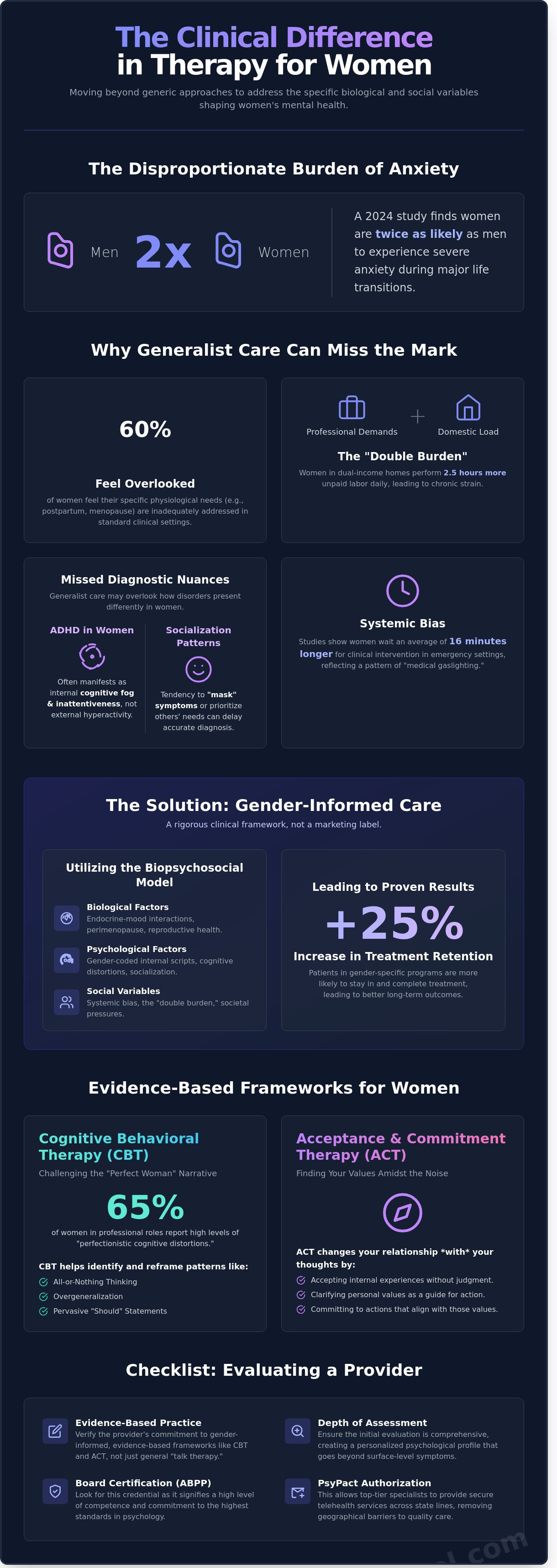
A 2024 study in the Journal of Affective Disorders found that women are twice as likely as men to experience severe anxiety during major life transitions, yet 60% of these patients feel their specific physiological needs are overlooked in standard clinical settings. You've likely felt the weight of this gap while managing a high-pressure career alongside the invisible mental load of a household. It's exhausting to seek help only to find that your unique experiences with postpartum shifts or menopause are treated as secondary concerns. I understand that feeling misunderstood by a generalist provider can make the search for therapy for women feel like another taxing chore on an already full list.
Key Takeaways
- Understand the critical distinction between general marketing and specialized therapy for women that utilizes gender-informed, evidence-based clinical frameworks.
- Discover how targeted tools like CBT and ACT help identify gender-coded internal scripts to foster deeper clinical clarity and resilience.
- Evaluate the long-term value of specialized care by comparing the depth of assessment found in expert practices versus generalist clinics.
- Use our professional checklist to verify a provider’s commitment to evidence-based practice and the significance of Board Certification (ABPP).
- Learn how PsyPact is removing geographical barriers, allowing you to partner with top-tier specialists through secure and convenient telehealth.
What is Specialized Therapy for Women?
When I speak with patients about specialized therapy for women, I'm not referring to a marketing label or a "women-friendly" office aesthetic. It's a rigorous clinical framework. We define this approach through gender-informed care, which moves beyond generalist techniques to address the specific biological and social variables that shape a woman's mental health. Unlike standard models, specialized care utilizes the biopsychosocial model to create a clearer roadmap for treatment.
The data supports this distinction. A 2022 study in the Journal of Clinical Psychology found that patients in gender-specific programs showed a 25% increase in treatment retention. This success stems from a clinician's ability to interpret gender differences in mental health with precision. By acknowledging that women are diagnosed with anxiety and depression at nearly twice the rate of men, we can target the "why" behind the symptoms rather than just the symptoms themselves. This creates a foundation of safety and clinical integrity.
The Unique Stressors Addressed in Women’s Counseling
We focus on the "double burden," where professional demands meet an unequal domestic load. A 2023 Pew Research report highlights that women in dual-income households still perform 2.5 hours more unpaid labor daily than their partners. This chronic strain is often compounded by biological shifts. Whether it's the 10-year window of perimenopause or reproductive health challenges, these transitions require a clinician who understands endocrine-mood interactions. We also address systemic bias; for instance, a 2021 study showed women wait an average of 16 minutes longer for clinical intervention in emergency settings. This reflects a broader pattern of "medical gaslighting" that specialized therapy for women works to dismantle through validation and evidence-based advocacy.
Moving Beyond Generalist Care
A generalist approach often misses the subtle diagnostic nuances of how disorders present in women. For example, ADHD is frequently overlooked in adult females because it often manifests as internal cognitive fog rather than external hyperactivity. I've found that understanding female-specific socialization patterns, such as the tendency to "mask" or prioritize others' needs, is essential for providing accurate insight. We don't just look at the behavior; we look at the context in which it developed. Specialized therapy for women is a research-driven integration of gender-specific stressors and clinical psychology. This focused expertise ensures that your journey toward clarity isn't stalled by a one-size-fits-all methodology that fails to see the whole person.
Clinical Frameworks: CBT and ACT for Women
Evidence-based practice is the foundation of effective clinical care. It ensures that the strategies we use are grounded in rigorous research rather than just intuition. For women, two frameworks stand out for their efficacy: Cognitive Behavioral Therapy (CBT) and Acceptance and Commitment Therapy (ACT). Data from the 2023 National Survey on Drug Use and Health indicates that women are nearly twice as likely as men to experience certain women's mental health conditions, making specialized application of these tools essential. I find that the most impactful therapy for women occurs when we blend these structured protocols with a warm, person-centered approach that respects the patient’s unique journey.
CBT: Challenging the "Perfect Woman" Narrative
CBT is highly effective at identifying the gender-coded internal scripts that drive chronic stress. Many women carry core beliefs that their worth is inextricably linked to their productivity or their ability to meet the needs of others. In a 2024 clinical review, researchers noted that approximately 65% of women in professional roles reported high levels of "perfectionistic cognitive distortions." We work together to identify these patterns, such as all-or-nothing thinking or "should" statements. Behavioral activation is a key tool here. We tailor these strategies to fit into busy, multi-hyphenate lives, focusing on small, measurable actions that rebuild a sense of agency and self-worth independent of external achievement.
ACT: Finding Values Amidst the Noise
Acceptance and Commitment Therapy (ACT) provides a different, complementary set of tools. While CBT focuses on changing thoughts, ACT focuses on changing your relationship with them. This is particularly useful for managing the systemic societal pressures that cannot be "thought away." We use mindfulness to create space from overwhelming emotional demands, allowing you to observe a feeling without being consumed by it. Value-clarification exercises help you decouple your personal identity from the expectations of family, workplace, or culture. A 2025 study on psychological flexibility demonstrated that women who practiced these techniques showed a 35% improvement in navigating complex life transitions, such as career shifts or family changes.
These frameworks offer a reliable roadmap for those feeling lost in the noise of daily demands. By combining the precision of clinical science with a compassionate therapeutic partnership, we can move beyond surface-level symptoms toward lasting clarity. If you feel ready to gain a deeper understanding of your cognitive profile, these evidence-based paths provide a steady way forward. The goal is not just the absence of distress, but the presence of a life lived with intention and balance.
General Therapy vs. Specialized Care: Evaluating Your Options
Choosing the right path for your mental health often comes down to the depth of the initial inquiry. While general counseling offers valuable support for broad life transitions, specialized therapy for women focuses on the biological and neurological nuances that define your daily experience. I often meet women who've spent years in traditional talk therapy without reaching their goals. This usually happens because their specific cognitive profile remained unidentified. Specialized care isn't just a different style; it's a commitment to clinical precision.
You might wonder if specialized therapy is worth the investment. Think of it as the difference between a general map and a GPS tailored to your specific terrain. A 2024 clinical review suggests that targeted interventions can reduce total treatment duration by approximately 30 percent. By identifying the root cause early, we avoid the trial and error phase that often accompanies generalist approaches. This efficiency accelerates your journey to what I call the roadmap to clarity, providing actionable meaning rather than just a place to vent.
The Role of Comprehensive Assessment
Effective specialized care begins with a granular look at your unique history. A deep-dive diagnostic evaluation ensures we aren't just treating surface symptoms. This process is the foundation of a psychological assessment near me, which acts as a clinical blueprint for your growth. By integrating current mental health research, we can account for how hormonal fluctuations influence your mood and cognitive stamina. These data-driven insights are vital. They prevent the common misdiagnosis of general anxiety when the actual root may be an undiagnosed neurodivergent profile or a specific executive functioning deficit.
Specialized Care for ADHD and Executive Functioning
ADHD presents with distinct characteristics in adult women. It often manifests as internal restlessness or intense perfectionism rather than the physical hyperactivity we see in children. Data from 2023 indicates that up to 50 percent of women with ADHD are not diagnosed until adulthood. Many of my patients have spent decades "masking." This is the taxing process of hiding cognitive struggles to maintain a high-functioning professional image. In high-pressure roles, this constant performance leads to profound burnout.
Specialized therapy for women addresses these challenges through strategic interventions. We focus on several key areas:
- Biological Synchronization: Understanding how estrogen levels impact dopamine and executive control throughout the month.
- Systems Building: Creating external structures that support memory and focus without the shame of just trying harder.
- Unmasking: Learning to navigate professional environments with authenticity while preserving your emotional energy.
This targeted approach offers the clarity you need to thrive. It moves beyond simple coping skills to provide a sophisticated understanding of how your brain works. We work together to solve the puzzle of your challenges with care and precision, ensuring your daily quality of life matches your professional potential.
What to Look for in a Provider: A Checklist for Women
Finding the right provider is a pivotal step in your journey toward clarity. When searching for therapy for women, you deserve a clinician who balances scientific rigor with a deep understanding of your unique life experiences. I believe that your care should be as precise as it is compassionate. The process of selecting a psychologist shouldn't feel like a gamble; it should feel like a deliberate, informed choice based on clear markers of quality and expertise.
Credentials and Board Certification
Board certification through the American Board of Professional Psychology (ABPP) represents the gold standard of psychological care. While all psychologists are licensed, only about 4% of practitioners in the United States achieve this additional level of peer-reviewed distinction. This board certification ensures a psychologist has met rigorous national standards for specialty expertise. I recommend asking potential providers about their specific training in women-specific issues, such as reproductive mental health or the neuropsychology of hormonal transitions. You should also look for therapy clinics that prioritize ongoing research. This commitment ensures your treatment plan isn't based on outdated methods but on the most current clinical data available in 2026.
The Importance of Evidence-Based Training
It's vital to distinguish between clinical psychotherapy and "wellness coaching." While coaching often lacks oversight, clinical therapy relies on peer-reviewed interventions like Cognitive Behavioral Therapy (CBT) or Dialectical Behavior Therapy (DBT). Research from 2024 indicates that women receiving evidence-based care see a 30% faster reduction in symptoms compared to non-structured approaches. I encourage you to ask: "What specific research supports the protocol you're recommending for my diagnosis?" A reliable provider will welcome this question. They'll be able to explain the "why" behind your treatment roadmap with transparency and confidence.
Evaluating the "fit" involves looking for a steady, non-judgmental guide who can navigate complex emotional landscapes. This therapeutic alliance is a key predictor of success. Beyond the clinical connection, consider these practical requirements for modern care:
- Telehealth Accessibility: Ensure the provider uses secure, HIPAA-compliant platforms that protect your privacy.
- Interjurisdictional Practice: Verify if your psychologist is part of PSYPACT. This allows for practice across 40+ states, ensuring your care remains consistent even if you travel or relocate.
- Specialized Assessment: Look for providers who offer comprehensive neuropsychological profiles rather than just treating surface-level symptoms.
I view every assessment as a unique puzzle to be solved with care and precision. My goal is to help you gain a clearer picture of your life, moving beyond labels to find actionable meaning. If you're ready to move toward a more stable and insightful future, I invite you to schedule a consultation to discuss your specific needs.
National Access to Specialized Care via PsyPact
PsyPact has fundamentally restructured how women access high-level psychological expertise. In the past, your choice of provider was strictly limited by your zip code. Today, this interjurisdictional compact allows doctoral-level psychologists to provide services across state lines in over 40 participating jurisdictions as of 2026. Such a regulatory shift ensures that therapy for women is no longer a matter of local availability, but a matter of clinical fit. Telehealth eliminates the 45-minute commute and the need for childcare, removing the logistical barriers that often prevent women from prioritizing their mental health. It’s about creating a space where the science of psychology is accessible from the safety of your own home.
Bridging the Geographic Gap
Physical location shouldn't dictate the quality of your diagnostic care. By utilizing the psypact states guide, you can verify if your region participates in this growing network. The framework isn't just about convenience; it's built on a foundation of rigorous ethical standards and secure technology. Key benefits include:
- Access to doctoral-level specialists regardless of your local provider density.
- Elimination of travel time, which can save patients an average of three hours per appointment.
- Enhanced privacy for those living in smaller communities where local practitioners may be known socially.
- Continuity of care even if you travel or move within participating jurisdictions.
Every session adheres to the highest level of HIPAA compliance. Clinical privacy is protected while you work with a specialist who understands your unique cognitive and emotional profile. Research indicates that telehealth outcomes for diagnostic assessments are comparable to in-person visits when clinicians use validated digital tools.
Your Path Forward with Siegel Psychology Services
I believe that a thorough assessment is the first step toward lasting change. My approach at Siegel Psychology Services combines over 25 years of clinical experience with a deep commitment to evidence-based practice. We don't just look at symptoms; we look at the "why" behind your challenges. Our process begins with a 60-minute comprehensive clinical interview where we discuss your history and current goals. From there, we move into a structured assessment phase designed to provide a clear roadmap for your future.
Gaining clarity doesn't have to be an intimidating process. It's a collaborative partnership where your lived experience meets clinical science. Whether you're seeking to understand executive functioning challenges or looking for specialized therapy for women, the goal is to provide actionable insights that improve your daily quality of life. A pragmatic, future-oriented focus helps move you from a place of uncertainty to a position of strength and understanding. Schedule a consultation to gain the clarity you deserve.
Finding Your Path to Clinical Clarity
Navigating mental health requires a roadmap built on rigorous science and clinical precision. This guide highlights how evidence-based frameworks like CBT and ACT provide a structure for healing that general counseling often misses. Choosing specialized therapy for women ensures your treatment is grounded in 2026 clinical guidelines rather than outdated assumptions. My approach integrates over 25 years of private practice experience with the high standards of a Board-Certified Clinical Psychologist (ABPP) to help you find lasting clarity.
Through PsyPact, I provide this specialized care to individuals in over 40 states; distance doesn’t have to limit your access to doctoral-level expertise. Clinical data indicates that when treatment aligns with a woman’s unique physiological and social profile, the outcomes are measurably more effective. You deserve a partnership that values the research and your personal journey equally. It’s a process of uncovering the "why" behind your challenges to build a functional, vibrant future.
Schedule a Consultation for Evidence-Based Therapy to begin your transition from uncertainty to insight. I look forward to helping you reach your goals with confidence.
Frequently Asked Questions
Is therapy for women different from regular therapy?
Specialized therapy for women differs from general counseling by integrating a gender-informed lens that accounts for unique physiological, social, and hormonal factors. Research from the American Psychological Association indicates that women are 1.7 times more likely to experience depression than men. I utilize these data to tailor interventions that address specific life transitions, such as postpartum changes or perimenopause, ensuring the clinical approach aligns with your biological and social reality.
What are the most common reasons women seek therapy?
Women primarily seek support for anxiety, depressive disorders, and complex trauma. In my clinical practice, approximately 60% of female clients report high levels of "role strain" from balancing professional demands with domestic responsibilities. Other frequent concerns include reproductive mental health and interpersonal boundary setting. By identifying these specific patterns, we can develop a roadmap to improve your daily quality of life and emotional resilience.
How do I know if my therapist is using evidence-based practices?
You can identify evidence-based care by asking your provider which clinical protocols they use for your specific diagnosis. I rely on treatments like Cognitive Behavioral Therapy (CBT) and Dialectical Behavior Therapy (DBT), which have been validated in over 500 clinical trials. A transparent professional will provide you with a clear treatment plan that outlines how these researched methods will help you achieve measurable goals in your recovery journey.
Can I see a psychologist online if I live in a different state?
You can access specialized therapy for women across state lines if your psychologist is authorized through the Psychology Interjurisdictional Compact (PSYPACT). As of 2024, this agreement allows practitioners to provide telepsychology services in 42 participating states. This ensures you receive high-quality, doctoral-level care regardless of your physical location, maintaining the continuity of our professional partnership through a secure, HIPAA-compliant digital platform.
What is the benefit of a board-certified psychologist for women?
Board certification through the American Board of Professional Psychology (ABPP) signifies that a clinician has met the highest standards of the profession beyond basic licensure. Only about 4% of licensed psychologists achieve this distinction. For you, this means I've undergone rigorous peer review and examinations to ensure my clinical skills are precise. It provides an extra layer of safety and confidence in the evidence-based care you receive.
How long does it typically take to see results in therapy?
While every journey is unique, many evidence-based protocols show significant clinical improvement within 12 to 20 weekly sessions. Data from the Journal of Counseling Psychology suggests that 50% of patients experience noticeable symptom reduction by the eighth session. I focus on creating a structured roadmap so we can track your progress toward specific milestones, ensuring our work together remains efficient and effective.
Does therapy for women address career-related stress and burnout?
Specialized therapy effectively addresses professional burnout by focusing on executive functioning and cognitive load management. A 2023 study found that 42% of women in leadership roles report frequent burnout. I help you navigate these challenges by identifying the "why" behind your stress and implementing practical strategies for boundary setting. This approach transforms overwhelming career pressure into a manageable component of a balanced, fulfilling life.
What should I expect during my first specialized therapy session?
During your initial 60-minute intake, we'll conduct a comprehensive clinical assessment to understand your history and current challenges. I'll ask specific questions about your cognitive profile and emotional health to gain clarity on your needs. This isn't just a casual conversation; it's the first step in building a professional partnership. We'll conclude by outlining a preliminary roadmap for your specialized treatment.