
ADHD in Adults: Should You See a Psychiatrist or a Psychologist?

What if the "brain fog" you've battled for the last 10 years isn't a character flaw, but a measurable biological difference in your executive functioning? It's a question many of my patients ask after years of feeling dismissed by medical practitioners who often overlook the 4.4% of U.S. adults living with ADHD. I understand the anxiety that comes with seeking an adhd adults psychiatrist or psychologist when you don't know which door to knock on first, especially when you're already feeling overwhelmed by daily demands.
You deserve clinical clarity on your cognitive profile and a roadmap for evidence-based treatment that addresses your unique strengths. My goal is to help you understand the distinct roles each professional plays in your care, from the nuances of neuropsychological testing to the specifics of pharmacological support. We'll look at the differences between diagnostic testing and medication management so you can move forward with a plan that truly supports your daily quality of life and long-term well-being.
Key Takeaways
- Understand the distinct roles of medical and psychological specialists to ensure your care is grounded in the right clinical expertise for your unique needs.
- Identify when to consult an adhd adults psychiatrist for medication management versus a psychologist for comprehensive neuropsychological testing and diagnostic profiling.
- Learn why a rigorous, evidence-based assessment is necessary to provide the diagnostic clarity needed for an effective and personalized treatment roadmap.
- Discover how a precise understanding of your cognitive strengths and challenges can eliminate the "trial and error" approach to managing your ADHD symptoms.
- Find out how to access board-certified ADHD specialists across state lines using the convenience and security of PsyPact telehealth services.
Understanding the Specialist Roles in Adult ADHD
Adult ADHD isn't a lack of willpower; it's a persistent neurodevelopmental condition. Research published in The Lancet Psychiatry (2018) indicates that roughly 2.5% of adults live with these symptoms. When you're seeking answers, you'll encounter various specialists who provide care for this condition:
- Psychiatrists: Medical doctors who focus on medication and biological management.
- Clinical Psychologists: Experts in behavioral therapy and complex diagnostic testing.
- Neurologists: Specialists who rule out other brain-based or organic disorders.
Diagnosis is a distinct phase from long-term treatment. A formal assessment requires a longitudinal history of symptoms appearing before age 12, as mandated by the DSM-5. Identifying these patterns early in adulthood is vital. It reduces the 35% higher risk of developing secondary issues like chronic depression or generalized anxiety. Working with an adhd adults psychiatrist is often one part of a multi-disciplinary approach that gives you a clearer picture of your life.
I view every evaluation as a unique puzzle. My goal is to move beyond simple labels and provide you with a roadmap for daily improvement. We focus on the whole person, ensuring the science supports your individual journey toward stability and confidence.
The Clinical Presentation of ADHD in Adults
Adult symptoms often differ from the classic childhood image of physical hyperactivity. You might experience executive functioning deficits, which can lead to a 40% reduction in efficiency when planning or prioritizing tasks. Hyperactivity often becomes internalized as a sense of mental restlessness; it's a constant, "driven by a motor" feeling inside. Emotional dysregulation is also a core feature. It leads to sudden shifts in mood that can strain your professional relationships and personal life.
Why Professional Diagnosis is Essential
I believe in finding the "why" behind your struggle to provide genuine clarity. A formal evaluation rules out "mimic" conditions that look like ADHD. For instance, roughly 10% of people with sleep apnea exhibit significant inattention. We also establish your cognitive baseline. This documentation is critical for securing workplace accommodations under the Americans with Disabilities Act (ADA). It transforms your struggle into a set of actionable strengths and a path forward.
ADHD Adults: Psychiatrist vs. Psychologist
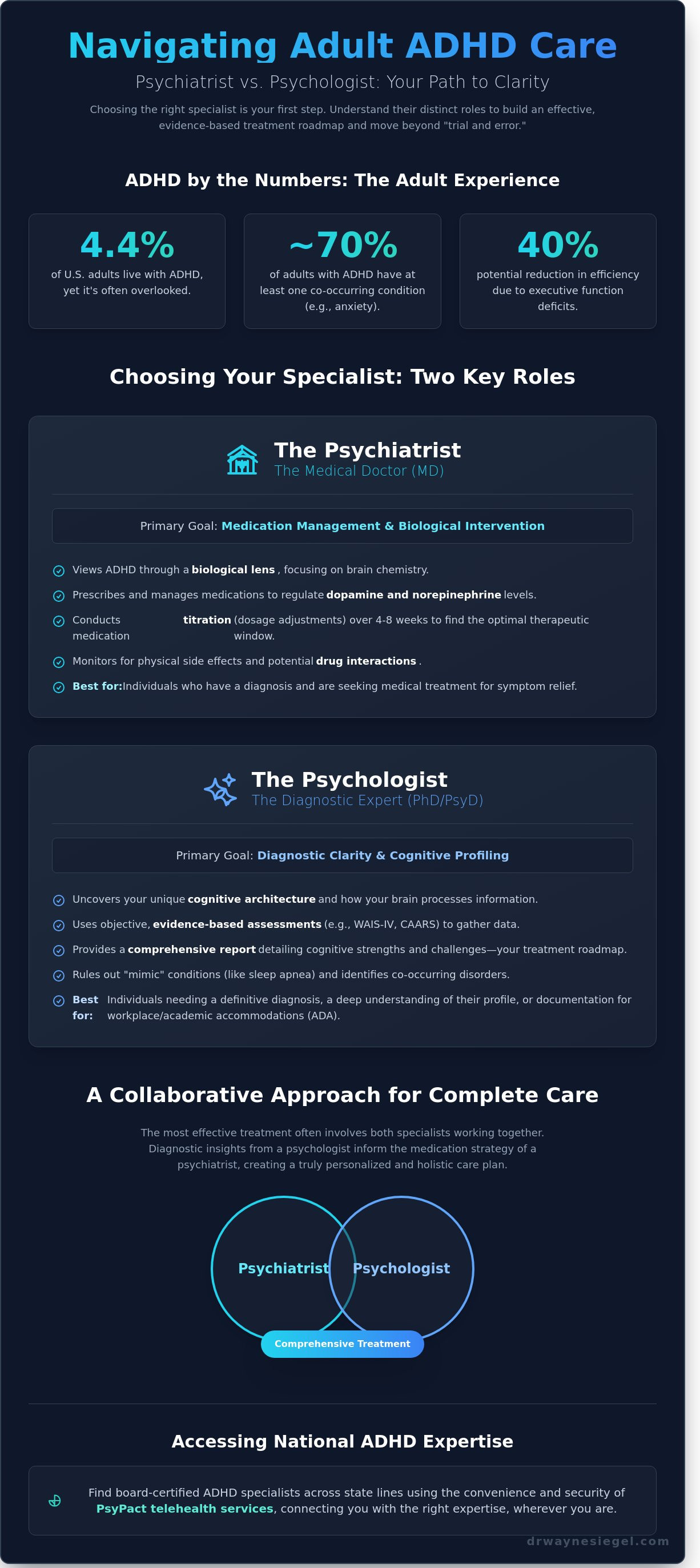
I often see patients who feel confused about which professional path to take when seeking answers. The choice between an adhd adults psychiatrist and a clinical psychologist depends entirely on whether you need immediate medical intervention or a deep understanding of your cognitive architecture. Psychiatrists are medical doctors (MDs) who view ADHD through a biological lens. They focus on the chemical mechanics of the brain. Clinical psychologists, typically holding a PhD or PsyD, specialize in the administration and interpretation of standardized psychological tests to measure how your brain processes information in real-time.
While a psychiatrist often relies on clinical interviews and self-reported symptoms to reach a conclusion, a psychologist uses objective data to confirm a diagnosis. This distinction is vital for those who want to move beyond a simple label. I find that a collaborative approach often yields the best results, but your starting point should align with your primary goal: symptom management or diagnostic clarity.
The Prescriptive Role of the Psychiatrist
Their work centers on neurotransmitter regulation, specifically targeting dopamine and norepinephrine levels. If you've already received a clear diagnosis and seek relief through medication, an adhd adults psychiatrist is your primary partner. They manage the titration process, which involves adjusting dosages over a period of 4 to 8 weeks to find your specific therapeutic window. This medical oversight is necessary for monitoring physical side effects, such as changes in heart rate or blood pressure, and ensuring there are no dangerous drug interactions.
The Diagnostic Role of the Psychologist
I believe that a diagnosis should be a roadmap, not just a category. Psychologists conduct deep-dive assessments into executive functioning and cognitive processing. We use evidence-based tools like the WAIS-IV or the Conners’ Adult ADHD Rating Scales to gather data that a standard interview might miss. This process is essential because 60% to 80% of adults with ADHD have at least one co-occurring condition, such as anxiety or a specific learning disability. A psychologist provides a comprehensive report that serves as a permanent medical record of your cognitive profile, which is often required for workplace accommodations.
Choosing between these paths is a personal decision. If you require a detailed neuropsychological evaluation to gain total clarity on your strengths and weaknesses, starting with a psychologist is the most effective route. If you're looking for a direct path to pharmacological relief, a psychiatrist will be your best resource.
The Evidence-Based ADHD Assessment Process
A definitive diagnosis is much more than a checked box on a symptoms list. In my practice, I treat the assessment as a rigorous scientific investigation into your cognitive architecture. We move beyond self-reports to gather objective data through four to six clinical hours of direct evaluation. This time allows us to look past surface-level behaviors to see the underlying mechanics of your brain. I compare your performance against age-normed data sets to ensure that we aren't just identifying personality traits, but rather statistical deviations that indicate a neurodivergent profile. This precision is why many patients choose a psychologist for the initial diagnostic heavy lifting before visiting an adhd adults psychiatrist for medication management.
The result of this process is a comprehensive report that functions as a roadmap for your future. We don't just provide a label; we provide clarity. This document details your unique cognitive profile, highlighting both the hurdles you face and the natural strengths you can leverage. It's a foundational piece of evidence that justifies specific workplace accommodations or therapeutic interventions.
Clinical Interview and Developmental History
I begin by looking backward to move forward. The DSM-5-TR requires that several ADHD symptoms be present before age 12. We'll explore your childhood academic records and social experiences to establish this timeline. I also analyze current functional impairments in at least two major life domains, such as your professional performance and your primary relationships. To gain a 360-degree view, I often request collateral information from a partner or family member. This helps us distinguish ADHD from other conditions that mimic its symptoms, such as chronic anxiety or sleep apnea.
Standardized Psychological Testing
Objective testing removes the guesswork from the diagnostic process. I utilize a battery of tests to measure specific executive functions, including:
- Working Memory: Your ability to hold and manipulate information in real-time.
- Processing Speed: The rate at which your brain absorbs and responds to new data.
- Sustained Attention: Your capacity to maintain focus on repetitive or low-stimulation tasks.
These tests also help identify co-occurring learning disabilities, which affect approximately 45% of adults with ADHD. I always include validity scales within these assessments. These scales ensure the data is accurate and reflects your genuine cognitive effort, providing a level of certainty that protects the integrity of your diagnosis. This evidence-based approach ensures that when you eventually consult an adhd adults psychiatrist, you're arriving with a clear, data-backed understanding of your needs.
Why Diagnostic Clarity is Your Treatment Roadmap
A diagnosis provides more than a clinical label; it serves as a precise blueprint for your future. I find that many patients arrive at my office after years of "trial and error" with various medications that didn't quite work as expected. Data from a 2018 study in The Lancet Psychiatry suggests that 2.8% of adults live with ADHD, yet many remain untreated or mistreated because their clinical picture lacks detail. When you consult an adhd adults psychiatrist for medication, that prescription is only as effective as the diagnostic data supporting it. A comprehensive evaluation identifies your unique cognitive profile, allowing us to leverage your inherent strengths instead of just cataloging your deficits.
This process also serves a vital emotional function. For the 30% of adults who aren't diagnosed until adulthood, the clarity of a formal assessment often dissolves decades of accumulated shame. It shifts the narrative from a character flaw to a neurobiological reality. We move away from asking why you can't "just do it" and start looking at how your brain actually processes information. This shift is the first step toward a person-centered care plan that values your individual experience.
Addressing Comorbidity and Misdiagnosis
Research in the Journal of Clinical Psychiatry indicates that 80% of adults with ADHD have at least one comorbid condition. I frequently see ADHD misidentified as Bipolar Disorder or Generalized Anxiety Disorder. My role as a psychologist is to peel back these layers to find the primary cause. If we treat anxiety when the root is actually executive dysfunction, the struggle persists. We focus on the "why" to ensure your treatment hits the right target from day one.
Integrating CBT and ACT into Your Journey
Evidence based practices like Cognitive Behavioral Therapy (CBT) are essential for managing executive function deficits. A 2010 study by Safren et al. proved that CBT significantly improves symptoms for adults already using medication. I also integrate Acceptance and Commitment Therapy (ACT) to help you navigate the emotional weight of your diagnosis. This dual approach ensures your care plan prioritizes your specific quality of life goals. You can schedule a consultation to begin your diagnostic journey today and find the clarity you deserve.
Accessing National ADHD Expertise via PsyPact
Your search for a diagnostic specialist shouldn't be restricted by your local map. Finding a local adhd adults psychiatrist with an open schedule is often difficult; however, PsyPact expands your options to include specialized psychologists nationwide. Historically, patients were limited to providers within driving distance, which often meant long waitlists or settling for generalists. Today, the Psychology Interjurisdictional Compact, known as PsyPact, is a regulated framework that allows board-certified psychologists to practice telehealth across state lines in over 40 participating states. This legal agreement ensures that you can access high-level expertise from the comfort of your own home.
I utilize this secure framework to offer national-level assessments that maintain the highest clinical standards. While an adhd adults psychiatrist typically manages the pharmacological side of treatment, my work focuses on the psychological and neuropsychological "why" behind your symptoms. Research published in 2021 confirms that remote neuropsychological evaluations, when conducted with standardized digital tools, provide the same diagnostic accuracy as traditional in-office visits. You receive a rigorous, evidence-based profile without the stress of travel. This process is about moving beyond mere labels to find actionable meaning.
The Benefits of National Telehealth Assessments
Choosing a national specialist provides advantages that local clinics might lack. You aren't just finding a provider; you're finding the right fit for your specific cognitive profile. Key benefits include:
- Specialized Expertise: Access to board-certified psychologists who specialize specifically in adult ADHD and executive functioning rather than general mental health.
- Clinical Comfort: Completing several hours of clinical interviews and testing from a familiar environment often leads to more authentic results and lower anxiety.
- Continuity of Care: If you travel for work or relocate to another PsyPact state, your diagnostic journey and follow-up care continue without interruption.
Next Steps Toward Clarity
Starting the process is straightforward. We begin with an initial consultation to discuss your history and determine if a full evaluation is the right path for you. To prepare, gather any past academic records or previous mental health evaluations. These documents provide a historical roadmap that strengthens the diagnostic picture. You don't have to live with the uncertainty of focus or productivity challenges. Gain the clarity you deserve with a professional assessment from Siegel Psychology Services and take the first step toward an empowered life.
Your Roadmap to Diagnostic Clarity
Choosing the right path for your mental health is a significant decision that impacts your daily quality of life. While an adhd adults psychiatrist typically focuses on the physiological aspects of treatment and medication management, a board-certified clinical psychologist provides the objective data needed for an accurate diagnosis. I've dedicated over 25 years to conducting evidence-based neuropsychological assessments that identify your specific strengths and executive functioning gaps. This process transforms vague struggles into a clear, actionable plan for your future.
My approach combines rigorous scientific standards with a person-centered focus. Through PsyPact, I provide these specialized telehealth services to patients across more than 40 states, ensuring geographical barriers don't prevent you from accessing expert care. We'll look past simple labels to understand how your brain functions in the real world. You're not just a set of symptoms; you're a person looking for answers, and I'm here to help you find them with precision and empathy.
Take the first step toward understanding your cognitive profile today. Schedule Your National ADHD Assessment with Dr. Siegel and gain the insight you need to move forward with confidence.
Frequently Asked Questions
Can a psychiatrist diagnose ADHD in adults without testing?
Yes, a psychiatrist can provide a diagnosis through a clinical interview, though 70% of clinicians recommend supplemental objective testing to ensure accuracy. While they rely on the DSM-5-TR criteria to identify persistent patterns, a brief 30 minute consultation often lacks the depth of a full neuropsychological battery. I believe a thorough look at your executive functioning provides the roadmap you need for effective treatment.
What is the main difference between a psychologist and a psychiatrist for ADHD?
The primary difference is that a psychiatrist is a medical doctor who focuses on medication management, while a psychologist specializes in comprehensive diagnostic testing and behavioral therapy. When looking for an adhd adults psychiatrist, you'll find they often manage the biological side of care. In contrast, psychologists spend 4 to 6 hours conducting standardized assessments to uncover your specific cognitive profile. This partnership ensures both your brain chemistry and your daily habits receive professional attention.
Do I need a formal assessment to get ADHD medication?
Most medical providers require a formal assessment before prescribing Schedule II stimulants like Adderall or Ritalin. Because these medications carry a high potential for misuse, 85% of clinics mandate a documented diagnosis to meet federal safety guidelines. A formal report gives your physician the data they need to proceed with confidence. It transforms a suspicion into a clear, clinical directive for your care.
How long does a comprehensive adult ADHD evaluation take?
A comprehensive adult ADHD evaluation typically takes between 4 and 8 hours to complete. This time is split between clinical interviews, objective cognitive tests, and self-report scales. We don't just look at attention; we examine memory, processing speed, and emotional regulation. This deliberate pace ensures we don't miss co-occurring conditions like anxiety or depression, which affect 50% of adults with ADHD.
Can ADHD be accurately diagnosed through telehealth?
Yes, research published in the Journal of Attention Disorders in 2021 confirms that telehealth assessments are as reliable as in-person evaluations. We use secure, HIPAA-compliant platforms to conduct interviews and digital testing modules. While the setting is different, the diagnostic rigor remains the same. This 100% digital approach removes travel barriers, making it easier for you to access the clarity you deserve from your own home.
Will my insurance cover an ADHD assessment by a psychologist?
Most commercial insurance plans cover 60% to 80% of the cost if the assessment is deemed medically necessary. You'll need to check if your policy includes CPT codes 96132 and 96133 for neuropsychological testing. I recommend calling your carrier to confirm your out-of-network benefits or deductible status. Understanding your coverage early helps us focus on your journey without financial surprises.
What happens if the assessment shows I do not have ADHD?
If the results don't meet ADHD criteria, we pivot to identify the actual source of your struggles. Approximately 30% of our evaluations reveal that symptoms are actually caused by sleep apnea, chronic stress, or mood disorders. My goal isn't just to give you a label; it's to provide an accurate roadmap. You'll leave with a clear explanation of your cognitive strengths and a plan to address your specific challenges.
Is a psychologist’s diagnosis accepted for workplace accommodations?
Yes, a psychologist's diagnostic report is a legally recognized document for requesting accommodations under the Americans with Disabilities Act of 1990. Employers and universities use these 15 to 20 page reports to implement specific supports, such as quiet workspaces or extended deadlines. This formal documentation provides the objective evidence needed to protect your rights. It's a powerful tool that helps you advocate for a more supportive professional environment.