
Choosing a Clinic for Psychology: A Comprehensive Resource Guide for 2026

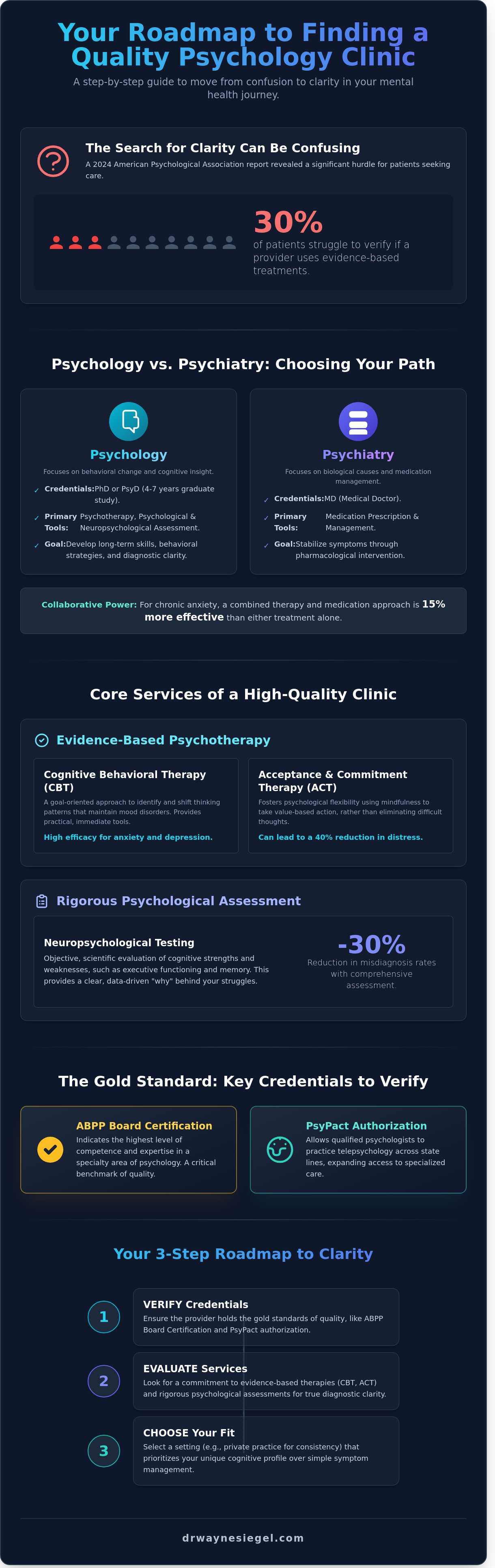
Did you know that a 2024 report from the American Psychological Association revealed that over 30% of patients struggle to verify if their provider actually uses evidence-based treatments? It's a common frustration. I've seen how this lack of clarity creates unnecessary barriers for those seeking a clinic for psychology. You deserve a clear path forward, grounded in the latest clinical research rather than guesswork. You're likely looking for a professional who can translate complex symptoms into a manageable plan for your life, and that starts with finding the right environment for care.
In this guide, I'll provide you with the exact tools you need to select a clinic that prioritizes your long-term well-being through rigorous, data-driven assessment. We'll walk through the specific steps to verify board certifications, clarify the distinct roles of mental health professionals, and demystify the 2026 standards for psychological testing. By the end of this article, you'll have a reliable roadmap to move from confusion to the clarity you need. My goal is to help you feel secure in your choices as we identify a solution that fits your unique cognitive profile.
Key Takeaways
- Understand the critical distinction between therapy-focused clinics and medication-based practices to ensure you receive the specific diagnostic clarity you need.
- Learn how to identify a high-quality clinic for psychology by evaluating their commitment to evidence-based treatments and rigorous psychological assessments.
- Compare the university training model with the seasoned expertise of private practice to determine which setting best supports your long-term consistency of care.
- Discover the professional benchmarks of quality, including ABPP Board Certification and PsyPact, that safeguard your journey toward mental health clarity.
- Explore a structured roadmap for your care that prioritizes your unique cognitive profile and personal strengths over simple symptom management.
What Is a Clinic for Psychology? Defining the Modern Standard
I often meet people who feel overwhelmed by the sheer number of mental health options available. A clinic for psychology isn't just an office; it's a structured, professional environment where we prioritize evidence-based diagnostic clarity. Unlike a solo practitioner's room, a clinic implies a higher level of professional oversight and a commitment to standardized care. Data from the American Psychological Association in 2024 suggests that integrated care models lead to a 20% improvement in patient outcomes compared to fragmented services. We've moved away from "talk therapy" in isolation toward a model that treats the whole person through rigorous science and empathy.
The Scope of Psychological Practice
My work focuses on providing a roadmap for your mental health. This includes individual psychotherapy for conditions like Major Depressive Disorder or PTSD, but it also extends to deep-dive assessments. Understanding What is Clinical Psychology? helps clarify that our field is rooted in both science and practice. We use neuropsychological testing to measure executive functioning and memory. These aren't guesses; they're objective data points. A 2023 study published in the Journal of Clinical Psychiatry found that comprehensive assessments reduce misdiagnosis rates by 30%. This professional setting ensures your journey is grounded in facts rather than assumptions.
- Individual Psychotherapy: Targeted treatment for anxiety, depression, and trauma.
- Neuropsychological Assessments: Scientific evaluation of cognitive strengths and weaknesses.
- Diagnostic Clarity: Identifying the "why" behind your struggles to create a precise plan.
Psychology vs. Psychiatry: Which Do You Need?
The primary difference lies in training and treatment tools. I hold a PhD or PsyD, which involves 4 to 7 years of graduate study focused on human behavior, statistics, and therapy. Psychiatrists are medical doctors (MDs) who specialize in the biological causes of mental illness and primarily manage medications. If you need a cognitive profile or a roadmap for behavioral change, you start at a clinic for psychology. We don't work in silos. Most modern clinics collaborate with your primary physician or psychiatrist to ensure your treatment plan is cohesive. Research from the National Institute of Mental Health suggests that a combination of therapy and medication management is 15% more effective for chronic anxiety than either treatment alone.
Choosing a clinic for psychology means you're looking for insight and long-term skill building. It's about finding a steady, non-judgmental guide who can navigate complex cognitive landscapes with you. This structured approach helps lower the barrier of anxiety, turning a clinical service into a personal partnership for your well-being.
Core Services: From Evidence-Based Therapy to Psychological Assessment
When you search for a professional clinic for psychology, you're looking for more than a listening ear; you're seeking a practice rooted in evidence-based care. I define evidence-based practice as the rigorous integration of the best available research with clinical expertise and your unique personal values. It's a three-legged stool where the science of what works meets the reality of your lived experience. This approach ensures that your treatment plan isn't based on guesswork, but on methods proven to produce measurable results.
Evidence-Based Psychotherapy Modalities
Cognitive Behavioral Therapy (CBT) is a cornerstone of modern treatment. It's a goal-oriented approach where we work together to identify and shift the specific thinking patterns that maintain mood disorders. A 2012 meta-analysis of 269 studies published in Cognitive Therapy and Research confirmed CBT’s high efficacy for anxiety and depression. It's about practical tools you can use immediately.
Acceptance and Commitment Therapy (ACT) offers a different path by fostering psychological flexibility. Instead of trying to eliminate difficult thoughts, ACT uses mindfulness to help you stay present and take action based on your core values. Research indicates that ACT can lead to a 40% reduction in psychological distress for individuals facing chronic health challenges or PTSD. When choosing a licensed psychologist, it’s vital to ask which of these research-backed frameworks they utilize to ensure your time in therapy is effective.
Comprehensive Psychological Testing
Formal diagnostic evaluations are necessary for complex conditions that a standard interview might miss. For example, adult ADHD is often misunderstood. While roughly 4.4% of adults in the U.S. live with ADHD, many go undiagnosed because their symptoms are masked by high intelligence or anxiety. A thorough assessment at a clinic for psychology moves beyond surface-level checklists to examine your specific executive functioning and cognitive profile.
The clinical hour is only the beginning. For every hour we spend together in testing, I spend several additional hours scoring and interpreting complex data. This meticulous process allows me to see the "why" behind your challenges. We'll look at memory, processing speed, and emotional regulation to build a complete picture of your strengths. If you're seeking clarity through a personal partnership, this data-driven roadmap is the first step toward lasting change.
Training Clinics vs. Private Practices: Evaluating Your Options
Deciding on the right clinic for psychology involves a clear look at two primary models: the university training center and the specialized private practice. I've found that patients often feel torn between affordability and the need for high-level expertise. Both paths offer distinct advantages depending on your specific diagnostic needs and financial situation. My goal is to help you find the clarity you need to make an informed choice for your long-term well-being.
The Training Clinic Model
These clinics operate within doctoral programs where graduate students provide care under the direct supervision of licensed faculty. It's a model rooted in the latest academic research. You'll often find lower costs here; many university clinics utilize sliding scales that start as low as $20 per hour. However, these clinicians typically rotate out every 12 to 24 months as they complete their degrees. This can disrupt the continuity of care for those seeking long-term support. They're excellent for general anxiety or mild depression, but they might lack the depth needed for rare neurological conditions or complex diagnostic puzzles.
The Specialized Private Practice
In a private setting, you're working with seasoned professionals who have often spent 10 to 15 years honing a specific niche. This is where you find board-certified experts who provide a stable, long-term therapeutic relationship. While hourly fees are higher, often ranging from $150 to $350, the precision of the work can lead to faster results. These practices specialize in complex evidence-based therapy approaches like CBT, specialized ADHD assessments, and neuropsychological evaluations. I believe the consistency of seeing the same doctor for years creates a safety net that's hard to replicate in a high-turnover environment.
Clinical supervision remains the gold standard in both settings. In 2024, the American Psychological Association emphasized that rigorous peer consultation is vital for preventing clinician burnout and ensuring diagnostic accuracy. Whether you choose a trainee or a veteran, ensure they're part of a system that values ongoing oversight and professional growth. Choosing a clinic for psychology requires balancing these practicalities with your personal comfort level. I often tell my patients that the best choice is the one where they feel heard, safe, and supported by a clear roadmap for their future.
- Training Clinics: Best for budget-conscious individuals and general mental health maintenance.
- Private Practices: Best for complex diagnostics, specific neurological concerns, and those valuing long-term clinician stability.
Identifying Quality: Credentials, Board Certification, and PsyPact
Finding the right clinic for psychology requires more than a search for proximity; it requires a commitment to clinical excellence. I believe you deserve a clinician whose expertise is verified by rigorous, objective standards. You should start your search by visiting the official state board of psychology website to ensure a provider's license is active. This step confirms the practitioner met the minimum 3,000 to 4,000 hours of supervised experience required for licensure in most states. It also reveals if any disciplinary actions exist. This is your baseline for safety and professional ethics.
The Gold Standard: Board Certification (ABPP)
Board certification through the American Board of Professional Psychology (ABPP) represents the highest level of specialty validation in our field. While all psychologists must be licensed to practice, only about 4% of practitioners nationwide earn this distinction. The process isn't a simple fee; it requires a comprehensive peer review of actual work samples and a rigorous oral examination by three senior specialists. When you choose a board-certified specialist, you're selecting someone who has demonstrated mastery through external, expert scrutiny. It serves as the most reliable marker that your provider adheres to the highest evidence-based standards.
Navigating Online Therapy with PsyPact
I often see patients who struggle to find local experts for specific cognitive or emotional concerns. The Psychology Interjurisdictional Compact, known as PsyPact, solves this by allowing psychologists to practice telepsychology across state lines legally. As of late 2024, 42 states and the District of Columbia have joined this compact. You can verify a provider's authority to practice by checking for an active E.Passport through the Association of State and Provincial Psychology Boards. This framework ensures you can access a specialist who fits your needs perfectly, even if they're located hundreds of miles away. It removes the geographical barriers to high-quality care.
Quality care doesn't stop at initial graduation or licensure. I maintain my expertise by completing at least 40 hours of continuing education every two years, focusing on the latest peer-reviewed research in neuropsychology. When evaluating a clinic for psychology, I recommend asking if their staff participates in regular peer supervision. Clinicians who consult with colleagues on complex cases provide more objective and precise care. This ongoing commitment to learning ensures your roadmap to clarity is built on the most current scientific data available.
If you're looking for a roadmap to better cognitive health, explore my neuropsychological evaluation services to see how specialized credentials impact your diagnostic clarity.
Your Roadmap to Clarity with Siegel Psychology Services
Finding a clinic for psychology involves more than just a search result; it's about finding a partnership grounded in evidence. I've dedicated over 25 years to refining a practice that balances board-certified expertise with a person-centered touch. My work focuses on the intersection of Cognitive Behavioral Therapy (CBT), Acceptance and Commitment Therapy (ACT), and trauma-informed care, ensuring every treatment plan is backed by peer-reviewed research. I utilize secure telehealth platforms to bridge the gap between world-class assessment and your home, providing a level of care that's both meticulous and convenient for clients nationwide.
I believe every person deserves to understand the "why" behind their cognitive and emotional patterns. My approach isn't about applying generic labels; it's about uncovering the specific mechanisms that influence your behavior. We focus on four core pillars:
- Clinical Integrity: 25 years of board-certified experience informs every session.
- Evidence-Based Care: We use CBT and ACT protocols that are proven to work.
- National Accessibility: Telehealth services allow me to help you, no matter where you live.
- Actionable Insight: We move beyond diagnosis to find real-world solutions.
Personalized Diagnostic Evaluations
Each evaluation I conduct is a deep dive into your unique cognitive profile. When we examine executive functioning or ADHD, we aren't just checking boxes on a form. We're using validated scientific instruments to build a comprehensive picture of how you process information. The result is a formal report, often exceeding 15 pages, which functions as a data-driven guide for your daily life. These reports bridge the gap between clinical data and human experience, providing a balance of rigorous science and compassionate insight that helps you manage work, school, and relationships more effectively.
Next Steps: Securing Professional Consultation
Whether you're seeking a personal diagnosis or professional clinical supervision, the path forward starts with a single conversation. I provide a steady, non-judgmental environment where we can examine your cognitive or emotional landscape together. This process is designed to lower the anxiety often associated with neuropsychological testing by providing a clear, predictable structure. You don't have to navigate these complexities alone. You can schedule a consultation for therapy or assessment today to begin the process of finding your own clarity and a more functional future.
Finding Your Path to Clinical Clarity
Choosing the right clinic for psychology requires a focus on credentialing and evidence-based methodologies. You now have the tools to distinguish between training facilities and established private practices while identifying quality markers like ABPP certification and PsyPact accessibility. These metrics provide a reliable framework for your mental health journey in 2026. My practice is built on these exact standards of excellence.
Since 1996, I've maintained Board Certification in Clinical Psychology (ABPP) to ensure my patients receive care grounded in rigorous, peer-reviewed standards. I specialize in Cognitive Behavioral Therapy (CBT) and Acceptance and Commitment Therapy (ACT) to help you move beyond symptoms toward a functional, meaningful life. Through my status as a national telehealth provider via PsyPact, I offer this specialized expertise to patients across the country. We'll work together to create a precise roadmap that addresses your unique cognitive and emotional profile. Begin your journey toward clinical clarity with Dr. Wayne Siegel. You don't have to navigate these complexities alone; professional insight is ready when you are.
Frequently Asked Questions
What should I look for when choosing a clinic for psychology?
You should prioritize providers who hold a doctoral degree, such as a Ph.D. or Psy.D., from an APA-accredited program. I recommend verifying that the facility uses outcome tracking tools like the PHQ-9 or GAD-7 to measure your progress every 4 to 6 weeks. A quality clinic provides a clear roadmap for your care, ensuring that treatment goals are specific and measurable rather than vague or open-ended.
Is a psychology clinic the same as a psychiatrist office?
No, these facilities serve distinct roles in your mental healthcare journey. A psychology clinic focuses on behavioral interventions, cognitive testing, and psychotherapy; it's typically staffed by doctoral-level psychologists. In contrast, a psychiatrist's office is led by a medical doctor who primarily manages mental health through pharmacology. While psychologists spend 45 to 60 minutes in therapy sessions, psychiatric visits often last 15 to 30 minutes for medication adjustments.
How do I know if a psychologist is board-certified?
You can verify board certification through the American Board of Professional Psychology (ABPP) online directory. Currently, only about 4% of licensed psychologists in the United States have earned this specific credential, which requires rigorous peer review and examinations beyond initial licensure. I maintain this certification to ensure my patients receive care that meets the highest national standards for clinical excellence and ethical practice.
Can I get a psychological assessment online through a clinic?
Yes, many clinics now offer tele-neuropsychology services for specific diagnostic needs. Research published in the Journal of Clinical and Experimental Neuropsychology shows that remote cognitive testing yields results comparable to in-person evaluations for 85% of standard assessments. We use secure, HIPAA-compliant platforms to conduct these sessions, though some manual dexterity tests still require a physical presence to ensure 100% data accuracy.
What are evidence-based practices in a psychology clinic?
Evidence-based practices are therapeutic interventions validated through randomized controlled trials and peer-reviewed research. In a modern clinic for psychology, this includes treatments like Cognitive Behavioral Therapy (CBT) or Acceptance and Commitment Therapy (ACT). These methods aren't based on guesswork; they rely on clinical data that proves their effectiveness, such as a 50% reduction in symptom severity within 12 to 20 sessions.
Does a psychology clinic provide medication management?
Most psychology clinics don't prescribe medication, as psychologists are trained in behavioral and cognitive interventions rather than medicine. However, five U.S. states currently allow psychologists with advanced psychopharmacology training to prescribe. In most cases, I collaborate directly with your primary care physician or a psychiatrist to coordinate your care, ensuring your behavioral therapy and daily prescriptions work together effectively.
What happens during a diagnostic psychological evaluation?
A diagnostic evaluation begins with a 60-minute clinical interview followed by several hours of standardized testing. We measure specific functions like memory, attention, and executive processing using tools like the WAIS-IV. I then analyze this data to create a comprehensive report. This process provides a clear roadmap, moving you from a place of uncertainty to a structured plan with 3 to 5 actionable recommendations for your daily life.
How does PsyPact work for out-of-state therapy?
PsyPact is an interstate compact that allows licensed psychologists to practice tele-psychology across state lines in 42 participating states as of 2024. This agreement ensures that you can maintain continuity of care even if you travel or move to another member state. It removes the legal barriers that previously limited access to specialists, allowing me to provide consistent support to patients regardless of their physical location within the compact.