
Dealing with Constant Worry and Dread: An Evidence-Based Guide to Finding Relief

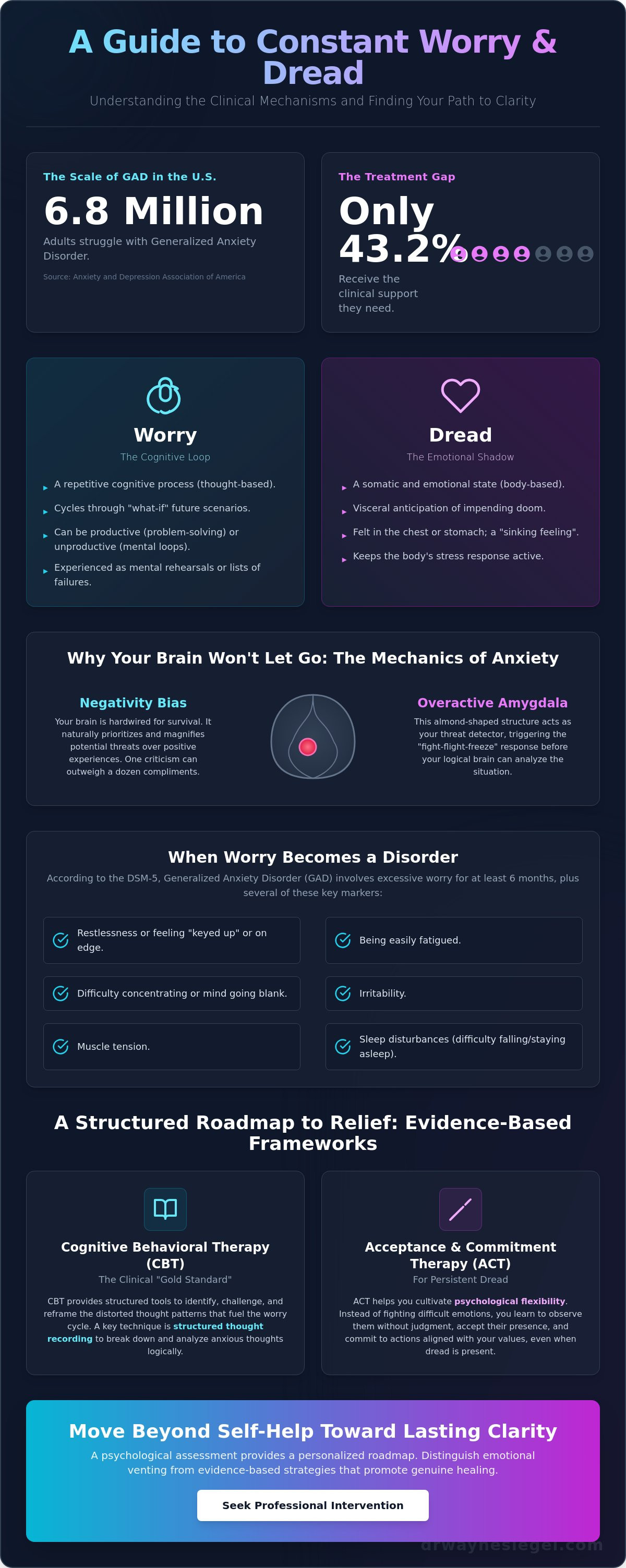
Did you know that according to the Anxiety and Depression Association of America, 6.8 million adults in the United States struggle with Generalized Anxiety Disorder, yet only 43.2 percent receive the clinical support they need? If you've spent your nights mentally rehearsing every possible "worst case" scenario, you know that dealing with constant worry and dread isn't just a mental habit. It's an exhausting physical experience that can leave your muscles tight and your sleep patterns fractured. It's easy to feel paralyzed when the future feels like a puzzle you can't stop trying to solve.
I want to offer you a clearer perspective grounded in neuropsychological research. You'll learn the specific clinical mechanisms that keep your brain stuck in these loops and discover how evidence-based frameworks like Cognitive Behavioral Therapy and Acceptance and Commitment Therapy provide a roadmap to stability. We'll examine the biological "why" behind your anxiety and provide actionable tools to help you decide if professional intervention is the right next step for your journey toward clarity.
Key Takeaways
- Understand the neurobiological roots of the "negativity bias" to gain insight into why your brain prioritizes perceived threats over your sense of safety.
- Learn how to apply the clinical "gold standard" of Cognitive Behavioral Therapy to begin dealing with constant worry and dread through structured thought recording.
- Discover how to cultivate psychological flexibility using Acceptance and Commitment Therapy (ACT) to adapt to difficult emotions rather than being overwhelmed by them.
- Identify the specific clinical markers that signal when specialized intervention is necessary to move beyond self-help and toward lasting psychological clarity.
- Establish a structured roadmap for relief by distinguishing between simple emotional venting and the evidence-based clinical strategies that promote genuine healing.
Understanding the Spectrum of Constant Worry and Dread
I often meet individuals who describe their daily experience as a heavy, invisible weight. Dealing with constant worry and dread isn't just about feeling stressed; it's a specific cognitive and physiological state that requires a precise understanding. Worry is primarily a repetitive cognitive process. It lives in your thoughts, cycling through potential future threats and "what-if" scenarios. Dread is different. It's a somatic and emotional state. You feel it in your chest or stomach as a visceral anticipation of impending doom. I often tell my patients that dread is the emotional shadow cast by future uncertainty.
Psychological research distinguishes between productive and unproductive worry. Productive worry acts as a catalyst for problem-solving. It identifies a risk and moves you toward a concrete action. Unproductive worry, however, is a mental loop that offers no resolution. It drains your executive functioning and keeps your nervous system in a state of perpetual alarm without providing a path to safety. Understanding which type you're experiencing is the first step toward regaining control.
Worry vs. Dread: Identifying Your Cognitive Profile
I find that most people lean toward one side of this spectrum. Worry is verbal and thought-based. You might find yourself mentally rehearsing arguments or listing every possible failure at work. Dread is felt in the body. It's the "sinking feeling" that persists even when things are going well. This is often fueled by anticipatory anxiety, a state where the brain stays on high alert for a threat that hasn't arrived. This cycle keeps your body's stress response active, making it nearly impossible to feel truly relaxed or present in the moment.
When Persistent Worry Requires a Diagnostic Lens
There's a distinct line between the common stress of a busy life and a clinical condition. According to the DSM-5, Generalized Anxiety Disorder (GAD) involves excessive anxiety and worry occurring more days than not for at least six months. This condition is often accompanied by specific physical and cognitive symptoms:
- Restlessness or feeling keyed up or on edge.
- Being easily fatigued.
- Difficulty concentrating or your mind going blank.
- Irritability.
- Muscle tension.
- Sleep disturbances, such as difficulty falling or staying asleep.
I want to challenge the "high-functioning" myth. Many people I see are highly successful professionals who meet every obligation while dealing with constant worry and dread behind the scenes. Success doesn't mean you aren't suffering. Seeking a psychological assessment near me is the gold standard for moving past vague labels. It provides a roadmap to clinical clarity, helping us understand your unique cognitive profile so we can build a personalized path toward lasting relief.
The Mechanics of Anxiety: Why Your Brain Won’t Let Go
Your brain is wired for survival, not necessarily for your happiness. This is driven by the "negativity bias," an evolutionary trait where our ancestors prioritized potential threats over safety to stay alive. In a modern context, this means your brain is naturally more attuned to a single criticism than a dozen compliments. When you find yourself dealing with constant worry and dread, it is often because your amygdala is overactive. This almond-shaped structure initiates the "fight-flight-freeze" response instantly. It doesn't wait for a logical analysis; it reacts to perceived danger by preparing your body for a crisis that may not actually exist.
A significant factor in why this cycle continues is the "worry as protection" myth. Your brain often mistakenly believes that by ruminating on a problem, you're somehow preventing it from happening or preparing for the worst. This creates a false sense of control. However, according to data from the Anxiety Disorders - WHO report, these persistent patterns affect roughly 301 million people worldwide. This cycle is reinforced by an "intolerance of uncertainty," where the mind treats any unknown future event as a guaranteed negative outcome. Instead of seeing a blank space in the future, the anxious brain fills it with a threat.
The Biological Threat Detection System
When dread takes hold, your HPA (hypothalamic-pituitary-adrenal) axis kicks into gear, releasing a surge of cortisol. This is what creates that heavy, sinking "pit in the stomach" feeling. Chronic worry keeps your nervous system in a state of hyper-vigilance, where you're always waiting for the other shoe to drop. It's a taxing biological process because the brain cannot distinguish between a physical predator and a financial deadline. Both trigger the same chemical cascade, leaving you physically exhausted and mentally drained. Finding a path forward often starts with gaining clinical clarity through a structured assessment.
Cognitive Distortions: The Fuel for Future Dread
Dread is rarely based on what's happening right now; it's fueled by "mental filters" that distort your perception of reality. These distortions make dealing with constant worry and dread feel like an inescapable loop. Two primary patterns include:
- Catastrophizing: This is the habit of jumping to the absolute worst-case scenario. If you make a small mistake at work, your mind immediately predicts you'll be fired and lose your home.
- Fortune Telling: You act as if a negative future outcome is already a settled fact. You don't just fear things might go wrong; you're convinced they already have.
These cognitive habits prevent you from seeing evidence of safety or success. By recognizing these distortions as biological and cognitive glitches rather than objective truths, you can begin to lower the volume on the internal alarm system that keeps you stuck in a state of high alert.
Cognitive Behavioral Therapy (CBT) Strategies for Daily Relief
Cognitive Behavioral Therapy (CBT) is the evidence-based gold standard for managing chronic anxiety. Clinical meta-analyses, such as those published in Cognitive Therapy and Research, consistently show that CBT techniques lead to significant symptom reduction for approximately 60% to 75% of individuals. When you're dealing with constant worry and dread, I focus on a structured, four-step approach to help you reclaim your mental bandwidth and improve your executive functioning.
- Step 1: Thought Recording. We identify the specific trigger and the automatic negative thought that follows.
- Step 2: Socratic Questioning. We evaluate the evidence for and against your worry to find a more objective perspective.
- Step 3: Worry Postponement. We schedule specific times to address concerns, preventing all-day rumination.
- Step 4: Behavioral Experiments. We test your fears in small, controlled environments to gather real-world data.
Challenging Unproductive Thoughts
I often guide patients through a framework that separates a thought's validity from its utility. We ask: "Is this thought true?" and "Is this thought helpful?" Even if a worry feels plausible, it's often not productive for your daily quality of life. To ground this process, I recommend using an Evidence Table. You list objective facts supporting the worry in one column and facts contradicting it in another. This data-driven approach allows us to replace catastrophic "what-ifs" with balanced, realistic alternatives that provide much-needed clarity.
Implementing a "Worry Window"
Dealing with constant worry and dread often feels like a full-time job. To break this cycle, we set a 15-minute "Worry Window" each day, perhaps at 4:30 PM. During the rest of your morning and afternoon, you "park" intrusive thoughts in a notebook or phone app to be addressed only during that scheduled time. This technique relies on habituation. By the time your window arrives, the physiological urgency of the thought has usually faded. This practice provides a roadmap for regaining control, showing your brain that you can choose when to engage with your anxieties rather than being at their mercy.
By treating these thoughts as data points rather than absolute truths, you can begin to dismantle the cycle of chronic dread. It's about moving from a state of reactive fear to one of proactive management. This shift doesn't happen overnight, but with consistent practice, these tools provide the structural support needed for a more stable emotional landscape.
Acceptance and Commitment Therapy (ACT) for Persistent Dread
I often see patients who spend immense energy trying to suppress their anxiety. Research published in the Journal of Contextual Behavioral Science indicates that experiential avoidance, the attempt to escape or suppress unpleasant thoughts, actually correlates with higher levels of psychological distress. When you're dealing with constant worry and dread, fighting these feelings usually amplifies them. Acceptance and Commitment Therapy (ACT) offers a different path. It focuses on psychological flexibility, which is the ability to stay in the present moment and adapt your behavior based on your long-term values rather than your immediate fears.
Expansion is the practice of making room for the physical sensations of dread without succumbing to panic. Instead of tensing against the "knot" in your stomach, you mentally breathe into it. This doesn't mean you like the feeling; it means you stop the secondary struggle against it. By observing the sensation as a neutral physical event, you reduce the physiological alarm that keeps the cycle of dread moving.
Defusing from Your Worries
Cognitive defusion helps you create space between yourself and your thoughts. Instead of treating a thought as an absolute truth, you view it as a transient mental event. I recommend the "labeling" technique. You change a statement like "I will fail" to "I am having the thought that I will fail." This subtle shift reduces the thought's power.
You can also use the "Passengers on the Bus" metaphor. Imagine your worries are noisy passengers. They can shout, but they don't have to drive the bus. Defusion isn't about changing the content of the thought; it's about changing how you relate to it.
Value-Aligned Action Amidst Uncertainty
Even when dread is present, you can choose to move toward what matters. This is called "Committed Action." A 2015 study in Behavior Modification showed that ACT participants experienced a 45% reduction in anxiety symptoms over a six-month period because the focus shifted from symptom reduction to life-functioning. You start by identifying core values such as integrity, growth, or family.
If family is a value, you might play with your children for 15 minutes even if you feel a sense of dread. Taking these small steps breaks the cycle of paralysis. Dealing with constant worry and dread becomes more manageable when your life is driven by purpose rather than the avoidance of discomfort.
Establishing a Roadmap to Clinical Clarity
Self-help strategies like mindfulness or journaling often provide a necessary foundation, yet they can reach a ceiling of effectiveness. When your efforts to manage anxiety feel like a full-time job without a paycheck, it's time to seek specialized support. Research from the National Institute of Mental Health indicates that nearly 19% of adults in the U.S. experience an anxiety disorder in a given year. For many, dealing with constant worry and dread requires more than general advice; it demands a structured, clinical roadmap grounded in data.
Clinical intervention differs significantly from "venting" to a friend or a general counselor. While talking helps, evidence-based care utilizes specific protocols such as Cognitive Behavioral Therapy (CBT) or Acceptance and Commitment Therapy (ACT) to target the biological and cognitive mechanisms of fear. As a board-certified psychologist, I provide a path that moves beyond temporary symptom management. We focus on measurable outcomes and functional improvements. For those living outside my immediate physical location, I offer interjurisdictional telehealth services across various PsyPact states, bringing clinical expertise directly to your home through a secure, regulated framework.
The Role of Professional Assessment
Clarity begins with an accurate diagnostic evaluation. Chronic anxiety doesn't exist in a vacuum. Often, what feels like dealing with constant worry and dread is actually a manifestation of underlying conditions. For example, 2023 longitudinal studies suggest that up to 50% of adults with ADHD also struggle with a comorbid anxiety disorder. Similarly, unresolved trauma can keep the nervous system in a state of permanent hyper-arousal. By choosing a clinic for psychology that prioritizes evidence-based assessment, you uncover the "why" behind your struggle. This data-driven approach ensures we treat the source, not just the shadow it casts on your daily life.
Beginning Your Partnership for Change
I view our work as a rigorous, scientifically grounded partnership. My approach is person-centered and future-oriented, focusing on your unique cognitive profile and personal strengths. Labels are never the destination; they're simply the coordinates we use to start the journey. You don't have to navigate this landscape alone. Clarity is possible, and a life defined by something other than worry is within reach. I invite you to reach out for a consultation today. Together, we can build a personalized roadmap that restores your sense of agency and improves your daily quality of life.
Moving Toward Your Roadmap for Relief
Navigating the persistent cycle of anxiety requires more than just willpower; it demands a structured approach rooted in proven science. We've explored how Cognitive Behavioral Therapy (CBT) and Acceptance and Commitment Therapy (ACT) provide the clinical framework necessary for relief. Research from the American Psychological Association confirms that these evidence-based protocols are the most effective tools for dealing with constant worry and dread. By understanding the mechanics of your brain's alarm system, you've already taken the first step toward regaining control. True relief comes from a personalized roadmap that addresses your unique cognitive profile.
As a Board-Certified Clinical Psychologist (ABPP) specializing in these protocols, I offer telehealth services across all 40+ PsyPact states to ensure access to high-level care. We'll work together to transform clinical data into a clear plan for your daily life. You don't have to carry this weight alone. I'm committed to helping you uncover the "why" behind your challenges and providing the tools to move forward with confidence.
Begin your journey toward clinical clarity with a consultation from Dr. Wayne Siegel.
There's a path forward, and I'm here to help you find it.
Frequently Asked Questions
Is it normal to feel a constant sense of dread for no reason?
While occasional worry is a universal human experience, a persistent sense of dread without a specific trigger often indicates an overactive nervous system or an underlying anxiety disorder. According to the Anxiety and Depression Association of America (ADAA), Generalized Anxiety Disorder affects 6.8 million adults in the United States. I often find that this "free-floating" anxiety stems from a sensitized amygdala that perceives threat where none exists. Understanding this neurological basis is the first step toward reclaiming your sense of safety.
How can I tell the difference between "normal" worry and an anxiety disorder?
The primary distinction lies in the intensity, duration, and level of impairment the worry causes in your daily life. "Normal" worry is typically tied to a specific event and resolves once the situation passes. In contrast, dealing with constant worry and dread that lasts for six months or more and interferes with work or relationships meets the diagnostic criteria for an anxiety disorder. Clinical assessments look for specific physical markers, such as muscle tension or sleep disturbances, to provide a clear roadmap for treatment.
What is the fastest way to calm a feeling of impending doom?
Physiological grounding techniques like the "5-4-3-2-1" method or paced breathing are the most effective ways to down-regulate the nervous system quickly. Research published in the journal Frontiers in Psychology in 2018 shows that controlled diaphragmatic breathing significantly reduces cortisol levels. By shifting your focus to tangible sensory inputs, you interrupt the feedback loop between your brain and your body. This provides immediate relief while we work on long-term cognitive strategies to manage your symptoms.
Can constant worry cause physical health problems over time?
Yes, chronic worry triggers a prolonged "fight or flight" response that can lead to significant systemic health issues. A 20-year longitudinal study published in The Lancet found that high levels of psychological distress are associated with a 20 percent increase in cardiovascular disease risk. Over time, elevated cortisol levels can weaken the immune system and disrupt digestive health. My goal is to help you mitigate these risks by addressing the cognitive roots of your stress through evidence-based interventions.
Does therapy really work for someone who has "always been a worrier"?
Evidence suggests that therapy is highly effective even for those with a lifelong predisposition toward anxiety. Meta-analyses of clinical trials indicate that Cognitive Behavioral Therapy (CBT) leads to significant improvement in 60 to 75 percent of patients with chronic worry. I view your history not as a fixed trait, but as a set of learned patterns that we can reshape together. Through targeted interventions, we can build new neural pathways that support resilience and long-term emotional stability.
What is the difference between CBT and ACT for treating dread?
Cognitive Behavioral Therapy (CBT) focuses on identifying and challenging distorted thought patterns to change your emotional response. In contrast, Acceptance and Commitment Therapy (ACT) emphasizes psychological flexibility and mindfulness. Instead of trying to eliminate the dread, ACT teaches you to observe it without judgment while taking actions aligned with your values. Both are evidence-based approaches, and I often integrate elements of both to create a personalized treatment plan that addresses your unique cognitive profile.
Should I see a psychologist or a psychiatrist for constant worry?
The choice depends on whether you're seeking talk therapy, psychological testing, or medication management. Psychologists hold doctoral degrees (PhD or PsyD) and specialize in evidence-based behavioral interventions and diagnostic assessments. Psychiatrists are medical doctors (MD) who primarily focus on the biological aspects of mental health and can prescribe medication. Many patients find the most success with a collaborative approach that utilizes both professional perspectives to ensure every facet of their well-being is addressed.
Can I get therapy for dread if I live in a different state?
You can access care across state lines if your provider is part of the Psychology Interjurisdictional Compact (PSYPACT). As of 2024, PSYPACT includes 40 states, allowing licensed psychologists to provide telepsychology services to patients in any participating jurisdiction. This legislation ensures that you receive high-quality, regulated care regardless of your physical location. It's a vital tool for maintaining continuity of care and expanding your access to specialized neuropsychological expertise from the comfort of your home.