
How to Stop an Anxiety Spiral: A Research-Based Guide to Regaining Clarity

Why does your brain's logical center seem to go offline exactly when you need it most? You're likely familiar with the physical toll: a heart rate that can spike toward 100 beats per minute and a sense of breathlessness that logic alone cannot quiet. It's frustrating when you've tried to reason with your fears, only to find yourself exhausted by mental loops. Understanding how to stop an anxiety spiral isn't about willpower; it's about understanding the neurobiology of your stress response. Clinical data indicates that during high-arousal states, the prefrontal cortex, which governs executive functioning, becomes significantly less active, making rational thought difficult.
I want to offer you a clearer roadmap toward stability. In this guide, I'll explain the clinical mechanisms behind these cognitive loops and provide evidence-based techniques to interrupt the cycle. You'll learn how to achieve an immediate reduction in physiological arousal and gain a cognitive framework to identify triggers before they escalate. We'll also discuss how to recognize when these patterns suggest it's time for a professional neuropsychological assessment to gain deeper insight into your unique cognitive profile and overall quality of life.
Key Takeaways
- Understand the neurobiological "feedback loop" to recognize why logic often fails during high arousal and how to regain control through physiological awareness.
- Compare the clinical applications of CBT and ACT to identify which evidence-based framework offers the best strategy for interrupting your specific pattern of catastrophic thinking.
- Master a practical, two-step roadmap on how to stop an anxiety spiral using immediate grounding techniques and paced respiration to trigger the parasympathetic nervous system.
- Learn to distinguish between situational anxiety and deeper patterns that may indicate a need for a professional diagnostic evaluation and a personalized path toward clarity.
- Gain the tools to transition from immediate crisis management to a long-term recovery plan focused on improving your overall quality of life and emotional stability.
Understanding the Anatomy of an Anxiety Spiral
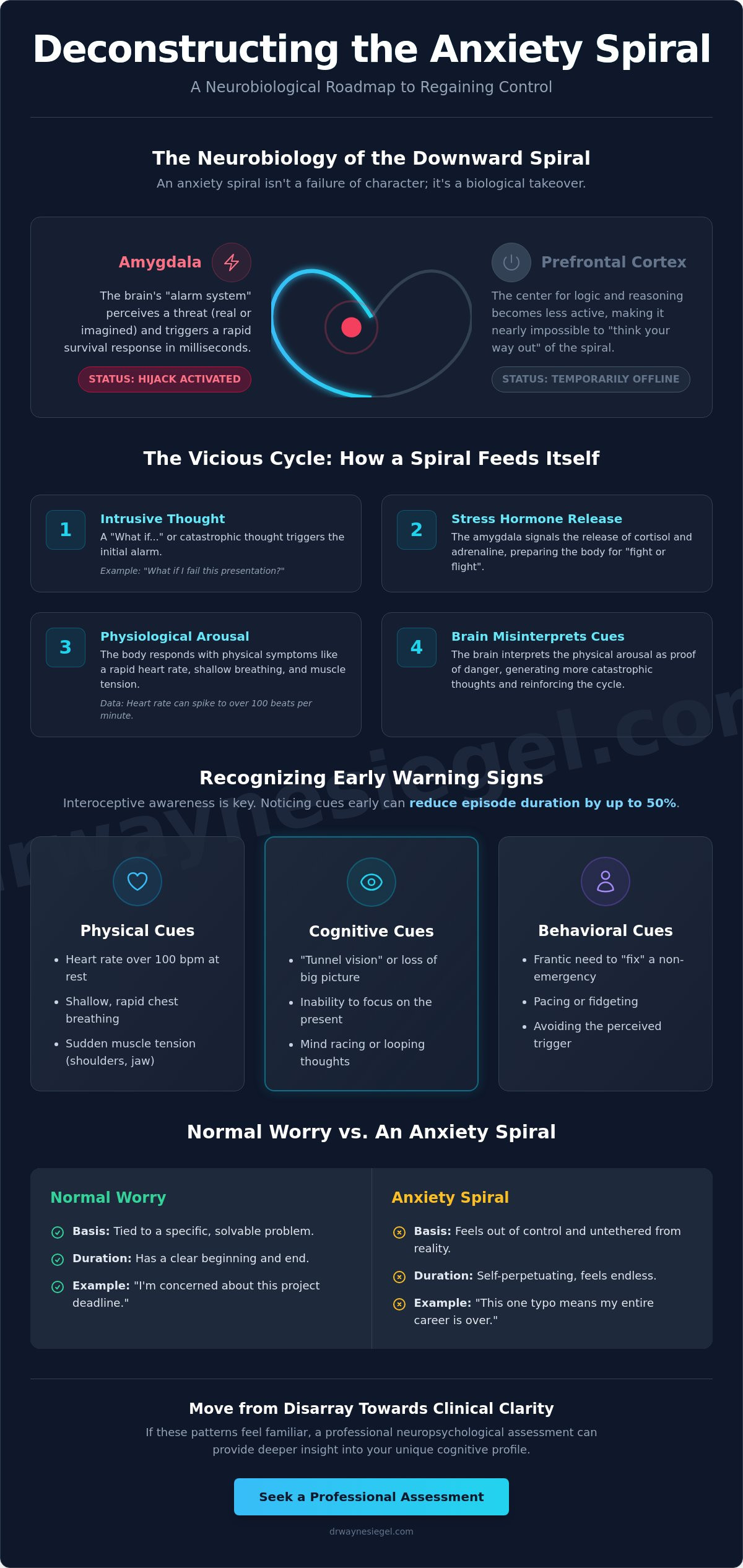
When you're caught in a spiral, it feels like your mind is an engine running at redline without a clutch. I define an anxiety spiral as a self-perpetuating cycle where catastrophic thoughts and physiological arousal feed into one another. It's a biological feedback loop. A single intrusive thought triggers a release of stress hormones like cortisol and adrenaline. Your heart rate increases. Your brain then interprets this physical change as proof of an actual threat, which generates even more frantic thoughts. This process can happen in seconds, leaving you feeling breathless and overwhelmed.
Distinguishing between normal worry and a clinical spiral is vital for your recovery. Normal worry is often tied to a specific, solvable problem. It has a beginning and an end. A spiral, however, feels out of control and untethered from reality. It's the difference between being concerned about a deadline and believing your entire career is over because of a single typo. This guide provides a roadmap to help you move from emotional disarray toward clinical clarity. Learning how to stop an anxiety spiral begins with deconstructing these automatic, high-speed processes.
The Role of Catastrophic Thinking
Catastrophizing is a common cognitive distortion where the brain treats a hypothetical negative outcome as an inevitable disaster. This "What If" mechanism is actually an evolutionary attempt to solve future problems by obsessing over them. However, it often leads to thinking traps like overgeneralization or jumping to conclusions. These patterns are often deep-seated; they're a primary focus during a psychological assessment near me. Identifying these traps allows us to build a more accurate cognitive profile and find actionable solutions.
Recognizing Early Warning Signs
Early intervention is the most effective way to manage your mental health. You can't easily redirect a train that's already reached top speed. I encourage my patients to develop interoceptive awareness. This is the ability to sense internal bodily signals before they escalate. Research suggests that noticing these cues early can reduce the duration of an anxiety episode by up to 50 percent.
- Physical cues: A heart rate exceeding 100 beats per minute at rest, shallow chest breathing, or sudden muscle tension in the shoulders.
- Cognitive cues: The onset of "tunnel vision" where you lose the ability to focus on the present moment or see the bigger picture.
- Behavioral cues: An urgent, frantic need to "fix" a situation that isn't actually an emergency.
Noticing these signs before the spiral reaches peak intensity is a core skill. It's the first step in mastering how to stop an anxiety spiral before it consumes your day. By identifying the physical "tell," you can apply grounding techniques while your logical brain is still accessible.
The Neurobiology of the Downward Spiral: Why Logic Fails
When you're learning how to stop an anxiety spiral, it's vital to understand the brain's internal alarm system. I often explain to my patients that an anxiety spiral isn't a failure of character; it's a biological takeover known as an "amygdala hijack." The amygdala is a small, almond-shaped structure in the limbic system that identifies perceived threats. When it detects a stressor, it triggers a cascade of neurochemical changes in milliseconds, long before your conscious mind can evaluate the situation. This rapid response is designed for survival, but it becomes a hindrance when the threat is a racing thought rather than a physical danger.
While the amygdala is screaming, the prefrontal cortex essentially goes offline. This is the area of the brain responsible for executive functioning, impulse control, and logical reasoning. I see this as a temporary power outage in your brain's command center. Because this region is inhibited, you can't simply reason your way out of a panic state while your brain is convinced you're in immediate peril. The sympathetic nervous system coordinates this response by accelerating your heart rate and dilating your pupils to prepare your body for a fight-or-flight encounter during a thought loop. This is why we must address the body's physical state before we can hope to regain mental clarity. Attempting to solve a complex life problem while your heart is racing at 100 beats per minute is like trying to repair a car engine while the vehicle is hurtling down a highway at 70 miles per hour.
The Cortisol and Adrenaline Surge
During a spiral, your adrenal glands release a surge of cortisol and adrenaline. These hormones prioritize immediate survival over analytical thought, which clouds your judgment. Research indicates that elevated cortisol levels can temporarily impair the hippocampus, the region responsible for providing context to our memories. This creates a physiological loop where your racing heart signals to your brain that you're in danger, which then triggers the release of even more stress hormones. Expecting yourself to "just calm down" during this chemical surge is a neurobiological impossibility. You need specific, sensory-based interventions to break this cycle and lower your physiological baseline.
Why Traditional Logic Doesn’t Work in a Crisis
Most of our daily thinking is "top-down," where the brain's higher centers manage our emotions. In a crisis, the system flips to "bottom-up" processing, where the brain ignores evidence of safety because the amygdala is overactive. Learning to avoid catastrophic thinking requires us to shift our focus from abstract "what ifs" to concrete sensory data. By using grounding techniques that engage your sight, touch, or hearing, you signal to the brain that your immediate environment is secure. Gaining this kind of insight into your cognitive profile is the first step toward building a personalized roadmap for lasting emotional stability and understanding how to stop an anxiety spiral before it takes hold.
Evidence-Based Strategies: Comparing CBT and ACT Approaches
When you are caught in a cycle of worry, the most effective tools come from clinical frameworks that prioritize data over distress. I frequently use Cognitive Behavioral Therapy (CBT) and Acceptance and Commitment Therapy (ACT) to help patients understand how to stop an anxiety spiral before it becomes overwhelming. Both methods are grounded in decades of peer-reviewed research and form the backbone of modern ptsd counseling. While they use different mechanisms, their shared goal is to provide you with a reliable roadmap back to stability. Clinical psychologists utilize these approaches to treat a wide range of anxiety disorders, ensuring that the care you receive is both rigorous and compassionate.
CBT: Challenging the Validity of the Spiral
CBT operates on the principle that our thoughts, rather than external events, create our emotional distress. To break a spiral, I often guide patients through cognitive restructuring. This process involves looking at the spiral through a factual lens using the "Evidence For and Against" technique. If your mind is racing with the thought that a mistake at work will lead to immediate termination, we list the objective data. We look at your past performance reviews, company policies, and recent feedback. This helps move the focus from a perceived threat to a grounded reality.
The goal of CBT is to change the content of your thoughts to reduce their emotional impact. The American Medical Association notes that stopping catastrophic thoughts often requires identifying these cognitive distortions before they gain momentum. By intentionally replacing a phrase like "I am in danger" with "I am experiencing an uncomfortable sensation," you strip the spiral of its power. You aren't just thinking positively; you're thinking accurately.
ACT: Defusion and Radical Acceptance
While CBT focuses on changing the thought, ACT focuses on changing your relationship with the thought. This is achieved through "thought defusion." Instead of accepting a thought as an absolute truth, you create distance. You practice saying, "I am having the thought that I am failing," rather than "I am failing." This simple linguistic shift helps you realize that thoughts are merely passing mental events, not necessarily facts. It is a vital skill when learning how to stop an anxiety spiral that feels deeply personal.
ACT also introduces the concept of "Expansion." This means making room for the anxiety instead of fighting it. Research into the "pink elephant" effect suggests that the harder you try to suppress a thought, the more frequently it recurs. Fighting a spiral often makes it spin faster because the struggle itself creates more physiological arousal. By practicing radical acceptance, you allow the sensation of anxiety to exist without giving it the authority to dictate your actions. This approach helps you stay present and focused on your values, even when your internal environment feels chaotic.
A Step-by-Step Roadmap to Interrupting a Spiral in Real-Time
Learning how to stop an anxiety spiral requires a shift from abstract worry to concrete, physiological intervention. When the brain's alarm system is overactive, logic often fails because the prefrontal cortex has effectively gone offline. I guide my patients through a structured, five-step roadmap designed to re-establish safety in the body before attempting to settle the mind.
- Step 1: Immediate Physiological Grounding. Use the 5-4-3-2-1 technique. Identify five things you see, four you can touch, three you hear, two you smell, and one you can taste. This forces the brain to process external data rather than internal threats.
- Step 2: Paced Respiration. Shift your focus entirely to the exhale. Breathe in for four seconds and out for six. This specific ratio stimulates the vagus nerve, which signals the parasympathetic nervous system to lower your heart rate.
- Step 3: Labeling the Experience. Explicitly state, "I am experiencing an anxiety spiral, and it is temporary." Research in affect labeling shows that putting feelings into words reduces activity in the amygdala.
- Step 4: Cognitive Defusion. Instead of "I am failing," try "I am having the thought that I am failing." This creates the distance necessary to observe the thought without being consumed by it.
- Step 5: Value-Based Action. Complete one small, physical task. Fold a single towel or organize a desk drawer. This restores a sense of agency and breaks the cycle of paralysis.
Sensory Grounding Techniques
The fastest way to re-engage the prefrontal cortex is through intense sensory input. One of the most effective biological "reset" buttons is the Mammalian Dive Reflex. Splashing ice-cold water on your face for 30 seconds can trigger an immediate 10% to 25% reduction in heart rate. This physiological shift moves the body out of a sympathetic "fight or flight" state and into a calmer baseline. Additionally, proprioceptive input, such as pushing your palms firmly against a wall or wearing a weighted vest, provides the brain with "heavy work" data. This feedback helps the nervous system locate the body in physical space, which provides a grounding effect when thoughts feel untethered.
Shifting from "What If" to "What Is"
When your mind is trapped in future-oriented "what if" scenarios, you must narrow your focus to the "Radius of Control." This involves identifying exactly what you can influence in the next ten minutes. If you're spiraling about a project due next month, your radius of control is limited to opening the document or making a single phone call today. Everything else is a future uncertainty that cannot be solved in the present moment. Ending the spiral requires a gentle return to daily functioning. Don't wait to feel "perfect" before moving on; instead, choose to walk into the next room and engage with a physical object. This transition helps you regain the clarity needed to navigate your day with intention.
If you find that these spirals are becoming a recurring obstacle in your life, gaining a deeper understanding of your cognitive profile can help. Contact my office to schedule a comprehensive evaluation and find your roadmap to clarity.
Moving Beyond the Spiral: Long-Term Recovery and Professional Support
Occasional stress is a normal part of the human experience. However, when you find yourself repeatedly searching for how to stop an anxiety spiral, it often indicates an underlying pattern rather than an isolated event. My goal is to help you move beyond temporary fixes toward a sustainable sense of clarity. While immediate grounding techniques provide relief, long-term recovery requires a deeper understanding of your unique cognitive profile.
When to Seek a Comprehensive Assessment
Understanding the "why" behind your cognitive and emotional experiences is the first step toward lasting change. I often see patients who feel overwhelmed by their thoughts, only to discover through a formal diagnostic evaluation that their struggles stem from undiagnosed ADHD, Generalized Anxiety Disorder (GAD), or complex trauma. Identifying these specific drivers allows us to move beyond symptoms and address the root cause of the distress. A clear diagnosis provides the roadmap necessary for effective, targeted treatment.
- Identifying the Root: Determining if executive functioning deficits or sensory processing issues are fueling the spiral.
- Clinical Precision: Seeing a board-certified clinical psychologist ensures that your assessment is grounded in rigorous science rather than guesswork.
- Actionable Meaning: Moving from a list of symptoms to a structured plan that improves your daily quality of life.
Accessing this level of specialized care is more accessible than it used to be. For those outside my immediate physical location, I utilize the framework of psypact states to provide high-quality telehealth services. This interjurisdictional agreement currently allows patients in over 40 participating states to access board-certified care. This ensures that your location doesn't prevent you from receiving a meticulous neuropsychological evaluation.
Building a Resilient Mental Framework
Long-term recovery isn't about the complete elimination of anxious thoughts. Instead, it's about building a resilient mental framework using evidence-based practices like Cognitive Behavioral Therapy (CBT) or Acceptance and Commitment Therapy (ACT). Research from the American Psychological Association indicates that these modalities are highly effective for managing chronic anxiety. They help you develop the skills to navigate difficult emotions without being consumed by them.
I believe that every individual has the capacity for growth when they have the right data and support. You don't have to navigate this journey to clarity alone. By shifting your focus from "eliminating anxiety" to "mastering the skills of navigation," you gain a sense of agency over your mental health. A structured approach, backed by clinical expertise, transforms a confusing cycle into a clear path forward. If you're wondering how to stop an anxiety spiral for good, the answer lies in combining immediate coping tools with a professional, evidence-based strategy for the future.
Moving Toward Cognitive Clarity
Regaining control when your thoughts begin to race requires more than just willpower; it demands a shift in your neurobiological response. By applying evidence-based frameworks like Cognitive Behavioral Therapy (CBT) and Acceptance and Commitment Therapy (ACT), you can effectively interrupt the physiological feedback loops that drive distress. You've learned that understanding how to stop an anxiety spiral involves grounding yourself in the present moment and using structured tools to bypass the amygdala's alarm system. These research-backed strategies provide a reliable roadmap for moving from chaotic overwhelm to a state of calm, objective insight.
I've served as a board-certified clinical psychologist since 1996, helping individuals navigate complex emotional landscapes through rigorous, science-based care. If you're ready to move beyond temporary fixes and build a long-term foundation for mental well-being, I'm here to help. Whether you need a comprehensive psychological assessment or targeted individual therapy, we can work together to map out your recovery. My practice provides telehealth services across all PsyPact-participating states, ensuring you have access to specialized expertise regardless of your location. If you are seeking clarity and a research-based roadmap for your mental health, contact Dr. Wayne Siegel today to discuss a comprehensive psychological assessment or individual therapy. You don't have to navigate this journey alone; professional support is a proven step toward the stability you deserve.
Frequently Asked Questions
How can I tell if I am having a panic attack or an anxiety spiral?
A panic attack is a sudden, intense surge of fear that typically peaks within 10 minutes, while an anxiety spiral is a prolonged cycle of repetitive, catastrophic thoughts. Panic attacks often involve acute physical symptoms like heart palpitations or shortness of breath. Research published in the Journal of Affective Disorders indicates that 13.2 percent of the global population experiences panic attacks. Spirals are characterized by cognitive rumination that can last for hours or days.
Does deep breathing actually work to stop a thought spiral?
Deep breathing is a physiologically proven method to stop an anxiety spiral by stimulating the vagus nerve to trigger the parasympathetic nervous system. A 2017 study in Frontiers in Psychology showed that participants who practiced diaphragmatic breathing for 20 sessions had significantly lower cortisol levels. By slowing your breath to approximately 6 breaths per minute, you signal to your brain that you're safe. This shift reduces the fight or flight response and restores executive functioning.
Can an anxiety spiral be a sign of adult ADHD?
An anxiety spiral can frequently be a secondary symptom of adult ADHD due to challenges with executive functioning and emotional regulation. According to the Journal of Clinical Psychiatry, roughly 47 percent of adults with ADHD also have a co-occurring anxiety disorder. When your brain struggles to filter stimuli or organize thoughts, it's easy to feel overwhelmed by a mental traffic jam. This often leads to a cycle of worry about unfinished tasks or social interactions.
What is the "5-4-3-2-1" grounding technique and why does it work?
The 5-4-3-2-1 technique is a grounding exercise that forces the brain to shift from internal distress to external sensory input. You identify 5 things you see, 4 you can touch, 3 you hear, 2 you smell, and 1 you can taste. This works because it engages the prefrontal cortex, the area responsible for logical thinking. By focusing on these specific sensory categories, you disrupt the neural pathways dedicated to rumination and bring your awareness back to the present.
Why do my anxiety spirals always happen at night or when I am alone?
Anxiety spirals often occur at night because the lack of external distractions allows the brain's Default Mode Network to become hyperactive. Without tasks to focus on, the mind naturally turns inward to process unresolved stressors. Research from the Sleep Foundation indicates that 50 percent of adults with anxiety experience increased symptoms during the evening hours. When you're alone, you lack the social feedback loops that typically help regulate your emotions and provide a reality check for catastrophic thoughts.
When should I see a professional for my racing thoughts?
You should seek professional help if your racing thoughts interfere with your daily quality of life for more than 2 weeks. If you find that you can't complete work tasks or maintain relationships due to cognitive distress, it's time for an evaluation. The American Psychological Association suggests that early intervention leads to better long term outcomes. I often tell my patients that seeking clarity through a formal assessment is a proactive step toward reclaiming their mental roadmap.
Is it possible to permanently stop anxiety spirals from happening?
While you may not permanently eliminate the capacity for anxiety, you can learn how to stop an anxiety spiral before it gains momentum through cognitive behavioral strategies. Research suggests that 60 percent of individuals show significant improvement after 12 to 16 weeks of targeted therapy. The goal is to build a robust toolkit of coping mechanisms that shorten the duration and intensity of these episodes. Over time, your brain develops new neural pathways that favor resilience.
How does a psychological evaluation help with chronic anxiety?
A neuropsychological evaluation provides a comprehensive roadmap by identifying the specific cognitive profiles and underlying causes of your chronic anxiety. Instead of guessing, I use standardized tests to measure executive functioning, memory, and emotional processing. This data allows me to create a personalized plan that addresses your unique challenges. By understanding the why behind your struggles, you gain the clarity needed to move forward with confidence and effective, evidence based solutions that improve your daily life.