
How to Calm a Hypervigilant Nervous System: A Research-Based Guide

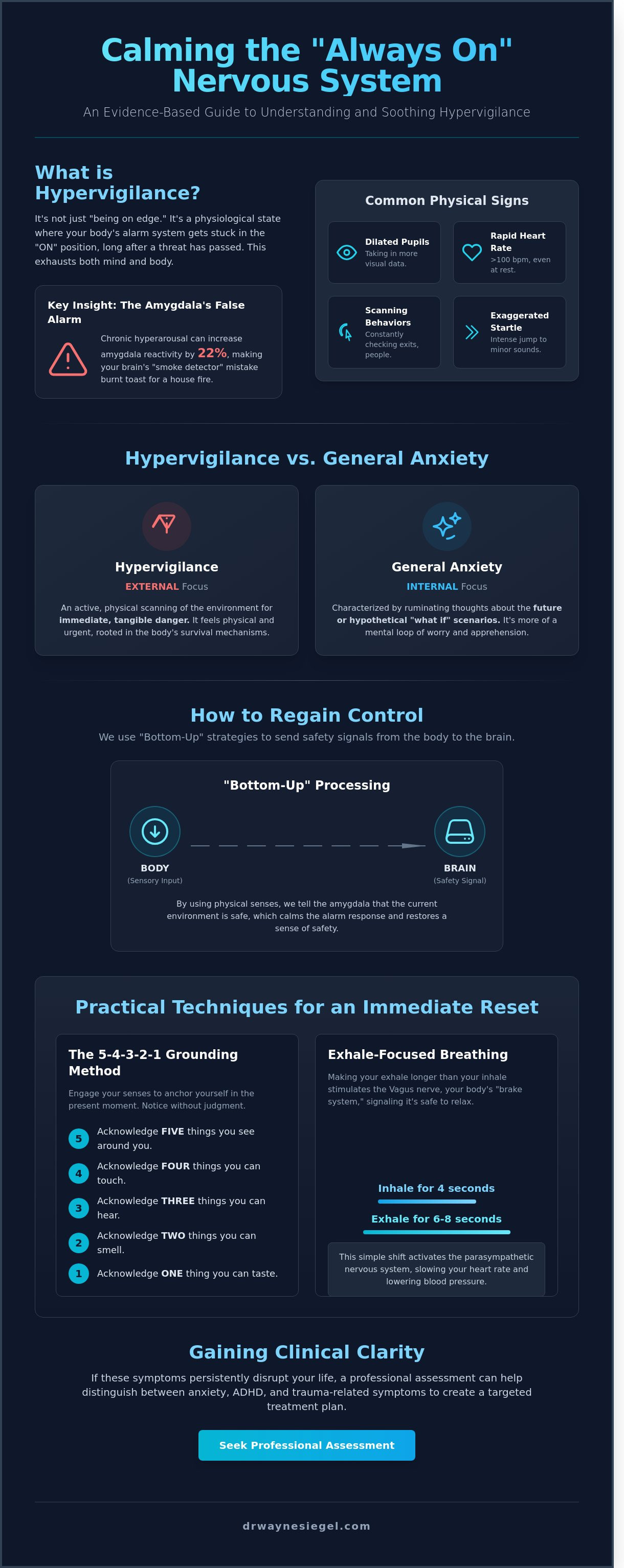
What if the exhaustion you feel isn't a lack of willpower, but your brain's inability to recognize that the threat has passed? You likely feel "always on," scanning every conversation for a hidden slight or every email for a looming crisis. This state of constant alert is more than just stress; research published in the Journal of Neuroscience indicates that chronic hyperarousal can increase amygdala reactivity by 22%, keeping your body trapped in a loop of perceived danger. If you're ready to break this cycle, it's essential to understand how to calm a hypervigilant nervous system through precise, evidence-based interventions.
I've spent my career as a neuropsychologist helping people move from this state of physiological static to one of profound clarity. I promise to provide you with actionable tools grounded in polyvagal theory that help reset your internal alarm and restore your sense of safety. We'll explore the biological "why" behind your exhaustion and outline a specific roadmap to help you regain focus and decide if professional diagnostic support is your next best step.
Key Takeaways
- Gain insight into the neurobiology of chronic alertness and the subconscious process of neuroception that keeps your body in a state of constant bracing.
- Discover how to calm a hypervigilant nervous system using evidence-based "bottom-up" strategies that prioritize physical safety to quiet the brain’s alarm response.
- Master practical, sensory-based techniques like the 5-4-3-2-1 method and exhale-focused breathing for an immediate physiological reset during times of high stress.
- Understand the critical distinction between adaptive vigilance and maladaptive hypervigilance to better navigate your journey toward emotional stability.
- Learn when to seek a comprehensive psychological assessment to gain the clinical clarity necessary for distinguishing between anxiety, ADHD, and trauma-related symptoms.
What is Hypervigilance? Understanding the "Always On" Nervous System
Hypervigilance isn't just a feeling of being on edge; it's a physiological state of increased sensory sensitivity and high alertness. To understand What is Hypervigilance?, we must view it as the body's attempt to provide protection. In a genuinely dangerous situation, this vigilance is adaptive. It keeps us safe by ensuring we're aware of every sound and movement. However, when this state persists long after the threat has passed, it becomes maladaptive. It leaves the nervous system stuck in an "always on" mode that exhausts both the mind and body.
When you're hypervigilant, your body remains in a state of high arousal. You might notice specific symptoms that indicate your sympathetic nervous system is working overtime:
- Dilated pupils: Your eyes naturally widen to take in more visual information from your surroundings.
- Rapid heart rate: Your heart may beat at over 100 beats per minute even while you're sitting still.
- Scanning behaviors: You find yourself constantly checking exits, watching people's hands, or monitoring noises in the hallway.
- Exaggerated startle response: A simple door closing or a phone ringing causes an intense physical jump.
I often see these symptoms in my practice when working with individuals who have experienced significant trauma. This persistent state is a core feature addressed in ptsd counseling. Recognizing these signs is the first step in learning how to calm a hypervigilant nervous system and regain a sense of clarity in your daily life.
The Amygdala and the False Alarm
Think of the amygdala as your brain's smoke detector. Its primary role is to sense danger and trigger a response. When someone experiences chronic stress or trauma, this detector becomes hypersensitive. It begins to sound the alarm at the smell of burnt toast rather than just a house fire. This lowered threshold for alarm activation keeps you outside your "window of tolerance." This term describes the zone where you can effectively manage emotions and respond to life's challenges. When you're hypervigilant, you're pushed into a state of hyper-arousal, making the world feel like a series of constant, immediate threats.
Hypervigilance vs. General Anxiety
The Neurobiology of Chronic Alertness: Why Your Body Stays Braced
The Sympathetic Nervous System (SNS) operates like an internal alarm system. When it detects a threat, it floods your system with adrenaline and cortisol. This "fight-flight-freeze" response is essential for survival, but it becomes problematic when the alarm remains stuck in the "on" position. This state is often driven by neuroception. Neuroception is a subconscious process where your nervous system scans the environment for danger long before your conscious mind realizes anything is wrong. Understanding this biological mechanism is the first step in learning how to calm a hypervigilant nervous system. The Cleveland Clinic explains hypervigilance as a heightened state of sensitivity that can be physically and mentally exhausting over time.
To counter this high-alert state, your body relies on the Vagus nerve. It acts as the "brake system" of the autonomic nervous system. About 80 percent of the Vagus nerve's fibers are sensory, which means they carry information from the body back to the brain. When this nerve is stimulated and active, it signals the brain that it's safe to rest, slowing your heart rate and lowering blood pressure. Without a strong "vagal brake," the body remains in a state of constant bracing.
The Cost of Allostatic Load
Allostatic load is the cumulative "wear and tear" that results from chronic stress. When cortisol levels remain elevated for long periods, it disrupts the body's natural equilibrium. This often manifests as specific physical symptoms that can feel unrelated to anxiety:
- Sleep disruption, especially difficulty staying asleep or waking up unrefreshed.
- Digestive issues, such as chronic bloating or irritable bowel symptoms.
- Persistent muscle tension, specifically in the jaw, neck, and shoulders.
"Chronic hypervigilance is not a character flaw, but a physiological adaptation to an environment that once lacked safety." If you're struggling to navigate these physical symptoms, gaining clarity through a professional evaluation can provide a structured roadmap for your recovery.
How the Brain Maps Threat
When you're in a state of high arousal, your brain's architecture shifts. The prefrontal cortex, which handles logic and reasoning, effectively goes "offline." At the same time, the hippocampus struggles to provide context to your experiences. This is why logic fails to calm a hypervigilant person in the moment of a trigger; the parts of the brain that process logic aren't fully engaged. Research indicates that the amygdala, the brain's emotional smoke detector, becomes the primary driver during these moments. You must establish physiological safety through the body before any cognitive work can begin. Learning how to calm a hypervigilant nervous system requires addressing these biological foundations rather than just trying to "think" your way out of the feeling.
Top-Down vs. Bottom-Up: Evidence-Based Frameworks for Regulation
Understanding how to calm a hypervigilant nervous system requires a dual approach that I often describe to my patients as working from the "basement up" or the "attic down." These two frameworks, bottom-up and top-down regulation, address different parts of your biology. Bottom-up strategies target the brainstem and limbic system first. They use the body to send a signal of safety to the brain. Top-down strategies, such as Cognitive Behavioral Therapy (CBT) or Acceptance and Commitment Therapy (ACT), use the prefrontal cortex to influence emotional states through logic and reasoning.
I've observed that when a system is stuck in high alarm, the prefrontal cortex effectively goes offline. You can't easily "think" your way out of a physiological panic. This is why a hypervigilant system usually requires bottom-up stabilization before top-down cognitive work becomes effective. If you're seeking a professional partner for this journey, choosing a clinic for psychology that offers integrated, evidence-based care is a critical step in building your personal roadmap to recovery.
Bottom-Up Somatic Regulation
Somatic regulation focuses on the autonomic nervous system. Grounding and proprioception, your body's ability to sense its location and movements, are essential here. When you're hypervigilant, your focus is often external, scanning for threats that aren't there. Sensory inputs can interrupt this state by forcing the brain to process immediate, safe physical data. For instance, cold water immersion can trigger the mammalian dive reflex. This biological response can lower a person's heart rate by 10% to 25% almost instantly. Other effective tools include:
- Weighted Blankets: These provide deep pressure stimulation, which research suggests can increase serotonin levels and lower cortisol.
- Proprioceptive Input: Activities like wall pushes or heavy carrying help "locate" the body in space, reducing the feeling of being untethered.
- Rhythmic Movement: Patterned activities like walking, drumming, or specific breathing cycles help reset the nervous system's internal clock.
Top-Down Cognitive Reframing
Once the body's alarm has been quieted, we can employ top-down tools to create lasting change. CBT is highly effective for identifying "cognitive distortions." These are biased ways of thinking, such as catastrophizing, where the mind automatically assumes the worst possible outcome for any situation. By labeling these thoughts, you regain a sense of agency over your internal narrative.
ACT introduces the concept of psychological flexibility. Instead of fighting against hypervigilant thoughts, you learn to observe them with a sense of detached curiosity. This prevents you from being consumed by the anxiety. The goal isn't to eliminate every fearful thought, but to ensure those thoughts don't dictate your actions. This structured approach helps you move beyond survival mode and back into a life aligned with your actual values.
How to Calm a Hypervigilant Nervous System: Practical, Research-Backed Strategies
When your body remains stuck in a state of high alert, you need a biological roadmap to return to baseline. I often help patients understand that learning how to calm a hypervigilant nervous system is not about "thinking positive." It's about using physiological overrides to signal safety to the brain stem. We can achieve this through a sequence of five evidence-based steps designed to interrupt the survival response.
The Science of the Long Exhale
The fastest way to communicate with your autonomic nervous system is through the breath. While a short, shallow inhale triggers the sympathetic "fight or flight" branch, a prolonged exhale stimulates the vagus nerve. I recommend a 4-8 breathing pattern: inhale for four seconds and exhale slowly for eight seconds. Research indicates that slow, controlled breathing at 5.5 breaths per minute optimizes heart rate variability and reduces sympathetic arousal. This specific rhythm shifts the body into a parasympathetic state, lowering blood pressure and heart rate within 120 seconds of consistent practice.
Orienting to the Present Moment
Hypervigilance often keeps your internal gaze fixed on potential threats. You can break this loop by physically orienting to your environment. I suggest the 5-4-3-2-1 technique to ground your senses. Identify five things you see, four you can touch, three you hear, two you smell, and one you can taste. This process forces the prefrontal cortex to come back online, effectively "fact-checking" the amygdala's alarm.
Looking at the horizon or the upper corners of a room also signals safety. Evolutionarily, a wide, panoramic view suggests no immediate predators are nearby. During this process, try to identify "glimmers." These are small moments of safety or micro-joys, such as the warmth of a sunbeam or the texture of a soft fabric. While triggers signal danger, glimmers signal 20% to 30% increases in felt safety, helping to recalibrate your internal alarm system.
- Vagus Nerve Stimulation: Splash your face with cold water (50-59°F) for 30 seconds. This triggers the "diving reflex," which immediately slows the heart rate.
- Cognitive Labeling: Use the phrase, "I am having a feeling of danger, but I am safe right now." Labeling an emotion reduces the intensity of the amygdala's response.
- Environmental Audit: Reduce sensory load by dimming lights or using noise-canceling headphones. A 2019 study showed that reducing ambient noise can lower cortisol levels in sensitive individuals.
Visualization is another pillar of evidence-based practice. I encourage patients to build a "safe place" mental image with high sensory detail. When you visualize a secure environment, your brain processes the imagined safety using the same neural pathways as real-world safety. This practice provides a reliable mental anchor when your external environment feels overwhelming.
If you find that your nervous system remains in a state of constant alarm despite these efforts, a professional evaluation can provide the clarity you need. Contact Dr. Wayne Siegel to begin your journey toward lasting neurological stability.
Gaining Clinical Clarity: When to Seek Professional Assessment
Self-regulation tools like deep breathing and grounding provide essential temporary relief, but they don't always address the underlying neurobiological patterns that keep you stuck. If you've tried various techniques and still find yourself in a state of high alert, it's time for a professional perspective. I find that many patients reach a plateau where self-help strategies no longer provide the progress they need. A comprehensive psychological assessment serves as a vital tool to move beyond guesswork. This process helps us distinguish whether your symptoms stem from PTSD, ADHD, or Generalized Anxiety Disorder. These conditions often share a significant overlap in presentation; for instance, clinical data suggests that nearly 30% of adults with ADHD also meet the criteria for an anxiety disorder. A board-certified psychologist uses this data to build a personalized roadmap. You can transition from a state of constant survival to one where you are truly thriving.
The Diagnostic Process
A trauma-informed clinical interview is the first step in our partnership. It's not just a conversation. It's a structured exploration of your history and current challenges. We use objective testing to gather data on your unique cognitive functioning. This removes the subjective bias that can sometimes cloud self-diagnosis. By developing a professional cognitive profile, we gain insight into how your brain processes stress and information. This clarity is essential for understanding how to calm a hypervigilant nervous system effectively. We look at executive functioning and emotional regulation to see exactly where the system is getting stuck. This roadmap isn't just about symptom reduction; it's about improving your daily quality of life through precision.
Evidence-Based Therapy Paths
Once we have a clear diagnosis, we apply gold-standard treatments. Cognitive Behavioral Therapy (CBT) and Acceptance and Commitment Therapy (ACT) are backed by decades of clinical research. These methods provide concrete tools to rewire the brain's response to perceived threats. When you understand the "why" behind your reactions, learning how to calm a hypervigilant nervous system becomes a structured, manageable process rather than a trial-and-error experiment. For those living in psypact states, access to this specialized care is available through secure telehealth. This interjurisdictional agreement allows you to work with experts across state lines, ensuring you get the specific care you need. Long-term healing is a realistic goal. You don't have to manage this alone. With the right evidence-based support, you can reclaim your sense of safety and focus.
Moving Toward Lasting Neurological Regulation
Living in a state of constant alertness is taxing on your cognitive function and physical health. It's exhausting to remain braced for threats that aren't there. Clinical research into the autonomic nervous system indicates that effective regulation requires a dual approach, addressing both physiological signals and cognitive reframing. When you understand how to calm a hypervigilant nervous system through evidence-based frameworks like Cognitive Behavioral Therapy (CBT) and Acceptance and Commitment Therapy (ACT), you move from reactive survival to intentional living. These tools provide a structured roadmap to help your brain distinguish between past trauma and present safety.
Gaining clarity on your specific neurobiological profile is the first step toward relief. As a board-certified clinical psychologist with over 25 years of experience, I focus on using proven, data-driven methods to help you find a sense of calm stability. I offer telehealth services across all PsyPact states to ensure you have access to expert care regardless of your location. Request a consultation with Dr. Wayne Siegel to gain clarity on your nervous system health. You don't have to navigate this journey alone; a clearer, more peaceful future is within your reach.
Frequently Asked Questions
Is hypervigilance a permanent condition?
No, hypervigilance isn't a permanent state because the brain possesses neuroplasticity. Research published in The Lancet Psychiatry indicates that evidence-based treatments like Cognitive Behavioral Therapy can reduce hyperarousal symptoms by 50% or more in patients with PTSD. Through consistent practice of regulation techniques, you can retrain your amygdala to distinguish between real threats and perceived ones. This process creates a roadmap for your nervous system to return to a state of baseline safety.
Can hypervigilance be a symptom of ADHD?
Yes, hypervigilance can manifest as a symptom of ADHD, particularly when sensory processing issues are present. A 2021 study in the Journal of Attention Disorders found that adults with ADHD often experience higher levels of sensory over-responsivity compared to neurotypical peers. This heightened awareness isn't always trauma-based; it's often a result of the brain's inability to filter out irrelevant stimuli. Understanding this cognitive profile helps me provide targeted strategies for your daily life.
How long does it take to reset a dysregulated nervous system?
The timeline for physiological change typically ranges from 8 to 12 weeks of consistent intervention. Data from Harvard University researchers shows that an 8-week Mindfulness-Based Stress Reduction program can lead to measurable increases in gray-matter density in the hippocampus. While you might feel immediate relief after a single session, long-term rewiring requires repetition to solidify new neural pathways. I focus on helping you build a sustainable roadmap that prioritizes steady progress.
What is the difference between hyperarousal and hypervigilance?
Hyperarousal is a physiological state of increased tension, while hypervigilance is the psychological behavior of scanning for threats. The DSM-5 classifies hyperarousal as a cluster of physical symptoms like an exaggerated startle response. Conversely, hypervigilance involves the cognitive process of being constantly on guard. Knowing how to calm a hypervigilant nervous system requires addressing both the physical tension and the mental scanning patterns through integrated clinical approaches. This distinction is vital for your journey.
Does caffeine make hypervigilance worse?
Yes, caffeine can exacerbate hypervigilance by stimulating the adrenal glands and increasing cortisol levels. Research indicates that doses as low as 200mg of caffeine can trigger jitteriness and increased heart rates in sensitive individuals. This physiological spike mimics the body's natural fight or flight response, making it harder for your brain to feel safe. If you're learning how to calm a hypervigilant nervous system, reducing stimulant intake is a practical step toward stabilizing your baseline arousal.
Can online therapy effectively treat hypervigilance?
Yes, online therapy is an effective medium for treating hypervigilance. A 2018 study in the Journal of Psychological Disorders found that internet-delivered CBT is as effective as face-to-face treatment for reducing symptoms. Telehealth provides safety for the 76% of patients who report feeling more relaxed at home, as they can engage in the therapeutic journey from their own environment. This comfort makes it easier to practice grounding techniques where triggers occur.
Is hypervigilance always caused by trauma?
No, hypervigilance isn't always the result of a single traumatic event. While it's a hallmark of PTSD, it can also stem from chronic high-stress environments or neurodevelopmental conditions like autism. For example, a 2019 report suggests that prolonged exposure to workplace stress can induce a state of burnout-related hypervigilance in 15% of employees. My goal is to look beyond the label and identify the specific why behind your symptoms to provide a clear roadmap.