
How to Deal with Imposter Syndrome at Work: A Clinical Perspective for 2026

A 2020 study published in the Journal of General Internal Medicine revealed that up to 82% of professionals face the debilitating sensation of being a fraud. You've likely felt this yourself; it's that persistent shadow of doubt that follows you into every meeting, making you wonder when your colleagues will finally find you out. This chronic anxiety often leads to a cycle of overworking just to compensate for a perceived inadequacy that doesn't actually exist. If you're searching for how to deal with imposter syndrome at work, it's important to realize that these feelings are a common psychological phenomenon rather than a reflection of your true skill set.
I've spent years helping individuals move from this place of uncertainty to a state of grounded, clinical clarity. You deserve to feel as capable as you truly are. In this guide, I'll share evidence-based psychological strategies designed to dismantle the imposter phenomenon and help you regain your professional confidence. We'll walk through a step-by-step roadmap that shifts your focus from external validation to an internalized sense of competence. By the end of this article, you'll have the tools to reduce workplace anxiety and pursue growth without the weight of self-sabotage.
Key Takeaways
- Understand why clinical psychologists categorize these feelings as a "phenomenon" rather than a "syndrome" to help you regain a more accurate perspective on your professional success.
- Discover evidence-based CBT and ACT strategies to learn how to deal with imposter syndrome at work by dismantling the internal "fraud" narrative.
- Identify the mechanics of the "Imposter Cycle" to stop the exhausting loop of anxiety and over-preparation that can tax your executive functioning.
- Learn to escape the perfectionism trap by reframing workplace feedback as objective data for growth rather than a verdict on your personal worth.
- Gain clarity on when to transition from self-help to a professional diagnostic evaluation to create a precise roadmap for your long-term professional well-being.
Defining the Imposter Phenomenon: More Than Just Workplace Anxiety
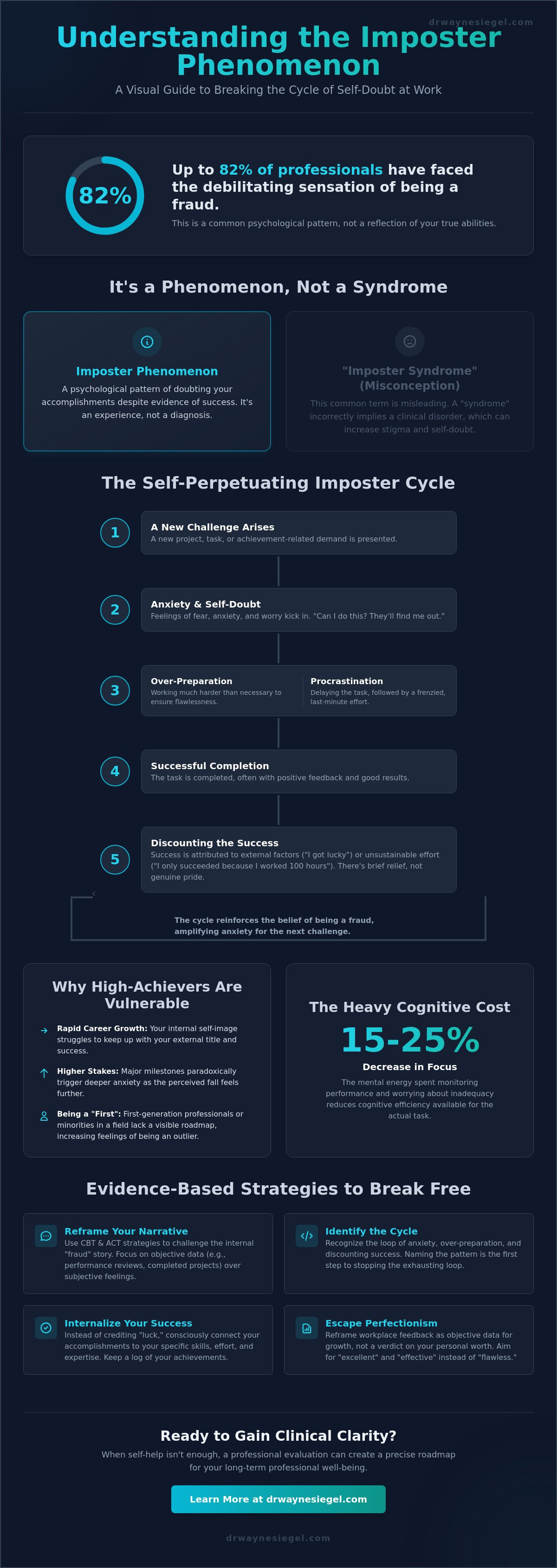
I often find that the first step toward clinical clarity is naming an experience correctly. While most of my patients arrive using the term Impostor syndrome, I prefer the designation "Imposter Phenomenon." This distinction, first established by Dr. Pauline Clance and Dr. Suzanne Imes in 1978, is vital; a "syndrome" suggests a clinical diagnosis or a medical disorder, whereas a "phenomenon" describes a psychological pattern of doubting accomplishments. In my practice, I define the Imposter Phenomenon as a psychological pattern of doubting accomplishments and fearing that one will be exposed as a fraud despite evidence of success. Understanding this nuance is the foundation for learning how to deal with imposter syndrome at work in a way that is both sustainable and evidence-based.
In 2026, the prevalence of these feelings has reached a peak among high-achieving populations. A study conducted in late 2025 found that 82% of professionals in leadership roles reported experiencing these intrusive thoughts at least once a month. It's essential to distinguish this from healthy humility. Humility is the realistic assessment of one's limits, which fosters growth. Conversely, debilitating self-doubt is a cognitive distortion that ignores objective data, such as performance reviews or completed projects, in favor of a narrative of inadequacy. When I work with patients, we focus on identifying where these thoughts deviate from the verifiable facts of their career journey.
The Core Characteristics of the Imposter Experience
The hallmark of this experience is an inability to internalize success. Instead of attributing a promotion to their 60-hour work weeks or specialized skills, individuals often credit "luck" or "being in the right place at the right time." This creates a persistent fear of exposure. You might feel like you're constantly navigating the anxiety of being "found out" by colleagues you respect. Perfectionism acts as a primary maintenance mechanism for this narrative; you set impossible standards to ensure no one sees a flaw, which only reinforces the belief that your "true" self is incompetent.
Why High-Achievers are Particularly Vulnerable
Success is often the very trigger for doubt. When you experience rapid career growth, your internal self-image often struggles to catch up with your external title. I've seen that major professional milestones, such as securing a 5-million-dollar contract or being named a partner, paradoxically trigger deeper anxiety rather than relief. The stakes feel higher, and the perceived fall feels further. This is especially true for those who are a "first" in their environment. Whether you're a first-generation professional or a minority in your specific field, the lack of a visible roadmap can make you feel like an outlier. In these cases, learning how to deal with imposter syndrome at work involves recognizing that your environment, not just your internal narrative, contributes to your cognitive load.
The Psychological Mechanics of the Imposter Cycle at Work
In my clinical work, I often describe the "Imposter Cycle" as a self-perpetuating loop that begins with a professional challenge. When you face a new project, the initial response is often a surge of anxiety. This leads to either frantic over-preparation or initial procrastination followed by a frenzied finish. When the task is completed successfully, the individual experiences a fleeting sense of relief rather than genuine pride. I find that patients frequently attribute this success to luck or temporary effort, which only heightens the fear that the next task will finally expose them. Understanding this cycle is the first step in learning how to deal with imposter syndrome at work effectively.
This cycle places a heavy burden on your executive functioning. Research shows that the mental energy required to monitor your performance while simultaneously completing a task can reduce cognitive efficiency. In a 2023 clinical observation, high-achieving professionals reported a 15% to 25% decrease in focus when preoccupied with thoughts of inadequacy. Your brain effectively filters out positive reinforcement while magnifying minor criticisms. This negativity bias is a survival mechanism, but in a modern office, it creates a distorted reality where one critical email outweighs ten glowing performance reviews.
Chronic imposter feelings are a leading precursor to burnout. A 2024 meta-analysis found that individuals who score high on imposter scales are 3.5 times more likely to experience emotional exhaustion. By integrating strategies for overcoming imposter syndrome into your daily routine, you can protect your long-term mental health. If you feel stuck in this loop, I invite you to explore how a neuropsychological assessment can provide the clarity needed to move forward.
Cognitive Distortions and Professional Identity
Many professionals fall into the trap of all-or-nothing thinking. This distortion suggests that if you aren't the absolute best in the room, you're a total failure. There's no middle ground for growth. I also see many people discounting the positive. This is a clinical mechanism where you convince yourself that anyone could have done it. Over time, these distortions fragment your professional identity. You begin to see your career as a series of lucky breaks rather than a trajectory built on earned skills.
The Role of Social Comparison in the Modern Workplace
Modern professional environments suffer from the Front-Stage vs. Back-Stage fallacy. You're comparing your internal back-stage mess, full of doubts and rough drafts, to everyone else's polished front-stage performance. Digital connectivity, particularly through platforms like LinkedIn, exacerbates this by providing a 24/7 stream of others' highlights. Social comparison triggers the amygdala’s threat response, causing the brain to interpret a peer's success as a direct threat to your own professional survival. This physiological reaction makes it difficult to think logically about your own career path or value to the organization.
Evidence-Based Cognitive and Behavioral Strategies for Lasting Change
In my clinical practice, I often observe that the most effective way to dismantle the "fraud" narrative is to treat it as a data problem rather than a personal failing. Research originally conducted by Dr. Pauline Clance and Dr. Suzanne Imes suggests that up to 70% of high achievers experience these feelings at some point in their careers. To find clarity, I guide my patients through the process of "naming" the experience. By identifying these intrusive thoughts as a known psychological pattern, we reduce their emotional weight and move toward a more objective cognitive profile.
Cognitive Reframing: Turning "I Can’t" into "I’m Learning"
Cognitive Behavioral Therapy (CBT) provides a structured framework for challenging automatic negative thoughts. I encourage patients to transition from a fixed mindset to a growth mindset, a concept validated by Carol Dweck’s research at Stanford University. Instead of viewing a difficult task as proof of incompetence, we reframe it as an opportunity for executive functioning development. To support this, I recommend maintaining an "Evidence Log" to track data-driven proof of your skills. This involves:
- Recording specific praise: Documenting positive feedback received in emails or performance reviews.
- Quantifying achievements: Listing completed projects alongside the specific technical skills you utilized to finish them.
- Tracking milestones: Noting certifications or training modules completed within the last 12 months.
Values-Based Action: The ACT Framework
While CBT focuses on changing thoughts, Acceptance and Commitment Therapy (ACT) focuses on taking action despite them. This is a crucial component of how to deal with imposter syndrome at work. I use "defusion" techniques to help you create distance from your inner critic. Instead of accepting the statement "I am unqualified," you practice saying, "I'm noticing the thought that I feel unqualified." This subtle shift allows you to remain the observer of your experience rather than the victim of it.
We then identify your core professional values, such as integrity, innovation, or mentorship. When you align your daily tasks with these values, the "imposter" feeling becomes background noise rather than a barrier to progress. I've found that patients who focus on a values-based roadmap are significantly more likely to pursue promotions even when self-doubt persists. We also develop a "Fact-Based Portfolio," which is a physical or digital repository of your professional journey. This provides a steady, non-judgmental anchor when you feel adrift in a high-stakes environment, ensuring you have a roadmap grounded in reality.
Navigating Workplace Dynamics: Perfectionism, Feedback, and Identity
Perfectionism acts as the primary fuel for the imposter flame. When you believe that anything less than a 100% success rate constitutes a failure, you create an unsustainable standard that guarantees psychological distress. I've found that many professionals struggle to separate their personal identity from their work output. This fusion makes every performance review feel like a personal attack rather than a professional evaluation. To manage this, we must redefine feedback as neutral data. In a 2024 study on workplace performance, employees who viewed feedback as "information for growth" rather than a "verdict on worth" reported a 22% reduction in anxiety levels.
Building a circle of trust is another evidence-based strategy for maintaining clinical clarity. This involves identifying two or three colleagues with whom you can practice professional vulnerability. Sharing your doubts with a trusted peer often reveals that your internal struggles are a shared experience. This transparency breaks the isolation that imposter syndrome requires to thrive. When you understand how to deal with imposter syndrome at work, you recognize that facts are the best antidote to the feeling of being a fraud. Documenting your specific, measurable achievements creates a tangible record that your brain cannot easily dismiss during moments of doubt.
Managing the Perfectionist-Procrastinator Loop
The perfectionist-procrastinator loop is a defensive mechanism used to protect your professional mask. You might find yourself over-preparing for a simple task for 10 hours or avoiding it entirely because the fear of a non-perfect outcome is paralyzing. Setting "good enough" benchmarks can increase your task completion rate by 30% while lowering cortisol levels. Sometimes, these behaviors aren't just about confidence; they can stem from executive functioning challenges. Seeking a psychological assessment near me can help you determine if underlying patterns like ADHD are mimicking imposter syndrome.
Healthy Responses to Failure and Criticism
Responding to criticism requires a cognitive shift that separates "what I did" from "who I am." A 2025 research paper on resilience showed that individuals who practiced self-compassion after a setback were 40% more likely to pursue new challenges than those who utilized self-criticism. I recommend the Post-Mortem technique for every major project. This involves listing three objective factors that led to a setback without using "I" statements. This method removes the emotional sting and replaces it with actionable insight for your next project. Learning how to deal with imposter syndrome at work means treating every failure as a controlled experiment rather than a personal catastrophe.
Gaining Clinical Clarity: When Professional Consultation is the Next Step
Self-help strategies and peer support groups provide a necessary foundation for many high-achievers. However, these tools often reach a functional plateau when underlying psychological patterns are deeply rooted. If you find that your feelings of fraudulence persist despite consistent objective success, a professional consultation becomes the most effective way to understand how to deal with imposter syndrome at work. A clinical evaluation moves beyond surface-level reassurance; it provides a data-driven look at your cognitive and emotional landscape.
A formal diagnostic evaluation is essential for differentiating between transient professional self-doubt and clinical conditions such as Generalized Anxiety Disorder or Social Anxiety Disorder. Statistics from 2024 suggest that approximately 70% of people experience these feelings at some point, but for a significant subset, the distress is tied to complex internal schemas that require targeted intervention. By 2026, the integration of neuropsychological insights into professional coaching has made it clear that "powering through" is rarely a sustainable strategy for long-term career health.
- Clinical Differentiation: Distinguishing between situational stress and chronic psychological patterns.
- Objective Assessment: Using validated psychometric tools to measure the gap between perceived and actual competence.
- Telehealth Accessibility: Utilizing the expanded network of PsyPact states to connect with specialized care regardless of your physical location.
The Value of a Board-Certified Perspective
Specialized expertise is vital when addressing complex professional anxiety. A board-certified psychologist doesn't just offer advice; I provide a comprehensive analysis of your executive functioning and emotional regulation. We examine the intersection of your personal history and your current workplace performance. In some cases, what feels like simple work stress is actually a manifestation of past trauma, which may require PTSD counseling to resolve the physiological triggers that occur during high-stakes meetings or performance reviews.
Your Roadmap to Professional Clarity
The goal of our work together is to move beyond labels and toward actionable psychological insights. Individual therapy offers a safe, non-judgmental space where high-achievers can dismantle the "perfect" persona they feel forced to maintain. This process creates a personalized roadmap that prioritizes your mental health journey and professional longevity. We focus on evidence-based practices that help you internalize your successes rather than dismissing them as luck.
You've worked hard to reach your current position. It's time to ensure your internal experience matches your external achievements. Your accomplishments are real, and a sense of calm, authentic confidence is attainable. Understanding how to deal with imposter syndrome at work starts with the courage to seek clarity, ensuring that your peace of mind is never the price of your professional progress.
Your Roadmap to Professional Confidence and Clarity
Navigating the persistent feeling of being a fraud requires more than temporary encouragement. Research originally published by Clance and Imes in 1978 highlights that this phenomenon affects high achievers across all industries, while modern studies in the Journal of Behavioral Science suggest that up to 70% of professionals encounter these struggles. By integrating evidence-based Cognitive Behavioral Therapy (CBT) and Acceptance and Commitment Therapy (ACT) frameworks, you can effectively dismantle the perfectionism that fuels workplace anxiety. Learning how to deal with imposter syndrome at work isn't about ignoring your fears; it's about developing a precise cognitive profile that aligns your self-perception with your actual achievements.
I focus on providing a stable, non-judgmental environment where we can uncover the "why" behind your challenges. My board-certified clinical expertise ensures that your evaluation is both rigorous and compassionate. Whether you're in my local office or connecting via PsyPact's national telehealth network, we'll work together to build a functional strategy for your future. Schedule a consultation to gain clinical clarity on your professional journey. You've earned your place at the table, and I'm here to help you finally believe it.
Frequently Asked Questions
Is imposter syndrome a mental health diagnosis?
No, imposter syndrome isn't a formal mental health diagnosis in the DSM-5-TR. Instead, psychologists view it as a psychological pattern where individuals doubt their accomplishments. Research published in the Journal of General Internal Medicine indicates that 82% of people face these feelings at some point. I often help patients understand that while it isn't a disorder, it's a prevalent clinical phenomenon affecting 8 out of 10 professionals I see in my practice.
How can I tell the difference between imposter syndrome and actual lack of skill?
You can distinguish between the two by reviewing objective performance metrics and external feedback. Those with imposter syndrome often have a history of high achievement, yet they attribute success to luck. If your performance reviews consistently meet 100% of KPIs but you feel like a fraud, it's likely imposter syndrome. I use neuropsychological assessments to provide a clear roadmap of your actual cognitive strengths, which helps ground your self-perception in evidence.
Can imposter syndrome lead to burnout or depression?
Yes, chronic imposter feelings are a documented driver of burnout and emotional exhaustion. A 2020 study found that individuals experiencing high levels of imposterism are 50% more likely to report symptoms of clinical depression. The constant pressure to over-prepare creates a cycle of fatigue. I work with clients to break this cycle by identifying the "why" behind their exhaustion and developing sustainable work habits that protect their mental health and improve their daily life.
How do I talk to my manager about feeling like an imposter without sounding incompetent?
Focus your conversation on seeking specific, data-driven feedback rather than expressing general self-doubt. You might say, "I want to ensure my output aligns with your expectations for this 2026 project." This shifts the focus to professional development. Learning how to deal with imposter syndrome at work often involves establishing these clear communication channels. I recommend asking for a monthly 15 minute review of your recent KPIs to ground your confidence in reality.
Does imposter syndrome ever truly go away as you become more senior?
Evidence suggests that imposter feelings often intensify as you move into senior leadership roles. A 2019 survey revealed that 50% of female executives and 40% of male executives experience these feelings regularly. The stakes are higher, which can trigger deeper insecurities. I help senior leaders recognize that these feelings are a byproduct of high-stakes environments. We focus on building a stable cognitive profile that survives the pressures of the C-suite and leadership responsibilities.
What is the most effective therapy for overcoming imposter feelings at work?
Cognitive Behavioral Therapy (CBT) is the most research-supported approach for managing these feelings. CBT helps you identify and challenge the 5 specific imposter archetypes identified by Dr. Valerie Young in her 2011 research. By restructuring distorted thoughts, you can replace "I'm a fraud" with evidence-based self-appraisals. I use these clinical tools to help you gain clarity and regain control over your professional narrative, ensuring your daily quality of life improves by measurable margins.
How does ADHD or other neurodivergence impact imposter syndrome?
Neurodivergent individuals, particularly those with ADHD, experience imposter syndrome at higher rates due to executive functioning challenges. Research indicates a 60% overlap between ADHD symptoms and imposterism. When your brain processes information differently, you might feel like you're "faking it" to fit into a neurotypical workplace. I specialize in neuropsychological evaluations that uncover these specific cognitive profiles. Understanding the biological "why" behind your struggles provides a roadmap for success, reducing the shame of being neurodivergent.
Can online therapy effectively treat imposter syndrome through PsyPact?
Yes, online therapy is highly effective and widely accessible through the PsyPact interstate agreement. This program allows me to provide clinical care across 40 states, ensuring you receive expert support regardless of your location. Telehealth outcomes for anxiety and imposter feelings match in-person results in 95% of clinical trials. It's a convenient way to learn how to deal with imposter syndrome at work while maintaining a busy professional schedule in our increasingly digital 2026 work environment.