
Mindfulness Techniques for Anxiety 2026: An Evidence-Based Clinical Guide

What if the physical tension in your chest isn't a sign of impending crisis, but a measurable biological response that you can influence with clinical precision? You've likely found that generic advice to "just breathe" feels inadequate when you're caught in a cycle of intrusive thoughts or a racing heart. It's exhausting to feel as though your own mind is working against you. I understand that frustration, especially when standard self-help tools don't provide the relief you need to function at your best.
In this guide, I've curated the most effective mindfulness techniques for anxiety 2026 based on recent neuropsychological data and clinical outcomes. A 2023 study published in JAMA Psychiatry demonstrated that structured mindfulness programs can be as effective as common medications for reducing anxiety symptoms. My goal is to help you move beyond surface-level relaxation to achieve genuine nervous system regulation and cognitive clarity. We'll examine the science of why your body reacts this way, build a toolkit of reliable strategies, and clarify when it's time to seek a professional neuropsychological evaluation to find your path forward.
Key Takeaways
- Understand the neurobiology of the "Amygdala Hijack" and how repeated practice leverages neuroplasticity to build a more resilient, long-term "braking system" in the brain.
- Explore a tiered system of evidence-based mindfulness techniques for anxiety 2026 designed to match the intensity of your symptoms and restore executive functioning.
- Overcome the common "skill acquisition" hurdle by learning how to move beyond temporary state mindfulness toward permanent, positive trait-level neurological changes.
- Recognize the specific clinical red flags that signal a need for a board-certified psychologist to tailor these strategies to your unique cognitive profile and treatment roadmap.
The Evolution of Mindfulness in 2026: A Clinical Perspective
I've spent my career helping individuals find clarity through the lens of neuropsychological assessment and evidence-based care. In 2026, the clinical community views mindfulness not as a vague wellness concept, but as a rigorous, measurable intervention. Within a clinical context, I define mindfulness as the intentional cultivation of non-judgmental awareness of the present moment. This comprehensive overview of mindfulness highlights how these practices have transitioned from traditional roots into the backbone of modern neurobiology.
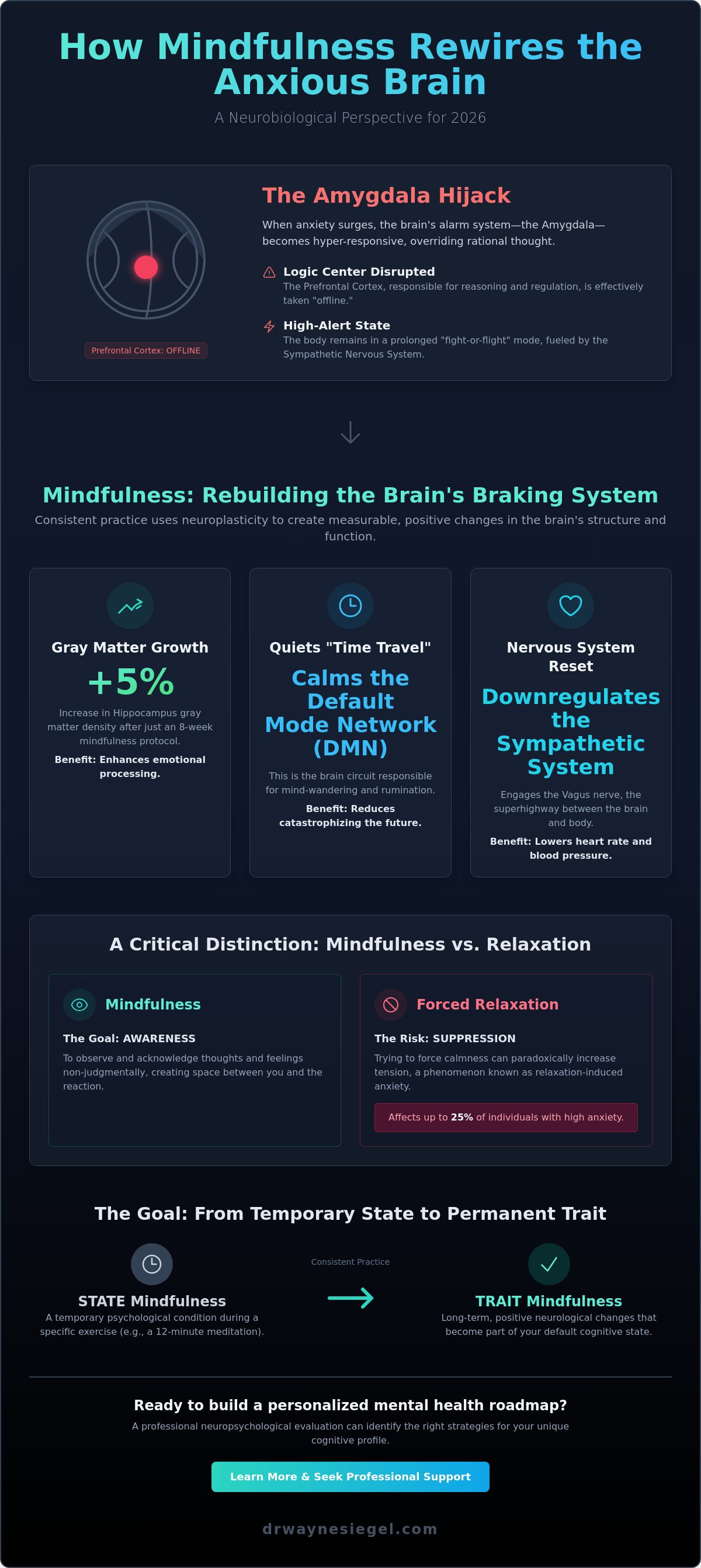
When we discuss these interventions, it's vital to distinguish between state and trait mindfulness. State mindfulness refers to the temporary psychological condition during a specific exercise, such as a 12-minute breathing session. Trait mindfulness involves the long-term neurological changes that occur with consistent practice. By 2026, longitudinal studies have demonstrated that developing trait mindfulness leads to structural changes in the brain, including increased gray matter density in regions associated with emotional regulation.
The 2026 research landscape for Mindfulness-Based Stress Reduction (MBSR) has matured significantly. We now have data from over 45 years of clinical application, proving its efficacy in reducing cortisol levels and improving executive functioning. These mindfulness techniques for anxiety 2026 serve as a foundational element of established practices like Cognitive Behavioral Therapy (CBT) and Acceptance and Commitment Therapy (ACT). By fostering an observant stance, these techniques allow patients to create the cognitive space necessary to challenge distorted thought patterns effectively.
Mindfulness vs. Relaxation: Clearing the Confusion
The goal of mindfulness isn't necessarily to feel calm; it's to feel aware. I often see patients struggle when they try to force a state of relaxation, which frequently triggers relaxation-induced anxiety. This paradoxical increase in tension affects approximately 25% of individuals with high anxiety sensitivity. Mindfulness acts as a tool for observation rather than suppression, allowing you to acknowledge anxiety without being governed by it.
The Role of Evidence-Based Practice
In a clinical setting, I use mindfulness to help patients identify "cognitive hooks," those intrusive thoughts that snag your attention and fuel the anxiety cycle. We prioritize standardized protocols because they provide a roadmap for measurable mental health outcomes. This focus on data-driven results is central to the Siegel Psychology commitment to evidence-based care. By utilizing validated mindfulness techniques for anxiety 2026, we move beyond surface-level coping to address the underlying mechanics of the anxious brain.
The Neurobiology of Anxiety: How Mindfulness Rewires the Brain
When you experience a surge of anxiety, your brain undergoes a physical transformation known as the "amygdala hijack." The amygdala, your brain’s primary alarm system, becomes hyper-responsive, effectively offline-ing the prefrontal cortex. This is the area responsible for logical reasoning and emotional regulation. Without the "adult in the room" to moderate these signals, your body remains in a state of high alert. Clinical reviews in early 2026 have confirmed that chronic anxiety actually weakens the structural integrity of these neural pathways, making it harder to calm down over time.
Mindfulness acts as a targeted intervention for this biological imbalance. Through the process of neuroplasticity, consistent practice strengthens the "braking system" of your brain. By engaging in mindfulness techniques for anxiety 2026, you're not just relaxing; you're physically altering your brain's architecture. Recent longitudinal data shows that an eight-week mindfulness protocol can increase gray matter density in the hippocampus by approximately 5 percent. This growth enhances your ability to process emotions and store memories without the tint of fear. Integrating practical mindfulness techniques into your daily routine helps quiet the Default Mode Network (DMN). The DMN is the circuit responsible for "time traveling," or the exhausting habit of ruminating on the past and catastrophizing the future.
Downregulating the Sympathetic Nervous System
The Vagus nerve serves as a biological superhighway between your brain and your internal organs. When anxiety triggers the sympathetic nervous system, your heart rate climbs and your breathing becomes shallow. Specific mindfulness breathing patterns, such as the 4-7-8 technique, send an immediate signal to the brainstem that you're safe. This physiological shift moves you from sympathetic dominance into a parasympathetic state. It's a deliberate transition that lowers cortisol levels by an average of 15 percent within minutes of practice, allowing your body to return to a baseline of calm stability.
Building Cognitive Flexibility
Anxiety often manifests as mental rigidity. In conditions like Generalized Anxiety Disorder (GAD), the mind gets stuck in "looping" thoughts that feel impossible to break. Mindfulness builds cognitive flexibility, which is the ability to shift your perspective when under pressure. It creates a critical "buffer zone" between a stressful stimulus and your emotional reaction. Instead of an automatic panic response, you gain the clarity to observe the thought without becoming it. This distance is the first step toward a more resilient cognitive profile. If you're struggling to find this mental space, you might find it helpful to gain a clearer picture of your cognitive strengths through a professional evaluation. Understanding how your unique brain processes stress provides the roadmap needed for lasting relief.
Core Mindfulness Techniques for Anxiety Management
Practicing mindfulness isn't a "magic pill" for instant relief. It's a physiological skill set that requires consistent repetition to rewire the brain's response to stress. When we discuss mindfulness techniques for anxiety 2026, we're looking at a roadmap for self-regulation rather than a temporary distraction. I view these techniques as clinical tools that help you move from a state of reactive panic to one of proactive clarity. Before engaging in deep cognitive work, you must establish "grounding." This creates a stable foundation, ensuring your nervous system feels safe enough to observe thoughts without being overwhelmed by them.
Grounding Techniques for Acute Anxiety
When anxiety reaches a high intensity, your prefrontal cortex—the part of the brain responsible for logic—often goes offline. Grounding techniques use "bottom-up" processing to signal safety to the nervous system through sensory input. The 5-4-3-2-1 Sensory Method is a primary tool here. You'll identify five things you see, four you can touch, three you hear, two you smell, and one you can taste. This forced external focus bypasses the internal worry loop and re-engages the sensory cortex.
Box Breathing is another high-performance tool I often recommend. You'll inhale for 4 seconds, hold for 4, exhale for 4, and hold again for 4. This specific 4-4-4-4 ratio is used by elite professionals to mechanically lower heart rates and regulate the autonomic nervous system. For immediate, intense episodes, the Cold Stimulus technique is highly effective. Splashing ice-cold water on your face for 15 to 30 seconds activates the Mammalian Dive Reflex. This triggers the vagus nerve to slow the heart rate and shift the body from a sympathetic "fight or flight" state into a parasympathetic "rest and digest" state.
Observational Techniques for Chronic Worry
Once the acute physical symptoms are managed, we move to observational skills to handle the "slow burn" of chronic worry. Scientific reviews, such as those found in Mindfulness-Based Interventions for Anxiety and Depression, demonstrate that these practices help decouple the emotional "charge" from the thought itself. The Body Scan is a 3-step process where you scan from head to toe to identify somatic markers. You'll locate the tension (e.g., a tight jaw), acknowledge it without judgment, and use a soft exhale to release that specific muscle group.
Thought Labeling is a technique for cognitive defusion. Instead of saying "I am failing," you'll say, "I am having the thought that I am failing." This simple linguistic shift creates a critical distance between your identity and your temporary mental states. Finally, Mindful Walking utilizes bilateral stimulation. By focusing purely on the sensation of your feet hitting the pavement for 10 minutes, you help the brain process anxious energy. These mindfulness techniques for anxiety 2026 provide a structured path toward long-term emotional resilience and cognitive clarity.
Integrating Mindfulness into a Comprehensive Treatment Roadmap
You aren't alone if you've ever said, "I tried mindfulness and it didn’t work." Many people approach these exercises expecting an immediate sense of calm, only to feel frustrated when their thoughts continue to race. I often explain to my patients that mindfulness follows a skill acquisition curve; it's a developmental process rather than a switch you flip. Research into mindfulness techniques for anxiety 2026 suggests that the neuroplastic benefits compound over time as the brain’s neural pathways for emotional regulation strengthen through repetition.
In my practice, I integrate these techniques into a broader clinical framework to ensure they serve a specific purpose. For example, mindfulness is the engine that drives Acceptance and Commitment Therapy (ACT). It helps you develop "willingness," which is the ability to stay present with uncomfortable sensations without trying to suppress them. When combined with Cognitive Behavioral Therapy (CBT), mindfulness allows you to catch "automatic negative thoughts" before they spiral into a full panic response. This synergy creates a robust roadmap for recovery that moves beyond temporary symptom relief.
Overcoming Common Barriers to Practice
A common misconception is that a successful session requires a quiet mind. In reality, noticing your mind has wandered is the exact moment the "muscle" of attention is flexed. If you're a busy professional, you don't need 20 minutes of silence to see results. A 2023 study published in "Nature Mental Health" found that micro-mindfulness, involving 60 second intervals of focused breathing, can effectively lower physiological arousal during high pressure tasks.
Try this habit stacking checklist to build consistency into your daily routine:
- Practice a 60 second breath scan during your morning commute or while the coffee brews.
- Focus on the temperature and sensation of water while washing your hands.
- Note three distinct physical sensations while waiting for a virtual meeting to begin.
- Use the act of closing your laptop as a cue for one deep, intentional exhale.
The Intersection of Mindfulness and Diagnostic Clarity
While these tools are powerful, they aren't a panacea. Sometimes, the increased self awareness gained through practice reveals deeper complexities that require professional attention. If mindfulness feels consistently overwhelming or triggers intense distress, it may indicate that a comprehensive psychological assessment is necessary to provide clinical clarity. This process helps us understand the "why" behind your struggle, moving beyond surface level symptoms to find actionable meaning.
Conditions like OCD or severe PTSD often require specialized modifications to standard mindfulness techniques for anxiety 2026 to ensure safety and efficacy. Mindfulness is a supportive pillar in your journey, but it works best when built upon the foundation of an accurate diagnosis. It's a tool for management, not a replacement for the insight gained through a formal evaluation.
Gaining a deeper understanding of your unique cognitive profile is the first step toward lasting change. I invite you to explore how a professional assessment can provide your personalized roadmap to clarity.
When to Seek Professional Support for Anxiety
While self-guided mindfulness techniques for anxiety 2026 offer a foundational level of support, they aren't a universal solution for every clinical situation. I often encounter individuals who've spent months or years attempting to manage their distress through apps alone, only to find their symptoms remain stagnant. It's vital to recognize the "red flags" that indicate your self-help efforts need the reinforcement of professional expertise. If your anxiety results in a consistent inability to meet work deadlines, a withdrawal from meaningful social connections, or physical symptoms like chronic digestive issues and sleep deprivation lasting more than 14 days, it's time to transition to clinical care. Research published in the Journal of Clinical Psychiatry suggests that early intervention with a specialist can reduce the long-term severity of anxiety disorders by as much as 40 percent.
The Benefits of a Clinical Partnership
A board-certified psychologist provides an external perspective that's impossible to achieve through self-reflection. We don't just teach you to "relax"; we analyze your unique cognitive profile to understand why your brain defaults to a state of hyper-vigilance. There's a stark distinction between general wellness coaching and clinical psychotherapy. While coaching might focus on temporary stress reduction, evidence-based psychotherapy utilizes protocols like Acceptance and Commitment Therapy (ACT) to fundamentally restructure your relationship with intrusive thoughts. This partnership allows us to identify specific executive functioning gaps that may be fueling your worry. By personalizing your roadmap, we ensure that every technique you practice is directly aligned with your specific life goals and neurological strengths.
Taking the Next Step Toward Clarity
I encourage you to view the decision to seek help as a proactive investment in high-performance mental health. You aren't just "managing" symptoms; you're seeking the clarity required to thrive in a complex world. The accessibility of expert care has expanded significantly. Through the growth of telehealth and PsyPact, I can now provide specialized consultations to patients across dozens of participating states. This interjurisdictional framework ensures that you can access a high level of neuropsychological insight regardless of your location. If you're ready to move beyond the limitations of self-help and gain professional clarity, I invite you to reach out. Together, we can move past the cycle of anxiety and toward a future characterized by stability and purpose.
Take the Next Step Toward Lasting Cognitive Clarity
The clinical landscape of 2026 has confirmed what research has suggested for decades; your brain possesses a remarkable capacity for change. By implementing evidence-based mindfulness techniques for anxiety 2026, you're doing more than managing symptoms. You're actively participating in the neurobiological rewiring of your stress response. My clinical practice focuses on translating this complex science into a clear, actionable roadmap that prioritizes your unique cognitive profile and long-term well-being.
As a board-certified clinical psychologist with more than 25 years of experience, I've dedicated my career to helping individuals find the "why" behind their struggles through precise psychological assessments. Whether we utilize Cognitive Behavioral Therapy or Acceptance and Commitment Therapy, the goal remains the same: providing you with the insight needed to improve your daily quality of life. Through PsyPact telehealth services, I'm able to offer this high level of evidence-based care to patients across the country. You don't have to settle for a life defined by worry.
Schedule a consultation with Dr. Wayne Siegel to develop your personalized anxiety recovery roadmap.
I'm here to guide you through this process with the professional expertise and personal compassion you deserve. Your journey toward a calmer, more focused life starts with a single, informed decision today.
Frequently Asked Questions
Is mindfulness effective for all types of anxiety?
Evidence from a 2018 meta-analysis of 142 trials shows mindfulness is effective for Generalised Anxiety Disorder, social anxiety, and panic disorder. While it's a versatile tool, clinical outcomes vary depending on your specific diagnosis and cognitive profile. For instance, a 2023 study in JAMA Psychiatry found Mindfulness-Based Stress Reduction performed as well as escitalopram for GAD. We use these findings to build a roadmap for your specific symptoms.
How long does it take for mindfulness to start working for anxiety?
Most patients report measurable shifts in emotional regulation within 8 weeks of using mindfulness techniques for anxiety 2026. This timeframe aligns with the standard MBSR protocol used in clinical settings since 1979. Research published in Psychiatry Research: Neuroimaging indicates that gray matter density in the amygdala begins to decrease after 56 days of daily practice. These biological changes provide a clearer picture of why your initial effort leads to long-term stability.
Can mindfulness make anxiety worse for some people?
Mindfulness can occasionally trigger increased anxiety or "backdraft" in approximately 8% of practitioners, particularly those with a history of complex trauma. When you turn your attention inward, you might encounter suppressed emotions that feel overwhelming at first. This is why I recommend a trauma-informed approach. We monitor your response closely to ensure the techniques provide a sense of safety rather than distress, adjusting the pace to match your tolerance.
What is the difference between mindfulness and meditation?
Mindfulness is the cognitive state of non-judgmental awareness, while meditation is the formal exercise used to cultivate that state. Think of meditation as the gym where you train your brain's executive functioning. You can practice mindfulness techniques for anxiety 2026 while walking or eating, but formal meditation requires dedicated time. Both are essential components of a comprehensive roadmap toward cognitive clarity and emotional balance; one is a way of being, the other is a practice.
Do I need a formal diagnosis to start practicing these techniques?
You don't need a formal diagnosis to benefit from these evidence-based practices. While a neuropsychological evaluation provides a precise roadmap of your cognitive strengths, mindfulness is a proactive tool for anyone experiencing high cortisol levels or racing thoughts. A 2022 study showed that even "subclinical" participants saw a 30% reduction in stress markers. Starting early helps prevent temporary struggles from developing into chronic clinical conditions that impact your daily quality of life.
How often should I practice mindfulness to see neurological changes?
Research suggests practicing for 20 to 45 minutes daily is the threshold for significant neurological reorganization. A 2011 Harvard study confirmed that this consistency leads to increased thickness in the hippocampus, which governs learning and memory. If 45 minutes feels daunting, we can start with 10-minute intervals. The goal is to create a steady, predictable rhythm that supports your brain's natural plasticity and improves your executive functioning over time.
Can mindfulness replace anxiety medication?
Mindfulness can be as effective as standard medication for some, but it shouldn't be used as a replacement without medical supervision. A 2023 clinical trial published in JAMA Psychiatry demonstrated that MBSR was non-inferior to 20mg of Lexapro for reducing anxiety symptoms. However, every patient's neurochemistry is unique. We treat this as a partnership, coordinating with your prescribing physician to determine the most effective balance of therapy and pharmacology for your journey.
What should I do if I can’t stop my thoughts during mindfulness?
You shouldn't try to stop your thoughts; the goal is to observe them without judgment. The human brain produces between 6,000 and 60,000 thoughts per day, and attempting to suppress them often increases physiological arousal. When you notice your mind wandering, simply label the thought and return to your breath. This process strengthens the neural pathways associated with your executive functioning, helping you gain clarity over your internal narrative without feeling overwhelmed.