
How to Explain Anxiety to Family: An Evidence-Based Communication Guide

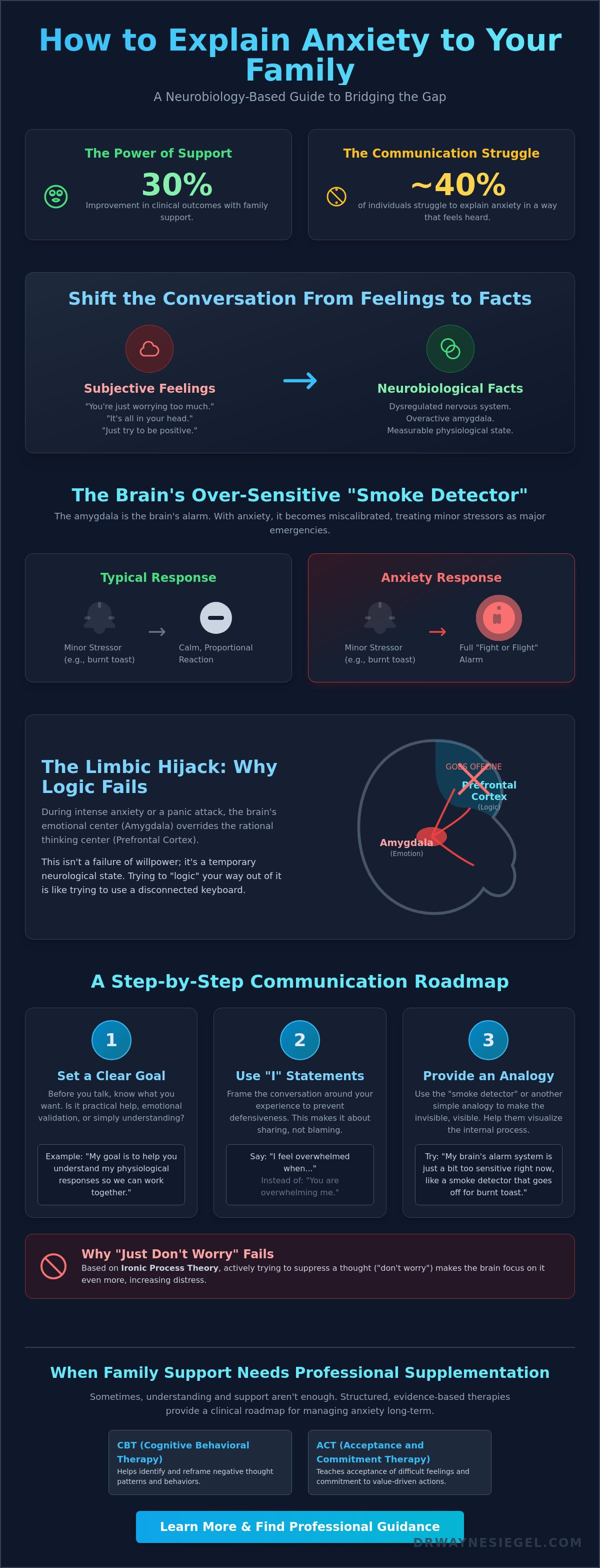
Research published in the *Journal of Nervous and Mental Disease* indicates that family support can improve clinical outcomes for anxiety by 30%, yet nearly 40% of individuals struggle with how to explain anxiety to family in a way that feels heard. You might feel like your words are hitting a wall. Perhaps you worry that sharing your truth will make you a burden. I've seen how isolating it is when your internal experience doesn't match the external perception of your life. It's a common struggle, but we can solve it through clear, evidence-based communication.
In this guide, I'll show you how to bridge the gap between clinical data and your personal narrative. You'll learn how to use specific vocabulary to describe your cognitive profile and the neurobiological roots of your stress response. We're going to move beyond vague descriptions. I'll provide you with a structured roadmap for these difficult conversations. By the end of this article, you'll have the tools to transform a source of friction into a foundation for mutual support and genuine validation.
Key Takeaways
- Shift the conversation from subjective feelings to the neurobiology of the amygdala and the autonomic nervous system’s "smoke detector" response.
- Use research-backed analogies to illustrate the "invisible illness" paradox, helping family members visualize internal distress through concrete comparisons.
- Master the specific timing and language required for how to explain anxiety to family effectively, using "I" statements to maintain a safe, non-confrontational dialogue.
- Identify when to transition from familial support to clinical roadmaps like CBT or ACT to provide the structured guidance necessary for long-term clarity.
The Challenge of Translating the Internal Experience of Anxiety
I often find that the greatest hurdle in a patient's journey isn't the symptoms themselves, but the isolation that comes when loved ones don't understand the struggle. Understanding how to explain anxiety to family starts with recognizing that you aren't describing a simple mood. Instead, you're describing a measurable dysregulation of the autonomic nervous system. While your family sees a "worried" person, your body is actually experiencing a physiological state where the sympathetic nervous system remains stuck in a "fight or flight" response. This biological reality is why Anxiety is more than a feeling; it's a persistent state of high arousal that affects your cognitive profile and physical health.
This creates what I call the "invisible illness" paradox. Because there are no casts or bandages, families often struggle to validate what they cannot see. When a family member dismisses your experience as "all in your head," it triggers a specific psychological impact. Research published in the journal Psychoneuroendocrinology indicates that social invalidation can lead to a 25 percent increase in cortisol levels and a higher likelihood of social withdrawal. To change this dynamic, we must frame your explanation as a bridge-building exercise. You aren't defending your character or making excuses. You're providing your family with the clarity they need to become partners in your care.
Why "Just Don’t Worry" Fails as a Strategy
In 1987, researcher Daniel Wegner identified what he called "ironic process theory." His data showed that the more we try to suppress a thought, the more frequently it returns. When family members tell you to "just stop worrying," they're inadvertently asking you to engage in a process that amplifies your distress. I help my patients differentiate between productive worry, which involves active problem-solving, and unproductive anxiety, which is a repetitive loop of rumination. Most families mistakenly believe anxiety is a choice or a personality flaw. By explaining that your brain's "alarm system" is over-sensitive due to neurobiology, you shift the focus from your willpower to your wellness journey.
Identifying Your Goal for the Conversation
Before you sit down with your loved ones, you must have a clear objective. Are you looking for practical support with daily tasks, emotional validation for your feelings, or simply a reduction in the pressure they place on you? When you approach the conversation with a specific roadmap, the question of how to explain anxiety to family becomes less about defending your character and more about sharing a plan for your well-being. I recommend writing a single sentence to guide the talk: "My goal is to help you understand my physiological responses so we can work together more effectively." Finally, assess their readiness to hear you. If a family member has been consistently dismissive in the past, you may need to start with smaller, more clinical pieces of information to build their understanding slowly.
The Neurobiology of Anxiety: Providing a Fact-Based Foundation
I often tell my patients that the first step in learning how to explain anxiety to family is shifting the conversation from abstract feelings to concrete biology. Your brain contains an almond-shaped structure called the amygdala. Think of it as a sophisticated smoke detector. In a typical system, it sounds the alarm only when there's an actual fire. With anxiety, the detector becomes oversensitive. It screams "danger" at a burnt piece of toast or a crowded room. This isn't a personal choice; it's a physiological reflex that has become miscalibrated.
In our ancestors, this "fight-flight-freeze" response saved lives from physical predators. Today, that same surge of adrenaline might trigger during a work presentation or a difficult conversation. The brain doesn't distinguish between a literal lion and a perceived social threat. When I work with families, I explain that anxiety represents a physiological state where the sympathetic nervous system remains chronically activated despite the absence of immediate threat. According to data on Anxiety Disorders, these conditions affect approximately 19.1% of adults in the U.S. every year, proving that this biological struggle is a widespread reality.
The Amygdala vs. The Prefrontal Cortex
During what I call a "limbic hijack," the emotional centers of the brain override logical thinking. The prefrontal cortex, the part of the brain responsible for reasoning and executive functioning, effectively goes offline. This is why logic doesn't work during a panic attack. You can't simply "calm down" when the part of your brain required to process that instruction is currently inaccessible. Helping your loved ones understand this disconnect is vital. It moves the focus away from "willpower" and toward biological management.
Physical Manifestations Families Can Recognize
When you're figuring out how to explain anxiety to family, pointing to physical evidence can help bridge the gap of understanding. Anxiety isn't just "in your head." It's a full-body experience driven by spikes in adrenaline and cortisol. These chemicals cause real, measurable changes in the body that family members can often see if they know what to look for:
- Persistent muscle tension, particularly in the jaw, neck, and shoulders.
- Digestive issues, such as nausea or chronic stomach discomfort.
- Sleep disturbances, including difficulty falling asleep due to a "revved up" nervous system.
- Increased heart rate and shallow, rapid breathing.
If your family remains skeptical, I often suggest using a psychological assessment near me to provide objective data. A clinical evaluation can transform a vague sense of worry into a clear, evidence-based roadmap. While chronic stress can alter neural pathways over time, the brain possesses remarkable neuroplasticity. This means that while the anxiety is a physiological reality, it's also treatable. We can rewire these pathways through targeted intervention. If you're seeking clarity on your cognitive health, a professional assessment is the most reliable way to begin that journey toward stability.
Bridging the Gap: Using Evidence-Based Analogies
When I guide patients through the process of how to explain anxiety to family, I often start with concrete imagery. Clinical definitions are helpful, but analogies bridge the gap between my professional observations and your family's personal experience. One of the most effective comparisons is the "Broken Leg" analogy. If you had a visible cast on your leg, your family would naturally hold the door open or offer you a seat. Anxiety is a real, functional impairment that simply lacks the plaster. I remind families that a lack of a visible bandage shouldn't result in a lack of care; the nervous system requires just as much recovery time as a fractured bone.
Another evidence-based tool I use is the "Faulty Alarm" analogy. The amygdala functions as the brain's smoke detector, designed to alert you to genuine danger. In an anxious brain, this alarm is calibrated too high. It doesn't just ring for a house fire; it screams at the smell of burnt toast or even steam from a shower. This helps your loved ones understand that your physical symptoms, like a racing heart or shallow breathing, are involuntary responses to a false signal.
I also describe the "Computer Program" effect. Think of anxiety as a background process on a laptop that consumes 95% of the CPU. On the surface, you might look like you're just sitting still, but your internal processor is working at maximum capacity. When a family member asks you a simple question and you feel overwhelmed, it's because there's no mental "RAM" left to process the request. This perspective provides a roadmap for your family to see that your exhaustion isn't laziness, but a result of intense internal labor.
Anxiety vs. Stress: A Comparison Framework
It's vital to help your family distinguish between common stress and clinical anxiety. While everyone feels stress, the "stuckness" of anxiety is a different physiological state. I've found that providing a clear comparison helps your loved ones identify what they are seeing in your daily life. You can use this framework when learning how to talk to friends and family about anxiety to ensure they don't minimize your experience as "just being stressed."
- Stress: Triggered by an external pressure (like a work deadline). It typically subsides once the situation is resolved.
- Anxiety: An internal, persistent state. It continues even when the external trigger is removed or if no clear trigger exists.
- Stress: Feels like having too much to do in too little time.
- Anxiety: Feels like a sense of impending doom or a "looping" thought pattern that you can't switch off.
The "Threshold" Concept
I often explain that every human has an anxiety threshold, but yours is currently set lower due to biological or environmental factors. Think of it like a glass of water. If a glass is already 90% full because of underlying anxiety, a single drop, such as a minor change in plans, will cause it to overflow. This is why you might appear to "overreact" to small events. It isn't the small event itself that caused the reaction; it was the fact that your system was already at its limit. This biological reality offers clarity and removes the shame often associated with sudden emotional outbursts.
A Step-by-Step Guide to the "Anxiety Disclosure" Conversation
Anxiety isn't just a feeling; it's a physiological and cognitive state that requires a structured communication strategy. When you're learning how to explain anxiety to family, timing is your most strategic tool. Research in interpersonal communication suggests that high-arousal moments, such as an active panic attack, are the least effective times for education. Instead, choose a low-stakes window when everyone is calm. This allows the prefrontal cortex to remain engaged, making it easier for your family to process complex information without becoming defensive.
I often recommend using Acceptance and Commitment Therapy (ACT) principles during these talks. This involves a technique called cognitive defusion. Instead of saying "I am anxious," which fuses your identity with the disorder, try saying, "I'm having the thought that I'm in danger," or "I'm noticing a tightness in my chest." This subtle shift helps your family see the anxiety as an external challenge you're managing together, rather than a permanent personality trait. It's a method we prioritize when helping patients find clarity through neuropsychological insights.
The "When, Where, and How" of Disclosure
Identify a quiet environment with no distractions, like a park bench or a quiet living room. Start with a script that emphasizes the value of the bond. You might say: "I want to share something with you because our relationship is important to me, and I want you to understand what I’m going through." This opening reduces the "threat response" in the listener. Choosing a clinic for psychology that values collaborative communication can provide you with additional scripts tailored to your specific cognitive profile.
Handling Negative or Dismissive Reactions
If a family member responds with "everyone gets nervous," don't take it personally. Use the "Validation plus Education" technique. First, acknowledge their perspective: "You're right that everyone feels stress." Then, pivot to clinical facts: "However, my experience involves a persistent 25% increase in heart rate and intrusive thoughts that interfere with my daily functioning." This moves the conversation from opinion to data. If you notice them becoming defensive or if the conversation circles back to "tough love" advice, it's time to pause. Set a boundary by saying, "I appreciate that you want to help, but unsolicited advice isn't what I need right now. I'll let you know when I'm looking for suggestions."
- Use "I" statements to describe your internal state.
- Provide specific, actionable examples of help, like "Please just sit with me while I breathe."
- Avoid "You" statements that can trigger defensiveness.
Establishing these communication protocols early on creates a roadmap for long-term support. It transforms a source of conflict into a partnership. If you're ready to move beyond labels and find a clear path forward, learn more about our diagnostic process.
When Family Support Needs Professional Supplementation
Helping your loved ones understand your internal experience is a powerful step toward healing. However, family members shouldn't carry the burden of being your primary therapist. This boundary is vital for maintaining healthy, sustainable relationships. While a spouse or parent can offer empathy, they lack the clinical training to deconstruct complex psychological patterns. Professional intervention provides a structured roadmap that even the most well-meaning relative cannot offer. Board-certified psychologists utilize clinical data and validated assessments to provide the clarity needed for long-term stability.
Accessing this specialized care is more feasible now than in previous decades. Through PsyPact states, patients can receive expert telehealth services across state lines. This ensures that geographical barriers don't prevent you from reaching a practitioner who understands your specific cognitive profile. Relying on a professional allows your family to remain your support system rather than becoming your treatment providers.
The Benefits of Evidence-Based Therapy
Cognitive Behavioral Therapy (CBT) is a gold standard in psychological care, supported by over 2,000 outcome studies demonstrating its efficacy. It works by teaching you to identify and reframe the specific cognitive distortions you're learning how to explain anxiety to family. By mastering these tools, you can communicate your needs without the conversation devolving into a crisis. If your symptoms are tied to specific past events, PTSD counseling provides a research-based framework for trauma recovery. These interventions shift the family dynamic significantly. Instead of your relatives acting as full-time caretakers, they can focus on genuine connection and shared joy.
Taking the Next Step Toward Clarity
Some families require objective evidence to fully grasp the reality of a mental health condition. A formal diagnostic evaluation offers a comprehensive cognitive profile that moves beyond subjective descriptions. It provides the clinical "proof" that often validates your experience in the eyes of skeptical relatives. Seeking professional help isn't a failure of your family's support; it's a strategic decision to use the most effective tools available. I view every assessment as a unique puzzle. We work together to find the "why" behind your challenges so you can move forward with a clear, actionable plan. If you're ready to move from confusion to insight, contact Siegel Psychology Services for a comprehensive evaluation or evidence-based therapy.
Building Your Roadmap to Understanding
Navigating the gap between your internal world and your family’s perception requires a roadmap grounded in clinical science. By anchoring your conversation in the neurobiology of the amygdala and using evidence-based analogies like the overactive smoke detector, you transform a silent struggle into a tangible, biological reality. These structured communication steps help replace household tension with objective clarity. While these tools facilitate better dialogue, managing a complex anxiety profile often requires a professional clinical perspective to ensure long-term stability. I’ve spent over 25 years as a Board-Certified Clinical Psychologist helping patients translate their cognitive experiences into actionable growth through proven frameworks like CBT and ACT. Learning how to explain anxiety to family is a vital first step toward a more supportive home environment. My practice offers telehealth services across all 40+ PsyPact states, ensuring you have access to expert care regardless of your location. You deserve a partner who values both the science of the mind and the human being behind the symptoms.
Take the next step with confidence; a clearer path forward is within your reach.
Frequently Asked Questions
How do I explain a panic attack while it is happening?
Use short, directive phrases to communicate that your nervous system is in a temporary state of "fight-or-flight" mode. Research from the Mayo Clinic indicates that during a panic attack, the amygdala triggers a sudden surge of adrenaline. Tell them, "I'm having a physical reaction and I need you to stay calm and breathe with me." This provides a roadmap for their behavior while validating your physiological experience.
What if my parents think therapy is a sign of weakness?
Reframe therapy as a proactive tool for optimizing your cognitive profile and emotional resilience. You can mention that 1 in 5 U.S. adults experience mental health conditions annually according to 2023 NAMI data. Explain that seeking professional insight is a sign of executive functioning strength; it involves identifying a challenge and implementing a strategic solution to improve your daily quality of life.
Can I bring a family member to a therapy session to help them understand?
Yes, many clinicians encourage "collateral sessions" to provide family members with clinical clarity on your diagnosis. A 2020 study in the Journal of Family Psychology found that family involvement in individual therapy can reduce relapse rates by 20 percent. I often facilitate these sessions to act as a bridge, ensuring your family receives an objective, evidence-based perspective on your journey.
How do I explain that I need space without hurting their feelings?
Use "I" statements to describe your sensory needs and set a specific timeframe for reconnection. Instead of saying "Leave me alone," try "I'm feeling overstimulated and need 20 minutes of quiet to reset my nervous system." This approach reduces ambiguity. Providing a clear roadmap for when you'll return helps maintain the relationship while prioritizing the self-regulation required for managing anxiety.
What are the most common misconceptions about anxiety that I should address?
Address the myth that anxiety is just "worrying" by explaining it as a clinical neurobiological condition. The DSM-5-TR defines Generalized Anxiety Disorder by specific physiological markers, not just thoughts. You should also clarify that you can't "just stop" the symptoms. Research shows that anxiety involves the prefrontal cortex and amygdala; it's a functional brain difference rather than a simple lack of willpower.
Is it better to explain anxiety in person or via letter/email?
Choose the medium that allows for the most regulated and precise communication of your needs. If face-to-face dialogue feels overwhelming, a written letter can provide a structured roadmap for your family to follow. Writing allows you to cite specific evidence and ensures your message isn't lost in an emotional moment. About 65 percent of communication is non-verbal, so letters remove that potential for misinterpretation.
How much detail should I share about my triggers?
Share enough detail to create a collaborative environment without feeling exposed. When learning how to explain anxiety to family, focus on the triggers that impact shared environments. For instance, if loud noises trigger a 40 percent increase in your heart rate, sharing that specific data point helps them understand the physical reality. You don't need to share every private thought to gain their support.
What should I do if my family continues to dismiss my anxiety after I explain it?
Maintain your boundaries and rely on your external support system while providing them with reputable resources. According to a 2021 Pew Research Center report, older generations often have different cultural frameworks for mental health. If direct conversation fails, provide them with a pamphlet from a recognized organization like the APA. Focus on your own progress and the clarity you've gained through your clinical assessment.