
Therapy for Overcoming Perfectionism: Evidence-Based Strategies for Clinical Clarity

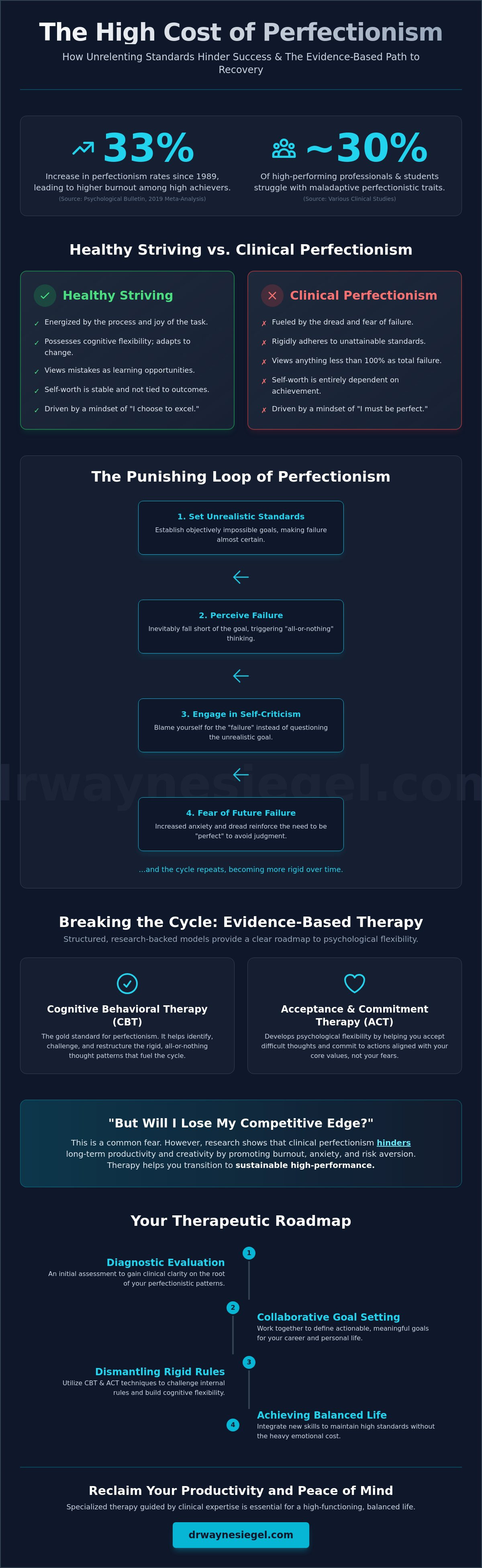
What if your drive for excellence is the very thing preventing your progress? A 2019 meta-analysis published in the journal Psychological Bulletin revealed that perfectionism has increased by 33% since 1989, leading to significantly higher rates of burnout among high achievers. You likely know the feeling of working tirelessly toward a goal only to be met with a sense of inadequacy once you reach it. It's exhausting to live under the weight of unrelenting standards that leave no room for human error. Seeking specialized therapy for overcoming perfectionism is often the first step toward reclaiming your productivity and peace of mind.
I want to help you find a more sustainable path forward. By utilizing evidence-based psychological frameworks, you can gain clinical clarity on the root of your anxiety and learn to dismantle these rigid internal rules. We'll explore how Cognitive Behavioral Therapy (CBT) and Acceptance and Commitment Therapy (ACT) help you develop psychological flexibility. This article outlines how these research-backed strategies allow you to keep your high standards while removing the heavy emotional price you've been paying for your success.
Key Takeaways
- Distinguish between healthy striving and clinical perfectionism to understand how tying your self-worth to achievement impacts your mental well-being.
- Discover how evidence-based frameworks like CBT and ACT provide a structured roadmap to dismantle rigid standards and foster psychological flexibility.
- Address the common fear of losing your competitive "edge" by exploring research that shows how perfectionism actually hinders long-term productivity and creativity.
- Learn why specialized therapy for overcoming perfectionism, guided by board-certified clinical expertise, is essential for achieving a high-functioning and balanced life.
- Gain clarity on the therapeutic process, from the initial diagnostic evaluation to setting collaborative, actionable goals for your career and personal relationships.
Understanding Clinical Perfectionism: More Than High Standards
I often meet individuals in my practice who view their high standards as their greatest asset, yet they feel a persistent, underlying sense of exhaustion. It's vital to recognize that clinical perfectionism isn't simply a desire to do well. Instead, it's a self-worth system where your value as a human being is tied exclusively to your latest achievement. When your identity depends on constant success, the pressure becomes a heavy burden that impacts every facet of your life. Understanding Clinical Perfectionism requires looking past the surface of "hard work" to see the rigid cognitive patterns beneath. Research conducted by Shafran, Cooper, and Fairburn in 2002 defines this state as the over-evaluation of striving and achievement, where one's self-esteem is entirely dependent on meeting demanding, self-imposed goals.
In my experience, "unrelenting standards" create a punishing cycle. You might feel a brief moment of relief when you hit a target, but that feeling is fleeting. Within minutes, the bar moves higher. This process doesn't lead to satisfaction; it leads to chronic anxiety and a fear that the next task will finally reveal you as "inadequate." Data from various clinical studies suggests that approximately 30% of undergraduate students and a similar percentage of high-performing professionals struggle with these maladaptive traits, which are often linked to burnout and depressive symptoms.
The Perfectionism Loop: A Cognitive Framework
The cycle of perfectionism is a closed loop of perceived failure. It begins when you set a goal that's objectively impossible to reach. When you don't meet that standard, you don't blame the unrealistic goal; you blame yourself. This triggers all-or-nothing thinking, a cognitive distortion where anything less than 100% is viewed as a total zero. I've seen how this serves as a maladaptive coping mechanism. By staying focused on "perfecting" a task, you're actually trying to protect yourself from the vulnerability of being judged or rejected. Engaging in therapy for overcoming perfectionism allows us to dismantle this loop and build a more resilient sense of self that isn't contingent on a checklist.
Perfectionism vs. Healthy Pursuit of Excellence
There's a significant difference between a healthy striper and a clinical perfectionist. A 2006 study by Stoeber and Otto highlights that healthy strivers focus on the process and the joy of the task. They possess cognitive flexibility, meaning they can adjust their expectations if they get sick or if a project's scope changes. Perfectionists, however, remain rigid. Clinical perfectionism is a rigid adherence to unattainable standards regardless of the physical or emotional cost. While high-achievers feel energized by their work, perfectionists are often fueled by the dread of failure. This distinction is a primary focus during therapy for overcoming perfectionism, as we work to transition from a mindset of "I must" to one of "I choose."
Evidence-Based Therapy Models for Overcoming Perfectionism
I believe that clinical clarity starts with a structured, scientific approach. When we explore Evidence-Based Therapy Models for Overcoming Perfectionism, we find that lasting change isn't a matter of willpower. It's the result of rigorous protocols that provide a roadmap for psychological health. My practice prioritizes measurable outcomes, ensuring that your recovery journey is grounded in objective milestones. Research, including a 2014 meta-analysis published in the Journal of Consulting and Clinical Psychology, indicates that structured interventions can reduce perfectionistic traits by significant margins, often showing measurable symptom reduction in 10 to 20 sessions.
I view the therapeutic process as a personal partnership. While the science behind the treatment is rigorous, the application must be person-centered. We don't just treat symptoms; we work together to understand the "why" behind your challenges. This combination of clinical authority and empathetic guidance creates a safe environment where you can dismantle high-pressure standards without losing your drive for excellence.
Cognitive Behavioral Therapy (CBT): Restructuring the Mind
CBT is the gold standard for treating the rigid thinking patterns associated with perfectionism. We focus on identifying "cognitive distortions," such as all-or-nothing thinking, where a single minor oversight feels like a total failure. I help patients design behavioral experiments to test these beliefs. For instance, a patient might intentionally leave a minor typo in an internal memo to gather data on the actual consequences. This evidence-based process helps you develop a realistic self-evaluation system, replacing harsh self-criticism with objective insight.
Acceptance and Commitment Therapy (ACT): Embracing Flexibility
ACT focuses on building psychological flexibility rather than just changing thought content. Through "cognitive defusion," I teach you to step back from self-critical thoughts, seeing them as mere language rather than absolute truths. We shift the focus from achievement-based self-worth to values-based living. This means your actions are guided by what matters to you, not by a fear of making mistakes. Mindfulness skills are essential here, as they allow you to tolerate the discomfort of being "imperfect" while staying committed to your long-term goals.
By integrating these models, I provide a clear path forward that balances technical proficiency with human compassion. If you're ready to move beyond labels and find actionable meaning in your struggle, I invite you to seek clarity through a professional evaluation. Together, we can build a cognitive profile that supports both your well-being and your genuine strengths.
Addressing the Fear: Will I Lose My Edge in Therapy?
I often hear a specific concern from high-achieving professionals: the fear that letting go of perfectionism will lead to mediocrity. You might worry that your relentless self-criticism is the very engine driving your success. In my practice, I've found that patients view their perfectionism as a necessary "edge" that keeps them ahead of the competition. However, clinical evidence suggests this engine often runs at a high cost to your long-term health and efficiency.
The goal of therapy isn't to lower your standards or make you less ambitious. Instead, we work to remove the psychological friction that slows you down. When we engage in therapy for overcoming perfectionism, we aren't discarding your drive; we are refining it. We move from fear-based motivation, which is exhausting and prone to burnout, to values-based motivation, which is sustainable and focused on genuine achievement.
The Productivity Paradox of Perfectionism
Research published in the Journal of Applied Psychology indicates that perfectionism has a negligible, and sometimes negative, correlation with actual job performance. This is known as the productivity paradox. The cognitive demand required to maintain impossible standards leads to "paralysis by analysis," a state where executive functioning is compromised by the fear of making a wrong choice. This often results in:
- Chronic procrastination as a defense against potential failure.
- Difficulty delegating tasks, leading to administrative bottlenecks.
- A significant reduction in creative risk-taking and innovation.
By learning to make faster decisions and accepting "good enough" for low-stakes tasks, you actually increase your total output. In some cases, these rigid patterns are a coping mechanism for other cognitive challenges. I often recommend a psychological assessment near me to identify if these perfectionist traits are masking underlying executive functioning issues, such as ADHD, which require specific clinical strategies to manage effectively.
Reframing Failure as Data
In a clinical setting, we use a process of desensitization to help you tolerate mistakes. We treat an "imperfect" outcome as a data point rather than a personal indictment. This shift is essential for building psychological resilience. A 2017 study on cognitive mindsets found that individuals who view failure as a learning opportunity are 47% more likely to persevere through complex challenges than those with fixed perfectionist views.
Through structured exposure to small, controlled "failures," I help you retrain your nervous system to understand that mistakes aren't catastrophic. This creates a safe environment where you can test new behaviors. Over time, this growth mindset allows you to pursue excellence without the paralyzing fear of being less than perfect, ultimately leading to a more stable and successful career path.
The Therapeutic Roadmap: What to Expect in Treatment
When you begin therapy for overcoming perfectionism with me, we start by creating a clear, evidence-based map of your cognitive landscape. I don't just look at surface-level symptoms; I look at the "why" behind the relentless drive for flawlessness. Our first step is an initial diagnostic evaluation to understand your unique cognitive profile. This involves using validated tools like the Multidimensional Perfectionism Scale (MPS), developed by Hewitt and Flett in 1990, which differentiates between self-oriented, other-oriented, and socially prescribed perfectionism. This data helps us see how your standards are functioning across different areas of your life.
We then move into collaborative goal setting. We don't aim for a vague sense of "feeling better." Instead, we target specific life domains such as work, relationships, and health. Research published in the Journal of Clinical Psychology in 2019 suggests that setting precise behavioral targets leads to a 25% higher rate of treatment adherence. I'll work with you to define what success looks like in your daily life, ensuring our objectives are both measurable and meaningful.
Phase 1: Awareness and Assessment
We begin by tracking perfectionistic thoughts and behaviors in real-time. This isn't about judgment; it's about gathering objective data. We use clinical guidance to identify the "cost-benefit" of your current standards. Many clients find that while high standards feel protective, they often correlate with a 40% increase in cortisol-related stress and chronic burnout. The assessment phase is a systematic diagnostic process to establish a baseline for growth.
Phase 2: Intervention and Exposure
This phase involves active skill-building designed to replace rigid habits with flexible responses. By engaging in these sessions, therapy for overcoming perfectionism becomes a practical laboratory for change. We use "perfectionism experiments" to practice lowering standards in low-stakes environments. For instance, you might intentionally leave a minor typo in a casual email to observe the actual consequences. We also focus on developing self-compassion as a clinical tool for emotional regulation. A 2021 meta-analysis found that self-compassion interventions significantly reduce the psychological distress associated with maladaptive perfectionism by providing a "buffer" against self-criticism.
A vital part of our work is learning to decouple your identity from your professional or academic output. You aren't your GPA or your year-end performance review. We use ongoing assessment of progress through standardized clinical measures to ensure we're moving in the right direction. This steady, deliberate process provides the clarity you need to improve your daily quality of life and find a sense of lasting stability.
Finding Specialized Care: The Value of Board Certification
When you seek therapy for overcoming perfectionism, the credentials of your psychologist matter. Board certification in clinical psychology represents the highest level of professional achievement in the field. While all psychologists must be licensed to practice, only about 4% of practitioners nationwide have successfully completed the rigorous peer-review process required for board certification. This distinction ensures that the care I provide meets stringent national standards for competence and ethical practice.
My approach is built on over 25 years of evidence-based experience. This extensive clinical history allows me to move beyond surface-level symptoms to address the underlying cognitive structures that drive perfectionistic behavior. I view every assessment as a unique puzzle. We aren't just looking for a label; we're looking for actionable meaning. By identifying your specific cognitive profile, we can create a roadmap that transforms your daily quality of life from a cycle of exhaustion into one of sustainable achievement.
National Access Through PsyPact
Accessing high-level specialized care is no longer limited by your physical proximity to a clinic. Through the Psychology Interjurisdictional Compact, residents in psypact states can receive treatment across state lines. This agreement currently includes over 40 states, providing a secure and regulated framework for interjurisdictional telehealth.
- Professional Standards: PsyPact psychologists must meet high benchmarks for education and training to practice under this authority.
- Enhanced Security: Telehealth sessions are conducted via HIPAA-compliant platforms to ensure your data remains confidential.
- Specialized Expertise: You can prioritize finding the right clinical fit over geographical convenience, ensuring you receive therapy for overcoming perfectionism from an expert who understands the nuance of the condition.
Your Next Steps Toward Clarity
The first step toward change is an initial consultation. This is a time for us to determine if my clinical approach aligns with your goals. During this meeting, I focus on the "therapeutic fit," which research consistently identifies as a primary predictor of successful outcomes. We'll discuss your history and the specific ways perfectionism limits your flexibility or well-being.
I want to help you transition from a life governed by "shoulds" to a life defined by intentionality. We'll work together to identify your strengths and build a strategy that emphasizes clarity over criticism. This process is about moving from a rigid set of rules to a flexible, resilient mindset. When you're ready to gain a clearer picture of your life and find a path forward, I'm here to serve as your steady, non-judgmental guide.
Embracing a Roadmap Toward Sustainable Excellence
Moving beyond the paralyzing grip of clinical perfectionism requires more than just willpower; it demands a structured, scientific approach. We've explored how evidence-based frameworks like Cognitive Behavioral Therapy (CBT) and Acceptance and Commitment Therapy (ACT) provide a roadmap for change without sacrificing your high standards. I've been Board-Certified in Clinical Psychology since 1996, and I've seen how these tools help individuals replace rigid self-criticism with functional excellence. You don't have to navigate this alone or worry about losing your competitive drive. Through therapy for overcoming perfectionism, we focus on the "why" behind your challenges to build a life of sustainable achievement. My practice offers national telehealth access via PsyPact, ensuring that rigorous, compassionate care is accessible regardless of your location. I'm here to help you translate these clinical insights into a clearer, more balanced daily reality. You deserve a life defined by your strengths rather than your anxieties.
Begin your journey toward clinical clarity with an evidence-based approach to recovery.
Frequently Asked Questions
Is perfectionism considered a mental health disorder?
Perfectionism isn't classified as a distinct mental health disorder in the DSM-5, but it's a transdiagnostic trait that underlies several clinical conditions. Research from the Journal of Clinical Psychology indicates that roughly 25% of the general population exhibits perfectionistic traits. I see it as a cognitive style that often fuels obsessive-compulsive disorder or eating disorders. We focus on the "why" behind these patterns to gain clarity on how they impact your daily life.
How long does therapy for perfectionism typically take to see results?
You can typically expect to see measurable shifts in your cognitive patterns within 12 to 20 weekly sessions. This timeframe is based on standardized protocols for therapy for overcoming perfectionism which prioritize evidence-based interventions. While some patients report improved insight after 4 sessions, deeper structural change in your self-evaluation process requires consistent practice. We'll use a roadmap to track your progress and ensure we're meeting your specific goals for emotional stability.
Can perfectionism be a symptom of ADHD or high-functioning anxiety?
Perfectionism often manifests as a compensatory mechanism for ADHD or a core feature of high-functioning anxiety. A 2018 study in the Journal of Attention Disorders found that adults with ADHD often use perfectionistic behaviors to mask executive functioning challenges. It's a way to avoid the perceived "failure" of forgetfulness or impulsivity. By conducting a thorough neuropsychological profile, I can help you determine if your standards are a response to these underlying neurodivergent traits.
What is the difference between CBT and ACT for treating perfectionism?
Cognitive Behavioral Therapy (CBT) focuses on identifying and restructuring distorted thought patterns, while Acceptance and Commitment Therapy (ACT) emphasizes psychological flexibility and value-based living. CBT might ask you to test the validity of a "must" statement. In contrast, ACT teaches you to observe that thought without letting it dictate your actions. Both are evidence-based approaches I use to help you build a more resilient and compassionate relationship with your achievements.
Will therapy for perfectionism make me less ambitious or successful?
Therapy doesn't reduce your ambition; it shifts you from "maladaptive" perfectionism to "adaptive" excellence. Research published in the Review of General Psychology shows that maladaptive perfectionists often have lower productivity due to procrastination and fear of failure. By refining your approach, you can maintain high standards without the paralyzing self-criticism. This process actually enhances your professional performance by improving your executive functioning and reducing burnout.
How do I know if my standards are "unrelenting" or just high?
Your standards are considered "unrelenting" when you continue to pursue them despite significant negative consequences to your health, relationships, or well-being. High standards become problematic when your self-worth is entirely dependent on achieving them. For example, if you feel like a total failure after a 95% score, that's a sign of clinical perfectionism. I help you find clarity by distinguishing between a healthy drive for quality and a rigid need for flawlessness.
Is online therapy effective for overcoming deep-seated perfectionistic traits?
Online therapy is highly effective for treating perfectionism, with a 2020 meta-analysis in the Journal of Medical Internet Research showing outcomes equal to in-person care. Digital platforms allow for real-time application of strategies in your natural environment. This accessibility often lowers the barrier to seeking help. I provide a secure, professional virtual space where we can work through your cognitive profile with the same rigor and empathy as an office visit.