
How to Find a Therapist That is a Good Fit: An Evidence-Based Guide

Did you know that the quality of your relationship with a provider is a better predictor of your success than the specific type of therapy they use? A landmark meta-analysis published in the journal Psychotherapy involving over 30,000 cases found that the therapeutic alliance accounts for roughly 30% of the variance in treatment outcomes. If you've felt anxious about the prospect of "starting over" or confused by the complex "alphabet soup" of credentials like PhD, PsyD, and LICSW, you aren't alone. Learning how to find a therapist that is a good fit isn't just about a gut feeling; it's a measurable process that can significantly reduce your barrier to care.
I believe that clarity is the first step toward healing. You deserve a roadmap that balances clinical expertise with a genuine personal connection. In this guide, I'll provide you with a research-backed framework to identify a provider who aligns with your specific psychological goals and cognitive needs. We'll examine the distinction between a practitioner's technical skill and their relational rapport, culminating in a clear checklist to help you book your first session with total confidence.
Key Takeaways
- Learn why the therapeutic alliance is the single most important predictor of clinical success, often carrying more weight than the specific treatment modality itself.
- Discover how to navigate the hierarchy of clinical credentials and why seeking a specialist is essential for addressing complex psychological needs.
- Utilize a professional consultation framework to master how to find a therapist that is a good fit by asking targeted questions about clinical approach and transparency.
- Evaluate the practical elements of a sustainable partnership, including the long-term benefits of out-of-network care and the expanded accessibility offered by PsyPact.
- Gain clarity on how evidence-based frameworks like CBT and ACT provide a measurable roadmap for achieving your personal mental health goals.
The Science of the Therapeutic Alliance: Why "Fit" Predicts Progress
I often tell my patients that the most sophisticated diagnostic tools are only as effective as the relationship supporting them. When you begin your search for support, you might focus on a provider's degrees or years of experience. While these credentials matter, the clinical evidence suggests a different priority. The quality of the relationship between you and your clinician, known as the therapeutic alliance, is the most consistent predictor of a positive outcome. The Science of the Therapeutic Alliance demonstrates that this collaborative bond is more than just a "vibe." It's a structured partnership designed to facilitate neurological change.
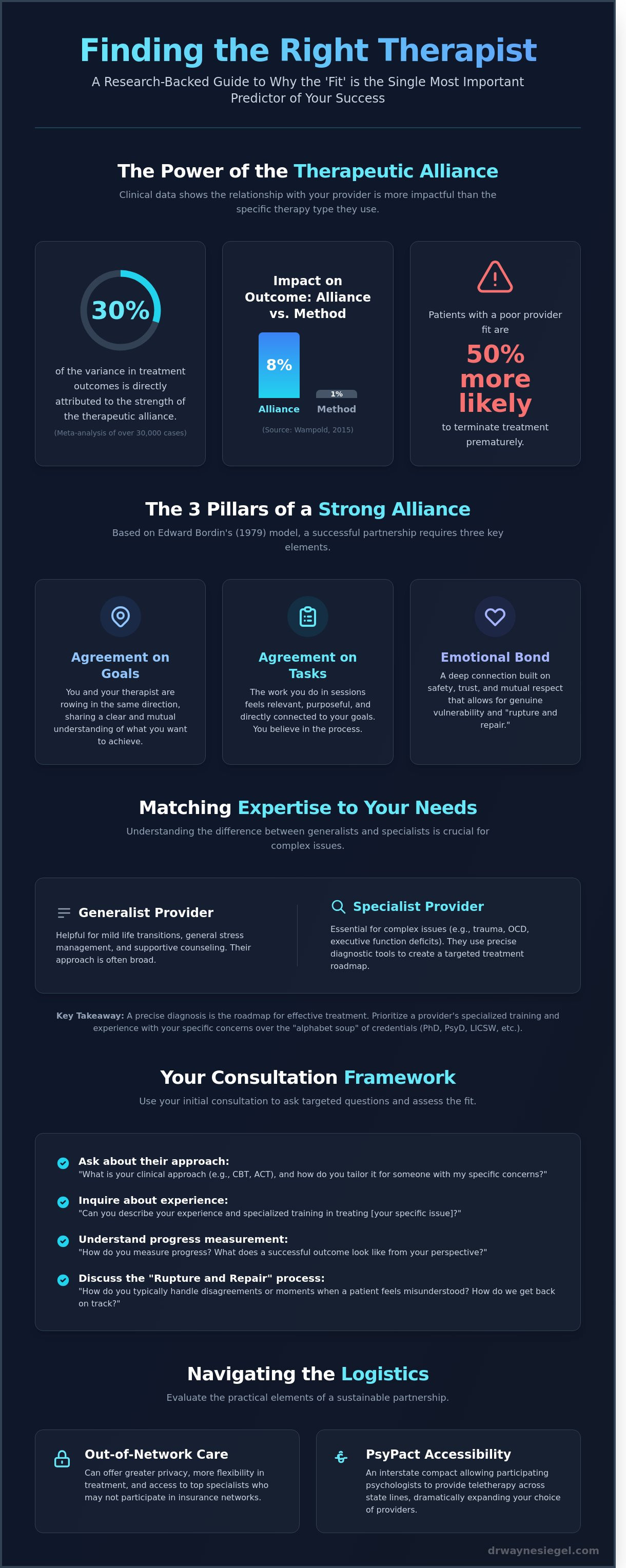
A 2018 meta-analysis published by the American Psychological Association found that the alliance is a stronger predictor of patient improvement than the specific type of therapy practiced. Whether a therapist uses Cognitive Behavioral Therapy or psychodynamic approaches, the results often depend on the strength of the connection. Research by Dr. Bruce Wampold in 2015 indicated that the alliance accounts for roughly 8% of the variance in therapy outcomes, while the specific treatment method accounts for only about 1%. Learning how to find a therapist that is a good fit requires looking for this specific synergy. When the fit is poor, patients are 50% more likely to terminate treatment prematurely, which often leads to stagnation and a sense of defeat.
The Three Components of a Strong Alliance
Research by Edward Bordin in 1979 identified three distinct pillars that define a successful alliance. First, you must have agreement on goals; you and your therapist need to be rowing in the same direction. Second, there must be agreement on tasks, meaning the actual work done in sessions feels relevant to your needs. Finally, a deep emotional bond characterized by safety and respect must exist to allow for true vulnerability. Without these three elements, the "work" of therapy lacks the necessary foundation to produce lasting clarity.
Evidence-Based Outcomes and Rapport
A strong rapport does more than make you feel comfortable. It facilitates neurological safety. When you feel heard and respected, your nervous system can move out of a "fight or flight" state, allowing for better emotional regulation and cognitive processing. This is why a "challenging" therapist can sometimes be a better fit than one who is simply agreeable. A skilled clinician will push you toward growth while maintaining a foundation of support. This process often involves "rupture and repair," where small misunderstandings are addressed and resolved. This cycle actually strengthens the bond, teaching you that relationships can survive conflict. Understanding these dynamics is essential when determining how to find a therapist that is a good fit for your long-term cognitive and emotional health.
I view every initial consultation as the start of a unique puzzle. We aren't just looking for a doctor; we are looking for the roadmap that leads to your specific goals. This professional partnership differs from a social connection because it's entirely focused on your growth and data-driven progress. It's a quiet, focused dialogue in a professional office, structured enough to be efficient but open enough for you to feel truly heard.
Decoding Credentials and Modalities: Matching Expertise to Need
Choosing a therapist often feels like deciphering a secret code. You encounter strings of letters like PhD, LCSW, or LMHC and wonder how these titles impact your daily life. Understanding these distinctions is the first step in learning how to find a therapist that is a good fit for your unique cognitive and emotional profile. I believe that clarity at the start of your journey leads to more sustainable outcomes. When you know what a clinician is trained to do, you can better predict if they can solve the specific puzzle you're facing.
Specialization matters. While a generalist may be helpful for mild life transitions, complex issues require a deeper level of expertise. For instance, if you suspect an underlying executive functioning deficit, a therapist with a general counseling background might miss the nuances that a specialist would catch. I often tell my patients that a precise diagnosis is the roadmap for effective treatment. Without it, you're just driving without a GPS. Research indicates that clinicians who specialize in specific disorders often achieve better patient outcomes than those who maintain a broad, general practice.
PhD vs. PsyD: Understanding Doctoral-Level Training
Doctoral-level psychologists usually spend 5 to 7 years in graduate school. A PhD program focuses heavily on research and clinical rigor, training the clinician to think like a scientist. A PsyD, or Doctor of Psychology, focuses more on the clinical application of those scientific principles. Both degrees require a one-year full-time internship and often a post-doctoral fellowship. This extensive training translates to a higher proficiency in performing comprehensive diagnostic psychological evaluations. If you want the highest level of verified expertise, look for a therapist who is board certified through the American Board of Professional Psychology (ABPP). This certification is a rigorous gold standard that only about 4% of licensed psychologists in the United States achieve.
CBT, ACT, and Beyond: Finding Your Modality
The method a therapist uses is just as important as their degree. When Decoding Credentials and Modalities, you'll likely encounter Cognitive Behavioral Therapy (CBT) and Acceptance and Commitment Therapy (ACT). CBT is a structured, skill-based approach. It's highly effective for anxiety and depression because it focuses on changing the thought patterns that drive your emotions. Data from the National Institute of Mental Health suggests that these evidence-based practices offer some of the most reliable results for long-term symptom relief, often showing significant improvement in 12 to 20 sessions.
ACT takes a different path by focusing on value-driven life changes. Instead of trying to eliminate difficult thoughts, ACT teaches you to accept them and move toward what matters most to you. It's a powerful tool for those who feel stuck in a cycle of avoidance. Identifying which approach aligns with your learning style is a key part of how to find a therapist that is a good fit. Some people prefer the logical, homework-heavy structure of CBT. Others find more peace in the mindfulness and acceptance found in ACT. I find that when the modality matches the patient's personality, the therapeutic bond strengthens significantly.
Reading a therapist’s profile requires a bit of detective work. Look for clues about their clinical philosophy. Do they mention evidence-based practices? Do they talk about measurable goals or insight-oriented work? These terms reveal whether they prioritize data or intuition. If you're looking for a partner to help navigate complex cognitive landscapes, I invite you to see how a neuropsychological perspective can provide the roadmap you need. A good profile should feel like a personal invitation to a partnership, not a cold list of accomplishments.
The Consultation Framework: Essential Questions to Ask a Potential Therapist
I view the 15-minute consultation as a vital diagnostic tool for the patient. It isn't just a brief chat. It's a professional interview where you evaluate my expertise and my ability to create a safe, non-judgmental space. Research suggests that the therapeutic alliance, the bond between therapist and client, is responsible for approximately 30% of the success in any treatment. This makes the initial consultation the primary method for learning how to find a therapist that is a good fit for your unique cognitive and emotional needs.
Transparency regarding the "why" and "how" of therapy builds the foundation of trust. I encourage you to ask about fees, insurance, and scheduling during the first five minutes. If you require flexibility, verify their telehealth capabilities. For instance, many practitioners now utilize PsyPact, which as of 2024 allows psychologists to provide services across 42 participating states. This legal framework ensures that your care remains consistent even if you travel or relocate. You should also consult the American Psychological Association guide to finding a therapist to understand which evidence-based questions provide the most clarity during this initial call.
Clinical and Logistics Questions
Effective therapy requires a roadmap grounded in science. Ask the clinician about their specific experience treating your symptoms, whether you're struggling with executive functioning or complex trauma. You need to know if they use evidence-based practices. Ask, "How do you measure progress in your patients?" A clinician should be able to name specific metrics, such as the use of standardized assessments or weekly outcome rating scales. This objective data ensures that your journey is moving toward a defined goal rather than drifting aimlessly. Understanding their clinical framework helps you determine how to find a therapist that is a good fit for your long-term mental health strategy.
Assessing the "Person-Centered" Connection
Beyond the data, you must evaluate the therapist's listening style. Are they interrupting you to fit your story into a pre-set box, or are they truly hearing your narrative? I often describe my own style as a balance between being active and directive when providing insights, yet passive and reflective when you need space to process. Ask the therapist how they describe their own style. If they can't articulate their approach clearly, it may indicate a lack of clinical intentionality. Trust your intuition after the data has been collected. If you feel a sense of calm stability during the call, it's a strong indicator of future success.
Watch for specific red flags that suggest a lack of professional integrity. If a therapist is distracted, checks their phone, or cannot provide a clear fee schedule, these are indicators of poor boundaries. A 2021 study on therapeutic outcomes noted that clinicians who fail to establish clear expectations in the first session have a 40% higher patient dropout rate. You deserve a practitioner who is as meticulous about their professional conduct as they are about their clinical science.
- Lack of transparency: Vague answers about costs or credentials.
- Dismissiveness: Minimizing your concerns or symptoms during the first ten minutes.
- Poor communication: Taking more than 48 hours to respond to an initial inquiry.
- Rigidity: An inability to adapt their evidence-based approach to your personal strengths and values.
Finding clarity in your mental health journey starts with these precise, intentional questions. By treating the consultation as a formal vetting process, you transform from a passive recipient of care into an empowered partner in your own healing. This structured approach provides the roadmap you need to move from confusion to insight.
Practical Considerations: Insurance, Accessibility, and PsyPact
I've observed that the most successful therapeutic journeys are built on a foundation of sustainability. When you're researching how to find a therapist that is a good fit, you have to look beyond the clinical rapport to the practical realities of your life. A therapist might be brilliant; however, if their office is a 90 minute commute or their fees create a monthly financial crisis, the stress of attending will eventually outweigh the benefits of the session. I encourage you to view the logistical side of care as a vital component of the healing process itself. A sustainable fit is one that you can maintain for the full duration of your treatment roadmap without added strain.
Many patients find that out of network care offers a level of clinical freedom that isn't possible within the constraints of standard insurance plans. Approximately 30% of psychologists in the United States operate on a private pay basis to avoid the dictated timelines and diagnostic requirements of insurance companies. This model ensures your privacy because we don't have to share your detailed clinical notes or a specific diagnosis with a third party payer to justify your care. It allows us to focus entirely on your goals rather than meeting an arbitrary number of sessions set by an actuary. We can move at a pace that respects your unique cognitive and emotional needs.
The emergence of PsyPact has fundamentally changed the search for specialized care. PsyPact is an interstate compact that currently allows licensed psychologists in 42 states to practice telepsychology across state lines. This is a significant development for anyone looking for a highly specific expert, such as a neuropsychologist who specializes in adult ADHD or complex executive functioning issues. You're no longer limited to the providers in your immediate zip code. If the specialist who best understands your profile is three states away, you can still receive the same high caliber of care through a secure digital platform.
While I maintain a strong local presence in Minneapolis, I've seen how a hybrid approach benefits my patients. About 53% of therapy seekers now prefer a combination of in person and online options. This flexibility reduces the friction of therapy. You can visit the office when you need that face to face connection but switch to a virtual session when a busy work week or Minnesota winter weather makes travel difficult. Balancing local expertise with digital convenience ensures that your care remains a consistent part of your routine.
The Value of Specialized Assessment
Understanding the "why" behind your struggles is the first step toward finding clarity. A formal diagnostic psychological evaluation can clarify exactly what kind of therapist you need by identifying your specific cognitive profile. For example, an ADHD assessment can reveal if your challenges are rooted in executive functioning or if they're a byproduct of anxiety. You can learn more about this process in A Guide to Psychological Evaluations in Minneapolis to see how data can guide your search.
Navigating Telehealth Benefits
Digital access has removed many traditional barriers to mental health support. A 2018 study published in the Journal of Affective Disorders confirmed that online Cognitive Behavioral Therapy (CBT) and Acceptance and Commitment Therapy (ACT) are 100% as effective as in person sessions for treating anxiety and depression. By reducing the time spent commuting, you can focus your energy entirely on the work of growth. For more details on this, see Your Guide to Online Therapy Through PsyPact States.
If you're ready to gain a clearer picture of your cognitive health and find a sustainable path forward, contact my office today to schedule a comprehensive evaluation.
Finding Clarity with Siegel Psychology Services
Choosing a mental health professional often feels like a daunting task. When you're researching how to find a therapist that is a good fit, you're likely looking for a combination of high-level expertise and a sense of safety. My practice, Siegel Psychology Services, is built on the foundation of 25 years of clinical experience. I provide a space where rigorous science meets a compassionate, person-centered approach. This means your treatment isn't a one-size-fits-all template; it's a tailored strategy designed for your specific cognitive and emotional profile.
I rely exclusively on evidence-based practices like Cognitive Behavioral Therapy (CBT) and Acceptance and Commitment Therapy (ACT). These aren't just buzzwords. They're modalities backed by decades of research. For example, clinical data suggests that 60% of individuals with chronic anxiety see significant symptom reduction within 15 sessions of structured CBT. By focusing on these methods, I help you achieve measurable growth. We track your progress using objective markers, ensuring that our work leads to tangible improvements in your daily quality of life.
Specialization is key to finding clarity. Many of my patients come to me struggling with complex diagnostics, such as adult ADHD or the long-term effects of trauma. According to 2023 clinical reports, nearly 4.4% of adults in the U.S. live with ADHD, yet many remain undiagnosed or mismanaged. My diagnostic process goes beyond the surface level. I conduct thorough neuropsychological assessments to uncover the "why" behind executive functioning struggles. This deep dive provides a roadmap that turns confusion into actionable insight. We don't just label a condition; we map out a path to navigate it.
- Adult ADHD: Precision diagnostics to improve executive function.
- Trauma: Evidence-based care for complex PTSD and emotional regulation.
- Measurable Growth: Using ACT and CBT to track real-world progress.
- Board-Certified Care: Expert guidance backed by the highest national standards.
Clarity is the ultimate goal of our partnership. When you understand the architecture of your own mind, the path forward becomes visible. I view every assessment as a unique puzzle. My role is to help you assemble the pieces with precision and care. This collaborative process ensures that you leave each session with a clearer picture of your strengths and a concrete plan for your challenges. It's about moving from a state of emotional disarray to one of focused, intentional living.
Why Board Certification Matters
Board certification through the American Board of Professional Psychology (ABPP) is a distinction held by roughly 4% of psychologists nationwide. This credential involves a multi-year, rigorous peer-review process that validates a practitioner's expertise and ethical standards. With 25 years of private practice, I offer a steady, non-judgmental hand. This certification is your assurance that the care you receive meets the highest professional benchmarks in the field today.
Next Steps to Your Therapeutic Journey
Taking the first step is often the hardest part of learning how to find a therapist that is a good fit. I invite you to contact my Minneapolis office to schedule an initial 60-minute consultation. We offer in-person and national telehealth services. In this first session, we'll build your roadmap, identifying your immediate needs and long-term goals. Your journey toward clarity starts with a single, focused conversation.
Taking the Next Step Toward Lasting Clarity
The search for mental health support is a significant step toward personal insight. Research from sources like the American Psychological Association indicates that the therapeutic alliance accounts for approximately 30% of the variance in treatment outcomes. This clinical data underscores why understanding how to find a therapist that is a good fit remains the most critical factor in your healing journey. By evaluating specific credentials and utilizing a structured consultation framework, you move beyond guesswork into a process grounded in verifiable evidence.
Choosing a provider with verified expertise ensures your care is both ethical and effective. With over 25 years of clinical experience and Board Certification in Clinical Psychology (ABPP), I provide a stable roadmap for those seeking deep, actionable clarity. My practice is also PsyPact authorized, which allows me to offer telehealth services to patients in more than 40 states. You don't have to navigate these complex emotional landscapes alone.
Schedule a Consultation for Clarity with Dr. Siegel
You deserve a professional partnership that honors your unique history while focusing on your future strengths and long-term well-being.
Frequently Asked Questions
How many sessions does it take to know if a therapist is a good fit?
You should typically expect to spend 3 to 4 sessions with a provider before deciding if the relationship is productive. This timeframe allows you to move past initial intake paperwork and experience their actual clinical style. Research indicates that the therapeutic alliance is responsible for 30% of patient improvement. I find that this early period is essential for building the trust required to navigate your personal journey with confidence.
Is it okay to "fire" my therapist if it doesn't feel right?
It's entirely appropriate to end a relationship with a therapist if you don't feel a sense of progress or safety. Data from the Journal of Counseling Psychology shows that about 20% of clients choose to switch providers during their treatment. I recommend having one final session to discuss your concerns openly. This conversation often provides valuable insight and helps ensure your next referral is a more precise match for your goals.
What is the difference between a psychologist and a psychiatrist?
The distinction between these roles is rooted in their educational background and treatment focus. Psychologists hold a doctoral degree, such as a PhD or PsyD, and specialize in behavioral health and psychological testing. Psychiatrists are medical doctors who primarily manage the biological aspects of mental health through medication. In my practice, I often use neuropsychological data to coordinate care between these two disciplines, providing a more complete roadmap for your well-being.
Can I see a therapist who lives in a different state?
You can only work with a therapist in another state if they hold a valid license to practice in your specific location. As of 2024, 42 states have joined PSYPACT, an agreement that permits psychologists to provide telepsychology services across state borders legally. I suggest checking the PSYPACT map or your state’s licensing board website. This step ensures your care is ethical and that your provider meets the rigorous standards required for your area.
Does a therapist's gender or age matter for a good fit?
Demographics like age and gender only matter if they influence your comfort level and the strength of your therapeutic bond. While some research suggests that shared identity can improve initial rapport, the clinician's expertise is the primary driver of long-term success. When you're learning how to find a therapist that is a good fit, prioritize a provider’s specific training and their ability to offer a non-judgmental space that respects your unique history.
What should I do if I can't afford the therapist I like?
If cost is a concern, you should ask the provider if they offer a sliding scale fee or have openings through the Open Path Collective. Many clinicians, roughly 15% in private practice, set aside specific hours for clients who need financial flexibility. You can also request a superbill to submit to your insurance. Many PPO plans reimburse between 60% and 80% of out-of-network costs, which makes high-quality care more accessible for your budget.
How do I know if I need therapy or a psychological assessment?
You need a psychological assessment when you require a definitive diagnosis or a detailed map of your cognitive functioning. Therapy provides ongoing support for emotional challenges, but an evaluation uses standardized tools to uncover the reasons behind your struggles. Understanding how to find a therapist that is a good fit often starts with this objective data. I use these assessments to provide the clarity you need to choose an effective treatment path.