
How to Rebuild Self-Worth After Depression: An Evidence-Based Roadmap

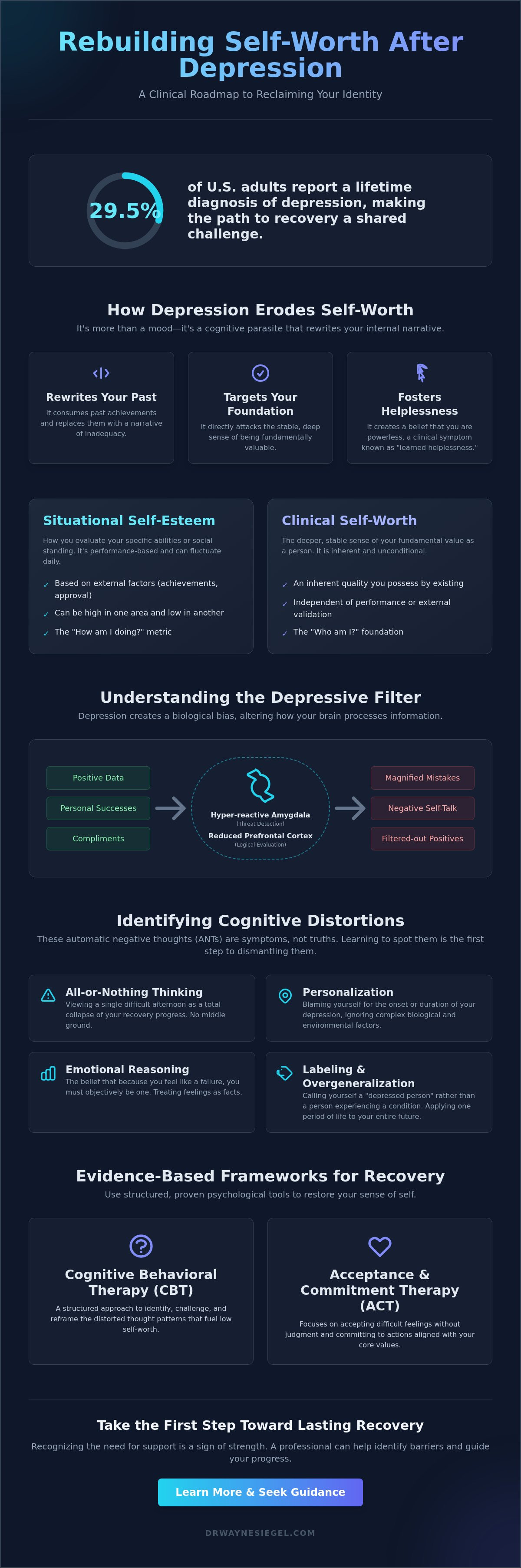
As of early 2026, 29.5% of U.S. adults have reported a lifetime diagnosis of depression, a statistic that reflects a significant and growing challenge in our communities. When the heaviest symptoms of a depressive episode finally begin to recede, you might expect a natural return to your former self. Instead, many of my patients describe a lingering sense of being a burden or a profound loss of identity that makes the future feel out of reach. If you're struggling with these feelings, you're likely searching for clarity on how to rebuild self-worth after depression without relying on empty platitudes.
I believe that restoring your sense of self requires more than just time; it requires a structured, evidence-based approach. We're going to look at a clinical framework for recovery that moves beyond simple "positive thinking" to focus on cognitive restructuring and behavioral shifts. This roadmap is grounded in the latest research and the diagnostic standards of the DSM-5-TR. I'll show you how to use psychological tools to regain your confidence and understand the biological "why" behind your current perspective. Together, we can turn this period of uncertainty into a clear path toward a more stable and self-assured life.
Key Takeaways
- Learn to distinguish between situational self-esteem and clinical self-worth to understand how depression functions as a cognitive parasite.
- Gain the ability to identify automatic negative thoughts and the all-or-nothing thinking trap that often stalls recovery efforts.
- Discover how to rebuild self-worth after depression using evidence-based frameworks like Cognitive Behavioral Therapy and Acceptance and Commitment Therapy.
- Implement practical protocols such as behavioral activation through low-stakes mastery tasks and research-backed self-compassion techniques.
- Recognize the clinical signs that indicate a need for a professional psychological assessment to identify underlying barriers to your progress.
The Erosion of Identity: Why Depression Damages Self-Worth
When you're navigating the aftermath of a depressive episode, you might notice a strange disconnect. Your energy is returning and your sleep is stabilizing, yet your sense of self remains fractured. I often explain to my patients that depression doesn't just lower your mood; it actively rewrites your autobiography. It functions as a cognitive parasite that consumes your past achievements and replaces them with a narrative of inadequacy. While Understanding Self-Esteem is often about how we evaluate our specific abilities or social standing, self-worth is the deeper, more stable sense of being fundamentally valuable. Depression targets this foundation, making the process of learning how to rebuild self-worth after depression feel like a steep uphill climb.
This erosion is often driven by a phenomenon known as learned helplessness. When you've spent months or years feeling unable to change your emotional state, your brain begins to believe that you're powerless in all areas of life. This isn't a personal failure or a lack of willpower. It's a standard clinical symptom. Your self-concept becomes a casualty of the illness, leaving you feeling "lost" or like a ghost of your former self. Validating this experience as a biological and cognitive result of depression is the first step toward reclaiming your identity.
The Difference Between Mood and Worth
Self-worth often lags behind physical recovery because the brain's "software" takes longer to update than its "hardware." Even after your neurochemistry begins to balance out, the residue of depressive thinking patterns remains. I want you to consider a vital shift in perspective: worth is an inherent quality, not a performance-based metric. You don't "earn" worth through productivity or social approval; you possess it simply by existing. Recognizing that your value didn't actually disappear, but was merely obscured, is essential for long-term stability.
Understanding the Depressive Filter
Depression creates a biological bias in how you process information. Research shows that during and after an episode, the amygdala, which handles emotional threats, often remains hyper-reactive. Meanwhile, the prefrontal cortex, responsible for logical self-evaluation, may have reduced activity. This imbalance creates a "depressive filter" that magnifies every mistake while filtering out positive data or personal successes. The depressive filter is a cognitive bias that persists post-episode, continuing to prioritize negative information even as your mood improves. By identifying this filter, we can begin to use evidence-based tools to see the world, and ourselves, with more clarity.
The Cognitive Architecture of Self-Worth: Identifying Distortions
To understand how to rebuild self-worth after depression, we must first examine the structural blueprints of your internal dialogue. While the clinical symptoms of a depressive episode might dissipate, the cognitive architecture often remains skewed toward self-criticism. This is largely due to automatic negative thoughts, or ANTs. These are reflexive, unbidden evaluations that bypass logical scrutiny. For many, these thoughts coalesce into emotional reasoning. This is the belief that because you feel like a failure, you must objectively be one. It's a logic error that treats a transient emotional state as a permanent fact of your identity.
Another common distortion is personalization. This occurs when you blame yourself for the onset or duration of your depression, ignoring the complex biological and environmental factors involved. This often pairs with all-or-nothing thinking. In this trap, a single difficult afternoon is interpreted as a total collapse of your recovery progress. Consulting an NHS guide to raising self-esteem can provide helpful initial context for these patterns. However, identifying these specific distortions is the essential first step in dismantling the depressive filter we discussed earlier. It's about seeing the thought for what it is: a symptom, not a truth.
Labeling and Overgeneralization
Depression often leads to the adoption of sticky labels. You might call yourself a "depressed person" rather than a person experiencing a clinical condition. This overgeneralization takes a single period of your life and applies it to your entire future trajectory. To counter this, I encourage patients to view setbacks as isolated data points rather than evidence of a character flaw. If you find these labels hard to shed, a professional psychological assessment can help provide the clinical clarity needed to separate your identity from your symptoms.
The Role of Rumination
Rumination is the brain’s tendency to loop on past mistakes or perceived inadequacies. It’s a significant barrier to rebuilding self-worth because it keeps the negative data from the depressive episode active in your working memory. Research indicates that high levels of rumination correlate with a longer duration of low self-worth. Clinical counters include:
- Active Engagement: Immersing yourself in tasks that require high focus to break the loop.
- Distraction: Using sensory-based grounding to exit the internal dialogue.
- Cognitive Reframing: Challenging the validity of the looping thought with objective evidence.
By shifting from passive thinking to active engagement, you can begin to quiet the internal critic and create space for a more balanced self-view.
Evidence-Based Frameworks: Using CBT and ACT to Restore the Self
Moving from the awareness of your thought patterns to active healing requires a structured, clinical approach. Cognitive Behavioral Therapy (CBT) and Acceptance and Commitment Therapy (ACT) are the primary evidence-based modalities I use to help patients navigate this transition. These frameworks don't just ask you to "think positively." Instead, they provide the technical tools for how to rebuild self-worth after depression by addressing the specific cognitive habits that maintain low self-evaluation. By engaging with these methods, you transition from being a passive observer of your symptoms to an active participant in your recovery journey.
CBT focuses on reality-testing, treating your negative self-beliefs as hypotheses rather than established facts. In contrast, ACT sessions, which in 2026 typically cost between $100 and $250 per session, prioritize psychological flexibility. The core of ACT is values-based living rather than goal-based living. While goals are binary outcomes that can trigger a sense of failure if not met, values are constant directions. If you value "contribution," you can act on that value through small, daily actions regardless of your current mood. These modalities offer a roadmap to clinical clarity that helps you align your behavior with your identity, even when your internal critic is loud.
Cognitive Restructuring for Self-Worth
Cognitive restructuring is the systematic process of replacing distorted beliefs with facts. The "Evidence For/Evidence Against" technique is a cornerstone of this practice. To use it, identify a specific belief, such as "I have nothing to offer." You then create a two-column list. In the first, you list objective evidence that supports the thought. In the second, you list verifiable facts that contradict it, such as a time you helped a colleague or completed a task. This data-driven approach forces the brain to acknowledge successes it would otherwise filter out through the depressive lens.
ACT and the Power of Self-as-Context
ACT introduces the "Chessboard Metaphor" to help you separate your worth from your internal experiences. In this view, your thoughts and feelings are like the pieces moving across the board. Some are "positive" and some are "negative," but you are the board itself. The board is not damaged or changed by the pieces moving across it. Mindfulness techniques allow you to observe your depressive history without letting it define your inherent value. This creates the necessary space to see yourself as the observer of your thoughts, rather than the victim of them.
Practical Steps for Rebuilding: A Roadmap to Recovery
Once we've identified the cognitive distortions that maintain low self-evaluation, the next phase of your journey involves behavioral implementation. This is where we move from theory to action. Understanding how to rebuild self-worth after depression requires a commitment to small, data-driven shifts in your daily routine. We're not looking for overnight transformations; we're looking for the consistent accumulation of "micro-wins" that eventually override the depressive filter. This process is about providing your brain with undeniable evidence of your competence and value.
I often recommend starting with an Evidence Journal. Unlike a standard diary, this tool is designed to track daily successes that your brain might otherwise ignore. Research into Dr. Kristin Neff's self-compassion protocol suggests that acknowledging our common humanity is vital for recovery. In early 2026, with 19.1% of U.S. adults reporting current treatment for depression, it's clear that you aren't alone in this struggle. Neff’s framework encourages self-kindness and mindfulness, helping you treat yourself with the same clinical objectivity and care you'd offer a friend. We also focus on identity-neutral goals. These are objectives that don't tie your value to the outcome, such as "walking for ten minutes" rather than "getting fit," which helps reduce the performance pressure that often triggers a relapse into self-criticism.
Mastery and Competence
Completing small, tangible tasks is essential because it rebuilds the competence circuit in your brain. When you finish a task, your brain receives a hit of dopamine, reinforcing the belief that you're capable of affecting change in your environment. I suggest choosing activities that provide immediate feedback, like organizing a single drawer or completing a brief puzzle. As your confidence grows, we use graduated exposure to social situations. You might start with a five-minute phone call before moving to a coffee date. If you're finding it difficult to establish these routines independently, a professional clinical roadmap can help you identify the specific barriers to your progress.
Nurturing a Supportive Social Map
Your environment plays a significant role in your self-perception. I encourage patients to audit their social circle, identifying "fillers" who provide support and "drainers" who exacerbate feelings of inadequacy. Clear communication is your best tool here; telling loved ones exactly what kind of support you need reduces the anxiety of feeling like a burden. In cases where the depressive episode was triggered by a specific event, ptsd counseling principles can be particularly effective. These evidence-based trauma recovery techniques help you process the past so it no longer dictates your current sense of worth.
When to Seek Professional Guidance for Lasting Recovery
While the strategies we've discussed provide a solid foundation, some individuals find that their sense of self remains static despite their best efforts. This often indicates that self-worth issues are part of a more complex diagnostic picture. If you're finding it difficult to implement the tools for how to rebuild self-worth after depression, it's not a sign of weakness. It's a sign that your cognitive profile may require a more tailored, clinical intervention. A board-certified psychologist serves as a steady, non-judgmental guide to help you navigate these emotional landscapes with precision and care.
Specialized care is now more accessible than ever. In 2026, the expansion of psypact states allows patients to receive expert interjurisdictional telehealth across much of the U.S. This is particularly beneficial if you require a psychological assessment to identify underlying barriers such as executive functioning deficits or undiagnosed trauma. These evaluations move beyond surface symptoms to uncover the "why" behind your challenges. They provide a level of clinical clarity that self-help alone cannot achieve, turning a vague sense of struggle into an actionable roadmap.
Beyond Self-Help: The Therapeutic Partnership
There's a distinct difference between "venting" and evidence-based psychotherapy. While sharing your feelings provides temporary emotional relief, modalities like CBT and ACT focus on structural change. When you're looking for a therapist, prioritize those with board certification and specific expertise in these frameworks. A psychologist helps you navigate complex emotional landscapes by identifying the subtle cognitive loops that keep you stuck. This partnership transforms recovery from a solitary struggle into a collaborative journey grounded in rigorous science.
Next Steps: Taking Action
Taking the first step is often the most difficult part of the process. I encourage you to view professional guidance as a pragmatic investment in your daily quality of life. Recovery isn't just about effort; it's about precision. By using the right clinical tools and professional support, you can move beyond the labels of the past and the "depressive filter" that has clouded your vision. Long-term stability is a realistic goal. With a clear roadmap and the right support, you can regain the confidence to envision a positive, purposeful future.
Reclaiming Your Sense of Self with Clinical Precision
Rebuilding your identity after a depressive episode isn't a matter of willpower; it’s a matter of using the right psychological tools. Identifying cognitive distortions and implementing behavioral activation helps dismantle the depressive filter. By shifting from goal-based pressure to values-based living, you create a stable foundation for recovery. Understanding how to rebuild self-worth after depression requires moving beyond labels and focusing on the verifiable evidence of your inherent value. Recovery isn't just about effort. It's about precision.
I'm here to provide the clinical clarity you need to move forward. As a board-certified clinical psychologist with 25 years of experience, I specialize in evidence-based treatments like CBT and ACT. Through PsyPact, I provide interjurisdictional telehealth to patients across the country, ensuring that specialized care is accessible regardless of your location. You don't have to navigate this landscape alone. I invite you to schedule a consultation with Dr. Wayne Siegel to gain clarity on your journey to recovery. There is a path toward lasting stability, and I'm ready to help you find it.
Frequently Asked Questions
Is it normal to feel like a different person after depression?
It's entirely normal to feel a shift in your identity because depression alters the brain's neural pathways and executive functioning. Many of my patients report feeling "hollowed out" or like a stranger to themselves. This isn't a permanent character change but a result of the cognitive residue left by the episode. Reclaiming your identity is a gradual process that involves rewiring these pathways through consistent, evidence-based behavioral shifts.
How long does it take to rebuild self-esteem after a major depressive episode?
The timeline for recovery is highly individual; however, clinical studies on Cognitive Behavioral Therapy often show significant improvement in self-evaluation within 12 to 20 weeks of structured practice. You should view this as a non-linear journey rather than a race. Consistent application of psychological tools will yield more stable results than rushing to feel "normal" again. Patience with your brain's healing process is a clinical necessity.
Can I rebuild my self-worth without professional therapy?
You can certainly initiate the process using self-directed tools like behavioral activation and evidence journaling. However, learning how to rebuild self-worth after depression is often more effective with professional guidance. A psychologist provides the objective perspective needed to identify deep-seated cognitive distortions that you might miss on your own. This partnership ensures your efforts are targeted and efficient, reducing the risk of a relapse into negative thought loops.
What is the difference between self-worth and self-confidence?
Self-confidence is typically performance-based, while self-worth is an inherent sense of value regardless of external success. You might feel confident in your ability to complete a task but still struggle with low self-worth. Rebuilding self-worth involves shifting away from these performance-based metrics. It's about recognizing your value as a constant, much like the "chessboard" metaphor we discussed in previous sections. Your value doesn't change based on your current output.
How do I stop apologizing for having been depressed?
You can stop apologizing by reframing depression as the medical condition it is, as defined by the DSM-5-TR. You wouldn't apologize for a physical injury; a depressive episode is no different. Using Dr. Kristin Neff’s self-compassion protocols helps you internalize that your struggle was a biological event, not a moral failure. Shifting your language from "I'm sorry I was down" to "I am recovering" establishes a healthier boundary and protects your progress.
What should I do if my negative thoughts feel like 'facts' rather than distortions?
When thoughts feel like facts, it’s a sign of a strong "depressive filter" that requires systematic reality-testing. I recommend using the "Evidence For and Against" technique to objectively evaluate these beliefs. If the thoughts remain overwhelming, a professional psychological assessment can provide the clinical clarity needed to distinguish between your identity and your symptoms. This process turns vague feelings into data points that we can actually address and change.
Can ADHD affect how I rebuild my self-worth after depression?
ADHD significantly impacts the recovery process because executive functioning deficits can make it harder to maintain the routines needed for rebuilding. Research indicates that individuals with comorbid ADHD and depression often struggle more with rumination and task initiation. Identifying these underlying cognitive barriers is essential. A tailored approach that accounts for your specific neuropsychological profile will make the roadmap to recovery much more effective and sustainable over the long term.
What if I feel like I have no strengths to focus on right now?
If you're struggling to see your strengths, focus on "identity-neutral" goals that don't require a high emotional lift. Start with micro-wins, such as completing a five-minute task or following a basic routine. Recording these in an Evidence Journal provides the objective data your brain needs to start seeing competence again. Over time, these small data points accumulate, making it easier to recognize the inherent strengths that depression temporarily obscured during the episode.