
How to Stop Intrusive Thoughts in OCD: Evidence-Based Strategies for 2026

What if I told you that the more energy you spend trying to delete a thought, the more permanently it's etched into your neural pathways? If you're struggling with obsessive-compulsive disorder, you've likely spent countless hours searching for how to stop intrusive thoughts ocd, only to find that the "stop" button doesn't work. I've sat with many patients who feel mentally exhausted from constant checking or neutralizing, terrified that a single dark thought defines their character. It's a heavy burden to carry, but your brain is simply misfiring an alarm, not reporting a fact.
You aren't alone in this struggle, and your desire for relief is valid. In this article, I'll explain why traditional "thought stopping" techniques fail and introduce you to the evidence-based strategies that actually work. Research from the International OCD Foundation indicates that approximately 70% of individuals see significant improvement through Exposure and Response Prevention (ERP). I'll provide you with a clear, clinical roadmap to help you distinguish thoughts from actions. We'll examine the latest 2026 findings on neuroplasticity and outline a structured plan to reduce the frequency of your obsessions, allowing you to move toward a life of greater clarity.
Key Takeaways
- Understand the clinical anatomy of ego-dystonic obsessions and how to distinguish them from the "normal" intrusive thoughts experienced by the general population.
- Explore the research-backed Ironic Process Theory to see why traditional "thought stopping" techniques paradoxically increase the frequency of unwanted mental events.
- Discover how to use Cognitive Defusion to strip power from distressing images, learning to view them as mere language rather than urgent threats to your values.
- Learn the clinical application of Exposure and Response Prevention (ERP), the gold-standard method for how to stop intrusive thoughts ocd by leaning into uncertainty.
- Gain clarity on the diagnostic process to ensure your symptoms are accurately identified and distinguished from overlapping conditions like GAD or ADHD.
Understanding the Anatomy of OCD Intrusive Thoughts
When we look at the mechanics of OCD, we start with the "ego-dystonic" nature of the experience. These are mental events that stand in direct opposition to who you're as a person. I often tell my patients that the very fact a thought bothers you so much is proof that it doesn't align with your values. A person who values safety is the one most likely to have intrusive thoughts about harm. This isn't a hidden desire or a secret roadmap for future action. It's a reflection of what you care about most, twisted into a source of fear by a sensitized nervous system.
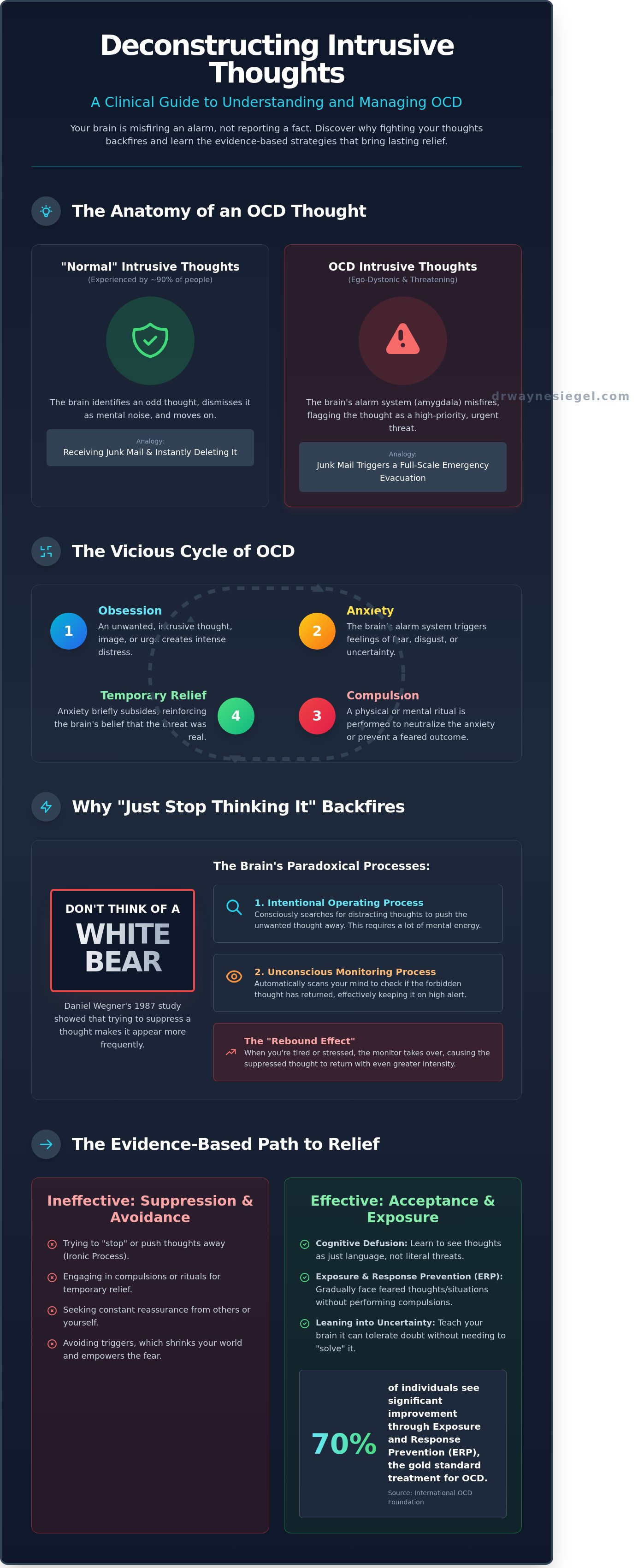
Research published in The Journal of Obsessive-Compulsive and Related Disorders indicates that approximately 90% of the general population experiences these types of thoughts. The difference for someone seeking a clinical Understanding Intrusive Thoughts isn't the content of the thought itself, but how the brain processes it. In a healthy cognitive profile, the brain dismisses these "brain pops" as junk mail. In OCD, the brain flags the junk mail as a high-priority emergency that requires an immediate response.
The Difference Between Obsessions and Compulsions
Obsessions are the internal triggers—the images, doubts, or sudden urges that cause a spike in anxiety. Compulsions are the physical or mental acts you perform to neutralize that distress. This creates a "relief cycle." When you perform a ritual, your brain receives a temporary hit of safety. However, this reinforcement tells the brain the thought was actually dangerous. To master how to stop intrusive thoughts ocd, we must address this cycle. The ritual provides relief for maybe 5 or 10 minutes, but it ensures the obsession will return with more intensity tomorrow.
Why OCD Thoughts Feel So Urgent
The feeling of "I must solve this now" is a neurological glitch, not a factual warning. Your amygdala, the brain's alarm system, identifies a neutral thought as a survival threat. This often leads to "thought-action fusion," a cognitive bias where you believe having a thought is the same as acting on it. Data from neuroimaging studies show heightened activity in the orbitofrontal cortex in those struggling with these symptoms. This brain region gets "stuck" in a loop, sending a red alert for a green light situation. Understanding how to stop intrusive thoughts ocd begins with recognizing that this urgency is just your hardware misfiring.
- Ego-dystonic: Thoughts that contradict your actual character.
- Thought-Action Fusion: The false belief that thoughts equal reality.
- Relief Cycle: How compulsions accidentally feed the obsession.
The Ironic Process Theory: Why Trying to "Stop" Thoughts Backfires
Daniel Wegner’s landmark 1987 study at Trinity University first illustrated why your efforts to suppress distress often fail. He asked participants to avoid thinking about a white bear for five minutes; however, those participants thought of the bear more than once per minute. This phenomenon, known as Ironic Process Theory, explains why your search for how to stop intrusive thoughts ocd often leads to more frequent and distressing obsessions. In my practice, I see how this paradox creates a heavy burden for those trying to "will" their way to a quiet mind.
When you try to push a thought away, your brain initiates two distinct processes. First, an intentional "operating process" searches for distracting thoughts to fill your consciousness. Second, an unconscious "monitoring process" scans your mind to ensure the forbidden thought hasn't returned. This monitor effectively keeps the intrusive thought active in your working memory. I find that this creates a paradoxical loop where the very act of checking for the thought's absence ensures its presence. It's a cognitive "glitch" where the brain stays on high alert for the very thing it wants to ignore.
The Mechanics of Mental Suppression
Mental suppression requires significant cognitive resources. Research shows that once your "operating process" becomes fatigued by stress or lack of sleep, the monitoring process continues to run unchecked. This leads to the "rebound effect," where the suppressed thought returns with higher intensity than if you'd never resisted it. Old techniques like snapping a rubber band on your wrist are no longer recommended by clinical experts. These methods teach the brain that the thought is a dangerous stimulus that requires a physical "stop" response. This reinforces the amygdala's fear reaction, making the thought feel like a legitimate threat rather than a passing mental event.
The OCD Cycle of Resistance
The instinct to resist a thought is the primary engine of the OCD loop. When you treat a thought as a threat, your brain releases cortisol and adrenaline. This physiological spike makes the thought feel more significant and "real," which then triggers more anxiety. This leads to a predictable cycle:
- An intrusive thought occurs as a normal part of brain activity.
- You attempt to "stop" or neutralize it to lower your rising anxiety.
- The brain flags the thought as high-priority because you're fighting it.
- The frequency of the thought increases, leading to a "search" for more "bad" thoughts.
Breaking this cycle requires moving away from suppression and toward Exposure and Response Prevention (ERP), which trains the brain to habituate to the presence of the thought without reacting. If you’re feeling overwhelmed by this loop, gaining a comprehensive cognitive profile can provide the clarity needed to choose the right clinical path for your unique brain chemistry. We move toward health not by stopping the thoughts, but by changing our relationship to them.
Shifting from Suppression to Acceptance and Commitment Therapy (ACT)
Many individuals initially believe the only way to find relief is to eliminate their distress entirely. However, psychological research indicates that the more we try to suppress a thought, the more frequently it returns. This phenomenon, often called the "rebound effect," suggests that the struggle to push away mental images actually fuels the OCD cycle. Acceptance and Commitment Therapy (ACT) offers a modern, research-driven roadmap that moves away from this internal battle. Instead of teaching you how to stop intrusive thoughts ocd through force, ACT focuses on building psychological flexibility. This is the ability to stay in the present moment and move toward your goals, even when uncomfortable thoughts are present.
I've found that shifting the goal from "thought elimination" to "valued action" provides a sense of agency that suppression cannot offer. ACT utilizes a concept called "Expansion," where you learn to make room for anxiety rather than trying to compress or hide it. By opening up to the experience, the thoughts lose their power to dictate your behavior. You aren't giving up; you're choosing to stop wasting energy on a fight that cannot be won through logic or force.
Cognitive Defusion Techniques
Cognitive defusion is the process of creating distance between yourself and your thoughts. You learn to see thoughts as nothing more than language or mental images rather than absolute truths or threats. One effective method is the labeling technique. Instead of saying "I am a bad person," you practice saying, "I am having the thought that I am a bad person." This small linguistic shift reminds you that you're the observer of the thought, not the thought itself.
- Treat thoughts as "passengers on a bus." You're the driver, and while the passengers may be loud or demanding, they don't have their hands on the wheel.
- Use a psychological assessment near me to identify your specific cognitive triggers and refine these defusion tools.
- Repeat a distressing word until it becomes just a sound, stripping away its emotional "hook."
Values-Based Living Despite Intrusive Thoughts
The core of ACT is living a meaningful life while the "OCD noise" persists. This requires "willingness," which is the choice to experience uncomfortable internal states without reacting with compulsions. This NIMH guide to OCD symptoms and treatment explains that while obsessions are involuntary, your behavioral response is where you regain your freedom. By focusing on your values, you can decide to go to dinner with friends or finish a work project even if an intrusive thought is present.
This approach differs from PTSD counseling, which often focuses on processing the memory of a specific past event. In OCD management, we focus on the present moment. You're teaching your brain that these thoughts aren't dangerous and don't require your full attention. When you act on your values despite the anxiety, you're effectively retraining your nervous system to prioritize your life over the "false alarms" of OCD.
Practical Steps for Managing Obsessions via ERP
In my clinical practice, I utilize Exposure and Response Prevention (ERP) because it remains the gold standard for learning how to stop intrusive thoughts ocd. Data from the International OCD Foundation (IOCDF) indicates that approximately 70% of individuals who complete a course of ERP experience a significant reduction in their symptoms. This method works by directly retraining the brain's alarm system. The "Exposure" phase involves intentionally leaning into the uncertainty of a distressing thought. Rather than trying to suppress the image, you allow it to exist in your mind without a fight. The "Response Prevention" phase is the most critical step; it's the point where you refuse to perform the mental or physical ritual that usually follows the thought.
This process facilitates a biological phenomenon called habituation. When you refuse to perform a compulsion, your amygdala eventually stops sending "red alert" signals in response to the trigger. Over a typical course of 12 to 20 sessions, your nervous system learns that the anxiety will peak and then fade on its own without any intervention. It's a journey toward clarity that requires a steady, structured roadmap. Because these exercises are intentionally challenging, they should always be performed under the guidance of a board-certified professional to ensure the exposures are safe and therapeutically sound.
Developing an Exposure Hierarchy
We begin the recovery process by building an exposure hierarchy. This is a ranked list of your triggers, categorized by the level of distress they cause. You'll assign each thought a number using the Subjective Units of Distress (SUDs) scale, ranging from 0 to 100. This allows for systematic desensitization, where we start with manageable challenges before moving to more difficult ones. The steps typically include:
- Identifying a specific intrusive thought or trigger.
- Assigning a SUDs score to the trigger (e.g., 30 for a mild thought, 90 for a severe one).
- Confronting the trigger without performing any safety behaviors.
- Remaining in the situation until the distress level drops by at least 50%.
The goal isn't to like the thought or find it pleasant. Instead, we're training your brain to stop fearing it. By staying with the discomfort, you reclaim the power that OCD has taken from your daily life.
The Importance of Consistency
Progress in OCD recovery depends on consistency. Clinical studies on inhibitory learning suggest that we aren't just "getting used" to the fear; we're creating new, stronger memories that compete with old, fear-based ones. If you "cheat" by performing even a small ritual, it reinforces the idea that the thought is dangerous. To strengthen these new neural pathways, I often recommend "scripting." This involves writing a short, detailed story about your worst-case scenario and reading it for 15 minutes daily without checking or seeking reassurance. This creates a new cognitive profile where you're no longer a slave to "what if" scenarios.
Establishing Clinical Clarity Through Professional Assessment
Understanding how to stop intrusive thoughts ocd begins with a precise, clinical diagnosis. It's common for symptoms to overlap with Generalized Anxiety Disorder (GAD) or ADHD, which can lead to ineffective self-treatment. For example, a 2021 study published in the Journal of Clinical Psychiatry found that nearly 30% of adults with OCD also meet the criteria for ADHD. Without a formal assessment, you might target the wrong cognitive mechanisms. Working with a board-certified clinical psychologist ensures that your treatment plan is built on your actual diagnostic profile. I view psychological testing as more than just a set of labels; it's a personalized roadmap for your recovery. This process moves you from a state of confusion to a clear, data-driven strategy that addresses the "why" behind your challenges.
What to Expect in a Diagnostic Evaluation
A clinical evaluation is a structured, patient-focused process. It typically begins with a diagnostic interview to review your history and the specific nature of your obsessions. I use standardized assessments, such as the Yale-Brown Obsessive Compulsive Scale (Y-BOCS), to measure symptom severity and impact on daily life. This evaluation identifies your specific OCD subtype, whether it involves contamination fears, harm obsessions, or perfectionism. Pinpointing these nuances is vital for creating an effective Exposure and Response Prevention (ERP) plan. If you're feeling overwhelmed by the options, you can learn more about choosing a clinic for psychology to find a provider that aligns with your specific needs. Accurate testing provides the insight necessary to reclaim your quality of life.
Telehealth and National Access to Care
Access to specialized care has expanded significantly in recent years. Through PsyPact states, I can provide expert clinical services to individuals across state lines via secure telehealth platforms. Many patients worry that remote therapy might be less effective, but the evidence suggests otherwise. A 2022 meta-analysis confirmed that digital delivery of ERP leads to significant reductions in symptom severity, comparable to in-person sessions. This means you don't have to live near a major medical center to receive high-quality, evidence-based care. My goal is to provide a steady, non-judgmental environment where you can focus on learning how to stop intrusive thoughts ocd regardless of your location. I am here to guide you through this journey with precision and empathy. Contact Siegel Psychology Services to begin your journey toward clarity.
Building Your Roadmap to Mental Clarity
Moving beyond the cycle of obsessions requires a fundamental shift in how you relate to your mind. Research into the Ironic Process Theory demonstrates that active suppression only strengthens the very thoughts you're trying to avoid. Instead, evidence-based frameworks like Acceptance and Commitment Therapy (ACT) and Exposure and Response Prevention (ERP) offer a validated roadmap for recovery. These strategies don't aim to delete thoughts; they change your reaction to them, reducing their power over your daily life. Learning how to stop intrusive thoughts ocd isn't about force. It's about gaining the clinical clarity needed to navigate your internal landscape with confidence.
I've spent over 25 years as a board-certified clinical psychologist helping individuals decode these complex cognitive patterns. My practice focuses on the intersection of rigorous science and compassionate care, utilizing specialized CBT and ACT protocols to improve your quality of life. Whether you're in my office or connecting through PsyPact's national telehealth network, we'll work together to build a personalized plan for your well-being.
You're capable of finding peace, and the right tools make all the difference.
Frequently Asked Questions
What is the difference between a normal thought and an OCD intrusive thought?
Most people experience intrusive thoughts, but OCD thoughts are distinguished by their frequency and the intense distress they cause. A 2014 international study found that 94% of people have these thoughts occasionally. The difference lies in how you respond. In OCD, the brain's error signal is overactive, leading to a 40% increase in perceived threat compared to the general population. I view these as sticky thoughts that require a specific roadmap to navigate.
Will I ever act on my intrusive thoughts?
You won't act on these thoughts because they're ego-dystonic, meaning they're the opposite of your true values. Research published in Clinical Psychology Review confirms there's no evidence linking intrusive thoughts to actual behavior. I often explain to patients that the very horror you feel is proof you'd never follow through. Understanding how to stop intrusive thoughts ocd involves recognizing that these thoughts are biological noise rather than personal intent.
How long does it take for ERP and ACT to start working?
Most patients begin to see a measurable reduction in symptoms within 8 to 12 weeks of consistent Exposure and Response Prevention (ERP) therapy. Clinical data from the International OCD Foundation shows that 70% of people respond well to this structured approach. I've found that clarity often emerges by the tenth session. We track your progress using the Yale-Brown Obsessive Compulsive Scale (Y-BOCS) to ensure we're meeting specific recovery milestones.
Is medication necessary to stop intrusive thoughts?
Medication isn't strictly necessary, but it's an effective tool that helps approximately 40% to 60% of patients when combined with cognitive behavioral strategies. The American Psychological Association notes that SSRIs can lower the volume of thoughts, making it easier to engage in ERP. I work with you to determine if this path fits your unique cognitive profile. Our goal is always to improve your daily quality of life through the most efficient means.
Why do my intrusive thoughts focus on things I find repulsive or taboo?
Your thoughts focus on taboo subjects because your brain is trying to protect what you value most through a process called ironic monitoring. A 1987 Harvard study by Daniel Wegner demonstrated that trying to suppress a thought makes it 3 times more likely to reappear. Because you find these topics repulsive, your brain flags them as high-priority threats. I help you see this as a biological glitch rather than a reflection of your character.
Can I practice these techniques on my own without a therapist?
You can practice these techniques independently, though research indicates that therapist-led ERP has a 20% higher success rate than self-help alone. I provide a clear roadmap so you can eventually become your own therapist. Using evidence-based tools like the ERP Coach app can help you maintain a structured routine. It's about building your executive functioning skills to manage the thoughts as they arise in your daily environment without feeling overwhelmed.
Does mindfulness actually help with OCD intrusive thoughts?
Mindfulness is a powerful evidence-based tool that can reduce the emotional reactivity of OCD by roughly 30% according to a 2018 study in Frontiers in Psychiatry. It helps you observe thoughts without judgment. Learning how to stop intrusive thoughts ocd requires this non-judgmental stance. I teach mindfulness as a way to stay grounded in the present moment, which prevents the what if loops from taking control of your afternoon or your work day.
What should I do if my intrusive thoughts get worse during treatment?
It's common for thoughts to feel more intense during the initial stages of ERP, a phenomenon known as an extinction burst. This typically occurs during the first 3 to 5 sessions as you stop performing compulsions. I'll be your steady guide through this temporary spike. Data shows that pushing through this phase leads to a 50% reduction in long-term anxiety. We'll adjust your roadmap to ensure you feel safe and supported during this journey.