
Coping with High-Functioning Anxiety: An Evidence-Based How-to Guide for High Achievers

What if the precise traits that drive your professional success are the same ones fueling a state of chronic physiological stress? Research published in the Journal of Occupational Health Psychology indicates that high-achieving individuals often experience a 25% higher rate of burnout due to persistent internal pressure. You've likely spent years perfecting the art of "getting by" while internalizing a fear of failure and the physical exhaustion of over-performing. I understand how isolating it feels to maintain a facade of composure while your mind remains trapped in a cycle of overthinking and boundary-less work days. Finding effective ways of coping with high-functioning anxiety isn't about lowering your standards; it's about refining your internal cognitive profile to work for you rather than against you.
In this guide, I'll provide a roadmap to help you transition from persistent tension to true psychological flexibility through evidence-based clinical insights. You'll learn how to sustain your high performance without the heavy emotional tax that currently drains your energy. We'll examine the specific neurobiological mechanisms behind your anxiety and provide a step-by-step framework for achieving lasting mental clarity.
Key Takeaways
- Understand the mechanics of "Duck Syndrome" and how high-functioning anxiety often presents as over-activity rather than traditional avoidance.
- Identify the "safety behaviors" that provide temporary relief but inadvertently reinforce long-term cycles of stress and over-functioning.
- Discover research-driven frameworks like CBT and ACT to help you move beyond simply coping with high-functioning anxiety toward true psychological flexibility.
- Learn specific, evidence-based techniques such as cognitive labeling and values clarification to distinguish between anxiety-driven tasks and meaningful goals.
- Gain a clear roadmap for your mental health journey by understanding how a comprehensive clinical assessment removes the guesswork from your treatment plan.
Understanding High-Functioning Anxiety: Why Success Often Masks Struggle
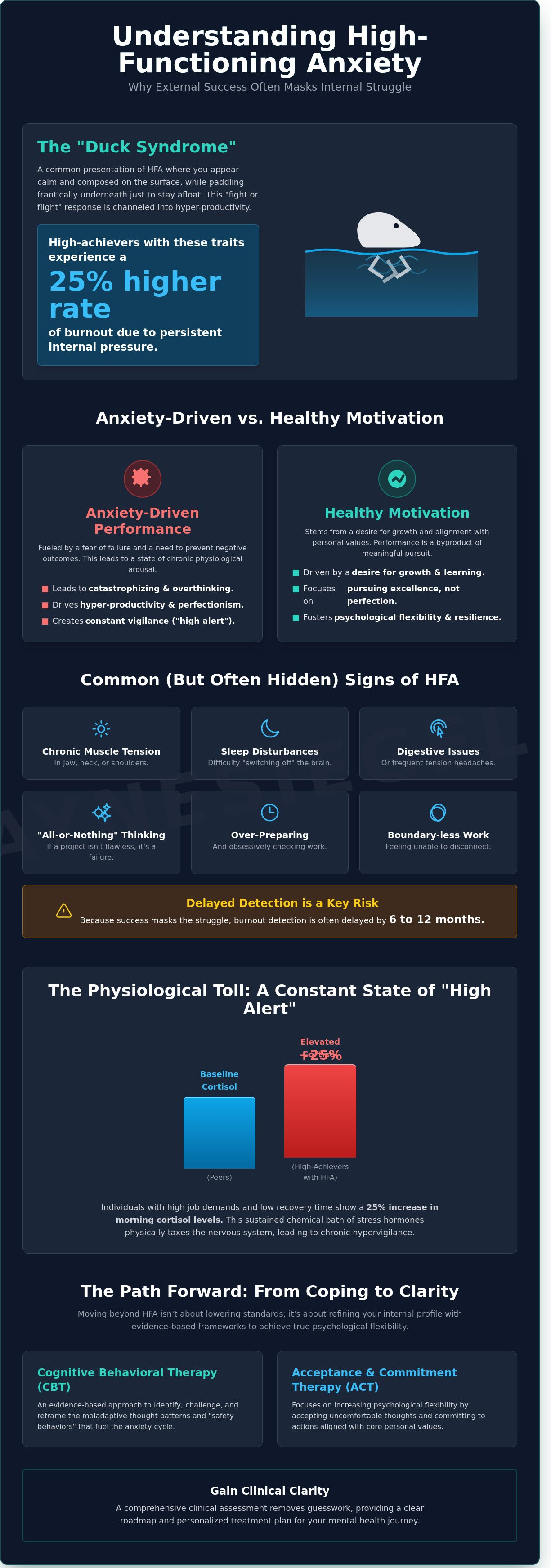
High-functioning anxiety (HFA) isn't a separate clinical label found in the DSM-5. Instead, it's a specific functional style often seen in individuals who meet the criteria for Generalized Anxiety Disorder (GAD). While GAD affects approximately 6.8 million adults in the U.S. according to the Anxiety and Depression Association of America, those with HFA often channel their "fight or flight" response into hyper-productivity. We call this the "Duck Syndrome." You appear calm and collected on the surface, but underneath, you're paddling frantically just to stay afloat. Societal rewards for perfectionism and punctuality often lead both clinicians and individuals to ignore the struggle. HFA sits outside official anxiety disorder diagnoses as a descriptive term for those whose anxiety drives them forward rather than holding them back.
The Internal Cost of External Success
Healthy motivation stems from a desire for growth, while anxiety-driven performance is fueled by a fear of failure. Developing effective strategies for coping with high-functioning anxiety requires us to look at the cognitive patterns behind the productivity. I often hear patients describe a persistent "waiting for the other shoe to drop" sensation. This isn't just caution; it's a cognitive distortion called catastrophizing. You might find yourself mentally rehearsing every possible failure before a meeting. Research indicates that this constant vigilance creates a state of chronic physiological arousal. It's exhausting to maintain a facade of effortless mastery when your internal world feels like a series of near-misses.
Identifying Your Personal Anxiety Profile
Identifying HFA requires looking past your resume and toward your physical health. Common markers include:
- Chronic muscle tension in the jaw, neck, or shoulders.
- Sleep disturbances, specifically difficulty "switching off" the brain at 2:00 AM.
- Digestive issues or frequent tension headaches.
Since success masks the struggle, detection of burnout is often delayed by 6 to 12 months compared to those with more visible symptoms. High-functioning anxiety is a state where anxiety serves as a motor rather than a barrier, albeit at a significant metabolic cost. Recognizing these signs is the first step toward coping with high-functioning anxiety and reclaiming your daily quality of life.
The Psychology of Over-Functioning: How Anxiety Drives (and Limits) Performance
In my clinical practice, I often observe high achievers who appear exceptionally composed on the surface while navigating a turbulent internal environment. This phenomenon is frequently driven by "safety behaviors." These are specific actions, such as over-preparing for a 15-minute presentation or obsessively checking emails, designed to mitigate a perceived threat of failure. While these behaviors offer a temporary sense of relief, they create a reinforcing loop. By relying on these crutches, the brain never learns that the feared outcome is unlikely to occur without them, which complicates the process of coping with high-functioning anxiety over the long term.
This cycle is fueled by a constant physiological state of "high alert." When you're in this state, your body maintains elevated levels of cortisol and adrenaline. A 2022 study published in the Journal of Occupational Health Psychology found that individuals with high job demands and low recovery time showed a 25 percent increase in morning cortisol levels compared to their peers. This sustained chemical bath doesn't just feel uncomfortable; it physically taxes the nervous system, leading to a state of chronic hypervigilance that eventually limits the very performance it seeks to protect.
Perfectionism as a Maladaptive Coping Mechanism
I find it helpful to distinguish between a healthy pursuit of excellence and the rigid "need" for perfection. For many, perfectionism acts as a psychological shield. It's an attempt to become bulletproof so that no one can find a flaw or judge your competence. Understanding High-Functioning Anxiety in High Achievers involves recognizing how "all-or-nothing" thinking patterns dominate this experience. If a project isn't flawless, it's perceived as a total failure. This cognitive distortion makes vulnerability feel like an existential threat rather than a natural part of the human experience.
The Burnout Trajectory for High Achievers
The path to burnout for those with HFA is often invisible until a crisis occurs. Because your external output remains high, colleagues and family members may not realize you're struggling. Research indicates that high achievers often ignore the early signs of exhaustion, such as irritability or disrupted sleep, until they experience a significant decline in executive functioning. This might manifest as difficulty with decision-making or a noticeable drop in cognitive flexibility. If you're noticing these patterns, gaining a clearer picture of your cognitive profile through a neuropsychological assessment can be the first step toward reclaiming your well-being. By the time many seek my help, they've been operating in a "functional" but depleted state for months or even years. Learning to identify these stages is essential for successfully coping with high-functioning anxiety before it leads to a total collapse of your daily quality of life.
Evidence-Based Frameworks: Comparing CBT and ACT for Anxiety
When we look at the clinical landscape for managing internal pressure, two primary evidence-based frameworks stand out. Cognitive Behavioral Therapy (CBT) and Acceptance and Commitment Therapy (ACT) offer distinct yet complementary paths for those coping with high-functioning anxiety. My goal is to help you understand how these methodologies function so you can find the roadmap that best fits your unique cognitive profile. For high achievers, the choice of therapy should never be arbitrary. It must be a deliberate, person-centered decision based on what provides the most clarity and actionable insight for your life.
Cognitive Behavioral Therapy (CBT) for Perfectionism
CBT remains the gold standard for treating anxiety disorders, backed by decades of peer-reviewed research. It operates on the premise that our thoughts, feelings, and behaviors are inextricably linked. In high-pressure environments, your internal narrative often defaults to a rigid "I must not fail" script. CBT provides the tools to dismantle this. Through a process called cognitive restructuring, you learn to treat these thoughts as hypotheses rather than absolute facts. You test their validity against real-world evidence. This methodical approach helps lower the physiological arousal associated with perfectionism, allowing you to maintain your high standards without the crushing weight of catastrophic thinking.
Acceptance and Commitment Therapy (ACT) for Values-Based Living
While CBT focuses on changing the content of your thoughts, ACT focuses on changing your relationship with them. It prioritizes psychological flexibility. This is the ability to stay present and act according to your values, even when you're experiencing difficult emotions. A core technique in ACT is "diffusion." Instead of being fused with the thought "I'm underperforming," you learn to observe it as a passing mental event. You might say to yourself, "I'm noticing the thought that I'm underperforming." This small shift creates the space needed to choose actions that align with your long-term goals rather than your immediate fears. If you're ready to explore these frameworks with a professional, you can start by finding a clinic for psychology that specializes in evidence-based care.
Choosing between these models isn't about finding a "better" version of therapy. It's about precision. Some individuals find immense relief in the logical, evidence-based deconstruction of CBT. Others find that the mindfulness-based acceptance of ACT allows them to stop fighting their thoughts and start living their lives. Coping with high-functioning anxiety effectively requires a strategy that respects your intelligence and your drive. By integrating these frameworks, we move beyond mere symptom management and toward a more meaningful, values-driven existence.
How to Cope with High-Functioning Anxiety: A Research-Driven Step-by-Step Guide
Managing a high-pressure career while experiencing internal turmoil requires more than just "stress management." It demands a structured, neurological approach. This roadmap provides a clinical framework for coping with high-functioning anxiety while maintaining your professional standards. I've developed these steps to help you regain control by shifting how your brain processes various stress signals.
- Step 1: Cognitive Labeling. When your heart races, don't interpret it as a sign of impending failure. Research from UCLA in 2007 demonstrates that "affect labeling" effectively dampens the amygdala's response. Recognize the sensation as a physiological signal, not a literal truth.
- Step 2: Values Clarification. Distinguish between tasks driven by "safety" and those driven by "value." Safety behaviors are actions taken to avoid perceived judgment or failure. High achievers often spend 30% of their day on these avoidant tasks. Focus instead on actions that align with your long-term professional goals.
- Step 3: Strategic Boundary Setting. Implement functional limits on your availability. This might mean a hard stop for emails at 6:30 PM. A 2021 study in the Journal of Occupational Health Psychology found that psychological detachment from work is essential for cognitive recovery.
- Step 4: Somatic Grounding. Use Progressive Muscle Relaxation (PMR) to lower your baseline arousal. This technique, developed in 1938, involves tensing and releasing muscle groups to signal safety to the nervous system. Dedicating 15 minutes to this practice can measurably reduce resting cortisol.
- Step 5: Cognitive Reappraisal. Challenge the assumption that your anxiety is the source of your success. Data suggests that while moderate stress can drive performance, chronic anxiety eventually acts as a cognitive tax. You're successful despite the anxiety, not because of it.
Intervening in the Moment of Anxiety
When you feel a surge of tension during a high-stakes meeting, use the "STOP" technique. Stop what you're doing, Take a breath, Observe your internal state, and Proceed with intention. This creates a neurological gap between a trigger and your reaction. By "naming it to tame it," you move brain activity from the emotional centers to the prefrontal cortex. This mindful awareness allows you to stay present and effective without feeling overwhelmed by the physical symptoms of stress.
Building Long-Term Resilience
Sustainable coping with high-functioning anxiety relies on consistent physiological maintenance. Prioritize 7 to 9 hours of sleep; even a single night of restricted sleep can increase anxiety levels by 30% the following day. View scheduled downtime as a strategic necessity for your executive functioning rather than a luxury. Research indicates that self-compassion is a powerful performance-enhancing tool that reduces the paralyzing effects of perfectionism. If you want to move beyond surface-level symptoms and gain a clearer picture of your cognitive strengths, schedule a consultation for a comprehensive neuropsychological evaluation to begin your journey toward clarity.
Gaining Clinical Clarity: The Role of Professional Assessment
While self-management techniques provide immediate relief, long-term success in coping with high-functioning anxiety requires a deeper look at your cognitive architecture. A comprehensive psychological assessment serves as the foundational first step. It moves you past the "trial and error" phase of mental health care. For the high achiever, guessing is an inefficient use of resources. Diagnostic clarity provides the data needed to build a targeted treatment plan that respects your time and professional demands. Working with a board-certified psychologist who understands the high-achiever profile ensures that your drive isn't pathologized, but rather understood as part of your unique cognitive profile.
Moving Beyond Self-Help to Strategic Partnership
Think of professional intervention as a high-level consultation for your mind. You wouldn't manage a multi-million dollar project without a strategic roadmap; your mental health deserves the same rigor. A professional assessment identifies what lies beneath the surface. For instance, research from the Attention Deficit Disorder Association indicates that up to 50 percent of adults with ADHD also struggle with an anxiety disorder. Without a clinical evaluation, you might spend years treating anxiety when executive functioning deficits are the actual root cause. This partnership transforms vague symptoms into actionable insights. It allows you to move from simply managing symptoms to understanding the "why" behind your experiences.
The Roadmap to Clinical Clarity
Evidence-based, person-centered care is the gold standard for professionals who value integrity. It's about optimizing your performance by addressing the friction in your daily life. For busy executives or clinicians, access is often the biggest hurdle. The expansion of PsyPact states has revolutionized this process, allowing you to receive expert care across state lines via secure telehealth. This flexibility ensures that your location doesn't limit your access to specialized doctoral-level expertise.
Viewing your mental health as a component of your professional integrity allows you to approach coping with high-functioning anxiety with the same meticulousness you bring to your career. This process involves several key benefits:
- Precision: Differentiating between generalized anxiety, social anxiety, or high-functioning depression.
- Identification: Uncovering co-occurring issues like trauma or neurodivergence that mimic anxiety.
- Efficiency: Developing a treatment plan based on data rather than assumptions.
Clarity is the antidote to the fog of high-functioning anxiety.
Build Your Roadmap to Sustainable Success
High-functioning anxiety often persists because it's easily mistaken for a professional asset. Research published in the Journal of Anxiety Disorders confirms that while internal pressure can drive performance, it frequently leads to cognitive fatigue and burnout if left unaddressed. You've seen how evidence-based frameworks like CBT and ACT offer a way to reframe your relationship with stress. These tools allow you to maintain your high standards while replacing fear-based habits with value-driven actions.
Mastering the art of coping with high-functioning anxiety starts with gaining objective insight into your unique cognitive profile. I've spent over 25 years as a board-certified clinical psychologist helping high achievers translate their internal struggles into actionable growth. My practice uses rigorous, research-driven assessments to move beyond surface-level symptoms and identify the "why" behind your challenges. Through PsyPact telehealth services, I provide this specialized clinical care to patients in over 40 states, ensuring you receive expert guidance regardless of your location.
You don't have to navigate this journey alone. I'm here to help you build a clearer picture of your life and develop the precise strategies you need to thrive both personally and professionally.
Schedule a consultation with Dr. Wayne Siegel to gain clinical clarity today.
Frequently Asked Questions
Is high-functioning anxiety a real diagnosis?
High-functioning anxiety isn't a formal clinical diagnosis in the DSM-5-TR (2022). It's a term practitioners use to describe individuals who meet the criteria for Generalized Anxiety Disorder but maintain high levels of external performance. In my practice, I find that while your resume looks impressive, the internal experience involves a persistent state of "fight or flight." This often leads to significant burnout if left unaddressed.
Can I be successful without my anxiety?
You can absolutely maintain your success without the crushing weight of anxiety. Research on the Yerkes-Dodson law indicates that while a baseline of "eustress" helps performance, chronic anxiety actually impairs executive functioning over time. By learning to separate your drive from your distress, you gain the clarity needed to lead with intention. You'll find that your achievements become more sustainable when they aren't fueled by fear.
How is high-functioning anxiety different from regular stress?
Stress is typically a response to an external pressure that dissipates once the situation resolves. In contrast, coping with high-functioning anxiety involves managing an internal, persistent state of worry that doesn't shut off when the workday ends. A 2018 study in The Lancet highlights that while stress is a reaction, anxiety is a sustained emotional state. It requires a different clinical approach to find lasting relief.
What are the best evidence-based therapies for anxiety?
Cognitive Behavioral Therapy (CBT) and Acceptance and Commitment Therapy (ACT) are the gold standards for treatment. Clinical data shows that CBT provides significant symptom reduction for 60% of patients within 12 to 16 sessions. In my work, I use these frameworks to help you build a roadmap for managing intrusive thoughts. We focus on improving your daily quality of life through measurable behavioral changes and cognitive restructuring.
How do I know if I need a professional psychological evaluation?
You should consider a professional neuropsychological assessment if your internal distress begins to impact your sleep, physical health, or executive functioning. If you've spent more than 6 months feeling "on edge" despite your professional achievements, an evaluation provides the data needed to understand your unique cognitive profile. This process moves beyond labels. It offers you a clear path toward sustainable well-being and professional longevity.
Can online therapy effectively treat high-functioning anxiety?
Online therapy is a highly effective modality for high achievers. A 2020 meta-analysis in the Journal of Affective Disorders confirmed that internet-delivered CBT is just as effective as face-to-face sessions for anxiety. This option provides the flexibility that many of my patients require. It allows them to integrate evidence-based care into a demanding professional schedule without sacrificing the quality of the clinical partnership or the results of the treatment.
What is the first step to coping with high-functioning anxiety today?
The first step toward coping with high-functioning anxiety is acknowledging that your high performance shouldn't come at the cost of your peace. Start by tracking your "anxiety triggers" for 7 days to identify patterns in your cognitive load. This data-driven approach allows us to look at your life with the same precision you apply to your career. It creates a foundation for meaningful change and professional insight.
How does high-functioning anxiety affect long-term health?
Chronic anxiety keeps your body in a state of hyperarousal, which elevates cortisol levels and puts a strain on your cardiovascular system. A 2016 study published by Harvard Medical School noted that chronic distress is linked to a 26% higher risk of developing heart disease. Addressing these symptoms now isn't just about feeling better today; it's a vital investment in your long-term physical health and your future cognitive clarity.