
How to Support a Partner with Depression: An Evidence-Based Guide for 2026

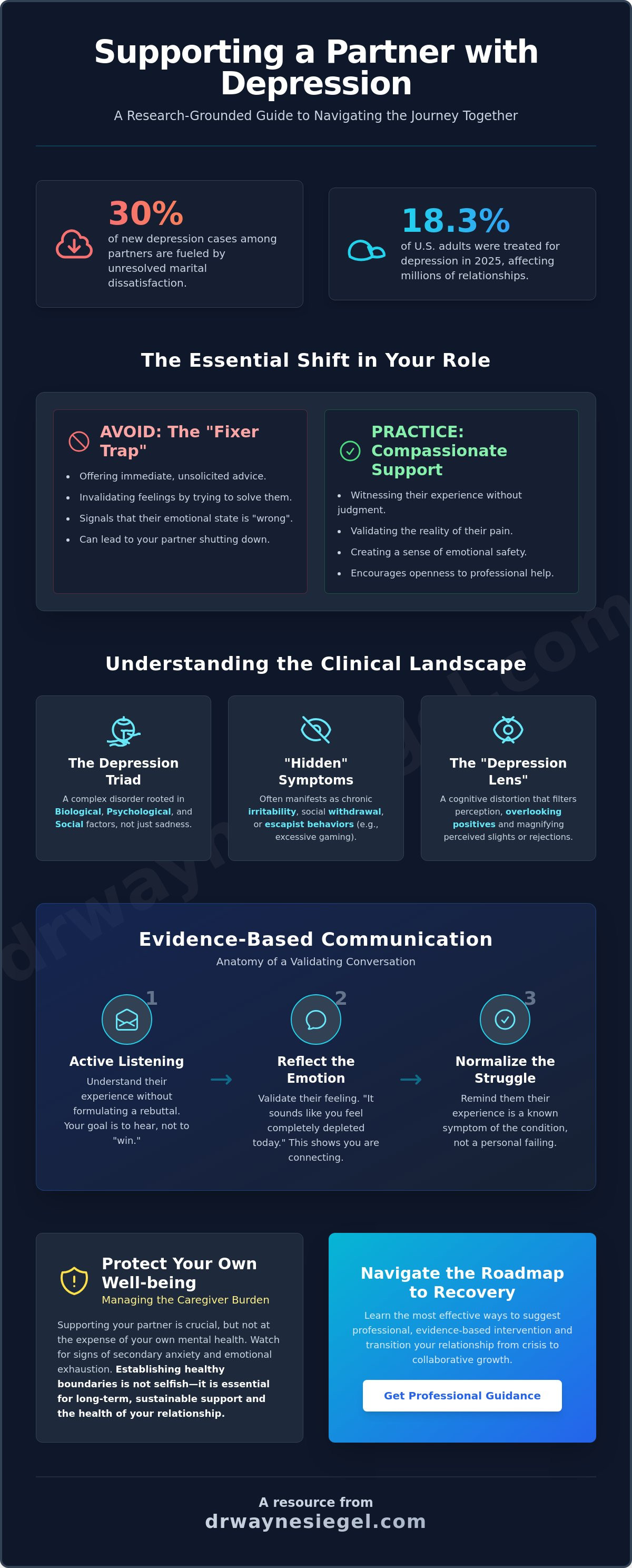
Did you know that marital dissatisfaction fueled by unresolved mental health struggles accounts for nearly 30% of new depression cases among partners? If you feel like you're walking on eggshells or find yourself frustrated because your attempts to help are constantly rejected, you aren't alone. In 2025, a record 18.3% of U.S. adults were treated for depression, leaving millions of partners asking how to support a partner with depression without losing themselves in the process. It's a heavy burden that often leads to emotional exhaustion and secondary anxiety for the caregiver.
I believe that the most effective support comes from shifting your role from a fixer to a compassionate partner in evidence-based recovery. This guide provides you with research-grounded strategies to help your partner navigate their journey while protecting your own well-being and the health of your relationship. I'll share a clear roadmap for communication, explain the clinical "why" behind common depressive behaviors, and provide clarity on when it's time to suggest professional intervention like a diagnostic psychological evaluation.
Key Takeaways
- Identify "hidden" symptoms like irritability and withdrawal to gain a clearer understanding of the biological and social factors influencing your partner's mood.
- Avoid the "fixer trap" by utilizing evidence-based communication strategies that prioritize emotional validation over immediate, unsolicited problem-solving.
- Discover how to support a partner with depression while establishing healthy boundaries to protect your own mental health from secondary anxiety and exhaustion.
- Learn the most effective ways to suggest professional intervention, such as a diagnostic psychological evaluation, to provide a clear roadmap for recovery.
- Transition your relationship from crisis mode to a state of collaborative growth by focusing on shared values and long-term resilience.
Understanding the Clinical Landscape of Depression in Relationships
To understand how to support a partner with depression, we must first look past the surface level behaviors that often cause friction in a household. Depression isn't a singular feeling of sadness; it's a complex Major Depressive Disorder rooted in a triad of biological, psychological, and social factors. While temporary situational sadness usually dissipates once a stressor is removed, clinical depression persists, often regardless of external circumstances. In 2025, 29.0% of U.S. adults reported a lifetime diagnosis, highlighting that this is a widespread clinical reality rather than a personal failing or a temporary mood.
I often see partners struggle because the symptoms don't always look like traditional weeping or lethargy. In many individuals, particularly men, depression manifests as chronic irritability, social withdrawal, or escapist behaviors like excessive gaming or overworking. These "hidden" symptoms can make you feel like you're being pushed away or criticized. It's vital to recognize the "Depression Lens," a cognitive state where the condition distorts your partner’s perception. This lens makes them view the relationship through a filter of hopelessness, frequently interpreting neutral comments as personal rejections.
The Biological and Psychological Mechanism
At a neurological level, depression involves a dysregulation of neurotransmitters like serotonin and norepinephrine, which directly impacts executive functioning. This means your partner may struggle with basic decision-making or organizing daily tasks; this isn't a lack of effort but a temporary impairment of cognitive resources. I define depressive cognitive distortions as "learned filters" that prioritize negative data. This mechanism causes the brain to overlook positive interactions while magnifying perceived slights, making it difficult for your partner to feel the warmth you're trying to provide.
How Depression Changes Relationship Dynamics
When one partner is depressed, a "withdrawal and pursuit" cycle often develops. You might try to move closer to offer help, but your partner withdraws to cope with emotional overwhelm, leading to a painful breakdown in intimacy. This often includes a decreased libido, which can feel like a personal rejection to the non-depressed partner. It's also common to mistake psychomotor retardation for laziness. This clinical symptom physically slows down movement and speech, making even simple chores feel like an insurmountable physical task for the person suffering. Gaining clarity on these biological realities helps you move toward a more objective, empathetic stance within the relationship.
Evidence-Based Communication: Validation Over Fixation
When you see someone you love in pain, your natural instinct is to offer a solution. I often see partners fall into the "Fixer Trap," where they provide immediate advice to "fix" the depressive symptoms. While well-intentioned, research suggests that unsolicited advice often leads to a partner shutting down because it inadvertently signals that their current emotional state is "wrong" or easily solved. Learning how to support a partner with depression requires a shift from solving the problem to witnessing the experience. This approach is rooted in Acceptance and Commitment Therapy (ACT), which encourages staying present with difficult emotions rather than trying to suppress or eliminate them immediately.
One of the most powerful tools I recommend is "Radical Validation." This involves acknowledging the absolute reality of your partner’s internal pain without necessarily agreeing with their depressive conclusions. For example, if your partner says they feel like a failure, you don't have to agree that they are a failure. Instead, you validate the weight of that feeling. Evidence-based strategies for supporting a family member or friend emphasize that being heard is often more therapeutic than being corrected. This creates a sense of safety that can lower the barrier to seeking professional help.
The Anatomy of a Validating Conversation
Effective communication follows a logical, step-by-step progression. First, practice active listening without formulating a rebuttal; your goal is to understand, not to win an argument. Second, reflect the emotion you hear by saying something like, "It sounds like you feel completely depleted today." Finally, normalize the struggle within the context of their condition. Remind them that their lack of energy is a known symptom of their clinical profile, not a character flaw. This structured approach helps remove the shame that often accompanies depressive episodes.
Avoiding Common Communication Pitfalls
Toxic positivity is a significant barrier to recovery. Phrases like "just look on the bright side" or "it could be worse" are clinically counterproductive because they minimize the patient's biological reality. If you find yourself becoming frustrated during repetitive negative conversations, it's helpful to use "I" statements to express your own needs. Saying "I feel overwhelmed when we only talk about the struggle; can we sit in silence for a moment?" is more effective than an accusatory "You always complain." For those who need more personalized communication roadmaps, a professional consultation can provide the specific linguistic tools needed to navigate these complex interactions.
Managing the Caregiver Burden: Protecting Your Own Mental Health
Supporting a partner through a depressive episode is not just an emotional commitment; it's a significant clinical and financial undertaking. According to data published on October 3, 2025, family caregivers face average out-of-pocket expenses of $7,200 annually for costs related to their loved one's depression. Beyond the financial strain, there's a high correlation between a partner’s depression and the supporter’s increased risk for developing anxiety. I often see caregivers experience secondary traumatic stress, where the supporter begins to mirror the emotional symptoms of the patient. Recognizing these early signs of burnout is the first step toward maintaining the stability of the entire household.
I believe that establishing "Healthy Detachment" is essential for long-term recovery. This doesn't mean you stop caring. It means you learn to separate the person you love from the behaviors of their condition. By maintaining your own social life and hobbies, you create a research-backed "protective factor" that prevents the relationship from collapsing under the weight of the illness. Learning how to support a partner with depression requires you to remain a distinct individual with your own healthy emotional reserves.
Setting Sustainable Boundaries
Boundaries are the framework that keeps support from turning into codependency. You must define what you can and cannot provide. For example, you might say, "I can listen for 20 minutes before dinner, but I cannot be your only emotional outlet today." This isn't an act of abandonment. It's a way to ensure you don't become completely depleted. Identifying when a relationship has become codependent is vital for both of you. If your mood is entirely dictated by your partner’s daily symptoms, the dynamic has shifted from supportive to clinically entangled.
Building Your Own Support Roadmap
Your well-being is a critical component of the family unit's health. I frequently recommend individual psychotherapy for the supporting partner. This provides a safe, non-judgmental space for processing frustration, grief, and the weight of caregiving. Selecting a reputable clinic for psychology ensures that you have access to evidence-based tools designed for your specific needs. Finding clarity in your own journey allows you to return to your partner with renewed empathy and a more stable cognitive profile. This transforms a crisis into a manageable, shared path forward.
Navigating the Roadmap to Professional Evidence-Based Treatment
Suggesting professional intervention is a delicate but necessary step in learning how to support a partner with depression. I recommend framing this conversation around the desire for clarity rather than implying your partner is "broken." Instead of saying "you need help," try "I've noticed you're carrying a heavy burden lately, and I want us to find a specialist who can help us understand exactly what we're facing." This shifts the focus from a personal failure to a collaborative search for answers. It works because it positions you as an ally on their team.
In these collaborative efforts, accessing comprehensive support from organizations like Hope Therapy Center can help both partners address the individual and relational aspects of mental health recovery.
It's important to distinguish between supportive counseling and evidence-based treatments like Cognitive Behavioral Therapy (CBT) or Acceptance and Commitment Therapy (ACT). While traditional talk therapy provides a space to be heard, evidence-based therapy provides a "roadmap" rather than just a "venting session." These modalities use structured protocols to challenge cognitive distortions and build psychological flexibility. By May 2026, the normalization of teletherapy has made these specialists more accessible than ever. Many practitioners now operate within PsyPact states, allowing you to access experts across state lines through secure, interjurisdictional telehealth.
Sometimes, depression doesn't exist in a vacuum. If your partner struggles with chronic focus issues or impulsivity alongside low mood, a comprehensive psychological assessment is a vital tool to rule out co-occurring conditions like ADHD. As of 2025, young adults aged 18-29 have depression rates at 26.7%, and many of these cases involve complex diagnostic profiles that require precise identification. Obtaining an accurate diagnosis ensures the treatment plan is tailored to the individual's specific cognitive profile rather than a generic set of symptoms.
Identifying the Right Level of Care
Individual psychotherapy is often the starting point, but a diagnostic psychological evaluation is necessary when symptoms are resistant to standard treatment or when the underlying "why" remains unclear. When choosing a provider, look for board certification in clinical psychology to ensure a high level of rigorous training. You can help your partner prepare for their first clinical hour by organizing a brief history of their symptoms and any previous treatment attempts. This preparation lowers the barrier of anxiety often associated with the first appointment.
Supporting the Treatment Process
Once treatment begins, your role evolves into that of a collaborative partner. You can support their therapy homework by creating a quiet environment for practice without becoming a "nag." Remember that recovery is a non-linear journey. Setbacks are a normal part of the process, not a sign that the treatment is failing. If you're ready to gain a clearer picture of the path forward, I invite you to schedule a diagnostic psychological evaluation to begin the journey toward clinical clarity.
Building a Resilient Partnership Through Collaborative Recovery
As symptoms begin to stabilize, the focus of your partnership shifts from immediate crisis management to a sustainable "growth mode." Learning how to support a partner with depression is an evolving process that eventually requires looking beyond the illness toward shared goals. I utilize Acceptance and Commitment Therapy (ACT) to help couples identify the values that define their relationship. By focusing on what truly matters to both of you, you can build a resilient foundation that isn't solely defined by the presence or absence of depressive symptoms. This shift allows the relationship to move from a state of survival to one of meaningful connection.
I view each case as a unique puzzle where we work together to uncover the biological and psychological "why" behind the struggle. If the clinical profile suggests that the depression is rooted in past trauma, integrating PTSD counseling becomes a necessary part of the roadmap. Research from 2025 indicates that personalized treatment considering biological and social factors leads to significantly better long-term outcomes than a generic approach. My goal is to provide the clinical clarity needed for both the individual and the family unit to thrive once again.
A Person-Centered Approach to Lasting Change
I prioritize functional outcomes and daily quality of life over mere symptom reduction. A tailored, evidence-based plan is far more effective than one-size-fits-all advice because it respects the specific cognitive profile of the patient. By adopting a diagnostic "puzzle-solving" mindset, we can identify specific barriers to recovery, such as executive functioning deficits or maladaptive coping mechanisms. This precision leads to higher treatment efficacy and a clearer path toward relationship renewal.
Next Steps: Finding Clarity Together
Reaching out for a professional consultation is the first step in transforming your household dynamic. When you work with a board-certified clinical psychologist, you can expect a meticulous, data-driven process that prioritizes integrity and thoroughness. We'll start with an initial consultation to determine the appropriate level of care, whether that's individual psychotherapy or a more intensive diagnostic evaluation. I want you to know that recovery is possible. With the right evidence-based tools and a commitment to collaborative growth, you can navigate this complex landscape and emerge with a stronger, more resilient partnership.
Moving Toward Relationship Clarity and Recovery
Navigating a partner's mental health journey requires a transition from being a "fixer" to becoming a compassionate, evidence-based ally. By prioritizing radical validation over unsolicited advice and establishing healthy boundaries for your own mental health, you create a stable environment where recovery can take root. Understanding how to support a partner with depression is not just about their well-being; it's about preserving the long-term health of your shared life through clarity and clinical insight.
I am a board-certified clinical psychologist with over 25 years of experience specializing in CBT and ACT approaches. My practice offers telehealth services across all PsyPact states, ensuring you have access to expert guidance regardless of your location. Whether you're seeking a diagnostic psychological evaluation or professional consultation, I'm here to help you solve the unique puzzle of your situation. Schedule an evidence-based consultation with Dr. Wayne Siegel today.
You don't have to navigate this complex emotional landscape alone. There is a clear roadmap to recovery, and with the right professional partnership, you can find the stability and connection you both deserve.
Frequently Asked Questions
What is the #1 thing I should say to a partner with depression?
The most impactful thing you can say is a statement of radical validation, such as "I can see how much pain you're in, and I am here with you." This approach aligns with Acceptance and Commitment Therapy (ACT) by providing emotional presence without the pressure of an immediate solution. Research indicates that feeling heard reduces the sense of isolation that often fuels depressive episodes. It's a simple way of showing how to support a partner with depression without triggering the "fixer trap."
Can I "fix" my partner’s depression if I try hard enough?
You cannot fix your partner's depression through sheer effort or love because it's a complex clinical condition involving biological and neurological dysregulation. While your support is a vital variable in their recovery journey, the primary work of healing belongs to the patient and their clinical team. Trying to take full responsibility for their mood often leads to caregiver burnout and personal resentment rather than a reduction in their clinical symptoms.
How do I know if my partner’s depression is becoming a crisis?
A crisis is typically identified by specific behavioral shifts such as expressions of total hopelessness, withdrawal from all social contact, or direct mentions of self-harm. If you observe these red flags, immediate professional intervention is required. While my practice focuses on diagnostic evaluations rather than emergency crisis intervention, recognizing these signs allows you to gain clarity on the severity of the situation and seek the appropriate level of acute care promptly.
Is it normal to feel angry or resentful toward my depressed partner?
Feeling resentment or anger is a scientifically documented response to the long-term strain of supporting a depressed loved one. These emotions often stem from the loss of emotional intimacy and the increased domestic burden you've likely assumed since the onset of their episode. It's important to view these feelings as data points indicating your own need for support and boundaries rather than as a sign of a failing relationship or a lack of compassion.
What happens if my partner refuses to seek professional help?
If a partner refuses professional help, your focus must shift toward maintaining your own mental health and setting clear, sustainable boundaries. You can express your needs by stating that you require them to participate in a diagnostic process to maintain the health of the partnership. While you can't control their choices, a professional consultation for yourself can help you navigate the difficult decision-making process that follows a refusal of care.
How can I distinguish between depression and a lack of effort in the relationship?
Clinical depression is distinguished from a lack of effort by the presence of psychomotor retardation and executive functioning deficits. When a partner is depressed, their brain struggles to initiate tasks or process information at a normal speed. This isn't a character flaw; it's a neurological symptom. A diagnostic psychological evaluation can provide the necessary clarity to separate these clinical symptoms from relationship dynamics or personality traits, moving beyond mere labels.
How long does evidence-based treatment for depression typically take to show results?
Evidence-based treatments like Cognitive Behavioral Therapy (CBT) and ACT typically show measurable results within 8 to 12 weeks of consistent, weekly sessions. While every cognitive profile is unique, research indicates that most patients experience a significant reduction in symptom severity during this timeframe. It's a non-linear journey, so setbacks are expected. However, following a structured roadmap ensures that progress is being tracked against specific, functional goals rather than vague emotional states.
Are online therapy and assessments as effective as in-person visits?
Research published in late 2025 confirms that teletherapy and digital assessments are as effective as in-person visits for diagnosing and treating most depressive disorders. The normalization of these platforms has removed significant barriers like travel time and social anxiety. In my practice, I utilize secure interjurisdictional telehealth to provide the same level of meticulous, data-driven care to patients across all PsyPact states. This ensures clinical integrity remains high regardless of the delivery method.