
Therapy for Survivors of Emotional Abuse: Evidence-Based Paths to Recovery (2026)

What if the persistent self-doubt and hypervigilance you feel aren't permanent character traits, but predictable neurological responses to prolonged psychological stress? I understand how exhausting it's to live in a state of constant second-guessing, where gaslighting has clouded your sense of reality and left you feeling disconnected from your own identity. It's a heavy burden to carry, and searching for the right therapy for survivors of emotional abuse can feel overwhelming when you're already struggling to regulate your emotions. With the national average cost of therapy reaching $150 per session in 2026, finding a path that offers real, measurable results is more critical than ever.
I've designed this guide to provide you with clinical clarity on your symptoms and a research-grounded roadmap for recovery. You'll learn how evidence-based modalities facilitate cognitive restructuring to help you rebuild executive functioning and self-worth. We'll also examine how recent legislative changes, such as the 15 percent reduction in federal Medicaid funding from the 2025 "One Big Beautiful Bill Act," are reshaping the landscape of mental health access. My goal is to help you move beyond mere labels to find actionable meaning and a clearer picture of your life ahead.
Key Takeaways
- Understand the clinical mechanics of how chronic psychological stress disrupts emotional regulation by impacting the amygdala and prefrontal cortex.
- Explore how specific evidence-based frameworks in therapy for survivors of emotional abuse, such as CBT and ACT, facilitate the restructuring of cognitive patterns.
- Identify the essential phases of a professional roadmap for healing, beginning with safety and stabilization before moving into deeper processing.
- Learn why seeking a board-certified psychologist ensures a higher standard of clinical expertise and ethical rigor in your recovery journey.
- Discover how the PSYPACT framework expands your access to specialized care through secure, interjurisdictional telehealth across participating states.
Understanding the Clinical Impact of Emotional Abuse on Mental Health
Emotional abuse is a chronic stressor that alters psychological equilibrium. In my clinical practice, I define this through a lens of persistent behavioral patterns that include control, isolation, and verbal aggression. These actions aren't isolated incidents; they're deliberate attempts to erode your autonomy and sense of self. Unlike physical injuries, which typically follow a standard biological healing timeline, psychological trauma presents an "invisible wound" paradox. The emotional damage often persists or even intensifies long after the relationship ends because it fundamentally reshapes how you perceive safety and trust in your environment.
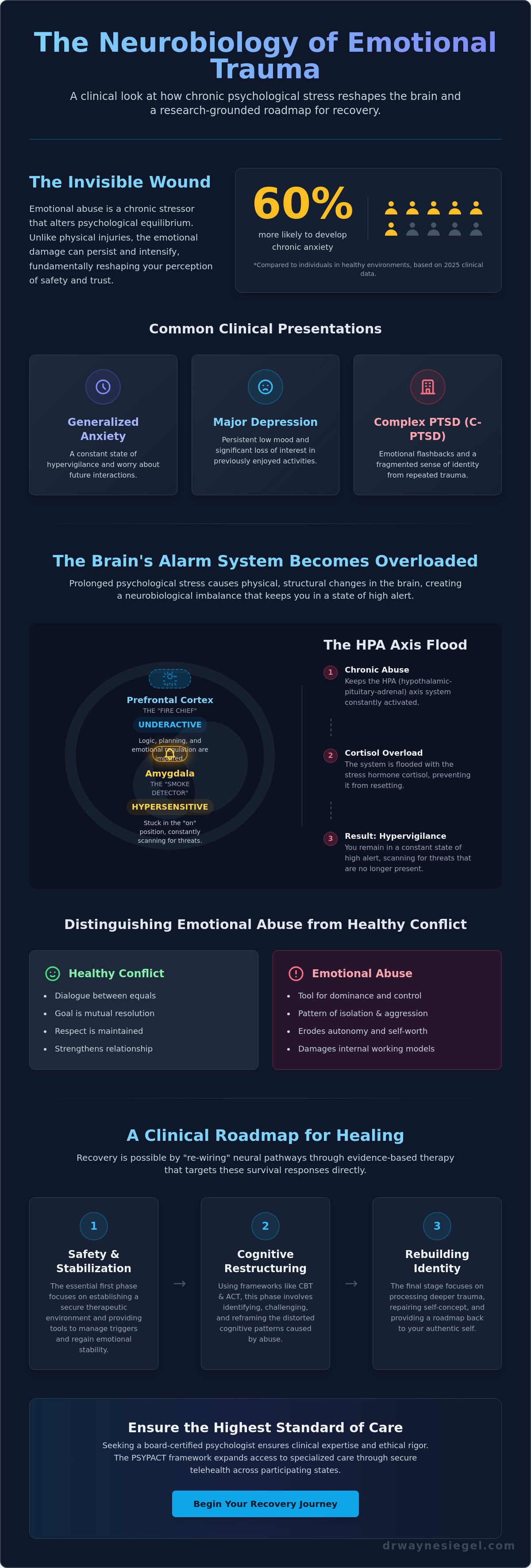
Survivors often present with a specific cluster of symptoms that require careful diagnostic evaluation. Clinical data from 2025 indicates that individuals experiencing prolonged psychological trauma are approximately 60 percent more likely to develop chronic anxiety compared to those in healthy environments. In my assessments, I frequently identify several common clinical presentations:
- Generalized Anxiety: A constant state of hypervigilance and worry about future interactions.
- Major Depression: A persistent low mood and a significant loss of interest in previously enjoyed activities.
- Complex PTSD (C-PTSD): A condition characterized by emotional flashbacks and a fragmented sense of identity resulting from repeated trauma.
Accessing specialized therapy for survivors of emotional abuse provides the evidence-based tools necessary to manage these triggers and regain a sense of stability. It’s about moving beyond the confusion to find a clear roadmap for your recovery.
The Role of Gaslighting and Cognitive Dissonance
Gaslighting involves systematic manipulation that targets your reality-testing. It’s a deliberate effort to make you question your own sanity and memory. This creates cognitive dissonance, a clinical state where you're forced to reconcile the abuser’s manufactured reality with your own lived experience. Validating your narrative is the essential first step in our clinical partnership. It allows us to move past the internal conflict and begin the necessary work of cognitive restructuring.
Distinguishing Emotional Abuse from Relationship Conflict
Distinguishing abuse from healthy conflict requires looking closely at the power dynamic. In healthy relationships, conflict is a dialogue between equals where the goal is mutual resolution. In Psychological abuse, the interaction is a tool for dominance and control. I examine the frequency and duration of these events to identify a clear, damaging pattern. Over time, these patterns damage your internal working models, making it difficult to trust your own judgment. Specialized therapy for survivors of emotional abuse focuses on repairing this self-concept and providing a roadmap back to your authentic self.
The Neurobiology of Emotional Trauma: Beyond Talk Therapy
When you've experienced prolonged psychological stress, the changes in your life aren't just emotional; they're structural. I often explain to my patients that the brain possesses a physical "alarm system" that can become stuck in the "on" position. The amygdala, which serves as your brain's smoke detector, becomes hypersensitive. Simultaneously, the prefrontal cortex-the area responsible for logic, planning, and emotional regulation-can become underactive. This biological imbalance is why you might feel unable to "just get over it." Your brain's fire chief is effectively being locked out of the station while the alarm is screaming.
This state of constant high alert is driven by the HPA (hypothalamic-pituitary-adrenal) axis. In a healthy environment, this system triggers a burst of cortisol to help you handle a crisis and then resets. However, chronic abuse keeps this system flooded. This leads to hypervigilance, where you're constantly scanning for threats that aren't there. Utilizing evidence-based therapy for survivors of emotional abuse is essential because it targets these survival responses directly. We aren't just talking about your feelings; we're working to "re-wire" the neural pathways through the principle of neuroplasticity. This biological capacity for the brain to reorganize itself is the foundation of all psychological healing.
Chronic Stress and Executive Functioning
Prolonged exposure to cortisol doesn't just make you anxious; it can physically impair your executive functioning. I frequently see adults who believe they've developed ADHD later in life, only to discover their difficulty with focus and decision-making is a direct result of trauma-induced cognitive fatigue. If you find yourself struggling to organize daily tasks or maintain concentration, seeking a psychological assessment near me can provide the clinical clarity you need. It helps us distinguish between primary neurodevelopmental challenges and the cognitive impact of your history, allowing for a more precise treatment roadmap.
The Nervous System in Recovery
Recovery involves expanding what clinicians call the "window of tolerance." This is the zone where you can process emotions without becoming overwhelmed or shutting down. Effective therapy for emotional abuse focuses on moving your nervous system from "survival mode" back into a state where growth is possible. In my practice, I prioritize creating a stable, non-judgmental environment because safety is the biological prerequisite for change. By establishing this foundation, we can begin the work of individual psychotherapy to restore your sense of agency and daily quality of life.
Comparing Evidence-Based Therapies for Emotional Abuse Recovery
There is a significant difference between "supportive talk therapy" and evidence-based clinical intervention. While having a space to vent can provide temporary relief, I prioritize research-grounded frameworks because they offer a structured path toward lasting cognitive change. When selecting therapy for survivors of emotional abuse, it's vital to choose modalities with proven efficacy in peer-reviewed studies. These treatments don't just offer empathy; they provide specific mechanisms to dismantle the psychological structures an abuser may have spent years building within you. By utilizing a person-centered approach, we ensure that your autonomy remains the focal point of the recovery process, effectively restoring the power of choice that was previously compromised.
In my practice, I find that a deep Understanding Emotional Abuse Therapy requires looking at how different clinical tools address specific injuries. We aren't just treating a set of symptoms. We're rebuilding a person's entire internal landscape. This involves a meticulous selection of tools that match your specific cognitive profile and emotional needs. Whether we're addressing the "inner critic" or working on nervous system regulation, the goal is always clarity and a functional return to your daily quality of life.
CBT for Cognitive Restructuring
Cognitive Behavioral Therapy (CBT) is highly effective for identifying and dismantling maladaptive schemas formed during periods of abuse. These schemas are the deep-seated, often unconscious beliefs like "I am responsible for others' anger" or "I cannot trust my own judgment." In our sessions, we work to identify the "inner critic" as an externalized version of the abuser's voice. We use evidence-based techniques to manage intrusive thoughts and self-doubt, moving from reflexive victim-blaming toward objective self-appraisal. This process typically yields measurable shifts in self-perception within 12 to 20 weeks of focused clinical work.
ACT for Psychological Flexibility
Acceptance and Commitment Therapy (ACT) focuses on building psychological flexibility. Rather than trying to "fix" or eliminate painful memories, you learn to observe them without being overwhelmed or paralyzed. This is essential for therapy for survivors of emotional abuse because it allows you to stay present even when triggers occur. We use your core values as a roadmap for rebuilding your life post-abuse. Mindfulness-based practices within ACT support nervous system regulation, helping you move out of a constant state of defense and back into a life driven by your own authentic desires and strengths.
Establishing a Roadmap for Healing: The Clinical Process
Healing from psychological trauma is a structured process that moves through specific, evidence-based phases. In my practice, I don't view recovery as a vague journey of "getting better," but as a series of clinical milestones designed to restore your agency. This roadmap ensures that our work in therapy for survivors of emotional abuse is purposeful and grounded in your unique cognitive profile. By following a logical progression, we can address the layers of trauma without overwhelming your nervous system.
Phase 1 focuses on stabilization and safety. Before we can deconstruct the past, we must establish a strong therapeutic alliance and provide you with tools to manage immediate distress. This is often where ptsd counseling becomes a vital component, helping to settle the hypervigilant state of your brain's alarm system. We prioritize your current stability as the necessary foundation for all future growth.
Phase 2 involves processing and deconstruction. During this stage, we examine the mechanics of the abuse to understand how it impacted your internal working models. By stripping away the abuser’s manufactured narrative, you gain the clinical clarity needed to see your experiences objectively. This phase is about dismantling the "invisible wounds" we discussed earlier and replacing them with factual insight.
Phase 3 is dedicated to integration and growth. This final stage is where you reclaim your identity and begin setting firm boundaries. It's about taking the skills gained in therapy for survivors of emotional abuse and applying them to build a future defined by your own values. You move from a state of survival into a life of intentional choice and improved daily quality of life.
The Importance of Diagnostic Clarity
A comprehensive evaluation is the essential first step toward the right treatment. I utilize diagnostic psychological evaluations to screen for co-occurring conditions like anxiety or depression, which affect approximately 45 percent of trauma survivors. Moving beyond simple labels allows us to find actionable meaning in your symptoms. This clarity transforms a collection of struggles into a clear roadmap for intervention, ensuring that we're treating the whole person rather than just a set of symptoms.
Setting Healthy Boundaries
Boundaries are a clinical necessity for psychological safety. In our sessions, we use evidence-based strategies to help you communicate needs and limits clearly and consistently. Rebuilding trust in yourself is a vital precursor to trusting others. As you master these skills, you'll likely notice an improvement in your executive functioning and a reduction in social anxiety. If you're ready to begin this structured process, I invite you to schedule a professional consultation to discuss your specific needs.
Partnering with a Board-Certified Psychologist for Trauma Recovery
Choosing a professional partner for your recovery is a decision that warrants meticulous care. When seeking therapy for survivors of emotional abuse, the distinction of board certification from the American Board of Professional Psychology (ABPP) serves as a critical indicator of clinical excellence. This credential signifies that a psychologist has undergone rigorous peer review and demonstrated a high level of expertise in their specialty. It’s more than just a title; it’s a commitment to the highest ethical standards and the most current evidence-based practices. This ensures your care is grounded in proven science rather than anecdotal methods. The goal of specialized therapy is to provide a roadmap to clinical clarity, allowing you to move beyond the fog of past trauma toward a functional, empowered future.
By partnering with an expert, you transition from a state of mere survival to a higher quality of daily life. This partnership is built on intellectual curiosity and a commitment to uncovering the "why" behind your specific challenges. I treat every assessment and session as a unique puzzle to be solved with precision and care. As we move through the diagnostic process together, you'll gain a clearer picture of your cognitive profile and the strengths you can leverage to rebuild your sense of self. This professional partnership transforms a clinical service into a personal roadmap for growth.
Telehealth and the PsyPact Advantage
As of May 2026, the psychological landscape has evolved to offer unprecedented access through interjurisdictional agreements. If you reside in one of the many psypact states, you can access specialized care regardless of your physical distance from my office. This ensures continuity of care, which is vital for trauma work where a stable therapeutic alliance is a primary predictor of success. Online therapy provides a safe, controlled environment where you can engage in deep work from the comfort of your own space. I ensure that all digital sessions meet the highest legal and ethical standards for privacy and interjurisdictional practice.
Taking the First Step Toward Clarity
When you schedule an initial consultation, look for a provider who demonstrates both technical proficiency and deep empathy. You deserve a specialist who views your journey with meticulous care and a commitment to thoroughness. While the psychological damage caused by emotional abuse is complex, it's a solvable puzzle with the right guide. I invite you to reach out for a professional consultation or a diagnostic psychological evaluation to begin building your roadmap toward lasting recovery. Taking this step is an act of reclaiming your autonomy and investing in your future well-being.
Reclaiming Your Narrative Through Evidence-Based Care
Recovery from the "invisible wounds" of psychological trauma is a meticulous process that requires more than just support; it demands a clinical roadmap. We've explored how chronic stress disrupts the HPA axis and why diagnostic clarity is the essential first step in rebuilding your executive functioning. By utilizing evidence-based therapy for survivors of emotional abuse, you can dismantle the maladaptive schemas installed by an abuser and replace them with objective self-appraisal. This structured approach moves beyond mere labels to help you find actionable meaning in your daily life.
I've been Board-Certified in Clinical Psychology (ABPP) since 1996, and I'm dedicated to providing the rigorous care necessary to solve these complex psychological puzzles. My practice utilizes proven frameworks like CBT and ACT to ensure your treatment is grounded in peer-reviewed science. Whether we connect through PsyPact telehealth or in my office, I'm here to act as a steady guide in your recovery journey. Schedule a consultation with Dr. Wayne Siegel to begin your journey toward clinical clarity. Healing is entirely possible when you have the right evidence-based tools and a professional partnership focused on your well-being.
Frequently Asked Questions
Is emotional abuse considered a form of trauma?
Yes, clinical research confirms that emotional abuse is a significant form of psychological trauma, often categorized as "Type II" or complex trauma. It involves repetitive stressors that can lead to Complex Post-Traumatic Stress Disorder (C-PTSD). This chronic exposure causes neurological alterations in the amygdala and prefrontal cortex similar to those seen in survivors of physical violence. I view these invisible wounds as a primary target for structured clinical intervention.
How can I tell if I need professional therapy for past emotional abuse?
You may need professional therapy for survivors of emotional abuse if you experience persistent functional impairment in your daily life. Common indicators include chronic hypervigilance, difficulty regulating your emotions, or a pervasive sense of self-doubt that interferes with decision-making. If you find yourself constantly scanning for threats or struggling to maintain stable relationships, a diagnostic psychological evaluation can provide the clarity needed to determine if clinical support is necessary.
Which therapeutic modality is best for survivors of gaslighting?
Cognitive Behavioral Therapy (CBT) is highly effective for survivors of gaslighting because it focuses on reality-testing and dismantling distorted thought patterns. By identifying the "inner critic" as an externalized voice of the abuser, we can rebuild your objective self-appraisal. Additionally, Acceptance and Commitment Therapy (ACT) helps you stay present and connected to your own values. This serves as a powerful antidote to the confusion and isolation caused by systematic psychological manipulation.
How long does it typically take to recover from psychological abuse in therapy?
Recovery timelines are unique to each individual, though many patients experience significant symptom reduction within 12 to 24 weeks of consistent work. The process typically moves through phases of stabilization, processing, and integration. While acute symptoms like hypervigilance often settle early in the roadmap, the deeper work of reclaiming your identity and rebuilding executive functioning is a longer-term clinical process. I focus on measurable milestones to track your progress throughout our partnership.
Can CBT help with the self-esteem issues caused by emotional abuse?
Yes, CBT is specifically designed to address the maladaptive schemas that erode self-esteem after prolonged abuse. These are the deep-seated beliefs, often formed during trauma, that you're inadequate or responsible for others' behaviors. By utilizing evidence-based techniques to challenge these beliefs, we replace them with objective, fact-based appraisals. This process helps you regain confidence in your own judgment and restores a sense of agency that was previously compromised by the abuser’s narrative.
What is the difference between a therapist and a board-certified psychologist?
A board-certified psychologist has met the highest national standards of clinical expertise beyond initial licensure. While many therapists provide valuable support, board certification through the American Board of Professional Psychology (ABPP) involves a rigorous peer-review process and a demonstration of advanced specialty skills. This ensures your therapy for survivors of emotional abuse is conducted by a practitioner with a deep understanding of complex diagnostic profiles and evidence-based trauma interventions.
Does online therapy work for treating complex trauma?
Research published in 2025 indicates that online therapy is just as effective as in-person sessions for treating complex trauma and PTSD. Telehealth offers a safe, controlled environment that can be particularly comforting for survivors who experience social anxiety or hypervigilance in new spaces. Through the PsyPact agreement, I can provide this high level of specialized care across state lines, ensuring you have access to a board-certified expert regardless of your location.
What happens if my abuser is still in my life while I am in therapy?
If your abuser is still in your life, our initial clinical focus will be on stabilization and establishing psychological safety. We prioritize developing firm boundaries and evidence-based communication strategies to protect your mental health while you're in a high-stress environment. While recovery is more complex when the stressor is ongoing, therapy provides the tools to maintain your sense of reality and prevent further erosion of your self-concept during the healing process.