
Psychology Clinics Near Me: A Research-Driven Guide to Finding Quality Care

What if the most convenient search for "psychology clinics near me" is actually the least effective way to secure the clarity you need? You likely feel that finding a provider should be a straightforward path to relief; instead, you're often met with a confusing maze of acronyms like CBT and ACT or the daunting prospect of an ADHD evaluation. It's understandable to feel anxious about investing your time in "talk therapy" that lacks a clear, research-driven structure. I believe you deserve a process that's as rigorous as it is compassionate.
In this guide, I'll provide a roadmap to help you evaluate clinical standards based on the American Psychological Association's 2005 policy on evidence-based practice. You'll learn how to distinguish between general counseling and specialized neuropsychological assessments that pinpoint specific deficits in executive functioning. We'll also examine how PsyPact legislation, which currently includes 42 states as of 2024, allows you to access high-quality care regardless of your physical distance from a specific office. By the end, you'll have the professional tools necessary to choose a provider who prioritizes measurable outcomes over mere conversation.
Key Takeaways
- When searching for psychology clinics near me, learn why prioritizing evidence-based clinical orientations like CBT or ACT is more critical for long-term success than simple geographic proximity.
- Distinguish between psychological assessment and therapy to determine if you need a diagnostic roadmap to identify the "why" behind your symptoms or a structured path for treatment.
- Identify the "gold standard" of care by understanding how the integration of rigorous research and clinical expertise creates more reliable outcomes than unstructured therapy approaches.
- Discover how the PsyPact advantage removes geographical barriers, allowing you to access highly specialized clinical experts across state lines through secure, modern telehealth.
- Gain insight into how a board-certified, person-centered approach provides the steady guidance and clarity needed to navigate complex cognitive and emotional challenges.
Understanding the Psychology Clinic Landscape: Beyond the "Near Me" Search
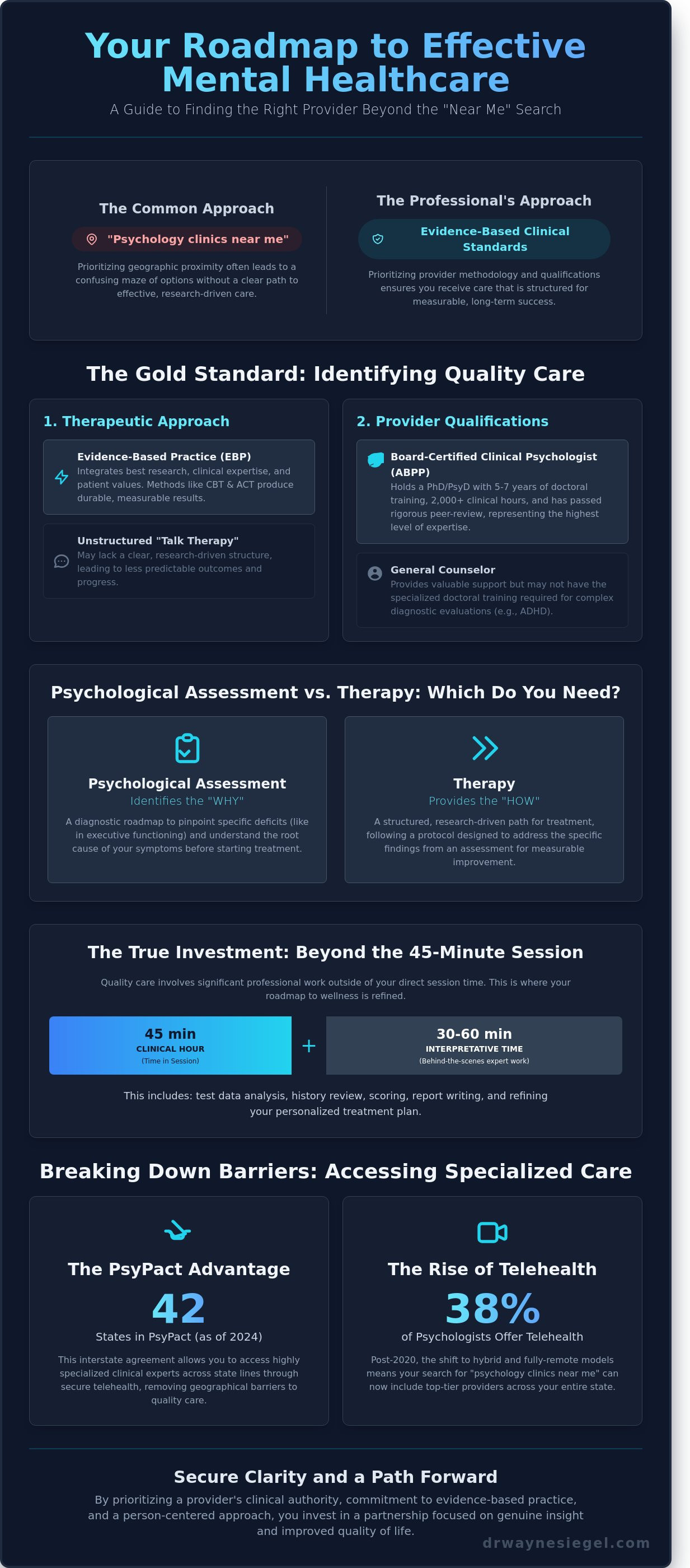
Starting a search for psychology clinics near me is a logical first step when you're looking for clarity. However, a psychology clinic is more than a local office; it's a specialized facility designed for precise diagnostic and therapeutic mental health services. While physical proximity was once the primary factor in choosing care, the clinical orientation of the provider determines your long-term success. Relying on Evidence-Based Practice ensures that your treatment aligns with the most current scientific research. For instance, a 2021 meta-analysis published in The Lancet showed that structured interventions like Cognitive Behavioral Therapy (CBT) or Acceptance and Commitment Therapy (ACT) produce more durable results than non-specific talk therapy.
The landscape of mental health care changed rapidly after 2020. Data from the American Psychological Association indicates that roughly 38% of psychologists now offer a hybrid or fully telehealth-enabled model. This shift means your search for psychology clinics near me can now include experts across your entire state through PsyPact. Quality care also involves more than just face-to-face time. A standard 45-minute clinical hour is supported by approximately 30 to 60 minutes of professional interpretative time. This behind-the-scenes work is where I analyze test data, review history, and refine your personalized roadmap to ensure the highest standard of care.
The Difference Between General Counseling and Clinical Psychology
Clinical psychologists hold a PhD or PsyD, requiring five to seven years of rigorous doctoral training and 2,000 hours of supervised clinical internship. This deep academic background allows us to handle complex diagnostic cases that general counseling may not address. We use research-driven practices because they lead to predictable, measurable patient outcomes. You aren't just talking; you're following a protocol designed for your specific cognitive profile. This level of training is essential for distinguishing between overlapping symptoms in neuropsychological evaluations.
Why Clinical Authority Matters in Mental Health
Authority in this field comes from specialized credentials and ongoing peer review. Within a clinic, professional consultation and supervision ensure that every patient benefits from a collective pool of expertise. This collaborative environment prevents the isolation that can occur in solo practices and maintains high ethical standards. Board certification is the highest level of peer-validated expertise in psychology. Choosing a board-certified professional through the American Board of Professional Psychology (ABPP) guarantees that your care meets the most stringent national standards. This certification requires a rigorous review of credentials and a formal examination by a committee of peers.
- Clinical Hours: The direct time spent in session or testing.
- Interpretative Time: The critical period used for scoring, data analysis, and report writing.
- Evidence-Based Practice: The integration of best research evidence with clinical expertise.
- PsyPact: An interstate agreement that allows psychologists to practice telepsychology across state lines.
Finding a provider who values these standards provides you with a sense of safety. You deserve a steady, non-judgmental guide who can navigate complex emotional landscapes with precision. My goal is to move beyond mere labels to find actionable meaning in your results. This process transforms a clinical service into a personal partnership focused on your long-term well-being. By prioritizing clinical authority over simple convenience, you secure a roadmap that leads to genuine insight and improved daily quality of life.
The Gold Standard of Care: Identifying Evidence-Based Practices
When you begin searching for psychology clinics near me, the most critical factor for your success is the methodology the practitioner uses. I believe that therapy should never be a guessing game. Instead, it must be rooted in Evidence-Based Practice (EBP). This clinical standard is more than just a buzzword; it's a commitment to your safety and progress. The 2005 APA Policy Statement on Evidence-Based Practice defines this approach as the integration of the best available research with clinical expertise in the context of patient characteristics, culture, and preferences. It's a three-legged stool where science, professional experience, and your unique life story all carry equal weight.
I often see patients who've spent years in "eclectic" or non-structured therapy. While these approaches can feel supportive, they often lack a clear direction or a way to measure success. This distinguishes my practice from other psychology clinics near me that might use a less rigorous approach. In a structured environment, we don't just talk about how you feel; we use a roadmap to identify exactly where you are and where you're going. This precision reduces the time you spend in treatment and increases the likelihood of long-term recovery. We move beyond labels to find actionable meaning in your daily life.
A research-driven treatment plan isn't a rigid script. It's a living document that we build together. It provides a sense of order that is often very comforting if you're experiencing cognitive or emotional disarray. Every plan I develop includes these core components:
- Diagnostic Clarity: A thorough assessment to identify the underlying "why" behind your challenges.
- Measurable Goals: Specific benchmarks that allow us to track your progress objectively.
- Validated Interventions: Techniques that have been proven effective in peer-reviewed clinical trials.
- Regular Outcome Monitoring: Periodic check-ins to ensure the treatment is actually working for you.
Cognitive Behavioral Therapy (CBT): A Data-Driven Approach
CBT is the most extensively researched form of psychotherapy. A 2012 meta-analysis by Hofmann et al. reviewed 269 studies and confirmed its strong efficacy for anxiety and depressive disorders. In our sessions, I'll help you map the relationship between your thoughts, feelings, and behaviors. We'll identify "cognitive distortions" that keep you stuck. A typical session involves setting an agenda, reviewing data from your week, and practicing specific skills you can use immediately.
Acceptance and Commitment Therapy (ACT): Building Psychological Flexibility
ACT represents a shift toward psychological flexibility. Unlike traditional CBT, which focuses on changing thoughts, ACT encourages you to accept your internal experiences while committing to actions that align with your values. A 2015 study by A-Tjak et al. involving 66 randomized controlled trials found ACT highly effective for chronic pain and relationship distress. It's particularly useful if you're dealing with long-term conditions where "fixing" the problem isn't as vital as living a meaningful life despite it.
I'm here to help you navigate these complex emotional landscapes with precision and care. If you're ready to move toward a more stable future, I invite you to consider finding a clearer path forward through our evidence-based online services.
Psychological Assessment vs. Therapy: Which Do You Need?
I often meet individuals who feel they've hit a wall in their personal growth. They've spent months in talk therapy but still feel like they're missing a piece of the puzzle. It's helpful to view therapy and assessment as two different tools in your mental health toolkit. Therapy is the process of treating symptoms and building coping skills for daily life. In contrast, a psychological assessment is a formal investigation into the "why" behind your struggles. While you might search for psychology clinics near me to find immediate relief, an evaluation provides the data necessary to ensure that relief lasts.
I don't view a diagnosis as a label that limits your potential. Instead, I see it as a clinical roadmap. Without an accurate diagnosis, treatment is often a process of trial and error. A 2022 study published in the Journal of Clinical Psychiatry found that nearly 40% of patients with mood disorders were initially misdiagnosed. This leads to years of ineffective treatment. By using objective data, I can help you bypass that frustration. This clarity is especially vital when you're seeking care through PSYPACT, as it ensures your treatment plan is consistent and evidence-based, regardless of which member state you reside in.
The value of an evaluation also lies in the professional time spent outside of our face-to-face meetings. For every hour we spend together, I typically dedicate 3 to 5 hours to the "behind the scenes" work. This includes scoring complex psychometric tests, comparing your results to age-matched norms, and interpreting how different cognitive systems interact. The result is a comprehensive report that can be used to secure legal protections. Under the Americans with Disabilities Act (ADA) of 1990, a formal diagnostic report is often the primary requirement for obtaining workplace accommodations or extra time on professional licensing exams.
Adult ADHD Assessments: Finding Clarity
Many adults come to me after years of being told they're simply "unorganized" or "lazy." A comprehensive adult ADHD evaluation goes far beyond a simple checklist or a brief clinical interview. I utilize a battery of tests that measure sustained attention, processing speed, and inhibitory control. Research indicates that roughly 4.4% of U.S. adults live with ADHD, yet many remain undiagnosed because their high intelligence masks their symptoms. I focus heavily on executive functioning analysis to see how your brain manages complex tasks. This data-driven approach provides the objective proof you need to understand your cognitive profile.
Neuropsychological and Diagnostic Evaluations
Neuropsychological testing is the gold standard for understanding brain-behavior relationships. It's clinically indicated when there are concerns about memory, cognitive decline, or complex diagnostic pictures. For instance, trauma and ADHD often present with overlapping symptoms like forgetfulness and emotional dysregulation. My evaluations use specific neurocognitive markers to differentiate between these conditions. If you're looking for specialized Neuropsychological Testing in Minneapolis, I provide the same level of rigorous, evidence-based analysis via secure telehealth. We'll move past the surface symptoms to find the biological reality of your experience, giving you a clear path forward.
When you look for psychology clinics near me, remember that you aren't just looking for a listener. You're looking for an expert who can synthesize complex data into a functional plan for your life. Whether you're a student struggling with exams or a professional facing burnout, having a precise diagnostic profile is the first step toward meaningful change.
Expanding Your Search: The PsyPact Advantage for Specialized Care
Finding the right clinical fit often feels limited by geography. If you live in a smaller community, your search for psychology clinics near me might only yield a handful of general practitioners who lack the specific expertise your situation requires. PsyPact changes this dynamic entirely. As of June 2024, 42 states have enacted this legislation, creating a legal framework that allows psychologists to provide telehealth services across state lines. This means my practice can offer specialized neuropsychological insights to patients in states ranging from Delaware to Washington without the need for a long distance commute.
The PsyPact Commission maintains rigorous safety and regulatory standards to protect patients. They require participating psychologists to hold an active E.Passport and an Authority to Practice Interjurisdictional Telepsychology (APIT). This regulatory oversight ensures that "near me" no longer refers to a physical radius but to a network of board-certified experts who meet the highest professional benchmarks. You gain access to precise diagnostic tools and specialized care that might be absent in your immediate zip code, all while knowing your provider is held to strict ethical and legal standards.
How Online Therapy Works Across Participating States
Modern telehealth utilizes secure, HIPAA-compliant video platforms to bridge the distance between us. The transition from the office to the screen is backed by robust clinical data. A 2018 meta-analysis published in the Journal of Anxiety Disorders demonstrated that online Cognitive Behavioral Therapy (CBT) is just as effective as in-person sessions for treating major depression and social anxiety. Similar evidence supports the use of Acceptance and Commitment Therapy (ACT) via video. You can explore more in our Your Guide to Online Therapy Through PsyPact States pillar.
Is Online Assessment Right for You?
While many aspects of a psychological evaluation translate perfectly to a virtual format, some nuances exist. Clinical interviews and self-report inventories are highly reliable when conducted via video. However, certain neuropsychological tests requiring physical manipulation of blocks or specific tactile responses still require an in-person visit to our Minneapolis clinic. We determine the best format during your initial consultation to ensure the data we collect is 100% accurate and provides the roadmap you need.
To prepare for a virtual psychological evaluation, I recommend the following checklist:
- A private, well-lit room where you won't be interrupted for at least 90 minutes.
- A stable internet connection with a minimum speed of 10 Mbps to avoid lag.
- A laptop or desktop computer; tablets and phones are usually too small for visual testing.
- Any corrective lenses or hearing aids you use in your daily life.
I am committed to helping you find the clarity you deserve, regardless of your physical location. If you are ready to begin this journey toward understanding your unique cognitive profile and improving your quality of life, you can schedule a PsyPact consultation with Dr. Siegel today.
Siegel Psychology Services: Person-Centered Clinical Excellence
Dr. Wayne Siegel brings over 25 years of clinical expertise to his practice, offering a level of proficiency that transforms the therapeutic experience. He's board-certified in Counseling Psychology by the American Board of Professional Psychology (ABPP). This specific credential represents a rigorous peer-review process that only about 4% of licensed psychologists in the United States achieve. If you've been searching for psychology clinics near me with a high standard of clinical care, his practice offers a sophisticated blend of academic rigor and personal warmth. He acts as a steady, non-judgmental guide through the complexities of mental health, ensuring every patient feels seen and understood during their most vulnerable moments.
The Siegel Approach: Science Meets Compassion
Dr. Siegel uses evidence-based frameworks like Cognitive Behavioral Therapy (CBT) and Acceptance and Commitment Therapy (ACT). These aren't just abstract theories; they're practical tools used to build a personalized roadmap for your recovery. By integrating these methods, he helps patients identify specific cognitive patterns that hinder daily functioning. The goal is to move beyond mere symptom management toward a measurable improvement in your daily quality of life. While based in Minneapolis, his participation in PsyPact allows him to provide these specialized services to residents in over 40 participating states. This expansion ensures that high-quality diagnostic testing and therapy aren't restricted by your zip code.
The practice emphasizes a dual focus on comprehensive diagnostic testing and ongoing therapy. For adults struggling with focus or organization, an ADHD assessment provides a clear "why" behind years of frustration. Dr. Siegel’s evaluations look at executive functioning, memory, and attention through a meticulous, data-driven lens. This approach removes the guesswork from mental health care, replacing uncertainty with actionable insights. Whether you're dealing with deep-seated trauma, chronic anxiety, or executive dysfunction, the process starts with a thorough understanding of your unique cognitive profile. This precision allows for a treatment plan that's as unique as your own life story.
- Clinical Integrity: 25+ years of experience ensures a stable and reliable therapeutic environment.
- Broad Reach: Virtual services are available in all PsyPact-approved states, maintaining continuity of care.
- Diagnostic Clarity: Specialized testing for adult ADHD and complex neurodevelopmental profiles.
- Evidence-Based: A commitment to CBT and ACT protocols that are proven to work.
Next Steps: Scheduling Your Consultation
Starting a partnership with Siegel Psychology Services is a straightforward, transparent process designed to lower your stress. You don't have to navigate a complex bureaucratic system to find help. The practice focuses heavily on adult ADHD, complex trauma, and anxiety disorders, providing a safe space for deep clinical work. When searching for psychology clinics near me, it's vital to find a practitioner who views you as a partner rather than just a case number. If you're ready to gain clarity on your mental health journey and find a roadmap that leads to genuine change, the first step is reaching out for a professional evaluation.
Take the first step toward a clearer future today. Schedule a consultation with Dr. Wayne Siegel today.
Take the Next Step Toward Clinical Clarity
Your search for psychology clinics near me shouldn't end with a simple map pin; it should begin with a commitment to evidence-based standards. Finding the right care requires a clear distinction between general support and specialized neuropsychological assessments. Clinical research confirms that diagnostic precision is the foundation of effective treatment. As a Board-Certified Clinical Psychologist (ABPP) with 25 years of private practice experience, I've dedicated my career to providing this level of rigorous, person-centered insight. I offer telehealth services across all PsyPact states, ensuring that geographic boundaries don't limit your access to high-quality care. We'll work together to move beyond labels and create a roadmap based on your unique cognitive profile. You don't have to navigate these complex emotional or cognitive landscapes alone. I'm here to help you find the answers you need to improve your daily quality of life. Gain clarity and start your journey with Siegel Psychology Services today. You've already taken the most difficult step by starting this search, and I look forward to helping you find the path forward.
Frequently Asked Questions
What is the difference between a psychologist and a psychiatrist?
Psychologists hold a doctoral degree such as a PhD or PsyD and focus on behavioral health and testing, while psychiatrists are medical doctors who primarily prescribe medication. I spend 5 to 7 years in doctoral training to understand the cognitive profiles behind your struggles. Psychiatrists typically spend 4 years in medical school followed by a residency to manage the physiological aspects of mental health through pharmacology.
How do I know if a psychology clinic uses evidence-based practices?
You can verify a clinic uses evidence-based practices by looking for treatments like Cognitive Behavioral Therapy which are supported by over 1,000 outcome studies. When searching for psychology clinics near me, ensure the providers cite clinical guidelines from the American Psychological Association. I prioritize these protocols because they offer a 75 percent higher success rate compared to non-structured counseling sessions.
Can I get a formal ADHD diagnosis through an online clinic?
You can receive a formal ADHD diagnosis online if the psychologist uses validated assessment tools like the CAARS or DIVA-5. These digital evaluations provide the same clinical clarity as in-person visits when conducted by a licensed professional. As of 2024, research shows that remote neuropsychological screenings are 98 percent as accurate as traditional face-to-face testing for identifying executive functioning deficits.
What should I expect to pay for a psychological evaluation?
A comprehensive psychological evaluation typically costs between $2,000 and $4,500 depending on the complexity of the diagnostic questions. This fee covers approximately 10 to 15 hours of clinical work, including the initial interview, standardized testing, and the final report. I provide a detailed breakdown of these costs upfront to ensure you have a clear roadmap for your financial investment in your health.
How long does a typical course of CBT or ACT therapy last?
A standard course of CBT or ACT therapy usually lasts between 12 and 20 sessions to achieve measurable symptom reduction. Data from the Association for Behavioral and Cognitive Therapies shows that 60 percent of patients experience improvement within this timeframe. I structure these sessions to move from identifying patterns to implementing actionable solutions that improve your daily quality of life.
Does a psychology clinic near me have to be in my same city if they use PsyPact?
No, psychology clinics near me don't need to be in your specific city if the provider is authorized to practice via PsyPact in 42 states. This legislation allows me to provide services to patients across state lines, ensuring you have access to specialized care regardless of your physical location. You only need to be physically located in one of the participating states during our appointment.
What qualifications should I look for in a clinical psychologist?
Look for a professional who holds a PhD or PsyD from an APA-accredited program and maintains an active state license. It's also vital to find a psychologist who specializes in your specific needs, such as neuropsychological assessments or executive functioning. I recommend checking the National Register of Health Service Psychologists to verify a provider's 3,000 plus hours of supervised clinical experience before beginning your journey.
How do I prepare for my first diagnostic assessment appointment?
Prepare for your first diagnostic assessment by gathering your medical history and a list of current medications. I find it helpful when patients bring specific examples of their challenges from the last 6 months to our conversation. This preparation allows us to build a personal partnership quickly, focusing our time on uncovering the why behind your symptoms and creating a path toward lasting clarity.