
25 Essential Questions to Ask a New Therapist: An Evidence-Based Guide

Did you know that research published in the journal Psychotherapy indicates that the quality of the initial bond between patient and provider predicts treatment success more accurately than the therapist’s specific academic degree? While it's natural to feel a sense of trepidation about opening up to a stranger, you shouldn't have to guess if your provider is the right fit. You likely feel the weight of finding someone who truly understands the "why" behind your challenges without wasting your time or financial resources on ineffective talk therapy.
I believe that every patient deserves a clear roadmap to wellness. This starts with having the right tools to interview your provider. By utilizing specific, research-backed questions to ask a new therapist, you can move past the surface and evaluate a clinician’s technical proficiency and clinical outcomes. This guide provides a 25 point checklist to help you distinguish between general support and targeted, evidence-based care; ensuring your mental health journey is grounded in both science and empathy.
Key Takeaways
- Discover why the therapeutic alliance-the collaborative bond between you and your provider-is a more powerful predictor of positive outcomes than any specific treatment modality.
- Learn how to distinguish between general counseling and evidence-based practices like CBT and ACT to ensure your care is grounded in rigorous scientific research.
- Identify the essential questions to ask a new therapist when seeking specialized diagnostic assessments for ADHD to ensure the process provides a clear roadmap for your care.
- Gain clarity on navigating the logistics of mental health care, including how to maximize out-of-network benefits and evaluate the effectiveness of telehealth options.
- Empower your final decision-making process by learning how to weigh a clinician’s clinical expertise against your own internal sense of clarity and professional fit.
The Science of the "Right Fit": Why Your Questions Matter
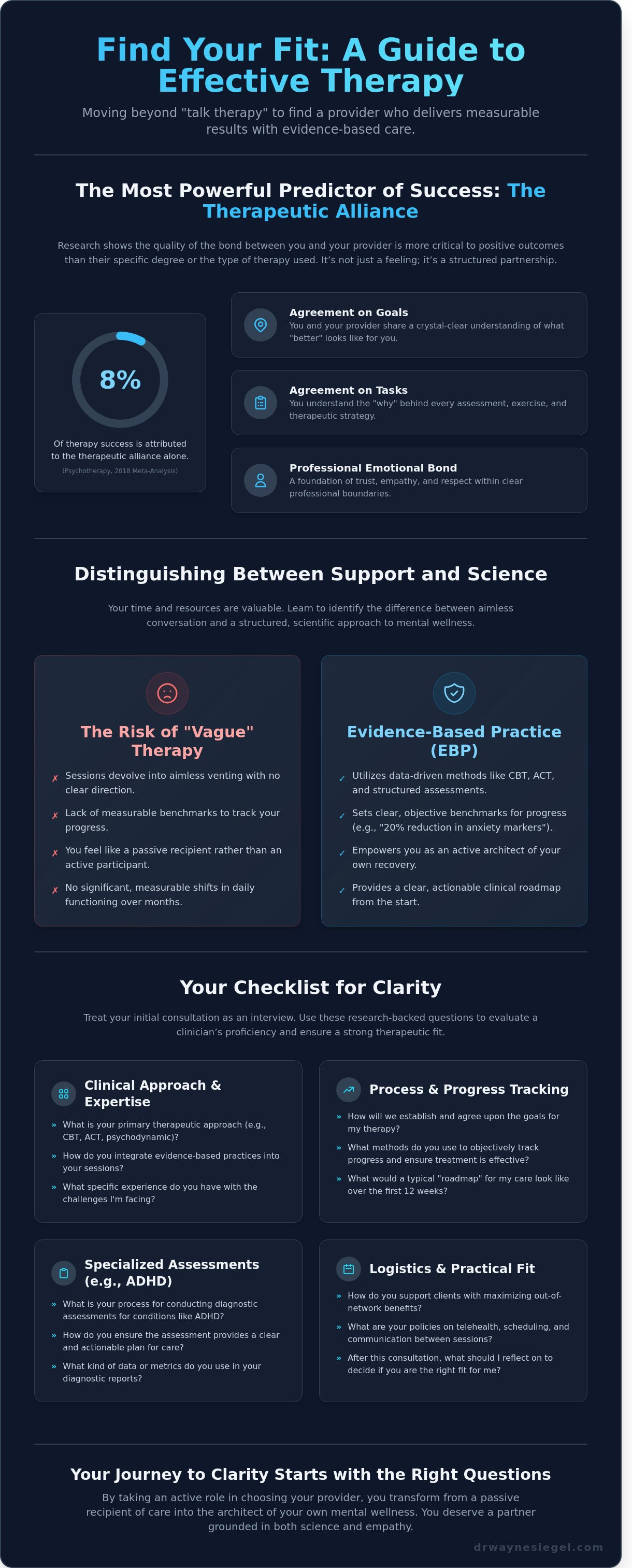
Searching for the right clinical support often feels overwhelming. I've found that many patients approach their first session with a sense of quiet uncertainty, wondering if their concerns will be truly understood. You aren't just looking for a listener; you're looking for a partner in your cognitive and emotional health. This partnership is what we call the therapeutic alliance. Research consistently shows that this bond is the most critical factor in your success. A 2018 meta-analysis published in the journal Psychotherapy analyzed over 30,000 patients and found that the quality of the alliance was a far more reliable predictor of positive change than the specific type of treatment applied. It accounted for roughly 8% of the total variance in therapy outcomes, a significant margin in clinical science.
This collaborative relationship shifts the power dynamic from a traditional "doctor-patient" hierarchy to a shared partnership. When you enter my office, you bring the expertise of your lived experience, while I provide the clinical framework. To understand what is psychotherapy at its core, one must look past the couch and the conversation toward the underlying clinical mechanics. Asking specific questions to ask a new therapist at the start of your journey ensures that you aren't a passive recipient of care. Instead, you become an active architect of your own recovery, moving from a state of confusion to a clear, actionable clinical roadmap.
Understanding the Therapeutic Alliance
The alliance isn't a vague feeling of "liking" your therapist; it's a structured interaction built on three distinct pillars. These include agreement on the goals of treatment, agreement on the tasks required to reach those goals, and the development of a professional emotional bond. The American Psychological Association defines clinical fit as the integration of the best available research with clinical expertise in the context of patient characteristics, culture, and preferences. I've observed that the most successful outcomes happen when these elements align perfectly. Asking targeted questions to ask a new therapist helps you gauge their empathy and professional boundaries. It allows you to see if they can hold space for your struggles while maintaining the rigorous standards required for psychological growth.
The Risk of "Vague" Therapy
I often see patients who've spent months in "talk therapy" without seeing measurable shifts in their daily functioning. Without a structured roadmap, sessions can easily devolve into aimless venting. This lack of direction is often the result of a therapist failing to use an evidence-based approach. Specific questions reveal if a clinician uses data-driven methods, such as Cognitive Behavioral Therapy or structured neuropsychological interventions. Effective therapy requires setting measurable benchmarks for your progress. For instance, we might look for a 20% reduction in specific anxiety markers or a measurable improvement in executive functioning scores within the first 12 weeks of treatment.
- Goal Alignment: Are we working toward the same definition of "better"?
- Task Clarity: Do you understand the "why" behind every exercise or assessment?
- Benchmark Tracking: How will we objectively prove that you're making progress?
Your goal is to gain clarity. By treating the initial consultation as an interview, you protect your time and your emotional energy. You deserve a practitioner who views your care as a unique puzzle to be solved with care, precision, and scientific integrity. This active approach transforms the therapeutic process from a series of conversations into a deliberate journey toward insight and stability.
Evaluating Clinical Expertise and Evidence-Based Approaches
Choosing a provider requires more than a gut feeling. You deserve a professional whose methods are grounded in scientific rigor. One of the most vital questions to ask a potential therapist involves their use of evidence-based practices (EBP). These are treatments that have been through clinical trials and peer-reviewed studies to prove their effectiveness for specific conditions. Research from the American Psychological Association suggests that EBP leads to more consistent, measurable patient outcomes compared to generalized "talk therapy" that lacks a structured framework.
Evidence-based practice integrates three pillars: the best available research, clinical expertise, and your unique patient characteristics. When you're interviewing a provider, you're looking for someone who doesn't just offer a listening ear but applies a systematic approach to your recovery. According to 2023 data from the National Alliance on Mental Illness, early intervention with the right modality can reduce long-term symptom severity by up to 40 percent. This is why the specific questions to ask a new therapist must focus on their technical proficiency.
Modality-Specific Questions
Asking "What evidence-based treatments do you use for my condition?" forces a therapist to move beyond vague descriptions. You want to hear specific names like Cognitive Behavioral Therapy (CBT) or Acceptance and Commitment Therapy (ACT). CBT is highly structured; it typically focuses on identifying and restructuring the 10 common cognitive distortions that fuel anxiety or depression. In contrast, ACT focuses on psychological flexibility. Instead of trying to eliminate difficult thoughts, ACT helps you accept them while committing to actions that align with your core values.
A therapist's commitment to the science is also revealed by how they stay current. Ask them which journals they read or what recent training they've completed. A provider who hasn't updated their training in five years may be using outdated protocols. Scientific understanding of the brain evolves rapidly; a dedicated practitioner treats their education as a lifelong pursuit.
The Value of Board Certification
The American Board of Professional Psychology (ABPP) provides a level of credentialing that goes far beyond basic state licensure. While all psychologists must be licensed to practice, only about 4 percent of licensed psychologists in the United States hold board certification. This distinction signifies that the provider has undergone a rigorous, voluntary peer-review process. This includes a review of their work samples and a comprehensive oral examination by senior experts in the field.
Board-certified clinical psychologists demonstrate a mastery of their specialty that ensures a higher standard of care. This expertise is particularly important for diagnostic clarity. An accurate diagnosis is the foundation of any successful treatment plan; without it, you might spend months in therapy addressing the wrong issue. Specialists with board certification are trained to look at the whole person, identifying complex cognitive profiles that others might miss. Gaining this level of clarity through a professional roadmap ensures that your time in therapy is an investment in measurable change.
Specialized training leads to more efficient care. When a therapist understands the underlying neuropsychological mechanisms of a condition, they can tailor interventions that work with your brain's natural pathways. This precision reduces the trial-and-error phase of therapy, allowing you to see improvements in your daily quality of life much sooner. Always confirm if a provider's board certification is current and recognized by the ABPP to ensure you're receiving the highest tier of clinical care.
Practical Logistics and Telehealth Considerations
Logistics often feel like the biggest hurdle to starting care. Research from the National Alliance on Mental Illness shows that 42% of adults who need mental health services don't receive them because of cost or accessibility concerns. I believe that clarity regarding fees and scheduling shouldn't be a source of anxiety. When you're refining your list of questions to ask a new therapist, prioritize these practical details. Understanding the financial roadmap early on allows us to focus entirely on your clinical goals during our sessions. This transparency is the foundation of a safe, professional partnership.
Financial and Administrative Clarity
Ask if the provider offers a Good Faith Estimate. Under the No Surprises Act, which took effect on January 1, 2022, healthcare providers must give a written estimate of expected charges to self-pay or uninsured patients. This document protects you from unexpected costs. You should also inquire about out-of-network benefits. Many of my clients use "superbills," which are detailed receipts you submit to your insurance company for potential reimbursement. You can review our current Hourly Psychotherapy and Assessment Fees to see how these rates fit your financial plan. I also suggest asking about cancellation policies. Most practices require 24 to 48 hours' notice to avoid a fee, as that time is reserved exclusively for your care.
Telehealth and PsyPact Questions
Telehealth has significantly increased access to specialized clinical services. One of the most vital questions to ask a new therapist is whether they're authorized to practice in your state via PsyPact. This interstate compact currently includes 40 states and allows you to work with experts across the country from the comfort of your home. I prioritize your privacy by using HIPAA-compliant video platforms like Zoom for Healthcare or Doxy.me. These tools use end-to-end encryption to keep our conversations confidential. You should also ask how technical failures are handled. A professional should have a backup plan, such as a phone call, if the internet connection drops. We also establish a safety protocol for remote sessions, ensuring we have your physical address and local emergency contacts on file before we begin.
Accessibility isn't just about the cost of a single hour. It's about the sustainability of the entire treatment plan. I recommend asking how often you'll meet and for how long. A typical psychotherapy session lasts 45 to 50 minutes, while a comprehensive neuropsychological evaluation might require several hours over multiple days. Knowing the expected duration of the diagnostic process helps you manage your time and energy. I aim to provide a clear roadmap so you know exactly what to expect from our first meeting to the final feedback session. This structure provides the stability needed to explore complex cognitive or emotional challenges without the distraction of administrative uncertainty. By addressing these factors upfront, we ensure that your journey toward clarity remains uninterrupted.
Specialized Inquiries for ADHD and Diagnostic Assessments
Seeking a formal diagnosis requires a different mindset than seeking ongoing emotional support. You aren't just looking for rapport; you're looking for psychometric expertise and clinical precision. When you're preparing questions to ask a new therapist, it's vital to distinguish between a general clinical interview and a formal neuropsychological evaluation. A standard therapy session focuses on processing emotions, while an assessment is a structured investigation into how your brain processes information.
Diagnostic evaluations require a rigorous vetting process because the results often dictate your access to medical treatment, workplace accommodations, or educational support. Approximately 4.4% of adults in the United States live with ADHD, yet many remain undiagnosed or misdiagnosed because their symptoms don't mirror the hyperactive child archetype. You need a clinician who views your history through a developmental lens, looking for patterns that have existed since childhood even if they've changed shape in your adult life.
Vetting an ADHD Specialist
Don't hesitate to ask about the specific tools a clinician uses. A simple self-report checklist is a screening, not a comprehensive evaluation. Ask: "What objective instruments do you use to measure executive functioning?" A robust battery often includes gold-standard tests like the WAIS-IV for cognitive ability or the Conners Continuous Performance Test to measure sustained attention. You should also confirm if they've handled cases similar to yours in the last 12 months. Adult ADHD often presents as chronic overwhelm or "burnout," which requires a different diagnostic approach than the behavioral disruptions seen in children.
It's equally important to ask about the final product. A diagnostic report shouldn't just be a list of scores. It must be a roadmap. Ask if the clinician provides actionable recommendations tailored to your specific environment. If you're a project manager, you don't need general advice; you need strategies for managing deadlines and cognitive load. Ensure the report meets the 2021 criteria set by organizations like the Americans with Disabilities Act (ADA) if you require formal workplace accommodations.
The Assessment Roadmap
The diagnostic journey should follow a transparent, step-by-step progression. This typically begins with a 90-minute clinical interview to gather your history, followed by 4 to 6 hours of face-to-face testing. When considering questions to ask a new therapist about this process, ask about their timeline for the final feedback session. In my practice, I find that providing a written report within 14 days of testing is essential for maintaining the momentum of your care. This timeline ensures the data is fresh and the path forward is clear.
The feedback session is the most valuable part of the entire process. This is where we translate raw data into a "cognitive profile" that explains why certain tasks feel impossible while others feel effortless. We move beyond labels to find clarity. If you're ready to gain this level of insight into your own brain, exploring an Adult ADHD Assessment in Minneapolis can provide the answers you've been looking for. We don't just identify deficits; we uncover the strengths that will help you navigate your daily life with more confidence.
To begin your journey toward diagnostic clarity and professional support, schedule a consultation with Dr. Wayne Siegel today.
Making Your Final Decision: From Consultation to Clarity
Once you've completed your initial interviews, you're left with a collection of notes and impressions. This data is vital for your success. Research published in the Journal of Counseling Psychology indicates that the therapeutic alliance, the quality of the bond between you and your provider, accounts for roughly 30% of the variance in treatment outcomes. By reviewing your specific list of questions to ask a new therapist, you can determine if a provider offers the structural and emotional support you need to reach your goals.
Synthesizing the Information
Review the answers you received with a critical eye. High-quality clinical partners avoid hiding behind academic jargon; they explain complex psychological concepts in a way that empowers you. A green flag is a therapist who provides a clear roadmap for your care. If they referenced evidence-based protocols or offered a specific timeline for reassessing your progress, they're demonstrating professional stability. You should feel a sense of safety in their presence, which is the necessary foundation for any deep cognitive or emotional work.
Trust your internal reaction to the dialogue. While the clinical credentials must be rigorous, your "gut" provides immediate feedback on the relational fit. Did you feel heard or did you feel like a case number? A study involving 4,000 therapy clients found that those who felt a strong connection by the third session were 3.5 times more likely to complete their treatment plan. If you felt judged or rushed during the consultation, those feelings rarely disappear as the weeks progress. I often tell my patients that the right fit should feel like a relief, a moment where the fog begins to lift.
If a provider isn't the right match, it's professional to decline their services politely. You don't owe a lengthy explanation. A brief email stating, "I appreciate your time, but I've decided to move in a different direction for my care," is sufficient. Most clinicians prefer you find a better fit rather than struggle through a partnership that isn't working. This clears the path for you to find the clinician who truly aligns with your cognitive profile and personal values.
Taking the Next Step
Finding the right clinician is the first major milestone in your journey toward mental clarity. Once you identify that professional, committing to the process is essential. Clinical data suggests that approximately 50% of patients show significant improvement within 8 to 10 sessions. This progress requires a consistent schedule and a willingness to engage with the tools your therapist provides. Transitioning into your first formal session usually involves a deep-dive intake where you'll set specific, measurable benchmarks for your growth.
My practice is built on a person-centered approach that integrates these rigorous, evidence-based standards with genuine compassion. I believe that every patient deserves a roadmap that is as unique as their own cognitive strengths. We focus on the "why" behind your challenges to ensure the solutions we build are sustainable and impactful for your daily life. If you're ready to move beyond uncertainty and toward a clearer understanding of your path, Schedule a consultation with Dr. Wayne Siegel to gain the clarity you deserve.
Finding Clarity Through Your Informed Choice
Finding the right therapeutic fit isn't just a matter of intuition; it's a process supported by clinical research. Data from the American Psychological Association indicates that the quality of the therapeutic alliance is one of the most significant predictors of treatment success. By preparing specific questions to ask a new therapist, you're taking an active role in your diagnostic journey. You now have the tools to evaluate evidence-based approaches and navigate the logistics of modern care, including PsyPact-authorized telehealth services. This preparation transforms a complex search into a structured path toward understanding your unique cognitive profile. I've spent over 25 years helping individuals find these answers through meticulous neuropsychological assessments. As a board-certified psychologist in clinical psychology (ABPP), I prioritize your need for objective data and compassionate insight. You don't have to navigate these challenges without a professional roadmap. Let's work together to uncover the "why" behind your struggles and build a practical plan to improve your daily quality of life.
Begin your journey toward clarity with a board-certified psychologist.
Frequently Asked Questions
What is the most important question to ask a new therapist?
The most vital question to ask is: "What specific framework do you use to measure my progress and how will we know when I've reached my goals?" This question ensures you aren't just talking, but moving toward a clear destination. Research from the American Psychological Association indicates that monitoring progress improves outcomes by 20 percent. I believe this transparency creates a partnership where you understand exactly how our work leads to your well-being.
How can I tell if a therapist is evidence-based?
You can identify an evidence-based therapist by asking which clinical modalities they utilize, such as Cognitive Behavioral Therapy (CBT) or Dialectical Behavior Therapy (DBT). These methods have been validated in over 500 clinical trials for their effectiveness. I often explain that evidence-based care means your treatment is grounded in peer-reviewed science rather than intuition. It's a roadmap built on what has been proven to work for thousands of others with similar cognitive profiles.
Is it okay to interview multiple therapists before choosing one?
It's absolutely appropriate to interview 3 to 5 therapists before making a final decision. The therapeutic alliance accounts for 30 percent of the variance in treatment outcomes; this makes the personal fit as vital as the clinical expertise. I encourage patients to treat the first consultation as a professional meeting to assess our chemistry. Finding a provider who offers a sense of safety and clarity is the first step in your journey toward healing.
What are the red flags to watch for in a first therapy consultation?
A primary red flag is a therapist who cannot provide a clear treatment plan or roadmap during your initial 45 minute session. If a provider avoids your questions or seems distracted, it's a sign they may not offer the meticulous care you deserve. Ethical guidelines from the National Association of Social Workers require practitioners to be transparent about their limitations. Trust your instincts if the environment doesn't feel like a secure foundation for growth.
Should I ask my therapist about their own personal life?
You should generally avoid asking about a therapist's personal life unless it directly impacts your clinical progress or comfort level. Most practitioners follow a "limited self-disclosure" policy to keep the focus entirely on your executive functioning and emotional needs. While I value a warm connection, our sessions are a dedicated space for your story. Keeping professional boundaries ensures that the 50 minutes we spend together remain focused on your specific roadmap to clarity.
How do I ask about the cost of therapy without feeling awkward?
You can ask about the cost by saying, "Could you provide your standard fee schedule and explain how you handle insurance reimbursements?" Being direct about finances is a standard part of the intake process and helps prevent future stress. Data shows that 25 percent of patients cite financial concerns as a primary reason for ending therapy early. I prefer to discuss these details openly so we can ensure your treatment plan is sustainable for your long-term journey.
What is the difference between a PhD psychologist and a Master-level counselor?
The main difference lies in the depth of clinical training; a PhD psychologist typically completes 5 to 7 years of graduate study focused on research and complex diagnostics. Master-level counselors, such as LCSWs or LPCs, usually complete 2 to 3 years of specialized training in clinical practice. I find that a doctoral-level background provides a deeper insight into neuropsychological assessments and the "why" behind complex challenges. Both paths offer valuable support; however, the PhD level is often more focused on diagnostic precision.
Can I see a therapist who lives in a different state?
You can see a therapist in a different state only if they're licensed in your state or belong to the PSYPACT commission, which currently includes 40 states. Telehealth laws are strict because they ensure your provider is held to the ethical standards of your local jurisdiction. When considering questions to ask a new therapist, always verify their licensing status to ensure your sessions are legally recognized. This verification provides a layer of professional integrity and safety for your therapeutic process.