
Symptoms of Complex PTSD (C-PTSD): A Research-Based Clinical Guide for 2026

A 2025 global analysis found that approximately 8.59% of people in community samples live with a condition that often goes misidentified. If you frequently feel like your personality is "wrong" rather than injured, you're likely grappling with the symptoms of complex ptsd (c-ptsd). It's exhausting to navigate intense emotional swings and feel disconnected from those you love. I understand how isolating this feels. You deserve to know that your experience has a research-backed name and that your struggles are a logical response to chronic trauma.
I've written this guide to help you distinguish between standard PTSD and the unique markers of C-PTSD defined by the ICD-11. You'll gain clarity on the three categories of "Disturbances in Self-Organization" and see how a professional diagnostic psychological evaluation can change your perspective. We'll explore the updated February 2026 APA phase-based treatment model to build a clear, evidence-based roadmap for your recovery. This journey begins with understanding the science behind your symptoms so you can finally move toward a stable and empowered future.
Key Takeaways
- Discover how the "Complex" designation reflects a multi-layered injury to your identity and emotional regulation, moving beyond the scope of standard PTSD.
- Identify the six core symptoms of complex ptsd (c-ptsd), including the specific disturbances in self-organization that often feel like personality traits but are actually adaptive survival strategies.
- Learn how chronic trauma physically reshapes your nervous system and shrinks your "Window of Tolerance," explaining why your emotional responses can feel so uncontrollable.
- Understand the value of a meticulous diagnostic psychological evaluation to gain clarity and prevent the common misdiagnosis of C-PTSD as other personality or mood disorders.
- Explore the 2026 phase-oriented treatment roadmap that prioritizes safety and stabilization as the essential first steps toward sustainable healing and reconnection.
Defining Complex PTSD: How It Differs from Standard PTSD
Understanding trauma requires moving beyond a generalized perspective. While many people recognize Post-Traumatic Stress Disorder, the clinical community now identifies a distinct and more pervasive diagnostic entity. Complex PTSD arises from prolonged, repeated exposure to traumatic events where escape is physically or psychologically impossible. This isn't a single "shock" to the system. It's a sustained environment of threat, often occurring in situations like long term domestic captivity or developmental neglect. The "complex" prefix in the symptoms of complex ptsd (c-ptsd) describes the multi-layered injury to a person's sense of self and their capacity for emotional regulation.
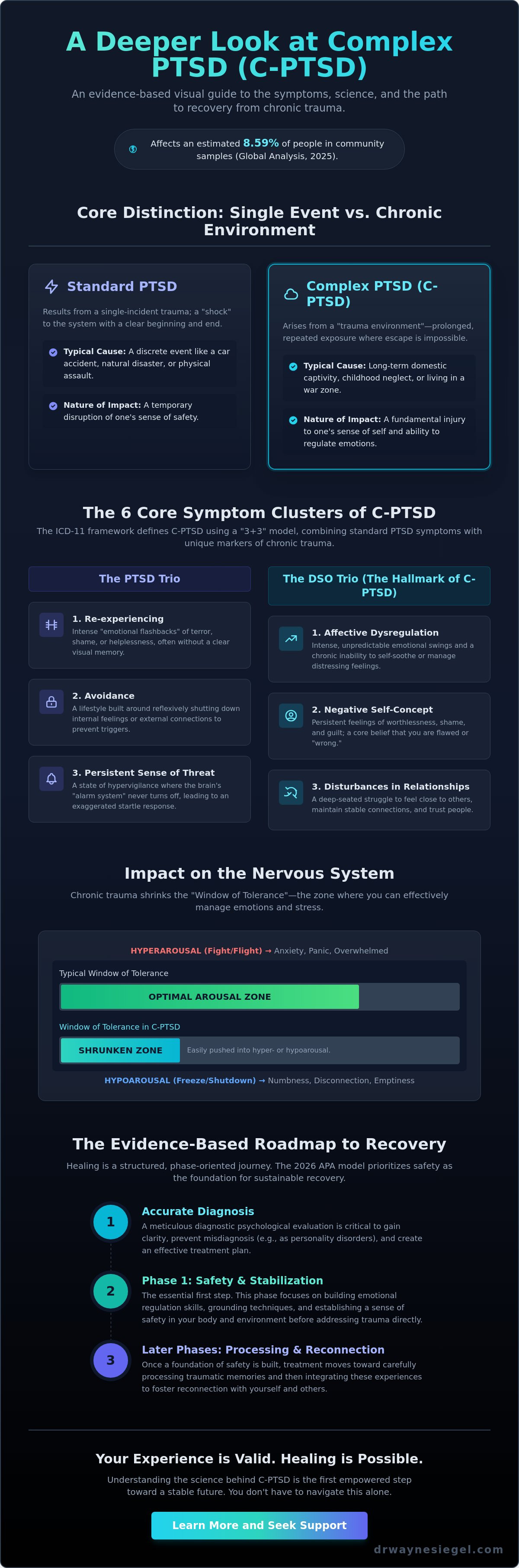
In 2018, the World Health Organization provided much needed clarity by formally including Complex post-traumatic stress disorder in the ICD-11. This was a pivotal shift. While the American Psychiatric Association's DSM-5 currently groups these experiences under a broader PTSD label, the ICD-11 recognizes that C-PTSD involves specific "Disturbances in Self-Organization" (DSO). These DSO markers represent a fundamental shift in how a person processes their existence. They include persistent feelings of worthlessness, a chronic inability to soothe intense emotions, and a deep-seated struggle to feel close to others.
The Core Difference: Event vs. Environment
Standard PTSD typically stems from a single-incident event, like a car accident or a discrete physical assault. The trauma has a clear beginning and end. In contrast, C-PTSD stems from a "trauma environment" where the threat is chronic and inescapable. This environment might involve years of emotional abuse or living in a war zone. C-PTSD is a relational injury that alters one's baseline state of being. Instead of a temporary disruption of safety, the individual's entire biological and psychological system adapts to a world where safety doesn't exist. These symptoms of complex ptsd (c-ptsd) are survival mechanisms that stayed active long after the threat passed.
The Role of the ICD-11 in Modern Diagnosis
The WHO's decision to categorize C-PTSD separately was a move to improve treatment accuracy. When clinicians rely on vague or incomplete labels, patients often receive interventions that fail to address the core disturbances in self-organization. I've seen how this clarity helps patients realize they aren't "broken," but rather adapted to an extreme environment. Securing a comprehensive psychological assessment near me is a vital step in moving from confusion to a structured, evidence-based plan for healing.
The Six Core Symptom Clusters of C-PTSD
Identifying symptoms of complex ptsd (c-ptsd) requires a nuanced understanding of how chronic trauma reshapes the human experience. It's not a list of character flaws; it's a set of adaptive survival strategies that became "stuck" in the nervous system. The ICD-11 framework defines this condition through a "3+3" model. This means an individual experiences the three core symptoms of standard PTSD alongside three specific "Disturbances in Self-Organization" (DSO). These DSO markers are the defining indicators that the trauma was chronic and relational in nature.
The Standard PTSD Trio: Re-experiencing, Avoidance, and Threat
The first half of the diagnostic profile involves symptoms familiar to many trauma survivors. However, in a complex context, they often take on a more pervasive quality. Re-experiencing goes beyond simple memories or nightmares. For many, it manifests as "emotional flashbacks" where you suddenly feel the intense terror, shame, or helplessness of the past without a clear visual memory. Avoidance becomes a primary lifestyle, where you reflexively shut down internal feelings or external connections to prevent triggers. Finally, a persistent sense of threat keeps your body in a state of hypervigilance. Your startle response is exaggerated, and your brain's "alarm system" never truly turns off, even when you're physically safe.
The DSO Trio: The Hallmark of Complex Trauma
The second half of the symptoms of complex ptsd (c-ptsd) profile is what truly distinguishes it from other conditions. These are the injuries to your "self-organization" that occur when trauma is inescapable. Clinicians utilize CPTSD symptoms and treatment frameworks to ensure these three clusters are addressed with the same rigor as the primary PTSD symptoms:
- Affect Dysregulation: This involves a chronic inability to soothe yourself. You might experience explosive emotional outbursts or, more commonly, a state of emotional numbing and dissociation.
- Negative Self-Concept: This is a persistent, deep-seated belief that you're "broken," "worthless," or "shameful." It's not just low self-esteem; it's a fundamental shift in your identity.
- Interpersonal Disturbances: Because the trauma was often relational, you may find it difficult to feel close to others or maintain stable relationships. Trust feels like a biological impossibility rather than a choice.
Recognizing these patterns is the first step toward reclaiming your life. If these descriptions mirror your daily reality, a diagnostic psychological evaluation can help you move from feeling "wrong" to understanding the specific injury your system has sustained. We can then begin the process of untangling these survival strategies to find a path toward genuine stability.
The Impact of Chronic Trauma on the Nervous System
To understand the symptoms of complex ptsd (c-ptsd), we must look at how the brain adapts to chronic danger. It's not just a mental struggle; it's a physiological restructuring. In a healthy system, the prefrontal cortex acts as the "logical center," helping us regulate emotions and make rational decisions. However, chronic trauma keeps the amygdala, the brain's alarm system, in a state of constant activation. Over time, this alarm begins to override the logical brain. This biological shift is the body's attempt to prioritize survival over reflection in an environment that feels perpetually unsafe.
One of the most helpful concepts I share with my patients is the "Window of Tolerance." This is the zone where you can effectively manage your emotions and process information. Chronic trauma significantly shrinks this window. When you're pushed outside of it, you're either in a state of hyper-arousal, characterized by anxiety and anger, or hypo-arousal, marked by numbness and depression. Because the brain is focused on survival, it may also employ "structural dissociation." This is where the mind partitions traumatic memories and emotions to allow you to function in daily life, even while carrying immense internal pain.
The Neurobiology of Hyper-arousal and Hypo-arousal
The nervous system typically responds to threat through two primary channels. Hyper-arousal triggers the "Fight or Flight" response, manifesting as the irritability and hypervigilance often seen in symptoms of complex PTSD. Conversely, hypo-arousal leads to the "Freeze or Fawn" response. Freeze is a state of immobilization, while fawning is a social survival strategy. These states aren't choices; they're automatic biological reflexes. While these changes are profound, neuroplasticity is the brain's ability to reorganize itself through targeted therapy, providing a hopeful foundation for trauma recovery.
Relational Trauma and the 'Fawn' Response
Fawning is a specific survival strategy where an individual reflexively pleases others to avoid conflict or harm. In the context of chronic childhood trauma, this was often the only way to stay safe within a difficult family dynamic. As adults, this manifests as a chronic inability to set boundaries or a tendency to prioritize others' needs at the cost of one's own identity. It profoundly impacts relationship patterns, making it difficult to establish the stable, reciprocal connections that are often missing in those with symptoms of complex ptsd (c-ptsd). Recognizing fawning as a survival skill rather than a personality flaw is a crucial step in the healing journey.
Navigating the Path to a Professional C-PTSD Diagnosis
Many people suspect they have a trauma-related condition after researching online, yet self-screening tools cannot capture the clinical complexity of these experiences. Misdiagnosis is a frequent challenge because the symptoms of complex ptsd (c-ptsd) often overlap with other conditions like Bipolar Disorder or Borderline Personality Disorder (BPD). A professional evaluation moves beyond simple labels to provide a roadmap for clarity. For many individuals, scheduling a psychological assessment near me serves as the essential turning point in their journey toward health. It transforms a vague sense of being "broken" into a precise understanding of a nervous system injury.
Differential Diagnosis: C-PTSD vs. BPD
In clinical practice, the distinction between BPD and C-PTSD is critical for effective treatment. While both involve emotional dysregulation, the underlying drivers are different. BPD is typically characterized by an intense fear of abandonment and frantic efforts to maintain connection. In contrast, C-PTSD frequently manifests as social avoidance; the individual withdraws to protect themselves from a perceived sense of threat. A board-certified psychologist uses standardized testing and meticulous clinical interviews to identify these nuances. Understanding the "Why" behind your behaviors changes the entire therapeutic approach. It ensures your care focuses on trauma processing rather than just behavioral modification.
The Role of Telehealth and PsyPact in Accessing Care
Finding a specialist who truly understands complex trauma used to depend on your physical location. Today, the list of PsyPact states allows patients to access trauma specialists across state lines through interjurisdictional telehealth. These evaluations are safe, rigorous, and highly effective. They utilize the same evidence-based protocols as in-person visits to provide a comprehensive cognitive and emotional profile. This expanded access means you don't have to settle for a generalist when your history requires a seasoned expert who specializes in the symptoms of complex ptsd (c-ptsd). We can conduct a thorough review of your history and current functioning from the safety and comfort of your own environment.
If you're ready to move from confusion to a clear plan of action grounded in research, I invite you to learn more about my diagnostic psychological evaluations. We'll work together to solve the puzzle of your challenges and build a stable foundation for your recovery.
Evidence-Based Treatment: Moving Toward Recovery
Recovery from chronic trauma is a deliberate, structured process that respects the complexity of the injury. The American Psychological Association's 2026 treatment guidelines emphasize a phase-oriented approach as the gold standard for care. This model ensures that we don't rush into processing painful memories before your system is ready. Instead, we move through three distinct stages: establishing safety and stabilization, processing the traumatic history, and eventually focusing on reconnection with a meaningful life. This sequence is specifically designed to address the symptoms of complex ptsd (c-ptsd) by first building the internal resources you need to stay grounded.
Effective recovery is built on a collaborative partnership. I view ptsd counseling as a shared journey where my clinical expertise meets your lived experience. We work together to untangle the survival strategies that served you in the past but now limit your present. By using research-backed interventions, we can move beyond mere symptom management toward a life defined by your values rather than your history.
How CBT and ACT Provide Tools for Regulation
Cognitive Behavioral Therapy (CBT) is highly effective for restructuring the "Negative Self-Concept" that often accompanies chronic trauma. We work to identify and challenge trauma-driven thought patterns, such as the persistent belief that "it was my fault" or "I am fundamentally broken." Alongside this, Acceptance and Commitment Therapy (ACT) provides essential tools for managing affect dysregulation. ACT teaches you how to observe painful emotions and symptoms of complex ptsd (c-ptsd) without becoming overwhelmed or controlled by them. The primary goal of these interventions is not just symptom reduction, but a measurable improvement in your daily quality of life.
Building a Roadmap for Long-Term Healing
Healing is not a linear path, and a person-centered approach ensures that the therapeutic pace respects your unique needs. By consistently applying these evidence-based tools, we help "re-wire" your nervous system for safety and connection. This process leverages neuroplasticity to expand your window of tolerance, making stable relationships and emotional balance possible again. If you're ready to move from survival to genuine recovery, I encourage you to seek a professional consultation. A diagnostic evaluation can serve as the first step in creating your personalized roadmap for long term healing and clarity.
Creating Your Roadmap to Clinical Clarity
Living with the symptoms of complex ptsd (c-ptsd) often feels like navigating a dense fog without a compass. By understanding the research-backed distinctions of this condition, you've already begun the process of moving from confusion to clarity. We've discussed how chronic trauma impacts the nervous system and why the 2026 APA phase-based treatment model is essential for sustainable recovery. You don't have to solve this puzzle alone. A professional assessment provides the objective data needed to transform your experience into an actionable plan for healing.
I bring over 25 years of specialized experience as a board-certified clinical psychologist to our partnership. My work focuses on evidence-based CBT and ACT protocols designed to help you reclaim your quality of life. Together, we'll build a steady foundation that respects your history while prioritizing your future. Schedule a consultation to begin your roadmap to clinical clarity. You deserve a life defined by your strengths rather than your injuries.
Frequently Asked Questions
Is C-PTSD a permanent condition or can it be treated?
C-PTSD is a treatable condition rooted in nervous system adaptation rather than a permanent character flaw. Research indicates that evidence-based interventions like CBT and ACT can significantly reduce symptom severity and improve daily functioning. By leveraging neuroplasticity, individuals can effectively re-wire their biological response to triggers. The February 2026 APA guidelines confirm that a structured, phase-based approach allows for sustainable recovery and a measurable increase in emotional stability.
What is the main difference between PTSD and C-PTSD symptoms?
The primary distinction lies in the three "Disturbances in Self-Organization" (DSO) that accompany the standard symptoms of complex ptsd (c-ptsd). While standard PTSD centers on re-experiencing, avoidance, and hyper-arousal from a single event, C-PTSD includes chronic affect dysregulation, a negative self-concept, and persistent interpersonal difficulties. These additional layers result from prolonged, inescapable trauma environments, such as long term neglect, rather than isolated incidents.
Why isn't C-PTSD in the DSM-5 yet?
The DSM-5-TR does not currently list C-PTSD as a standalone diagnosis because the American Psychiatric Association historically grouped these experiences under a PTSD specifier. However, the World Health Organization formally recognized it as a distinct entity in the ICD-11 in 2018. Many clinicians now use the ICD-11 framework to provide a more accurate diagnostic profile for patients whose histories of chronic trauma require a more specialized treatment approach.
Can C-PTSD cause physical health symptoms like chronic pain?
Chronic trauma frequently manifests as somatic symptoms, including chronic pain, migraines, and gastrointestinal issues. A 2025 meta-analysis suggests that individuals with high trauma loads have a significantly higher prevalence of inflammatory conditions. This happens because the body's alarm system remains chronically active, leading to physical wear and tear over time. Addressing the underlying nervous system dysregulation is often a critical component of managing these physical health challenges effectively.
Is it possible to have both ADHD and C-PTSD?
It is common for ADHD and C-PTSD to co-exist, though they can also mimic each other's presentations. Both conditions involve challenges with executive functioning and emotional regulation. A meticulous diagnostic psychological evaluation is necessary to tease these apart. Identifying whether a struggle with focus stems from a neurodevelopmental trait or a trauma-induced state of hypervigilance ensures that you receive the most effective support for your specific cognitive profile.
How do I know if I need a full psychological evaluation for trauma?
You should consider a full evaluation if your symptoms persist despite previous therapeutic efforts or if you suspect a misdiagnosis like Bipolar Disorder. A 2025 study showed that 44.7% of clinical samples met the criteria for C-PTSD, yet many individuals remained undiagnosed or mislabeled. An assessment provides the clinical clarity needed to move beyond surface-level symptoms and create a targeted, research-backed roadmap for your long term recovery.
What is an emotional flashback and how do I stop one?
An emotional flashback is a sudden, intense wave of feelings, such as terror or helplessness, that belonged to a past traumatic event. Unlike traditional flashbacks, these often lack a visual component and feel like a current reality. You can manage them by using grounding techniques to reconnect with the present moment. Recognizing that you're experiencing symptoms of complex ptsd (c-ptsd) rather than an immediate threat is the first step in regaining stability.
Can C-PTSD be diagnosed through online therapy in PsyPact states?
C-PTSD can be accurately diagnosed through telehealth by psychologists licensed in PsyPact states. As of 2026, over 40 states participate in this compact, allowing you to access specialized trauma experts regardless of your physical location. These virtual evaluations use the same rigorous, evidence-based diagnostic tools as in-person visits. This ensures you receive a high-quality assessment and a clear path forward from the safety and comfort of your own home.