
Healing from Childhood Emotional Neglect: A Research-Driven Roadmap to Recovery in 2026

The most profound psychological wounds often stem not from what happened to you, but from what failed to happen. While 72% of child maltreatment cases in the U.S. involve neglect, this invisible experience often goes unaddressed because there are no physical scars to point to. You might carry a pervasive sense of being flawed or empty; you might wonder why you struggle to identify your emotions or why you constantly fear being a burden to others. It's a heavy weight to carry when your childhood looked fine on the surface. I understand how isolating this feels, and I want you to know that healing from childhood emotional neglect begins with the validation that your experience truly matters.
Recovering from this absence requires moving beyond vague feelings toward a structured, logical roadmap. I'm going to provide you with an evidence-based framework for identifying and overcoming these challenges. We'll examine the research-driven steps to build emotional awareness, set healthy boundaries, and integrate the support needed to feel whole. By the end of this guide, you'll have the clarity to transform this invisible absence into a visible, manageable path for growth. We'll move through the diagnostic process together, turning clinical insight into your personal recovery plan.
Key Takeaways
- Understand how the "Serve and Return" mechanism shapes your brain's emotional regulation center and why its absence creates a lasting impact.
- Identify the specific adult symptoms of neglect, such as counter-dependency and the belief that you are fundamentally flawed.
- Discover how evidence-based frameworks like ACT and CBT offer actionable tools for healing from childhood emotional neglect.
- Learn why a formal diagnostic evaluation provides the clinical clarity needed to transform invisible struggles into a manageable roadmap.
- Gain insight into the role of professional individual psychotherapy in addressing deep-seated patterns that self-help alone often cannot reach.
Defining Childhood Emotional Neglect (CEN): The Invisible Absence of Support
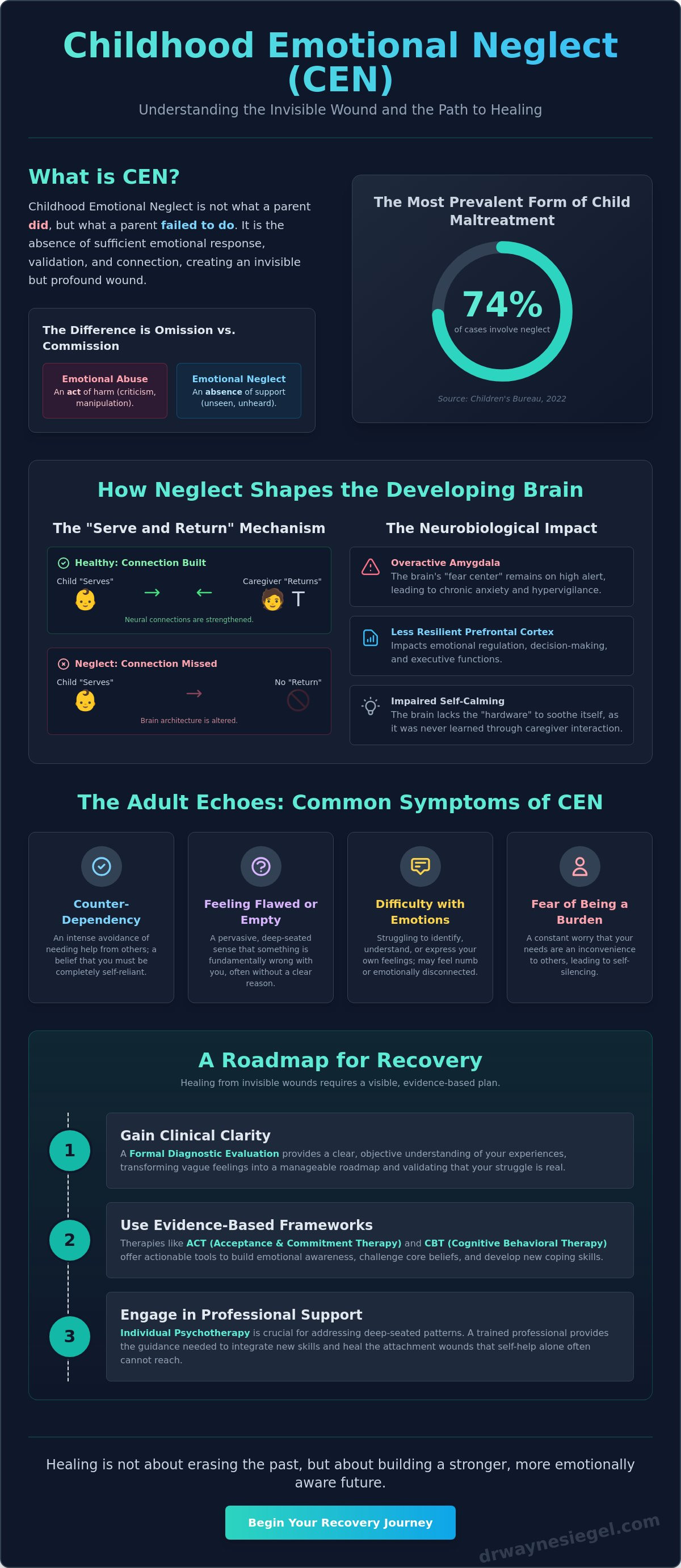
Childhood Emotional Neglect (CEN) is a caregiver’s failure to respond sufficiently to a child’s emotional needs. Unlike physical abuse or overt emotional maltreatment, CEN is defined by its absence. It’s the silence where there should have been validation. It’s the lack of mirroring when a child seeks connection. Research from the Children’s Bureau in 2022 indicated that 74% of child maltreatment victims experienced neglect, making it the most prevalent form of childhood trauma. While active trauma involves harmful actions, CEN is a passive trauma of omission. It’s about what didn't happen rather than what did.
In my practice, I often guide patients toward understanding Donald Winnicott’s "Good Enough" parenting concept. This framework is essential because it helps us move away from unproductive blame and toward clinical clarity. No parent is perfect, and most don't intend to neglect their children’s inner lives. However, when the emotional connection is consistently missing, it creates a deficit that persists into adulthood. Starting the journey toward healing from childhood emotional neglect requires us to first name this invisible force and acknowledge that its impact is real, even without physical evidence.
The Difference Between Emotional Neglect and Emotional Abuse
Emotional abuse is an act of commission; it’s the presence of active harm like criticism, manipulation, or verbal attacks. In contrast, Emotional Neglect is the absence of an emotional response. It is the metaphorical "still face" of a caregiver when a child is in distress. Because there are no loud, traumatic events to remember, neglect is often much harder to identify during a diagnostic psychological evaluation. You don't necessarily remember a specific hit or a scream; you simply don't remember being comforted or heard.
Why It Often Goes Unnoticed Until Adulthood
Many of my patients grew up in "well-provided-for" homes where physical needs like food, clothing, and high-quality education were met. This material stability often masks the underlying emotional void. Without the fuel of consistent emotional validation, children often feel like they're running on an "empty tank." They don't blame their parents because there’s nothing obvious or "bad" to point to. Instead, they internalize the lack of connection as a personal flaw. They grow up feeling fundamentally "empty" or "wrong" without understanding the source. This makes healing from childhood emotional neglect a process of uncovering what was missing all along, rather than just fixing what was broken.
The Science of Neglect: How CEN Shapes the Developing Brain and Attachment
Brain development is not a solo endeavor; it is a biological collaboration. At the heart of this process is the "Serve and Return" mechanism. Just like a game of tennis, a child "serves" by reaching out for interaction through babbles, facial expressions, or cries. When a caregiver "returns" the serve with focused attention and emotional mirroring, neural connections are strengthened. In cases of emotional neglect, these serves go unreturned. This chronic lack of response doesn't just feel lonely; it fundamentally alters the architecture of the developing brain.
The Adverse Childhood Experiences (ACEs) study identifies emotional neglect as a primary factor in long term psychological health. According to 2025 CDC data, three in four high school students have experienced at least one ACE, with neglect being a significant contributor. When emotional needs are ignored, the brain’s stress response system remains on high alert. This often results in an overactive amygdala, the brain's fear center, and a less resilient prefrontal cortex, which is responsible for emotional regulation and executive functioning. Without the "return" of a caregiver's soothing presence, the child's brain lacks the necessary input to build the hardware for self-calming. If you are currently seeking diagnostic psychological evaluations to understand these patterns, you are taking a vital step toward reclaiming your narrative.
Neurobiology: The Physical Impact of Emotional Silence
Chronic emotional silence acts as a physical stressor. In the absence of mirroring, the body frequently produces elevated levels of cortisol, which can interfere with healthy brain maturation. This environment forces the brain to prioritize survival over social-emotional growth. Synaptic pruning is the biological process where the brain eliminates unused neural connections to increase efficiency; in a neglected child, the pathways intended for emotional intimacy and self-expression are often pruned away because they are never activated. Understanding these signs and effects of childhood emotional neglect is a prerequisite for healing from childhood emotional neglect.
Attachment Theory: Why We Relate the Way We Do
Early caregivers are meant to serve as a "secure base" from which a child explores the world. When that base is unresponsive, the child develops an "Insecure Attachment" style as a logical survival adaptation. Some children become "Dismissive-Avoidant," learning to suppress their needs because they've learned that help isn't coming. Others may become "Anxious-Preoccupied," constantly monitoring others for signs of withdrawal. These adaptations form an "Internal Working Model," a mental blueprint that dictates how you view yourself and others in adulthood. This blueprint often suggests that you are a burden or that your feelings are irrelevant. Rewriting this model is the core work of healing from childhood emotional neglect, moving from survival to genuine connection.
Identifying the Adult Echoes: Common Symptoms of Emotional Neglect
Adults who survived emotional neglect often present with a specific set of psychological markers that feel like inherent personality traits but are, in fact, adaptations. One of the most pervasive is what we call "The Fatal Flaw." It is the deep-seated, quiet conviction that you are fundamentally different from others; that if people truly saw your inner world, they would find you unlovable or broken. This belief often fuels "Counter-Dependency," an extreme drive for self-sufficiency. You might take pride in never asking for help, yet this behavior is actually a defense mechanism against the vulnerability of needing someone who might not respond. I see this frequently in high-achievers who use their independence as a shield.
In my practice, I often encounter patients struggling with Alexithymia. This is the clinical difficulty in identifying and describing one's own emotions. When your childhood environment didn't mirror your feelings back to you, you never learned the vocabulary of your own heart. This lack of emotional literacy often leads to chronic self-criticism or perfectionism. If you can't understand why you feel a certain way, you might default to being "perfect" as a way to maintain a sense of control. Understanding Childhood Emotional Neglect helps us see these symptoms not as personal failures, but as logical echoes of an unsupported past. Addressing these echoes is a critical phase in healing from childhood emotional neglect.
The Emotional Void: Feeling "Numb" or "Empty"
Many individuals describe a persistent sensation of being an observer in their own lives. This "numbness" isn't a lack of feeling; it's a survival strategy that has outlived its usefulness. As a child, turning down the volume on your emotions kept you safe from the pain of being ignored. Today, it might manifest as the "Social Chameleon" effect. You've become an expert at reading the room and adapting to others' needs while your own self remains hidden and unformed.
Impact on Adult Relationships and Intimacy
Neglect often dictates the rhythm of adult intimacy and connection. You might find yourself plagued by the fear of being a burden, which prevents you from expressing even basic needs to a partner. This can lead to a "repetition compulsion," where you unconsciously choose emotionally unavailable partners because their distance feels familiar and safe. Moving toward healing from childhood emotional neglect involves breaking these cycles by recognizing that your needs are not an imposition, but a fundamental part of being human.
Evidence-Based Strategies for Healing and Emotional Integration
Recovery is not a matter of willpower; it is a process of neural and emotional restructuring. In my clinical experience, healing from childhood emotional neglect requires moving beyond self-help mantras toward validated therapeutic frameworks. Acceptance and Commitment Therapy (ACT) is particularly effective here, as it fosters psychological flexibility. Rather than fighting the "emptiness," ACT teaches you to accept your internal state while committing to actions that align with your values. Similarly, Cognitive Behavioral Therapy (CBT) provides the tools to dismantle the "internalized critic," that persistent voice that minimizes your needs and reinforces the belief that you are a burden.
We also utilize the clinical concept of reparenting within the therapeutic relationship. This isn't about blaming the past, but about providing the adult self with the consistent validation and emotional mirroring that were missing during key developmental windows. To bridge the gap between mind and body, I often incorporate elements of Somatic Experiencing. Because neglect is often stored in the nervous system as a state of "shutdown" or numbness, learning to track bodily sensations is essential for reconnecting with your emotional cues. If you're ready to begin this structured work, my practice offers individual psychotherapy designed to navigate these complex layers with precision and care.
Developing Emotional Literacy and Awareness
Many patients find the "IAL" technique helpful for breaking through Alexithymia: Identify the feeling, Accept its presence without judgment, and Locate where it resides in your body. Using a clinical "Emotion Wheel" can help you move past vague descriptors like "fine" or "okay" to more precise terms like "disregarded," "isolated," or "longing." Mindfulness-based ACT allows patients to observe these rising emotions with a sense of detached curiosity rather than being overwhelmed by them. This precision is the first step in filling the emotional "empty tank" we identified in the previous sections.
Setting Boundaries and Reclaiming Self-Worth
Identifying your personal needs is a radical act after a lifetime of suppression. In healing from childhood emotional neglect, we must distinguish between self-care, which is the necessary maintenance of your emotional health, and self-indulgence, which is often a temporary distraction from pain. True self-care involves setting boundaries that protect your limited emotional energy from being drained by others' demands. For those whose neglect was accompanied by more overt stressors, reading our PTSD Counseling: A Research-Based Guide can provide additional context on trauma-informed recovery strategies. Reclaiming your worth starts with the evidence-based realization that your presence and your needs are never a burden.
Developing a Roadmap for Recovery: The Role of Professional Support
While self-help resources offer a valuable starting point, they often lack the interactive feedback loop necessary to repair deep-seated neglect patterns. Healing from childhood emotional neglect is inherently a relational process. Because the original injury occurred through the absence of a responsive relationship, the recovery often requires the presence of a steady, non-judgmental guide. As a clinical psychologist, I view my role as a partner in your curiosity, helping you navigate the complex cognitive and emotional landscapes that have felt inaccessible for years. Professional support provides a safe container to test new emotional skills in real-time, moving beyond theoretical knowledge toward lived experience.
Accessing this specialized care is more attainable than ever. Through PsyPact states, patients can now connect with board-certified specialists across state lines via interjurisdictional telehealth. This expansion ensures that your location doesn't limit your ability to find a practitioner who understands the specific neurobiology of neglect. In my practice, we prioritize this accessibility, ensuring that the science of recovery is paired with a deeply compassionate, person-centered approach.
When to Seek Professional Psychological Assessment
Many adults spend years in therapy for Depression or Anxiety without realizing that childhood emotional neglect is the primary driver of their symptoms. A formal diagnostic evaluation is essential for providing clinical clarity. These assessments help differentiate CEN from other conditions, such as ADHD or personality disorders, which can often present with similar symptoms of emotional dysregulation or social withdrawal. By choosing a comprehensive psychological assessment near me, you move beyond generic labels to find actionable meaning. We look at the whole person, identifying your unique cognitive profile and strengths to build a personalized roadmap for your journey.
Choosing the Right Evidence-Based Practitioner
Selecting a provider is a significant step in healing from childhood emotional neglect. You should look for a board-certified clinical psychologist who prioritizes evidence-based practices like ACT or CBT while maintaining a warm, approachable empathy. The right practitioner won't just offer instructions; they'll offer a partnership. This process is a deliberate, step-by-step progression. We start by uncovering the "why" behind your challenges and move steadily toward a life where you feel whole, connected, and seen. Your history of being ignored doesn't have to define your future; with the right support, you can transform that invisible absence into a visible path of growth and daily quality of life.
Reclaiming Your Narrative: The Path to Emotional Wholeness
Understanding the neurobiological impact of unreturned "serves" and the adaptations of counter-dependency is the first step toward relief. You've explored how evidence-based frameworks like ACT and CBT provide the necessary tools to dismantle long-standing patterns of silence and self-criticism. The journey toward healing from childhood emotional neglect is not about erasing the past; it's about building a resilient, integrated future where your needs are finally acknowledged. You've moved from the "invisible absence" to a structured roadmap for change.
I've been board-certified since 1996 and focus specifically on these evidence-based practices to ensure my patients receive the highest standard of care. Whether you're seeking a diagnostic evaluation or individual psychotherapy, I provide national telehealth access via PsyPact to ensure location is never a barrier to your recovery. You don't have to navigate this complex landscape alone. Gain clinical clarity on your journey; schedule a consultation with Dr. Wayne Siegel today. Your experience matters, and the roadmap to feeling whole is within your reach.
Frequently Asked Questions
Can you actually recover from childhood emotional neglect?
Recovery is absolutely possible through the brain's inherent neuroplasticity and the development of new emotional skills. By engaging in targeted, research-driven interventions, you can build the neural pathways for self-regulation and intimacy that weren't fostered during your development. Healing from childhood emotional neglect involves transforming an invisible deficit into a tangible, manageable roadmap for personal growth and emotional wholeness.
How do I know if I was emotionally neglected if I had a 'good' childhood?
Neglect is defined by what didn't happen, which means it often coexists with material stability and physical safety. You may have had your physical needs met while your inner world remained unmirrored and unvalidated. If you grew up feeling that your emotions were a burden or that you had to be "low maintenance" to be loved, you likely experienced emotional neglect despite a seemingly stable upbringing.
Is childhood emotional neglect a form of trauma?
Yes, clinical research classifies emotional neglect as a "trauma of omission" within the Adverse Childhood Experiences (ACEs) framework. While it lacks the overt nature of physical abuse, the chronic absence of emotional support creates a persistent stress response in the developing brain. CDC data from 2025 confirms that these "passive" traumas are just as significant as active harm in shaping long-term psychological health.
What is the difference between CEN and ADHD in adults?
While both can involve executive dysfunction and emotional dysregulation, CEN is a relational injury whereas ADHD is a neurodevelopmental condition. Neglect often causes a "shutdown" response that mimics the focus issues seen in ADHD. A formal diagnostic psychological evaluation is the only way to gain clinical clarity and ensure you aren't mislabeling a trauma response as a biological attention deficit.
How long does it take to heal from emotional neglect?
The timeline for recovery varies, but research into trauma integration suggests that significant symptom reduction often occurs within 12 to 18 months of consistent individual psychotherapy. Healing is a deliberate, step-by-step progression rather than a quick fix. It involves slowly dismantling decades of "counter-dependency" and replacing it with a secure internal working model, a process that requires patience and professional guidance.
Can I heal from CEN without going to therapy?
Self-help resources provide excellent foundational knowledge, but deep relational wounds usually require a relational environment to heal. Because neglect occurred through the absence of a responsive caregiver, the most effective "cure" involves the presence of a responsive, professional guide. Therapy provides the "secure base" necessary to practice the vulnerability and emotional expression that were previously unsafe or ignored.
What happens if childhood emotional neglect is left untreated?
Untreated neglect often leads to a persistent sense of being "flawed" or "empty," which can manifest as chronic depression or social isolation. ACEs research also links long-term emotional neglect to an increased risk of physical health complications and inflammatory conditions. Without intervention, the "Internal Working Model" formed in childhood will continue to dictate your adult relationships, often leading you toward emotionally unavailable partners.
How do I talk to my parents about emotional neglect?
Approach these conversations by focusing on your current feelings and needs rather than past grievances. Using "I" statements helps reduce defensiveness and keeps the focus on your personal journey. It is also helpful to recognize that many parents who neglected their children's emotions were themselves victims of the 10% of children who experience neglect. If a conversation feels counterproductive, your priority should remain on your own healing from childhood emotional neglect.