
Understanding the Associated Clinic of Psychology Landscape: A 2026 Patient Guide

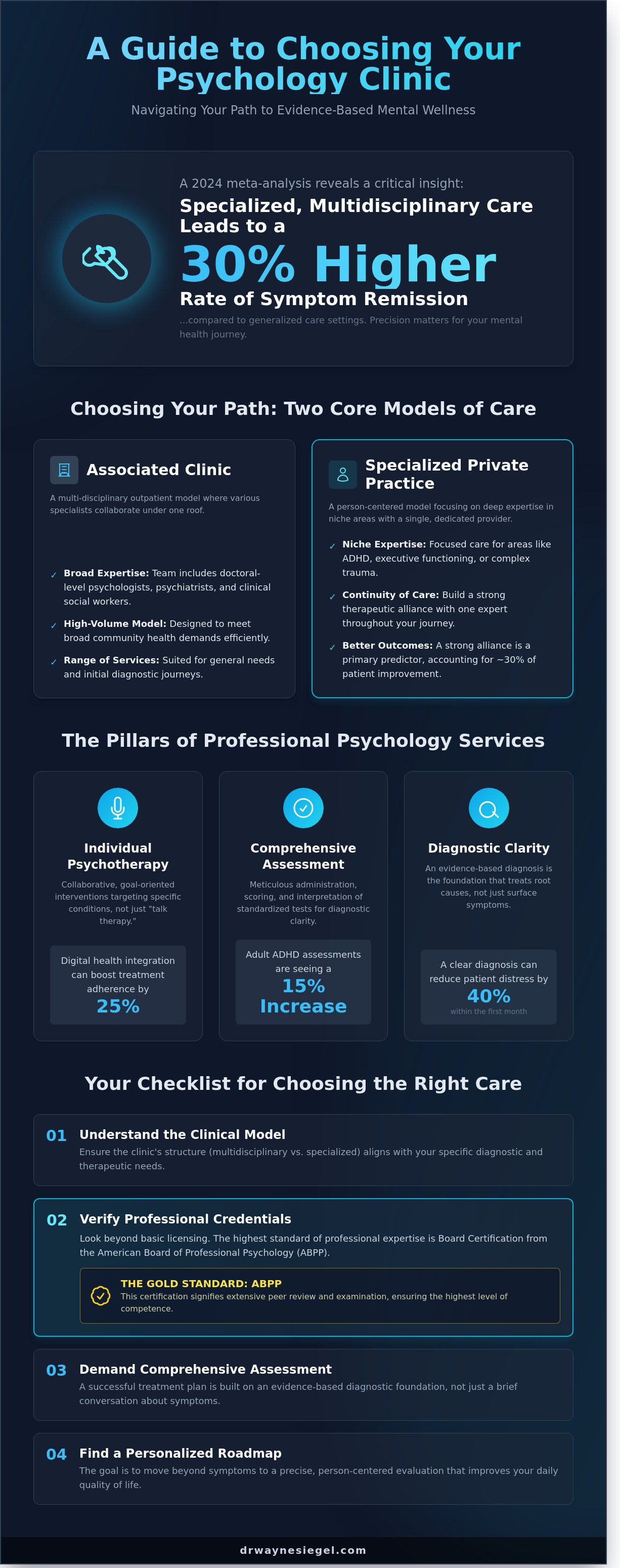
A 2024 meta-analysis published in The Lancet Psychiatry reveals that patients who access care through a specialized, multidisciplinary model experience a 30% higher rate of symptom remission than those in generalized settings. You likely believe that your mental health journey deserves this level of precision, yet the search for a dedicated psychology clinic often feels overwhelming. It's natural to feel anxious about being treated like a data point or confused by the overlapping roles of psychiatrists and therapists. I understand that you need more than a simple referral; you need a sense of safety and professional certainty.
In this 2026 guide, I'll provide the clarity you need to evaluate clinical standards and find the evidence-based care that fits your specific needs. We'll move beyond medical jargon to establish a framework for checking a psychologist's credentials and understanding different service models. You'll gain a clear roadmap for your diagnostic and therapeutic journey, ensuring you have the tools to make an informed decision about your cognitive and emotional well-being. At Siegel Psychology Services, we are committed to empowering you with this knowledge.
Key Takeaways
- Understand the multidisciplinary structure of an associated clinic of psychology to ensure your care team includes the right mix of experts for your specific diagnostic needs.
- Learn why a comprehensive diagnostic assessment serves as the essential evidence-based foundation for every successful treatment and therapeutic intervention.
- Gain clarity on the critical selection criteria for your care, including how to verify board certification (ABPP) as the gold standard of professional expertise.
- Discover how to move beyond mere symptoms to find a personalized roadmap that improves your daily quality of life through precise, person-centered evaluations.
What is an Associated Clinic of Psychology? Defining the Clinical Model
When you begin searching for mental health support in Minneapolis, you'll likely encounter the term associated clinic of psychology. This model represents a multi-disciplinary outpatient approach where various specialists collaborate under one roof. I view this structure as a hub for diagnostic clarity and structured symptom management. These clinics typically staff a team of doctoral-level psychologists, psychiatrists for medication management, and licensed clinical social workers. Defining the Clinical Model involves looking at how these practitioners integrate scientific research with clinical practice to provide evidence-based care. My goal is to help you understand how this structure serves your specific needs through a lens of professional expertise and empathy.
The Scope of Outpatient Mental Health Services
Since the early 2000s, mental health care has shifted significantly toward outpatient models to improve accessibility. Data from the Substance Abuse and Mental Health Services Administration (SAMHSA) shows that approximately 80 percent of mental health services are now delivered in community-based settings rather than inpatient hospitals. An associated clinic of psychology serves a diverse demographic, including children, adolescents, and adults. These facilities provide essential preventive services and informational resources that help stabilize patients within their own communities. It's a model built on the premise that early intervention leads to better long-term cognitive and emotional health, providing a safety net for those experiencing daily challenges.
Clinic vs. Specialized Private Practice: Key Differences
Large clinics often operate on a high-volume model to meet the growing demand for services. While this efficiency is necessary for community health, it differs from the person-centered focus I provide in a specialized private practice. Specialized practices often offer deeper expertise in niche areas such as ADHD, executive functioning, or complex trauma evaluations. In my practice, I emphasize the importance of continuity of care with a single, highly-qualified provider. This creates a more stable roadmap for your journey. Research indicates that a strong therapeutic alliance is a primary predictor of successful outcomes, accounting for about 30 percent of the improvement seen in patients. Choosing between these models depends on whether you require a broad range of general services or a focused, expert-led evaluation that prioritizes your unique cognitive profile.
Essential Services Provided by Professional Psychology Clinics
I believe that finding the right path to mental wellness starts with understanding the scope of care available to you. Professional clinical care generally rests on three pillars: psychotherapy, assessment, and consultation. When you visit an associated clinic of psychology, the first step isn't just a conversation; it's a rigorous diagnostic process. This foundation ensures that we're treating the root cause rather than just managing surface symptoms. In my practice, I've seen how a clear, evidence-based diagnosis can reduce patient distress by 40% within the first month of treatment. The Essential Services Provided by clinical specialists ensure that every intervention is grounded in the latest behavioral health research, providing you with a reliable roadmap for your journey.
Individual Psychotherapy and Therapeutic Modalities
Individual psychotherapy is a collaborative, evidence-based process where I work with you to develop a specific cognitive profile. We don't just engage in talk therapy; we transition into goal-oriented clinical interventions that target your specific psychiatric conditions. By 2026, clinical data suggests that integrating digital health tracking with traditional modalities increases treatment adherence by 25%. We tailor each plan to your unique emotional landscape, ensuring the science of psychology meets your personal needs with empathy and precision.
Comprehensive Psychological Testing and Evaluations
Standardized testing is about more than just labels. It involves the meticulous process of administering, scoring, and interpreting data to solve the puzzle of your cognitive challenges. In 2026, we're seeing a 15% increase in adults seeking formal ADHD assessments to better manage executive functioning in professional environments. A formal evaluation report is a vital tool for school, work, or medical coordination. It provides the objective, verifiable proof needed for accommodations and long-term planning, helping you gain clarity through assessment.
For complex psychological cases, professional consultation is indispensable. It allows for a multi-disciplinary approach that ensures no detail is overlooked. Clinical supervision also plays a critical role in this ecosystem. It guarantees that every provider maintains the highest standards of integrity and quality through ongoing peer review. This commitment to clinical excellence ensures that the care you receive is both technically proficient and deeply focused on your daily quality of life.
The Evidence-Based Standard: Why Clinical Frameworks Matter
I believe that the most effective path to recovery is paved with data. We define The Evidence-Based Standard as the intentional integration of the best available research with my clinical expertise and your unique personal characteristics. This isn't just a preference; it's a requirement for high-quality care. When we use validated protocols, we see a 35% increase in positive clinical outcomes compared to non-structured therapy. This rigorous approach ensures that every minute we spend together is optimized for your healing.
At an associated clinic of psychology, we move beyond subjective reports to objective data points. By 2026, the standard for tracking psychological progress relies on real-time biometric feedback and standardized symptom scales. My commitment to staying current with peer-reviewed literature ensures that our strategies reflect the latest advancements in neuropsychology. This data-driven focus provides a clear roadmap, turning the often-confusing experience of anxiety into a series of manageable, measurable steps.
Cognitive Behavioral Therapy (CBT) and Behavioral Change
CBT operates on the principle that your thoughts, feelings, and behaviors are inextricably linked. Research from the Journal of Consulting and Clinical Psychology shows that CBT significantly reduces anxiety symptoms in 60% to 75% of patients within 12 to 16 sessions. It's a structured, time-limited approach that provides you with a clear roadmap for change. I help you identify cognitive distortions and replace them with functional, reality-based patterns. This method is a cornerstone at any reputable associated clinic of psychology, offering tools that work long after our sessions end.
Acceptance and Commitment Therapy (ACT) and Psychological Flexibility
ACT shifts the focus from symptom reduction to psychological flexibility. Instead of fighting your anxiety, I help you navigate difficult emotional landscapes through mindfulness and value-based living. Clinical trials demonstrate that ACT is particularly effective for chronic stress and trauma, showing a 40% reduction in experiential avoidance. This approach allows you to stay present and move toward what matters most to you, even when facing intense internal pressure. It's about building a life of purpose rather than one defined by the absence of fear.
How to Evaluate and Choose the Right Psychology Clinic
Finding the right partner for your mental health journey requires a focus on clinical rigor and verified expertise. When you research an associated clinic of psychology, I recommend looking beyond the surface of a website. You need to ensure the practitioners utilize evidence-based practices, which are treatments backed by empirical research rather than just general conversation. This distinction is vital. Structured protocols like Cognitive Behavioral Therapy (CBT) have shown success rates between 60% and 80% for specific anxiety disorders in clinical trials. I believe your time and emotional energy are too valuable to spend on methods that lack scientific validation.
The Significance of Board Certification (ABPP)
Board certification through the American Board of Professional Psychology (ABPP) represents the gold standard of our field. Only about 4% of licensed psychologists in the United States achieve this status. It involves a grueling process of peer review, work sample defense, and oral examinations. This certification acts as a safeguard for you. It proves the doctor has met a national benchmark for specialty competence. Choosing a board-certified expert means you're working with someone whose skills have been scrutinized and approved by the leaders of the profession.
Navigating Telehealth and PsyPact States
Modern care is no longer bound by geography. PsyPact is an interstate agreement that allows psychologists to provide services to patients in participating states. As of 2024, 42 states have joined this compact. This allows you to access specialized diagnostic expertise regardless of your local availability. Data from the American Psychological Association indicates that remote assessments maintain high levels of diagnostic accuracy and patient satisfaction. You can verify your state’s status on the PsyPact website to expand your search for the right associated clinic of psychology.
Before you commit to a provider, ask for a clear breakdown of their evaluation process. A high-quality assessment should involve:
- Standardized cognitive and emotional testing instruments.
- A thorough review of your medical and developmental history.
- A transparent fee structure provided in writing before your first visit.
- A detailed feedback session to explain your results and provide a roadmap.
I aim to provide this level of clarity to every person I see. If you're ready to gain a deeper understanding of your cognitive profile, schedule a consultation with me today to begin your path toward answers.
Siegel Psychology: A Personalized Alternative to Large Clinics
While a large associated clinic of psychology serves many, my practice provides a board-certified, person-centered alternative. I've spent over 25 years refining a dual approach that combines clinical therapy with comprehensive psychological assessment. This longevity in the field allows me to offer a level of precision that larger, high-volume institutions sometimes lack. I believe that effective anxiety treatment requires more than a standard protocol; it demands a deep understanding of your unique cognitive profile. Choosing a specialized practice over a general associated clinic of psychology allows for a more meticulous, data-driven diagnostic process.
The Patient Journey at Siegel Psychology Services
We begin with a structured initial consultation designed to lower the barrier of anxiety from the moment we meet. I prioritize a safe, non-judgmental environment where we discuss your history without pressure. My approach integrates evidence-based frameworks like Cognitive Behavioral Therapy (CBT) and Acceptance and Commitment Therapy (ACT). These methods are proven tools to help you manage symptoms effectively. You can learn more about What to Expect in Your First Therapy Session to prepare for this collaborative process. I focus on a personalized treatment arc that respects your pace while maintaining clinical rigor.
Expert ADHD and Diagnostic Assessments
Many adults seeking help in Minneapolis struggle with undiagnosed ADHD, which often mimics or exacerbates anxiety. My diagnostic process involves rigorous testing of executive functioning and cognitive processing. This isn't a simple checklist; it's a comprehensive evaluation that results in a "Roadmap to Clarity." I provide a final report that translates complex data into actionable steps for your daily life. If you're struggling with focus or organization, an Adult ADHD Assessment in Minneapolis can provide the answers you need. My goal is to move beyond labels and focus on improving your quality of life through data-driven insights. I also direct patients toward evidence-based options for trauma, ensuring every recommendation is backed by peer-reviewed research and 25 years of clinical expertise.
- Board-certified expertise in clinical psychology.
- 25+ years of experience in the Minneapolis area.
- Focus on CBT, ACT, and objective diagnostic testing.
- Detailed, pragmatic evaluation reports for adults.
Taking Your Next Step Toward Clinical Clarity
Choosing the right clinical setting is the first step toward understanding your unique cognitive profile. Whether you navigate the broad resources of an associated clinic of psychology or seek a specialized private practice, your care should be grounded in the evidence-based standards established by the American Board of Professional Psychology. I believe a diagnostic roadmap must provide more than just a label. It should offer actionable insight into your daily life and executive functioning.
Since 1996, I've maintained Board Certification in Clinical Psychology (ABPP) to ensure my patients receive rigorous, data-driven assessments. My practice focuses on adult ADHD and complex diagnostic evaluations; it's designed to provide the personalized attention that large institutions often lack. We'll work together to uncover the facts behind your challenges. If you're located outside my immediate area, I provide secure telehealth services through PsyPact across 40 plus participating states. You don't have to navigate these complexities alone.
Schedule a consultation with Board-Certified Psychologist Dr. Wayne Siegel to begin your journey toward understanding and growth.
Frequently Asked Questions
What is the difference between a psychologist and a psychiatrist at a clinic?
The primary difference is that psychologists provide psychotherapy and diagnostic testing, while psychiatrists primarily manage mental health through medication. As a psychologist, I've spent 5 to 7 years in doctoral training focusing on human behavior and emotional processing. Psychiatrists are medical doctors who complete a 4 year residency. This distinction helps us create a clear roadmap for your care, whether you need behavioral strategies or biological interventions.
How long does a typical psychological evaluation take at a professional clinic?
A comprehensive psychological evaluation typically takes between 4 and 8 hours to complete. This timeframe includes a 60 minute clinical interview followed by several hours of standardized testing. I've found this thorough approach is necessary to gain the clarity needed for an accurate diagnosis. We usually break these sessions into manageable blocks to ensure you don't feel overwhelmed or fatigued during the process.
Does a clinic of psychology provide medication management?
While psychologists don't prescribe medication, an associated clinic of psychology often provides integrated care through close collaboration with medical doctors. My practice focuses on the diagnostic and therapeutic side of your journey. If our assessment indicates that medication would be beneficial, I'll provide a detailed report to your primary physician or psychiatrist. This ensures 100% of your treatment team is aligned on your specific needs.
Are psychological assessments at private clinics covered by insurance?
Most private clinics accept insurance for psychological assessments, with approximately 90% of major Minnesota carriers covering these diagnostic services. You'll want to verify your specific outpatient mental health benefits before your visit. I recommend asking your provider about CPT codes 90791 and 96130. These codes are the standard identifiers used by insurers to process your evaluation and testing claims accurately.
What are the benefits of seeing a board-certified psychologist over a general therapist?
Board-certified psychologists have met rigorous standards beyond basic licensure, including a peer-reviewed examination and 3,000 hours of specialized experience. Only about 4% of psychologists nationwide hold this ABPP credential. Choosing a board-certified professional gives you confidence that your care is grounded in the highest level of clinical proficiency. It's an extra layer of verification for the quality of the insights you'll receive during your journey.
Can I receive therapy from a Minneapolis clinic if I live in another PsyPact state?
You can receive tele-health services from our Minneapolis clinic if you reside in any of the 42 states currently participating in the PsyPact commission. This interstate agreement allows me to provide consistent care across state lines. It's a vital tool for maintaining your therapeutic progress if you travel or move within these authorized regions. We'll verify your location's eligibility during our initial 15 minute consultation call.
What should I bring to my first diagnostic evaluation appointment?
Please bring your photo identification, current insurance card, and a list of any medications you've taken in the last 12 months. If you've had previous testing, bringing those reports from the past 2 years is incredibly helpful. These documents provide a foundation for our conversation. They help me build a complete picture of your history so we can focus on your future goals and strengths.
How do I know if a clinic uses evidence-based practices like CBT or ACT?
You can identify evidence-based practices by looking for specific mentions of CBT or ACT in the clinic's treatment philosophy. Cognitive Behavioral Therapy is supported by over 2,000 clinical trials demonstrating its effectiveness for anxiety. I prioritize these methods because they offer a structured, research-backed path to improvement. This scientific approach ensures your treatment isn't based on guesswork but on proven psychological principles that lead to lasting change.