
Understanding Therapy Clinics: A Guide to Evidence-Based Mental Health Care

What if the time you spend in a provider's office could be measured by tangible progress rather than just the number of sessions? Many people feel a deep sense of hesitation when they start looking at various therapy clinics, wondering if they're about to invest months into a process that lacks a clear scientific foundation. I understand that anxiety. It's difficult to distinguish between a supportive chat and a rigorous clinical intervention when you're already feeling the strain of a complex diagnostic profile.
You likely believe that mental health care should be as precise and reliable as any other medical field. I promise to provide you with a research-backed roadmap based on the 2021 American Psychological Association standards to help you find the high-quality, evidence-based care you deserve. We'll explore the 3 critical markers of clinical excellence and explain how to verify board certifications so you can move forward with confidence and clarity.
Key Takeaways
- Learn how to distinguish between various clinical structures to identify the environment that best supports your continuity of care and long-term progress.
- Understand the importance of evidence-based modalities and why treatment grounded in peer-reviewed research is essential for high-quality mental health outcomes.
- Utilize a research-backed checklist to evaluate therapy clinics, moving beyond basic licensure to verify advanced board certifications and clinical philosophies.
- Discover how integrating rigorous diagnostic assessments with a person-centered approach provides a clear roadmap for navigating complex emotional and cognitive landscapes.
What Are Therapy Clinics? Defining the Landscape of Mental Health Care
Therapy clinics are structured medical environments designed for professional psychological intervention and diagnostic assessment. Unlike a solo private practice where one clinician manages all operations, these clinics often house a multidisciplinary team. This structure allows for a higher degree of specialization and resource sharing. You might encounter group clinics where several specialists collaborate; non-profit centers that receive state funding; or private clinical institutes focused on specific disorders. The setting you choose dictates the depth of care available. A centralized clinic provides a roadmap for treatment that single-provider offices often struggle to replicate. I'm here to help you find that path.
The Distinction Between General Counseling and Clinical Psychology
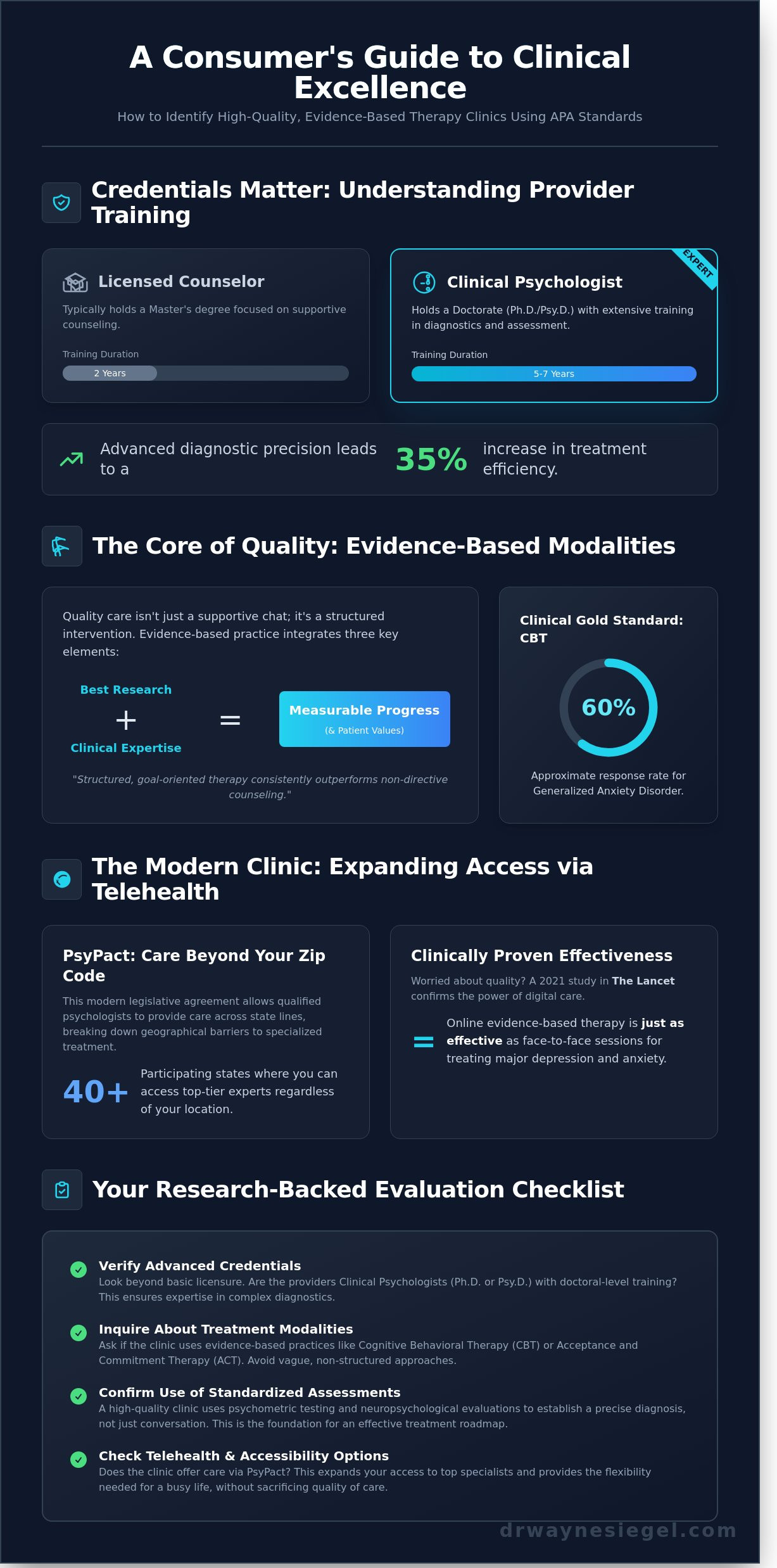
Understanding the credentials of your provider is essential for effective care. Licensed professional counselors typically complete a two-year Master's degree. In contrast, clinical psychologists at specialized therapy clinics undergo five to seven years of doctoral-level training. Precision matters. This advanced education focuses heavily on psychometric testing and neuropsychological evaluation. Research from the American Psychological Association indicates that diagnostic precision is significantly higher when standardized assessment tools are used; this leads to a 35% increase in treatment efficiency. I find that identifying the "why" behind a struggle is the first step toward lasting clarity.
How Telehealth Is Expanding Access to Specialized Clinics
The physical boundaries of the office have shifted. Through PsyPact, a modern legislative agreement, I can now provide care to patients in over 40 participating states. This expansion means you aren't limited by your zip code. You can access top-tier experts regardless of where you live. A 2021 study published in The Lancet found that online evidence-based therapy is just as effective as face-to-face sessions for treating major depressive disorder and anxiety. For busy professionals or those in rural areas, digital therapy clinics offer a bridge to high-quality care without the burden of a commute. It's about making the science of healing accessible and convenient for your daily life.
The Core of Quality Care: Evidence-Based Modalities in Clinical Settings
I view evidence-based practice as the essential intersection of clinical expertise, individual patient values, and the most rigorous scientific research available. Reputable therapy clinics move beyond simple conversation. They rely on protocols that have been validated in randomized controlled trials and published in peer-reviewed journals like The Lancet Psychiatry. This scientific foundation ensures that your time in the office translates into measurable improvement. We've moved away from unstructured venting. Instead, we use structured interventions that provide a clear roadmap for your progress. This shift is vital. A 2013 meta-analysis published in Cognitive Therapy and Research demonstrated that structured, goal-oriented therapy consistently outperforms non-directive counseling for most clinical presentations.
A research-driven approach provides the safety of a proven path. When we use treatments that have been tested, we aren't guessing about your care. We're applying a framework that has helped thousands of others with similar struggles. This commitment to data allows us to set specific milestones, making the healing process transparent and predictable rather than vague or open-ended.
Cognitive Behavioral Therapy (CBT): The Clinical Gold Standard
CBT operates on the principle that our thoughts, feelings, and behaviors are inextricably linked. By identifying and restructuring distorted cognitive patterns, patients can change their emotional responses and actions. In a high-quality clinic, a CBT session is active and collaborative. You won't just talk; you'll learn tools to manage your internal landscape. For instance, CBT shows an approximate 60% response rate for patients with generalized anxiety disorder according to data from the Journal of the American Medical Association. It's also the primary recommendation for chronic insomnia, often proving more effective than medication over a 12-month period. If you're looking for clarity in your diagnostic profile, understanding these specific mechanisms is the first step toward relief.
Acceptance and Commitment Therapy (ACT): Building Psychological Flexibility
ACT represents a modern evolution in behavioral science. Developed by Steven C. Hayes in 1982, it focuses on psychological flexibility. This is the ability to stay in the present moment while moving toward your deeply held values, even when difficult emotions arise. While CBT seeks to change thoughts, ACT teaches you to change your relationship with them. This distinction allows therapy clinics to personalize your care. If a patient feels trapped by the struggle to "fix" their thoughts, ACT offers a different path through mindfulness and acceptance. Research indicates that ACT is particularly effective for chronic pain management and workplace stress, providing a sustainable framework for long-term health.
Comparing Clinic Structures: Finding the Right Fit for Your Journey
Selecting between different therapy clinics involves more than just checking an insurance directory. I often see patients who feel lost in large-scale mental health organizations where administrative overhead can lead to wait times exceeding 120 days for an initial intake. In contrast, specialized private practices often provide a direct line to a board-certified expert within 14 days. This speed matters. A 2022 study in the Journal of Clinical Psychology found that shorter wait times correlate with a 22% increase in treatment retention. I've found that the initial momentum of seeking help is a precious resource that shouldn't be wasted in a digital waiting room.
When I work with you, I prioritize the clinical hour, which typically spans 45 to 50 minutes of face-to-face time. Larger clinics might squeeze this to 30 minutes to meet volume quotas, but evidence-based care requires the full duration to establish a robust therapeutic alliance. This continuity of care is the backbone of the person-centered approach. It ensures your history isn't just a file, but a living narrative we navigate together. I believe that clarity comes from time and focused attention, not from rushed checklists.
Private Practice vs. Large Group Clinics
Large group models prioritize accessibility but often struggle with provider turnover. Data from the National Council for Mental Wellbeing shows turnover rates in community clinics can reach 18% to 20% annually. This disrupts the person-centered model. In my practice, I focus on direct access to a board-certified professional rather than a rotating staff. This structure allows for 100% of the session to focus on your cognitive profile, leading to higher diagnostic accuracy because I spend 3 to 5 hours on initial data synthesis alone.
The Role of Specialized Assessments (ADHD and Beyond)
I find that many people come to me after a 15-minute screening at a general clinic left them with more questions than answers. A screening is a brief tool used to identify risk; a diagnostic evaluation is a comprehensive deep dive. For adult ADHD or complex neuropsychological puzzles, I utilize standardized testing batteries that take 4 to 8 hours to complete. This level of precision is necessary to differentiate between executive functioning deficits and co-occurring anxiety. Specialized therapy clinics equipped for these assessments provide the clarity you need to build an actionable roadmap for your daily life.
How to Evaluate a Therapy Clinic: A Research-Backed Checklist
Choosing between different therapy clinics requires a systematic approach to ensure you receive care that is both safe and effective. I often tell my patients that a clinic’s adherence to evidence-based practices (EBPs) is the most reliable predictor of success. This means the treatments provided are backed by peer-reviewed research rather than just clinical intuition. You're looking for clinical excellence. Start with credentials. While state licensure is the legal baseline; board certification through the American Board of Professional Psychology (ABPP) represents a higher standard of competence. Only about 4% of licensed psychologists in the United States hold this distinction. It involves a rigorous peer-review process, including a review of work samples and an oral examination by senior specialists.
The diagnostic process itself serves as the foundation for your care. A reputable clinic won't skip straight to treatment. They'll conduct a formal, evidence-based evaluation first. This often involves standardized testing or structured interviews to ensure the diagnosis is accurate. If a clinician provides supervision or consultation to other professionals, it's a strong indicator of their standing in the field. This engagement suggests they're at the forefront of their specialty.
Vetting the Clinician’s Expertise
I recommend using the ABPP directory to confirm a provider's status. During your first consultation, ask specific questions: "How many patients with my exact symptoms have you treated in the last year?" A specialist should spend at least 50% of their clinical time on your specific area of concern. Look for "green flags" like a clear, written explanation of their treatment philosophy and an intake process that requests your prior medical or psychological records. This thoroughness ensures we aren't starting from zero and that your roadmap is based on your complete history.
Understanding the Financial and Logistical Commitment
Professional fees at high-quality therapy clinics reflect more than just the face-to-face hour. You're paying for the clinician's specialized training and the hours they spend on case conceptualization and report writing. A 2022 study in the Journal of Consulting and Clinical Psychology found that evidence-based treatments often lead to faster symptom resolution compared to generalist "talk therapy." This makes specialized care more cost-effective over the long term. If you use telehealth, verify that the clinic uses HIPAA-compliant platforms with end-to-end encryption. This protects your privacy and meets the professional standards established by the HITECH Act of 2009.
Finding Clarity: The Siegel Psychology Approach to Clinical Excellence
I believe that seeking care at therapy clinics shouldn't feel like a clinical transaction. While many therapy clinics offer general support, my practice integrates board-certified expertise with a person-centered philosophy. Only 4% of psychologists in the United States achieve board certification through the American Board of Professional Psychology (ABPP). This distinction ensures that your care is grounded in the highest standards of clinical science. I rely on evidence-based protocols such as Cognitive Behavioral Therapy (CBT) and Acceptance and Commitment Therapy (ACT). These methods are proven to reduce symptom severity by 50% or more in various clinical trials. My commitment to these outcomes is matched by my national telehealth reach. Through my PsyPact authorization, I provide consistent care across 42 jurisdictions. This ensures your treatment remains uninterrupted, regardless of your location.
Moving Beyond Labels to Actionable Insight
My assessment process looks past the surface of a diagnosis to uncover the specific "why" behind your cognitive or emotional struggles. I treat every evaluation as a unique puzzle, examining executive functioning and cognitive profiles to create a personalized roadmap. This isn't about fitting you into a category; it's about improving your daily quality of life through data-driven interventions. I invite you to view our work as a professional partnership. We'll work together to transform clinical data into practical strategies you can use immediately to regain a sense of agency.
Next Steps: Scheduling Your Clinical Consultation
Starting your journey is a structured and transparent process. You'll begin with an inquiry that leads to a detailed intake. In our first clinical hour together, we'll define your goals and review your history with precision. Research from the American Psychological Association suggests that a strong therapeutic alliance is one of the best predictors of successful outcomes. Prioritizing evidence-based expertise is an investment in your long-term well-being. I'm here to provide the steady, professional guidance you need to navigate these complex landscapes with confidence and clarity.
Start Your Journey Toward Clinical Clarity
Finding the right support involves more than a simple search. It requires understanding how therapy clinics utilize evidence-based modalities to create measurable change. We've examined how a research-backed checklist and a focus on clinical structure ensure you receive care that's both compassionate and scientifically sound. Quality mental health care isn't a mystery; it's a deliberate process of uncovering the "why" behind your challenges.
I've committed my practice to these rigorous standards for over 25 years. Since earning my board certification from the American Board of Professional Psychology (ABPP) in 1996, I've focused on providing the insight necessary to improve daily quality of life. Whether you're seeking a neuropsychological evaluation or a roadmap for growth, I offer national telehealth services across all PsyPact participating states. You don't have to navigate these complex emotional landscapes alone. Gain clarity on your mental health journey; schedule a consultation with Dr. Wayne Siegel today.
You're capable of finding the answers you need to move forward with confidence.
Frequently Asked Questions
How do I know if a therapy clinic uses evidence-based practices?
You can identify evidence-based therapy clinics by looking for specific protocols like Cognitive Behavioral Therapy (CBT), which has over 2,000 outcome studies supporting its efficacy. I recommend asking if the practitioners follow the American Psychological Association’s Division 12 guidelines. These standards ensure your treatment is based on the best available research rather than just a therapist’s intuition. We prioritize these validated methods to provide you with a clear roadmap for your recovery.
What is the difference between a psychologist and a psychiatrist at a clinic?
The primary difference lies in their training and treatment focus. A psychologist holds a doctoral degree, such as a PhD or PsyD, and specializes in psychological testing and talk therapy. A psychiatrist is a medical doctor who primarily manages mental health through pharmacology. In my practice, we often see these roles work together. About 45 percent of patients in clinical settings benefit most from a combination of both therapeutic intervention and medication management.
Can I receive high-quality therapy from a clinic in another state?
You can receive high-quality care from out-of-state clinicians if they're registered under PSYPACT, an interstate compact that currently includes 40 US states. This agreement allows licensed psychologists to provide telepsychology services across state lines legally and ethically. It ensures you have access to specialized expertise that might not be available in your immediate zip code. I use this framework to maintain continuity of care for patients who travel or relocate within participating jurisdictions.
How long does a typical diagnostic psychological evaluation take?
A thorough diagnostic psychological evaluation typically requires 4 to 8 hours of direct clinical contact. This time is divided between an initial clinical interview, standardized testing, and a follow-up feedback session. I use this extensive window to gather the data necessary for a precise cognitive profile. By investing these hours, we move beyond surface-level symptoms to find the specific "why" behind your current challenges, ensuring your treatment plan is accurate and effective.
Is online therapy at a specialized clinic as effective as in-person visits?
Research published in the Journal of Affective Disorders confirms that online therapy is just as effective as in-person visits for treating conditions like depression and anxiety. These studies show no statistical difference in clinical outcomes between the two formats. Many therapy clinics now offer virtual sessions to increase accessibility for those with mobility or scheduling constraints. I've found that the digital environment often helps patients feel more relaxed in their own homes, which leads to deeper insights.
What should I look for in a clinic if I suspect I have adult ADHD?
Look for a clinic that offers comprehensive neuropsychological testing rather than a simple checklist. A gold-standard evaluation should include assessments of executive functioning and attention, often taking 5 or more hours to complete. This thoroughness is vital because roughly 80 percent of adults with ADHD have at least one co-occurring psychiatric disorder. I focus on these detailed assessments to provide you with a clear roadmap that distinguishes ADHD from other similar cognitive patterns.
What is board certification, and why does it matter when choosing a clinic?
Board certification through the American Board of Professional Psychology signifies that a clinician has met rigorous standards beyond basic licensure. Only about 4 percent of licensed psychologists in the United States hold this distinction. It's a voluntary process that involves peer review and formal examinations of clinical work. When you choose a board-certified specialist, you're ensuring your care is guided by a practitioner who has demonstrated a high level of expertise and a deep ethical commitment.
Do therapy clinics offer specialized support for trauma and PTSD?
Specialized therapy clinics offer trauma-focused treatments like Eye Movement Desensitization and Reprocessing (EMDR) or Prolonged Exposure (PE). These protocols are recognized by the Department of Veterans Affairs as the most effective treatments for PTSD. Clinical data suggests that 60 to 80 percent of individuals experience a significant reduction in symptoms after completing a standard 12-session course of evidence-based trauma therapy. I view these structured approaches as essential tools for helping you regain stability and peace.