
What Is Anhedonia and How to Treat It: An Evidence-Based Clinical Guide for 2026

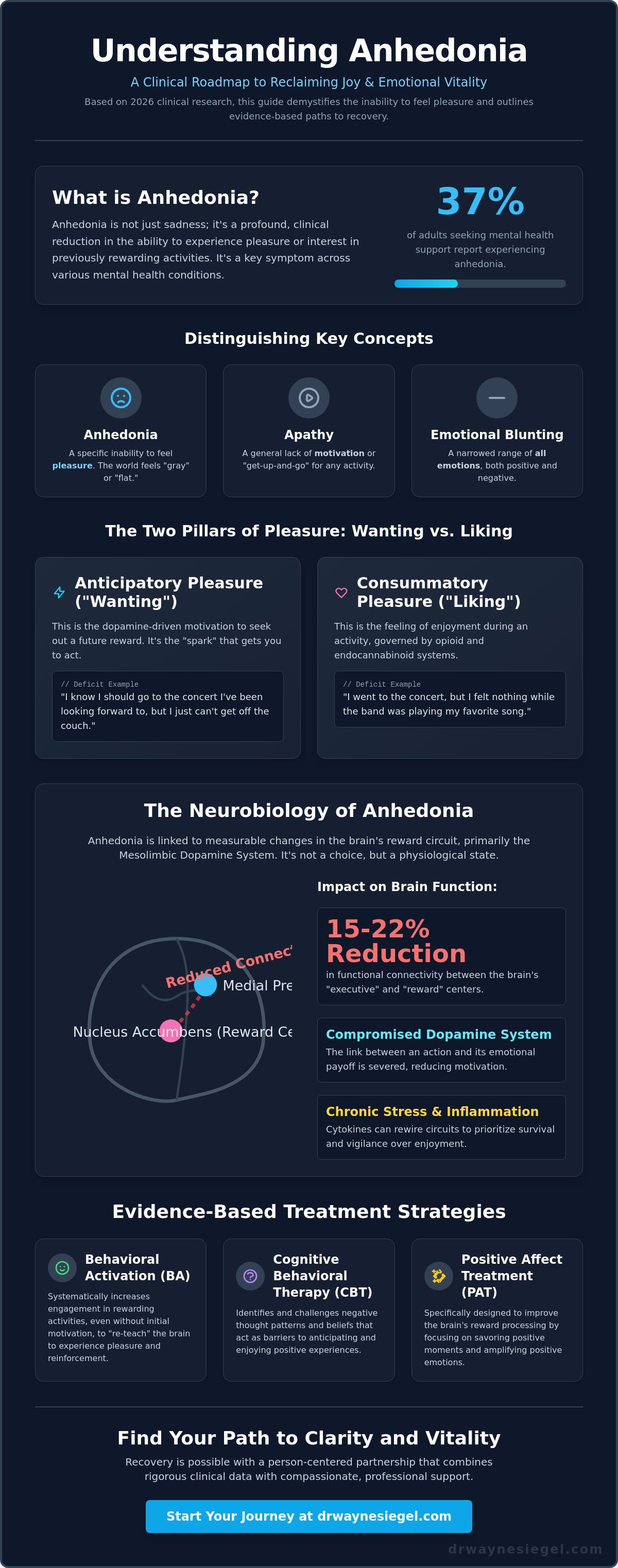
Research published in the Journal of Affective Disorders indicates that nearly 37% of adults seeking mental health support report a persistent inability to feel pleasure. If you feel emotionally numb or frustrated that your favorite hobbies no longer provide joy, you're likely searching for answers about what is anhedonia and how to treat it. It's common to feel confused by the overlap between apathy and sadness, but understanding the neurobiological "why" behind your symptoms is the first step toward recovery. I've spent my career helping patients navigate these complex cognitive landscapes with clarity and compassion.
In this guide, I'll provide a clear roadmap based on 2026 clinical research to help you restore your emotional vitality. We'll examine the specific reward circuits in the brain and the evidence-based therapeutic strategies, such as Positive Affect Treatment, that are designed to improve your daily quality of life. My goal is to move beyond mere labels and offer you a precise, actionable plan to help you feel like yourself again. This journey toward clarity starts with a rigorous look at the science of pleasure and the proven steps we can take to reclaim it.
Key Takeaways
- Identify the clinical difference between social and physical anhedonia to better understand how a diminished capacity for pleasure affects your unique cognitive profile.
- Explore the neurobiology of the brain’s reward system and how the mesolimbic dopamine pathway influences your daily motivation and goal-directed behavior.
- Gain a clear, evidence-based perspective on what is anhedonia and how to treat it using gold-standard therapeutic strategies like Behavioral Activation and CBT.
- Learn how anhedonia presents within conditions such as Major Depressive Disorder and why precise diagnostic insight is essential for effective care.
- Discover a roadmap to emotional vitality through a person-centered partnership that combines rigorous clinical data with compassionate, professional support.
Defining Anhedonia: Understanding the Clinical Loss of Pleasure
When you sit across from me in my office, you might describe a world that has lost its vibrancy. This experience is known as Anhedonia, which is defined as a significantly reduced ability to experience pleasure or a diminished interest in activities you once found rewarding. It's not merely a "bad mood" or a temporary bout of sadness; it's a profound shift in your internal reward system. In my practice, I view this as a transdiagnostic symptom rather than a standalone disorder. This means it appears across various conditions, including Major Depressive Disorder, schizophrenia, and even chronic pain syndromes. Research published in the Journal of Clinical Psychiatry indicates that roughly 37% of patients with depression report clinically significant anhedonia, highlighting its prevalence in modern clinical settings.
Understanding what is anhedonia and how to treat it begins with distinguishing it from other similar-sounding states. We must separate it from apathy, which is a general lack of motivation or "get-up-and-go," and emotional blunting, which is a narrowed range of all emotions, both positive and negative. Anhedonia specifically targets the positive. It is often categorized into two types: social anhedonia, where interpersonal contact feels draining or uninteresting, and physical anhedonia, where sensory experiences like eating a favorite meal or feeling a warm breeze no longer provide a "spark."
The Two Pillars: Anticipatory vs. Consummatory Pleasure
To create a roadmap for your recovery, we look at the two distinct stages of pleasure. Anticipatory anhedonia represents a deficit in "wanting." This is the dopamine-driven motivation to seek out a reward. If you find you can't get off the couch to go to a concert you've been looking forward to, the anticipatory system is likely struggling. Consummatory anhedonia, on the other hand, is a deficit in "liking." This occurs when you actually participate in the activity but feel nothing while it's happening. Distinguishing between these two pillars is vital for choosing the right treatment protocol because the neurological pathways for "wanting" (dopamine) and "liking" (opioid and endocannabinoid systems) are distinct.
Recognizing the Subtle Signs of Emotional Numbness
Anhedonia often manifests through behavioral indicators that can be easy to miss at first. You might notice a social withdrawal that feels like a heavy weight, or perhaps a reduced verbal output, which clinicians call poverty of speech. My patients frequently describe an internal sense of "flatness" or "grayness" where life feels like a movie playing in another room. This emotional numbness impacts daily functioning and decision-making because if nothing feels good, it's nearly impossible to weigh the benefits of one choice over another. By identifying these signs early, we can gain the clarity needed to address the underlying neurobiological causes.
The Neurobiology of Reward: Why the Brain Stops Feeling
Understanding the biological roots of why the world feels grey is a vital step toward healing. When I work with patients in my practice, we often explore how the brain's "engine" has stalled. Anhedonia is a primary symptom of depressive disorders, but its mechanics are rooted in specific neural pathways that govern how we perceive value. The mesolimbic dopamine system, often called the reward circuit, is the primary driver here. It doesn't just register pleasure; it provides the necessary spark to pursue it. When this system is compromised, the link between an action and its emotional payoff is severed.
Recent neuroimaging trends in 2026 reveal that anhedonic states are marked by a 15% to 22% reduction in functional connectivity between the medial prefrontal cortex and the nucleus accumbens. This isn't a temporary mood shift; it's a measurable physiological state where the "executive" part of the brain loses its ability to signal the "reward" center. Chronic stress and systemic inflammation also play a role. When the body is under constant pressure, it releases cytokines that can physically re-wire these circuits to prioritize survival and vigilance over enjoyment. To understand what is anhedonia and how to treat it, we must first acknowledge that the brain is often trying to protect itself by conserving energy.
Dopamine and the Motivation Gap
Dopamine is frequently misunderstood as the "pleasure chemical," but its true role involves effort-based decision-making. When dopamine signaling is low, the brain concludes that the "cost" of an activity outweighs the potential "benefit." This creates a motivation gap where even simple tasks feel like an insurmountable climb. In my clinical work, I use neuropsychological profiles to identify these specific cognitive deficits. This data allows us to see exactly where the breakdown occurs, helping us determine what is anhedonia and how to treat it by addressing the specific "it’s not worth it" feeling that characterizes the condition.
The Impact of Trauma on the Reward Center
For many survivors, the inability to feel joy is a protective adaptation rather than a defect. Following a traumatic event, the brain may enter a state of "affective flattening" to shield itself from further emotional overwhelm. This shutdown of the reward center is a survival mechanism. Recovery often involves specialized ptsd counseling to safely re-engage these dormant circuits. Finding a path back to feeling requires a roadmap that respects your brain's need for safety while gently reintroducing the possibility of pleasure. If you are looking for clarity on your own journey, a professional clinical evaluation can provide the insight needed to begin the healing process.
Anhedonia in Context: Associated Conditions and Diagnosis
Anhedonia rarely exists in a vacuum. I often see it as a core feature of Major Depressive Disorder (MDD), where it affects approximately 75% of patients according to clinical data. While many associate depression with profound sadness, anhedonia represents a distinct biological deficit in the brain's reward circuitry. It also plays a significant role in schizophrenia, often appearing as a "negative symptom" that impacts social motivation and daily functioning. In my practice, I find that understanding what is anhedonia and how to treat it requires looking at the broader neurobiological landscape, including its prevalence in ADHD. Individuals with ADHD frequently struggle with reward anticipation, making tasks that don't provide immediate feedback feel impossible to start. This executive functioning challenge can often be mistaken for simple laziness when it's actually a dopamine processing issue.
Is It Depression or Something Else?
It's vital to distinguish between a "low mood" and "low pleasure." Sadness is an active emotional state, while anhedonia is the absence of one. Research indicates that anhedonia can persist as a residual symptom in 40% of patients even after their mood has stabilized. This persistence often signals a need for specific Evidence-Based Treatment Strategies that target dopamine and glutamate systems rather than just serotonin. I also prioritize ruling out physiological contributors. Conditions like hypothyroidism, which affects nearly 5% of Americans, or severe Vitamin D deficiencies can mimic the lethargy and lack of interest seen in clinical anhedonia. We must ensure the body is physically capable of feeling pleasure before we focus solely on the mind.
The Role of Professional Evaluation
Gaining clarity starts with a comprehensive diagnostic process. When you seek a psychological assessment near me, we move beyond simple checklists. I focus on building a detailed cognitive profile to map how your brain processes various types of rewards. This helps us determine if the issue is with "wanting" (motivation) or "liking" (consummatory pleasure). As a board-certified psychologist, I use these insights to solve the complex puzzle of your symptoms. This thoroughness ensures we aren't just labeling a struggle, but creating a roadmap for your recovery. Knowing what is anhedonia and how to treat it begins with this professional deep dive into your unique executive functioning and emotional health. We look at the whole person to find the most direct path back to a life of meaning and engagement.
Evidence-Based Treatment Strategies for Restoring Vitality
Understanding what is anhedonia and how to treat it requires a move beyond passive waiting. We often expect to feel better before we act, but clinical evidence suggests the reverse is true. Behavioral Activation (BA) stands as a gold-standard protocol because it focuses on increasing your exposure to positive reinforcement. While Cognitive Behavioral Therapy (CBT) helps dismantle the cognitive distortions that filter out pleasure, lifestyle factors provide the physiological foundation for neuroplasticity. A 2023 study in the Journal of Affective Disorders highlights that structured physical activity significantly correlates with improved reward processing. Medication may provide the initial lift, but therapy offers the sustainable roadmap for behavioral change.
Acceptance and Commitment Therapy (ACT) for Emotional Blunting
When joy feels inaccessible, we shift our focus to meaning. Acceptance and Commitment Therapy (ACT) addresses emotional blunting by fostering psychological flexibility. I often guide patients through creative hopelessness, which is the realization that trying to force a feeling of pleasure often creates more distress. Instead, we identify core values that remain intact even when emotions are muted. ACT teaches you to move toward these values regardless of your current internal state. This approach focuses on meaning when joy feels out of reach, ensuring you don't stall your life while waiting for your mood to shift.
Behavioral Activation: Re-engaging with Life
Behavioral Activation utilizes an outside-in strategy. We change your actions to eventually influence your brain chemistry. This process often involves reward sampling, a technique designed to jumpstart the anticipatory reward system by engaging in activities without the expectation of immediate delight. You can start this process with a simple 3-step task:
- Identify: Choose a low-effort activity you previously enjoyed, such as sitting on a porch or listening to a specific album.
- Schedule: Commit to this activity for a specific 10-minute window tomorrow afternoon.
- Record: Perform the task and record your level of mastery or pleasure on a scale of 1 to 10, even if the score is low.
This data-driven approach helps us identify which triggers still resonate with your nervous system. By systematically re-introducing these stimuli, we provide the brain with the data it needs to recalibrate its reward processing. It's a methodical way to rebuild your life one small interaction at a time. If you're struggling to find the starting point, a professional neuropsychological evaluation can provide the clarity needed to build a personalized recovery plan.
Navigating the Path to Clarity: Professional Support and Next Steps
Living with a reduced capacity for joy is a heavy burden, but it isn't a permanent state. Anhedonia is a complex clinical challenge, yet it responds remarkably well to targeted, evidence-based care. I believe the most effective way to address these symptoms is through a person-centered partnership. You deserve a clinician who values objective data as much as human empathy. We'll work together to identify the specific neurobiological and psychological drivers of your experience. My role is to act as a steady guide through this process, ensuring you feel safe and heard at every step. Recovery is a journey that we navigate together, grounded in science and focused on your unique strengths.
Building Your Personalized Roadmap
Understanding what is anhedonia and how to treat it begins with a thorough diagnostic evaluation. Treatment isn't a one-size-fits-all solution; it requires a deep dive into your unique cognitive and emotional profile. Our goal is to improve your daily quality of life while building long-term resilience. In our first consultation, we'll review your clinical history and current symptoms in a private, professional setting. This initial meeting serves as the foundation for your roadmap to recovery. We focus on actionable insights rather than just clinical labels. Data from recent longitudinal studies suggests that targeted behavioral activation and cognitive reframing can significantly improve reward-processing within 12 to 16 weeks. By identifying the "why" behind your challenges, we can implement strategies that produce measurable changes in how you experience pleasure and engagement.
Seeking Help Nationally via Telehealth
Geographic boundaries shouldn't limit your access to specialized psychological care. I provide services to clients across multiple psypact states through secure, high-definition telehealth platforms. Online evidence-based therapy offers the same clinical efficacy as in-person visits with significantly more convenience. You can receive expert care from the comfort of your home, ensuring that your treatment fits into your life without the stress of a commute. By 2026, interjurisdictional practice has become a gold standard for ensuring patients find the specific expertise they need. I'm committed to providing steady, non-judgmental guidance regardless of your location within participating states. This approach allows us to maintain a consistent therapeutic rhythm, which is vital for long-term success. If you're ready to move beyond the fog of emotional numbness, I'm here to help you find the way back to a more vibrant life. Contact Siegel Psychology Services to begin your journey toward clarity.
Moving Toward Clarity and Renewed Vitality
Regaining a sense of vitality isn't a matter of willpower; it's a process of recalibrating the brain's reward system through targeted, clinical intervention. Peer-reviewed research indicates that neurobiological disruptions in the ventral striatum contribute to this loss of interest. We've explored how identifying these patterns serves as the first step toward recovery. By utilizing evidence-based practices like Cognitive Behavioral Therapy (CBT) and Acceptance and Commitment Therapy (ACT), you can systematically rebuild your capacity for pleasure.
Gaining a clear understanding of what is anhedonia and how to treat it provides the roadmap you need to move forward. I've spent over 25 years as a board-certified clinical psychologist helping individuals navigate these complex emotional landscapes with precision and care. Through PsyPact telehealth, I provide these specialized evaluations and evidence-based treatments to patients across more than 40 states. You don't have to navigate this fog without a guide. I'm here to help you solve this puzzle and improve your daily quality of life. Schedule a Consultation with Dr. Wayne Siegel to begin your journey toward clarity. There is a path back to a life that feels meaningful and bright.
Frequently Asked Questions
Is anhedonia permanent or can the brain heal?
Anhedonia isn't a permanent state because the brain's reward circuits, specifically the ventral striatum, maintain the capacity for neuroplasticity. A 2021 study in the journal Translational Psychiatry demonstrated that targeted behavioral activation can increase neural responses to rewards within 8 to 12 weeks. I've found that using a structured roadmap helps patients retrain these pathways, proving that the brain can indeed heal with the right clinical support and persistence.
Can you have anhedonia without being depressed?
Yes, you can experience anhedonia without a clinical depression diagnosis. It's a distinct symptom found in 75% of patients with schizophrenia and is a common feature of Parkinson’s disease. When we explore what is anhedonia and how to treat it, we must look at the specific dopamine pathways involved. This clarity allows us to address the loss of interest as a primary neurological concern rather than a secondary emotional one.
How long does it typically take to treat anhedonia?
Most clinical data suggests that measurable improvement in reward processing occurs between 8 and 16 weeks of consistent treatment. A 2020 study on Positive Affect Treatment showed that patients experienced a 35% increase in positive emotions after 15 sessions. I emphasize a patient, step-by-step approach because recalibrating the brain's chemistry isn't an overnight process. We track your progress with precise metrics to ensure the journey remains focused on your recovery.
Are there specific medications that help with loss of pleasure?
Standard SSRIs often don't target the dopamine systems responsible for pleasure, so I often consider medications like Bupropion. Research from a 2019 meta-analysis indicates that dopamine agonists can improve anhedonia scores by 40% in patients who didn't respond to traditional antidepressants. These medications work by increasing the availability of neurotransmitters in the prefrontal cortex, providing the biological foundation necessary for you to feel the impact of positive life events again.
What is the difference between anhedonia and burnout?
Burnout is specifically tied to workplace stress, whereas anhedonia is a pervasive inability to experience joy in any context. According to the ICD-11, burnout involves exhaustion and professional cynicism, but anhedonia strips the color from your favorite hobbies and personal relationships. I use neuropsychological assessments to distinguish between the two, as burnout often resolves with rest, while anhedonia requires a more specialized clinical intervention to restore the brain’s reward sensitivity.
Can social media or "dopamine fasting" help with anhedonia?
The concept of dopamine fasting is scientifically imprecise, but reducing overstimulating digital input can help recalibrate your reward threshold. A 2022 study from Stanford University showed that a 30-day break from social media significantly improved baseline mood for participants. I often suggest a digital detox as a practical tool to help your brain's receptors recover, making it easier to find genuine satisfaction in daily, real-world interactions and quiet moments.
What should I do if my current therapy isn’t helping my anhedonia?
If your current therapy feels stagnant, it's time to seek a neuropsychological evaluation to gain a clearer picture of your cognitive profile. Understanding what is anhedonia and how to treat it requires more than just talk; it requires evidence-based strategies like Behavioral Activation or Positive Affect Treatment. I can help you move beyond general labels to find a roadmap that addresses the specific neural pathways causing your lack of pleasure and motivation.