
What to Do If CBT Doesn't Work for Your Anxiety: A Clinical Roadmap for 2026

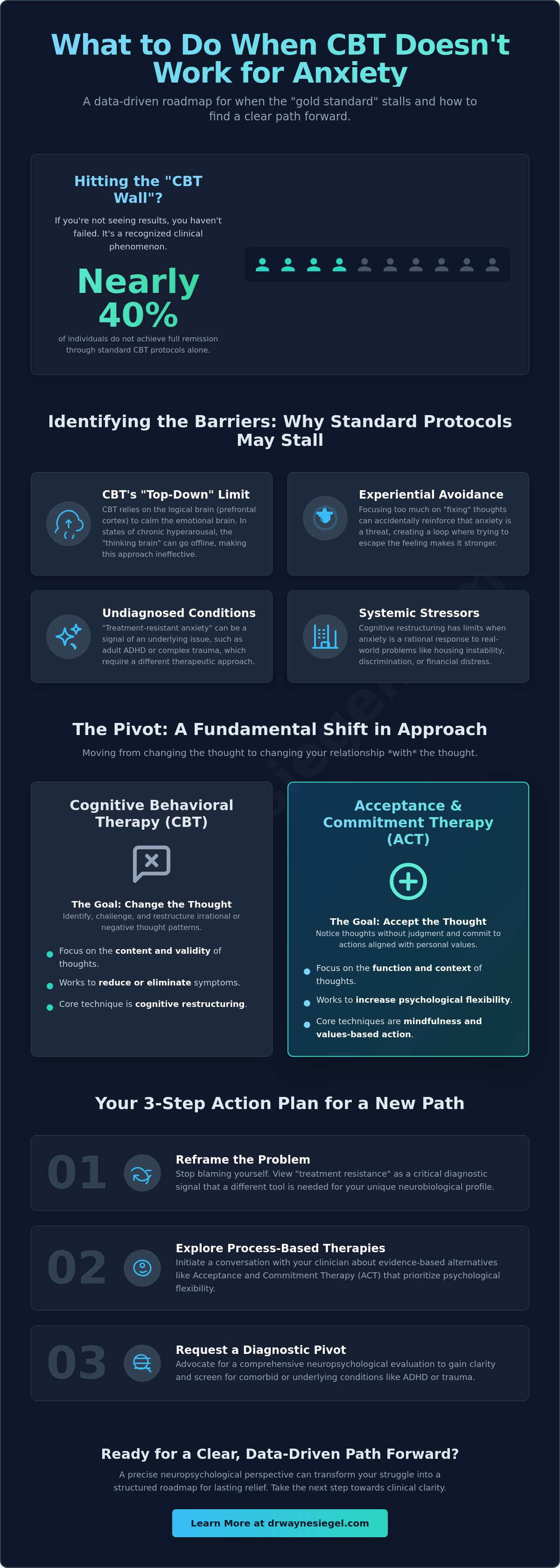
What if the "gold standard" for anxiety treatment isn't the right fit for your unique cognitive profile? If you've spent months practicing thought records and exposure exercises only to find your physiological symptoms remain high, you aren't a failure. It's a common experience; clinical data suggests that nearly 40% of individuals don't reach full remission through standard protocols alone. I understand how frustrating it feels to invest time and energy into a process that seems to stall, leaving you more confused than when you started.
You deserve a clear path forward. This guide outlines exactly what to do if cbt doesn't work for anxiety by focusing on diagnostic precision and the latest clinical research for 2026. I'll help you identify why your current treatment might be hitting a wall and introduce evidence-based alternatives like Acceptance and Commitment Therapy (ACT). We'll look at how a refined neuropsychological perspective can transform your struggle into a structured roadmap for lasting relief and clinical clarity.
Key Takeaways
- Recognize that hitting a plateau in therapy is a valid clinical phenomenon and learn to identify the "CBT Wall" where traditional cognitive restructuring may lose its effectiveness.
- Discover a strategic, evidence-based roadmap for what to do if CBT doesn't work for anxiety, shifting the focus toward modalities that address deep-seated experiential avoidance.
- Understand the fundamental shift from Cognitive Behavioral Therapy to Acceptance and Commitment Therapy (ACT), prioritizing a change in your relationship with thoughts over the effort to change the thoughts themselves.
- Learn why "treatment-resistant" anxiety often signals the need for a diagnostic pivot, such as a neuropsychological evaluation to screen for previously undiagnosed adult ADHD.
- Access a clear, three-step action plan designed to help you advocate for your needs and transition toward a more precise, data-driven treatment strategy that restores your quality of life.
Understanding the CBT Wall: Why Evidence-Based Therapy Sometimes Stalls
If you have spent months tracking your thoughts, challenging cognitive distortions, and completing exposure worksheets only to find your heart still racing at 3:00 AM, I want you to hear this clearly: you haven't failed at therapy. What you're experiencing is a recognized clinical phenomenon I often call the "CBT Wall." This is the specific point where traditional cognitive restructuring no longer yields emotional or physiological relief. While Cognitive Behavioral Therapy is often hailed as the gold standard, clinical data suggests that roughly 40% to 60% of patients with certain anxiety disorders do not achieve full remission through this method alone.
In my practice, I view "treatment-resistant anxiety" not as a permanent label, but as a diagnostic signal. It indicates that the current clinical tool is mismatched with your specific neurobiological profile. Evidence-based care isn't about forcing a patient into a specific protocol; it's about identifying the right evidence-based tool for the individual. When you're searching for what to do if cbt doesn't work for anxiety, the first step is gaining clarity on why the mechanism stalled. We move away from self-blame and toward a more precise, data-driven understanding of your nervous system.
The Limits of "Top-Down" Cognitive Processing
CBT is primarily a "top-down" intervention. It relies on the prefrontal cortex, the seat of higher-order logic, to regulate the amygdala and the lower-level emotional centers of the brain. This works well for many. However, if your nervous system is in a state of chronic hyperarousal, the "thinking brain" often goes offline. You can't logic your way out of a physiological fire alarm. In these cases, we need a "bottom-up" approach that addresses the body's safety signals before cognitive work can become effective again.
When the "Gold Standard" Isn't the Right Fit
CBT is not a monolithic solution. A 2018 study published in The Lancet Psychiatry highlighted that the therapeutic alliance, the professional bond between you and your clinician, accounts for significant variance in recovery. If the structured, manualized nature of CBT feels too rigid or dismissive of your lived experience, the therapy will likely stall. Finding what to do if cbt doesn't work for anxiety often involves pivoting to process-based therapies that prioritize your unique cognitive strengths and emotional history over a one-size-fits-all checklist. My goal is to provide that roadmap toward a more functional, peaceful daily life.
Identifying the Barriers: Why Standard Protocols May Not Be Enough
Standard CBT protocols often rely on the assumption that changing thoughts will change feelings. For many, this is effective. However, research indicates that roughly 40% of patients don't achieve full remission through traditional CBT alone. One primary driver of this stagnation is experiential avoidance. This occurs when a person is so unwilling to remain in contact with painful private experiences that they take steps to alter the form or frequency of these events. When a therapy session focuses too much on "fixing" a thought rather than learning to sit with the discomfort, it can accidentally reinforce the idea that the anxiety itself is a threat. This creates a loop where the harder you try to think your way out, the deeper the anxiety takes root.
Clinical barriers also include external realities that a thought record cannot resolve. If you're wondering what to do if cbt doesn't work for anxiety, we must look at your environment. Cognitive restructuring assumes a level of safety. If you're facing chronic housing instability or a discriminatory workplace, your "anxious" thoughts are often accurate assessments of risk. In these cases, a purely cognitive approach lacks the pragmatic tools needed to address systemic stressors. We need to move beyond the internal dialogue and look at the whole person's life context to find true clarity.
The Trauma Complication
Post-traumatic stress disorder or complex trauma fundamentally rewires the brain’s alarm system. For these individuals, the prefrontal cortex, the area responsible for logic and "challenging" thoughts, often goes offline during a spike in anxiety. Trying to use logic when your nervous system is in a state of hyperarousal can feel invalidating. It's like trying to reason with a smoke alarm while the house is on fire. In these instances, moving toward specialized ptsd counseling is a necessary step to address the physiological roots of the distress before cognitive tools can become effective.
Biological and Temperamental Factors
Our genetic makeup influences our baseline for emotional reactivity. Studies on the 5-HTTLPR gene polymorphism suggest that some people are biologically predisposed to more intense emotional responses. Additionally, rigid personality structures can make the structured nature of CBT feel restrictive rather than helpful. I also recommend a thorough medical screening. Physiological conditions like hyperthyroidism or cardiac arrhythmias can mimic anxiety symptoms with such precision that psychological intervention alone won't provide the relief you seek. If you're seeking a deeper understanding of your cognitive profile, a comprehensive neuropsychological evaluation can provide the roadmap you need to move forward.
Beyond Thought Challenging: The Role of Acceptance and Commitment Therapy (ACT)
If you've spent months attempting to fix your thoughts through cognitive restructuring only to find your anxiety remains, you aren't alone. For many people, the relentless effort to prove anxious thoughts wrong actually keeps the brain in a state of high alert. Acceptance and Commitment Therapy (ACT) offers a powerful, evidence-based alternative. While CBT focuses on changing the content of your thoughts, ACT shifts the focus toward changing your relationship with them. This approach is supported by over 1,000 randomized controlled trials as of 2024, proving its efficacy for individuals who find traditional logic-based interventions insufficient.
ACT is built upon six core processes: acceptance, cognitive defusion, being present, self as context, values, and committed action. These pillars work together to create psychological flexibility. This modality is particularly effective for sticky or existential anxiety that resists logic. When you're wondering what to do if cbt doesn't work for anxiety, ACT provides a roadmap that doesn't require you to win an argument with your own mind. It suggests that the struggle against anxiety is often what fuels the cycle of distress.
The Power of Psychological Flexibility
Psychological flexibility is the ability to stay in the present moment despite uncomfortable thoughts or sensations. It's not about ignoring pain; it's about moving toward what matters to you anyway. Cognitive defusion techniques are central to this process. Unlike cognitive restructuring, which asks you to analyze the evidence for a thought, defusion asks you to see the thought as just a series of words or images. A 2022 meta-analysis in the Journal of Contextual Behavioral Science demonstrated that increasing psychological flexibility is a primary driver of long-term recovery in chronic anxiety cases. By focusing on values-based living, you can create a meaningful life even in the presence of anxious symptoms.
Integrating ACT into Your Treatment Journey
Integrating ACT into your care often feels more person-centered and less clinical than traditional models. One practical exercise is "Labeling the Story." When an anxious thought arises, you simply name it. You might say, "I am having the thought that I will fail," or "There is the 'not good enough' story again." This creates a vital space between you and the emotion. This perspective shift helps you realize you're the observer of your thoughts, not the thoughts themselves. If you're exploring what to do if cbt doesn't work for anxiety, I encourage you to seek practitioners who are experienced in ACT. Look for therapists who prioritize your personal values over simple symptom reduction, as this future-oriented focus is what leads to a genuine improvement in daily quality of life.
The Diagnostic Pivot: When to Consider a Comprehensive Psychological Evaluation
When patients tell me they've spent years in therapy without relief, I often look for what's missing from the diagnostic picture. If you're wondering what to do if cbt doesn't work for anxiety, the answer often lies in a diagnostic pivot. We often frame "failed" therapy as a patient's lack of progress, but in my practice, I view it as a signal that the current clinical map is incomplete. CBT requires a specific set of cognitive tools to be effective. If an underlying condition is present that affects how your brain processes information, you're essentially being asked to build a house without a hammer.
I don't see psychological testing as a way to "label" you. Instead, it's a roadmap to clarity. A formal evaluation moves us past surface-level symptoms and into the mechanics of how your brain functions. This shift is vital because anxiety is frequently a secondary symptom of a different, primary challenge that hasn't been identified yet.
Uncovering Undiagnosed ADHD and Neurodivergence
Adult ADHD is one of the most common "hidden" factors in treatment-resistant anxiety. A 2017 study published in the Journal of Attention Disorders found that up to 47% of adults with ADHD also meet the criteria for an anxiety disorder. For these individuals, the racing thoughts and restlessness they feel aren't just "anxiety"; they're the result of a nervous system that's constantly under-stimulated or over-aroused. Traditional CBT protocols often fail here because they focus on challenging "irrational" thoughts. However, if your anxiety stems from executive dysfunction, your thoughts aren't irrational. They're a logical response to a brain that struggles to organize, prioritize, and regulate emotions.
If you've felt that what to do if cbt doesn't work for anxiety is simply "try harder," you've likely been fighting an uphill battle against your own neurobiology. A comprehensive psychological assessment near me can identify these executive functioning deficits. This allows us to tailor your treatment to include strategies that actually work for your specific cognitive profile, such as ADHD-specific coaching or neuro-informed therapy.
What to Expect from a Diagnostic Evaluation
The evaluation process I conduct is thorough and deliberate. It begins with an in-depth clinical interview where we discuss your history and current struggles. From there, I utilize standardized testing and validated measures to gather objective data on your cognitive strengths and weaknesses. This isn't a pass-or-fail test. It's a scientific deep dive into your memory, attention, and emotional processing. The result is a comprehensive report that provides a clear "why" behind your symptoms.
Having this professional profile changes the direction of your care. It gives your psychiatrist, therapist, or primary care doctor a precise target. Instead of broad interventions, you can move toward specialized care that respects your brain's unique architecture. We stop guessing and start following the data toward real improvement in your daily quality of life.
If you're ready to stop the cycle of ineffective treatment and find the clarity you deserve, I am here to help. Schedule a diagnostic consultation today to begin your roadmap to clinical clarity.
Constructing Your New Treatment Plan: Evidence-Based Steps Forward
If your progress has stalled, it is helpful to view your experience as a diagnostic data point. It isn't a dead end. When determining what to do if cbt doesn't work for anxiety, the first step is shifting from a failure mindset to an information-gathering mindset. Research published in 2023 indicates that roughly 40% of patients with generalized anxiety disorder don't achieve full remission with standard CBT alone. This doesn't mean you're untreatable; it means your cognitive profile requires a different clinical approach.
To move forward, follow this 3-step action plan with your current or future provider:
- Review the Data: Audit your last 12 sessions. Identify exactly which CBT tools (like thought records or exposure) felt ineffective and why.
- Request a Differential Diagnosis: Ask for a formal assessment to see if underlying factors like ADHD, OCD, or sensory processing issues are mimicking or fueling your anxiety.
- Pivot the Modality: Discuss transitioning to Acceptance and Commitment Therapy (ACT) or Dialectical Behavior Therapy (DBT), which often provide better results for those who find cognitive restructuring too intellectualized.
Advocating for Your Mental Health
Effective advocacy starts with asking the right questions. Don't hesitate to ask your therapist, "We have been focusing on cognitive reframing for three months without a reduction in my physical symptoms; what is our plan for a secondary approach?" You can also request a referral for a formal diagnostic consultation. Seeking a second opinion is a standard medical practice, not a slight against your therapist. You should look for a clinic for psychology that prioritizes board-certified experts. These professionals can provide the rigorous neuropsychological testing needed to uncover why standard protocols aren't sticking. This clarity allows you to build a roadmap based on your actual brain function rather than a generic manual.
Expanding Access via Telehealth
Modern clinical care is no longer limited by your zip code. If you live in an area without specialized anxiety experts, the expansion of psypact states in 2026 allows you to work with doctoral-level psychologists across state lines. This is particularly beneficial when you need a specialist who understands what to do if cbt doesn't work for anxiety and can offer advanced alternatives like Exposure and Response Prevention (ERP) or mindfulness-based interventions. Online evidence-based therapy has shown parity with in-person care in over 50 randomized controlled trials. It provides a bridge to the high-level expertise you need to finally see a shift in your daily quality of life.
You deserve a treatment plan that honors your unique complexity. If you're ready to move beyond "stuck" and gain a clearer picture of your mental health, Contact Siegel Psychology Services today to schedule a comprehensive consultation or diagnostic evaluation.
Your Evidence-Based Path to Lasting Relief
Finding that standard protocols haven't provided the relief you expected isn't a failure of your effort; it's an invitation to refine the clinical approach. By 2026, the roadmap for anxiety treatment has expanded to include Acceptance and Commitment Therapy (ACT) and more nuanced diagnostic pivots. If you feel stuck, a comprehensive psychological evaluation can uncover the specific cognitive barriers or executive functioning challenges that standard protocols might overlook. Understanding what to do if cbt doesn't work for anxiety requires moving beyond simple thought challenging toward a personalized, evidence-based strategy.
I've spent over 25 years as a board-certified clinical psychologist helping individuals navigate these complex emotional landscapes. Whether we're utilizing ACT to foster psychological flexibility or conducting a deep-dive assessment to build your unique cognitive profile, the goal is always actionable clarity. You don't have to navigate this transition alone. My practice offers national telehealth services via PsyPact, ensuring that expert, research-backed care is accessible regardless of your location.
Gain clinical clarity with a professional consultation or assessment. Let's work together to build a treatment plan that finally honors your unique strengths and needs.
Frequently Asked Questions
Is it normal for CBT to not work for anxiety?
Yes, it's quite common for standard protocols to fall short of expectations. According to research published in the Journal of the American Medical Association, approximately 50% of patients with anxiety disorders don't achieve full remission through Cognitive Behavioral Therapy alone. I see this not as a failure on your part, but as a clinical indicator that your unique cognitive profile requires a different roadmap or a more nuanced diagnostic lens.
How many sessions of CBT should I try before deciding it isn’t working?
Clinical guidelines from the American Psychological Association suggest evaluating your progress after 12 to 20 sessions. Most evidence-based protocols are designed to produce a measurable 25% reduction in symptom scores by the twelfth week. If you've reached 15 sessions without experiencing a shift in your daily quality of life, it's time to explore what to do if cbt doesn't work for anxiety with a more comprehensive assessment.
Can undiagnosed ADHD make anxiety therapy less effective?
Undiagnosed ADHD significantly complicates anxiety treatment because executive functioning deficits often interfere with a person's ability to implement therapy tools. A 2023 study in The Lancet found that 25% of adults seeking anxiety treatment also meet the criteria for ADHD. When your brain's "command center" struggles with regulation, traditional CBT exercises can feel overwhelming. Gaining clarity on your neurodivergent traits allows us to build a more effective, personalized strategy.
What is the difference between CBT and ACT for anxiety?
CBT focuses on identifying and changing "irrational" thoughts, while Acceptance and Commitment Therapy (ACT) focuses on changing your relationship with those thoughts through mindfulness. Research in the Journal of Contextual Behavioral Science indicates that ACT is especially helpful for the 30% of patients who find that directly challenging their thoughts leads to more distress. ACT prioritizes psychological flexibility and your personal values rather than just symptom reduction.
Do I need a new diagnosis if my current therapy is stalling?
You may not need a new label, but you likely need a clearer picture of your cognitive strengths and challenges. Therapy often stalls when the underlying "why" behind your anxiety hasn't been fully uncovered. A neuropsychological evaluation can provide the insight needed to move beyond a generic diagnosis. This process helps us identify if your struggle is rooted in sensory processing, executive dysfunction, or a specific cognitive profile that requires a different clinical approach.
What should I tell my therapist if I want to stop doing CBT?
I recommend being direct and focusing on your lack of measurable progress. You might say, "I've completed 14 sessions and my anxiety scores haven't changed, so I'd like to discuss a different roadmap." A professional therapist will welcome this feedback as it helps them refine your care. Openly discussing what to do if cbt doesn't work for anxiety ensures that you remain the pilot of your own healing journey while maintaining a collaborative partnership.
Are there other evidence-based therapies besides CBT and ACT for anxiety?
Several other modalities show high success rates in clinical trials. Dialectical Behavior Therapy (DBT) is effective for 75% of individuals who struggle with intense emotional regulation. Eye Movement Desensitization and Reprocessing (EMDR) is another gold-standard option, particularly if your anxiety is linked to past trauma. I often recommend these alternatives when a patient's diagnostic profile suggests that a "top-down" talk therapy isn't the most direct path to relief.