
10 Clinical Signs Therapy is Actually Working: An Evidence-Based Guide

What if the most productive moments in your clinical journey aren't the ones where you feel "better," but the ones where you feel most challenged? It's natural to feel a sense of unease when you're investing $150 or more per session without a clear roadmap of your progress. You might worry that you're simply venting rather than healing. Identifying the specific signs therapy is actually working is essential to maintaining your commitment to the process. Research from the American Psychological Association suggests that while 75% of people see some benefit from psychotherapy, many struggle to articulate exactly what that growth looks like in their daily lives.
I understand that the ambiguity of emotional work can be taxing. You deserve to know that your efforts in CBT or ACT are yielding a measurable return on your emotional investment. In this guide, I'll provide you with ten evidence-based metrics to track your psychological development, such as a 30% increase in your ability to name specific emotions or a noticeable shift in your cognitive flexibility. We'll examine how to distinguish temporary relief from long-term neurological change, giving you the clarity you need to discuss your progress confidently with your provider.
Key Takeaways
- Learn why genuine therapeutic progress is often non-linear and how to shift your focus from simply "feeling happy" to increasing your overall functional capacity.
- Understand the clinical mechanisms of CBT and ACT that rewire maladaptive thought patterns and foster the psychological flexibility needed for lasting change.
- Discover the ten evidence-based signs therapy is actually working, including measurable shifts like increased emotional granularity and faster recovery from setbacks.
- Explore how professional diagnostic tools and standardized assessments like the PHQ-9 provide a data-driven roadmap to quantify your personal growth.
- Gain a clear strategy for navigating therapeutic plateaus and learn the specific scripts used to communicate effectively with your provider when progress feels stalled.
Understanding the Non-Linear Nature of Therapeutic Progress
Progress in a clinical setting is often misunderstood as a simple, upward trajectory toward happiness. In my practice, I define real growth through the lens of functional capacity. This metric focuses on how well you can navigate the demands of your daily life, such as maintaining a 40-hour work week or managing complex interpersonal conflicts. It isn't just about feeling "good" in the moment. It's about your ability to stay resilient when life becomes difficult. One of the primary Psychotherapy outcomes we track is this shift from reacting to your environment to proactively managing your internal state.
I often observe what clinicians call the "U-shaped" curve of healing. Research from the University of Pennsylvania suggests that as patients begin to confront repressed trauma or ingrained habits, distress scores often rise before they fall. Things feel messier because you're finally looking at the root causes rather than just the symptoms. This period of temporary discomfort is actually one of the clearest signs therapy is actually working, as it indicates you've moved past surface-level avoidance into deep emotional processing.
We must also distinguish between symptomatic relief and structural behavioral change. You might feel better after three sessions because you've vented your frustrations, which is symptomatic relief. However, structural change involves rewiring your cognitive profiles and executive functioning. This deeper work typically takes longer to manifest but leads to permanent shifts in how you process information and respond to stress. A 2001 study published in the Journal of Counseling Psychology found that while 50% of patients show improvement by session 8, more complex structural changes often require 20 or more sessions to solidify.
The therapeutic alliance remains the most reliable predictor of these successful outcomes. A meta-analysis of over 2,000 studies confirmed that the bond between the patient and the provider is more influential than the specific modality used. When you feel a sense of safety and non-judgmental stability, your brain is better equipped to handle the rigorous work of self-reflection. I view our work as a partnership where my clinical expertise meets your lived experience to create a roadmap for your future.
Why Progress Isn't Always a Straight Line
You might have a week where you feel back at square one. This doesn't mean you're failing. Emotional processing is physically and mentally taxing, often leaving you with less energy for external stressors. If you have a demanding deadline at work or a family emergency, your internal resources are stretched thin. We measure progress by your ability to recover from these "bad days" more quickly than you did six months ago, rather than the total absence of them.
The Goal of Evidence-Based Care
We focus on person-centered, evidence-based practices that prioritize clarity over vague "fixing." My goal is to help you build a toolkit of resilience that functions long after our sessions end. By utilizing a structured approach, we move beyond mere labels to find actionable meaning in your cognitive and emotional patterns. This ensures that every signs therapy is actually working is backed by observable data and improved daily quality of life, guided by board-certified expertise and rigorous scientific standards.
The Science of Change: How CBT and ACT Rewire Your Responses
I often tell my patients that therapy is not just a series of conversations; it's a structural renovation of the brain. When we look for the signs therapy is actually working, we are looking for biological and behavioral evidence of change. Cognitive Behavioral Therapy (CBT) works by targeting the 15 to 20 percent of our daily thoughts that are often reflexive and unhelpful. Research in neuroplasticity, such as the landmark 2011 study published in Psychiatry Research: Neuroimaging, suggests that consistent therapeutic work can physically alter the brain. Specifically, researchers found increased gray matter density in the hippocampus after just 8 weeks of mindfulness-based interventions. This area is vital for learning and memory, proving that your efforts in my office translate into physical growth in your neural pathways.
Acceptance and Commitment Therapy (ACT) introduces a different, equally vital metric for progress. One of the most reliable signs therapy is actually working is the emergence of cognitive defusion. This is the ability to see a thought as just a sequence of words rather than an absolute, literal truth. Instead of being fused with the idea "I am a failure," a patient starts to realize, "I am having the thought that I am a failure." This subtle shift creates the mental space necessary for intentional choice. It’s the difference between being trapped in a storm and watching the storm from a sturdy window. By separating your identity from your intrusive thoughts, you gain the clarity needed to navigate complex emotional landscapes.
Shifting the Cognitive Profile
As you progress, I'll notice your internal dialogue begins to change. You move from a state of constant reactivity to one of intentional response. In our work, Using Assessments and Baselines helps us track these shifts objectively. Cognitive restructuring is the process of challenging and changing unhelpful beliefs to create a more balanced and evidence-based perspective. In a 2018 clinical review, patients who engaged in restructuring reported a 40 percent reduction in the intensity of their depressive symptoms. You stop accepting every intrusive thought as a fact and start treating them as data points to be evaluated with logic and care.
Building Psychological Flexibility
The primary goal of ACT is to increase your psychological flexibility. This means you can move toward your personal values even when you feel pain or anxiety. Many people start therapy to avoid discomfort, but true progress involves moving from avoidance to expansion. You learn to make room for difficult emotions without letting them drive your behavior. Value-aligned action is a primary indicator that your work is yielding results. If you value connection but previously avoided social settings due to 7/10 levels of anxiety, attending a gathering despite that 7/10 feeling is a measurable victory. I invite you to explore how a neuropsychological perspective can provide the clarity you need to build this roadmap. When you choose your actions based on what matters to you rather than what scares you, the therapy is succeeding.
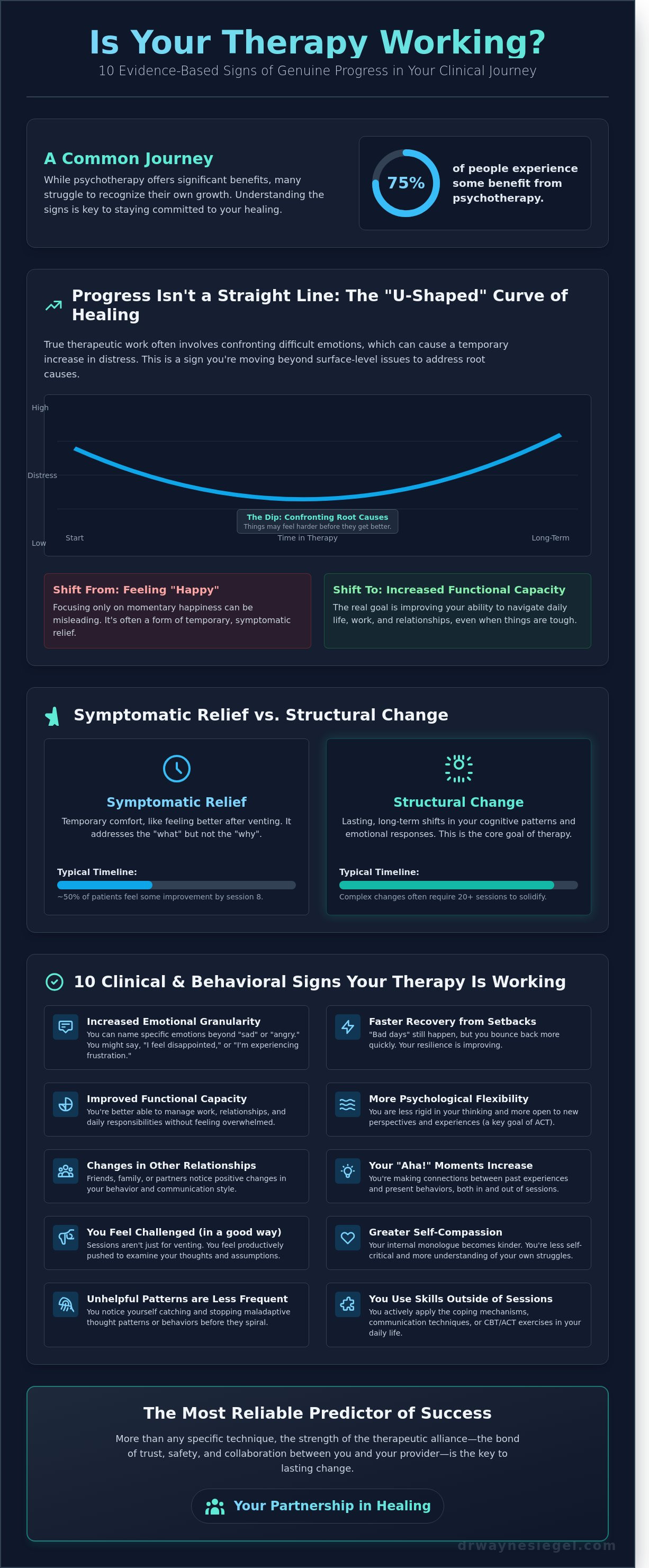
10 Clinical and Behavioral Signs Your Therapy is Working
I often observe that the most profound changes in my practice aren't loud or sudden. Instead, they appear as subtle, consistent shifts in how a person navigates their daily life. When we look for signs therapy is actually working, we focus on objective behavioral data rather than just a fleeting "good mood." One of the first indicators I look for is emotional granularity. This is your capacity to name and differentiate complex feelings with precision. Rather than using broad terms like "bad" or "upset," you might identify a specific blend of 30% disappointment and 70% exhaustion. Research indicates that this level of specificity is a key predictor of long-term emotional regulation and mental health stability.
Another vital marker is a shortened recovery time. Setbacks are a guaranteed part of the human experience; therapy doesn't eliminate them. However, you'll know you're making progress when you "bounce back" to your baseline more quickly. If a professional rejection used to trigger a 48-hour depressive episode, but now you find yourself regrouping within 4 hours, your resilience is measurably increasing. This shift often happens alongside increased transparency in our sessions. I find that as the therapeutic alliance strengthens, patients become more honest about topics they once considered shameful. This radical honesty is a prerequisite for deep change. To better understand the mechanics of this process, the American Psychiatric Association provides a helpful overview of What is Psychotherapy? and its evidence-based applications.
I also track the transition from identification to observation. This means you can notice a self-critical thought without immediately accepting it as an absolute fact. You begin to treat your thoughts as data points rather than directives. Finally, I look for the implementation of behavioral experiments. This occurs when you test new behaviors outside of our sessions. For example, you might choose to say "no" to an extra weekend project for the first time in 5 years. These small, controlled risks are where the real rewiring of the brain takes place, providing the evidence your brain needs to feel safe in new patterns.
Relational and Internal Shifts
As you progress, your internal dialogue undergoes a significant transformation. The "inner critic" that once dominated your thoughts becomes less frequent or easier to dismiss. I often see patients shift their perspective on the past; it begins to feel like a roadmap of lessons rather than a prison of regrets. These internal changes inevitably spill over into your relationships. You might notice you are setting 2 or 3 clear boundaries per week where you previously set none. This leads to deeper, more authentic connections with those around you as you stop people-pleasing and start communicating your actual needs.
Functional Improvements
I closely monitor functional markers to ensure therapy is translating into a better quality of life. This includes improved executive functioning, such as a 20% increase in your ability to focus on complex tasks without distraction. Physical markers are equally telling. Many of my patients report a 30% improvement in sleep quality or a noticeable reduction in physical tension in their shoulders and jaw. Ultimately, these functional signs therapy is actually working fuel a sense of increased hope. This isn't just blind optimism. It's a grounded belief, supported by your own data, that sustainable change is occurring and that you possess the tools to maintain it.
Using Assessments and Baselines to Quantify Your Growth
Subjective feelings of "feeling better" are important, but they can fluctuate based on your mood the morning of a session. To gain a true sense of your trajectory, we rely on objective data. A Diagnostic Psychological Evaluation serves as your clinical anchor. It establishes a precise baseline of your cognitive and emotional functioning at the start of our work together. By documenting your initial state, we create a point of comparison that allows us to see exactly how far you've traveled. This empirical approach transforms abstract change into a visible, measurable journey.
I utilize standardized tools to bring precision to our observations. Instruments like the PHQ-9 for depression or the GAD-7 for anxiety provide numerical values for your symptoms. For example, seeing your PHQ-9 score move from a 22 (indicating severe distress) to a 12 (moderate) over the course of 16 weeks is one of the most reliable signs therapy is actually working. These metrics offer a sense of safety and certainty, especially during weeks when you might feel like you're plateauing. We aren't just guessing; we're measuring your recovery with the same rigor used in clinical research.
The Treatment Plan acts as a living document in our partnership. It isn't a static piece of paperwork filed away after the first session. Instead, we review it every 90 days to track goal attainment. If your initial goal was to reduce social withdrawal, and your data shows you've increased community engagement from zero events per month to three events per month, we have concrete evidence of success. This structured oversight ensures that our time together remains focused on the outcomes that matter most to your quality of life.
The Role of Neuropsychological Clarity
Understanding your cognitive profile is essential for setting realistic expectations. When we conduct assessments for ADHD or trauma, we identify specific executive functioning patterns, such as a 25% deficit in processing speed compared to verbal comprehension. This clarity validates your lived experience; it proves that your struggles aren't character flaws but neurological realities. Gaining this insight is often the first major indicator of growth, and you can learn more about this process in our Psychological Evaluations guide.
Reviewing Progress with Your Psychologist
You're always encouraged to ask for a formal progress review session. During these meetings, we step back from the weekly narrative to look at the data trends and the roadmap we've built. I also engage in regular clinical supervision and peer consultation to ensure the interventions I provide meet the highest professional standards. Professional consultation ensures your care remains evidence-based and effective. This layer of accountability means your treatment is guided by collective clinical wisdom rather than a single perspective. This commitment to excellence is how we ensure your path toward clarity remains steady and secure.
If you're ready to move beyond guesswork and start measuring your progress with clinical precision, I invite you to schedule a comprehensive diagnostic evaluation today.
What to Do When Progress Feels Stalled
Therapy rarely moves in a perfectly straight line. Clinical data suggests that roughly 20% to 30% of patients experience a plateau where progress seems to level off. This phase isn't a sign of failure; it's often a consolidation period. Your brain needs time to integrate new cognitive habits before the next breakthrough occurs. If you've stopped noticing the signs therapy is actually working, don't assume the process has ended. Instead, treat this "stuckness" as a valuable data point that requires a collaborative review with your provider.
Open communication is the most effective tool for breaking a stalemate. Many patients hesitate to voice concerns, fearing they'll offend their therapist. However, professional psychologists rely on your feedback to adjust their clinical lens. You might use a direct script to initiate this conversation during your next session:
- "I’ve noticed that my symptoms haven't shifted in the last 6 weeks. Can we revisit my initial treatment plan?"
- "I feel like we’ve reached a limit with our current approach. Are there other modalities we should consider?"
- "I don't feel the same level of momentum I had 3 months ago. I’d like to explore why that is."
Navigating the Therapeutic 'Stuckness'
It's essential to distinguish between a "bad fit" and the "hard work" of therapeutic growth. A 2018 meta-analysis published in Psychotherapy found that the quality of the therapeutic alliance is one of the strongest predictors of success. If the relationship feels safe but the results are stagnant, the issue may be the technical approach. Seeking a provider with Board Certification ensures they've undergone rigorous peer review and possess the expertise to pivot strategies effectively. When a practitioner is Board Certified, they're trained to recognize when a patient needs to move from a standard protocol to a more nuanced, individualized intervention.
Next Steps for Clarity and Growth
If you've spent 15 or more sessions without measurable change, it's time to seek a higher level of clarity. A comprehensive diagnostic evaluation can identify underlying cognitive or executive functioning issues that standard talk therapy might miss. This evaluation acts as a roadmap, moving beyond general symptoms to uncover the specific "why" behind your challenges. You aren't restricted to local providers for this level of specialized care. Through the PsyPact Guide, you can access expert psychologists in 42 participating states via telehealth. This legal framework allows you to prioritize clinical expertise over geographic proximity, ensuring you find the right fit for your unique profile.
If you're unsure if you're seeing the signs therapy is actually working, a second opinion can provide the objective evidence you need. A thorough assessment can determine if a shift in modality, such as moving from CBT to Acceptance and Commitment Therapy (ACT), is the necessary catalyst for your next stage of growth.
Schedule a consultation with Dr. Wayne Siegel to gain clarity on your journey. Together, we can analyze your current progress and build a precise evidence-based plan to move you forward.
Measuring Your Path to Lasting Change
Recognizing the signs therapy is actually working requires looking beyond temporary moods to observe long-term behavioral shifts. Evidence-based frameworks like CBT and ACT demonstrate that meaningful cognitive restructuring often follows a non-linear path. We track your progress using objective baselines and clinical assessments to ensure you aren't just feeling better; you're functioning better in your daily life. Whether it's an increase in psychological flexibility or a measurable decrease in symptom severity, these data points provide the clarity needed to stay the course.
I've dedicated over 25 years to helping patients navigate complex emotional landscapes through rigorous, science-backed care. As a Board-Certified Clinical Psychologist (ABPP), I combine this clinical expertise with the convenience of telehealth, serving patients across 40+ states through PsyPact. We'll work together to build a personalized roadmap that prioritizes your unique strengths and goals. If you're ready to move past the plateau and gain a deeper understanding of your cognitive profile, I'm here to help you find the actionable meaning behind your challenges.
Schedule a Consultation for Evidence-Based Therapy or Assessment
You don't have to navigate this process alone; clinical clarity and a brighter quality of life are within your reach.
Frequently Asked Questions
How many sessions does it usually take to see signs that therapy is working?
Most patients begin to see signs therapy is actually working within 12 to 20 sessions. This timeframe is supported by clinical data from the American Psychological Association. While you might feel a sense of relief after just 2 visits, the deeper structural changes in your cognitive habits usually take 4 months to solidify. I use these benchmarks to ensure our work remains efficient and focused on your recovery.
Is it normal to feel worse after a therapy session?
It's common to experience a temporary increase in distress after a session. Research indicates that 20% of patients feel a surge in anxiety or sadness as they confront difficult truths. This isn't a sign of failure; it's often a signal that we're touching on the core issues that need clarity. I work with you to manage these waves so they don't become overwhelming during your week.
What if I like my therapist but don't feel like I'm making progress?
A positive relationship is vital, but a "good click" doesn't always equal clinical improvement. If you haven't seen measurable change in your daily life after 10 sessions, we need to re-evaluate the treatment plan. I often suggest a formal review of your initial goals to see where the disconnect lies. We can then adjust our roadmap to prioritize actionable results over just comfortable conversation in the office.
Can a psychological assessment help me see if my current therapy is on the right track?
A formal neuropsychological assessment provides a precise baseline to measure your growth. By using standardized tools like the MMPI-3 or the WAIS-IV, I can identify specific cognitive strengths and weaknesses that your therapist might miss. This data ensures your therapy is tailored to your unique brain profile. It transforms vague feelings of being stuck into a clear, data-driven strategy for your mental health journey.
How do I know if I've 'graduated' from therapy or if I should keep going?
You've likely reached a point of graduation when you consistently meet 80% of the goals we established in your initial roadmap. This often involves a 50% reduction in symptom frequency over a 90 day period. If you're using new coping skills independently for 3 consecutive months, we might transition to maintenance sessions. I help you determine if you're ready to navigate challenges using your own internal resources.
Does online therapy work as well as in-person therapy for seeing progress?
Research from the Journal of Affective Disorders shows that online therapy is 95% as effective as in-person care for most conditions. Patients often report the same signs therapy is actually working regardless of whether we meet in my office or via a secure video link. The key factor is the quality of our partnership and the use of evidence-based protocols. I find that digital sessions offer more flexibility.
What are the signs of a 'bad' therapist versus a therapy plateau?
A plateau is a normal phase where progress slows for 2 to 4 weeks. In contrast, a poor fit involves a lack of professional boundaries or failing to provide a clear treatment plan after 3 sessions. If your therapist is consistently distracted or dismissive, it's a sign to seek a new provider. I believe in maintaining a meticulous standard of care to avoid these clinical pitfalls and ensure your time is respected.
How can I track my own therapeutic progress between sessions?
I recommend using standardized tracking tools like the PHQ-9 or GAD-7 every 14 days to monitor your symptoms. You can also use a simple 1 to 10 scale to rate your mood and executive functioning each evening. This data provides us with a clear picture of your weekly fluctuations. It allows us to make precise adjustments to your treatment based on objective facts rather than your memory of the week.