
How to Get the Most Out of Therapy Sessions: An Evidence-Based Guide

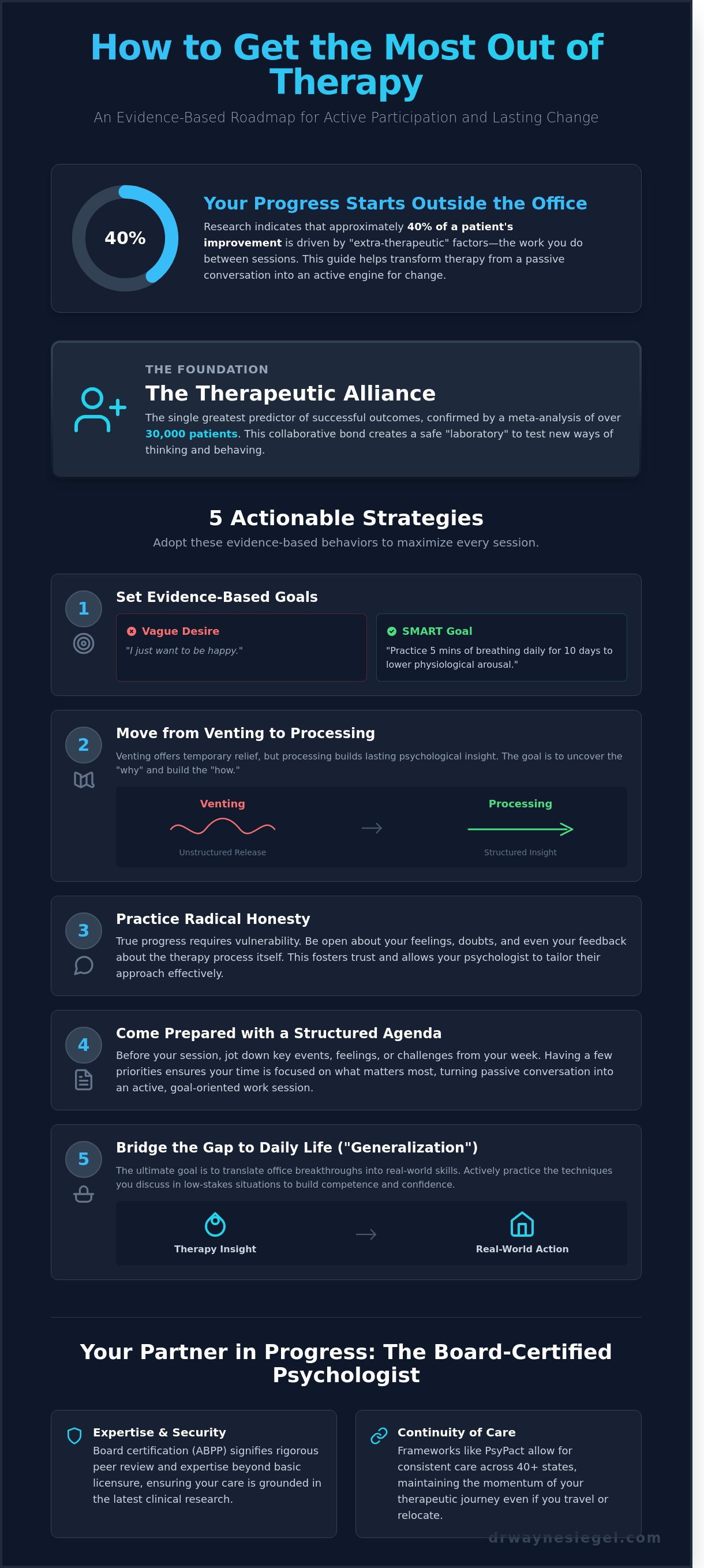
Research published in the Journal of Consulting and Clinical Psychology indicates that approximately 40% of a patient's improvement is driven by factors outside the clinical office, which often leaves people wondering how to get the most out of therapy sessions beyond just venting. You likely recognize the value of professional support, but you might also feel a lingering anxiety that you aren't doing it "right" or that your insights aren't sticking once you return to your daily routine. It's frustrating to invest time and resources into your well-being without seeing the clear, measurable shifts in your emotional stability that you expected.
I've designed this guide to provide a clinical roadmap grounded in the work of researchers like Dr. Scott Miller and the principles of the therapeutic alliance. My goal is to help you transform your sessions from passive conversations into active engines for change, ensuring you achieve faster symptom relief and better communication with your psychologist. We will examine the specific, evidence-based behaviors you can adopt before, during, and after your appointments to maximize your therapeutic ROI and gain the clarity you deserve.
Key Takeaways
- Understand why the therapeutic alliance is the single greatest research-backed predictor of success and how to foster this collaborative bond with your clinician.
- Learn practical strategies for how to get the most out of therapy sessions, including the use of structured agendas and the practice of radical honesty.
- Discover the clinical distinction between simple venting and productive processing to ensure your time is spent building meaningful psychological insight.
- Identify evidence-based methods for "generalization," the process of translating office-based breakthroughs into actionable skills for your daily life.
- Recognize the objective markers of a healthy therapeutic roadmap to ensure you are achieving measurable behavioral change and navigating potential plateaus.
Understanding the Foundation: The Therapeutic Alliance
I often tell my patients that the most critical factor in their progress isn't a specific worksheet or a single breakthrough moment. It's the strength of our partnership. In clinical terms, we call this the therapeutic alliance. This collaborative bond serves as the foundational step in learning how to get the most out of therapy sessions. It's the safety net that allows us to explore difficult emotions without the fear of judgment or collapse. When you feel seen and understood by your psychologist, the work of change becomes significantly more manageable.
The evidence supporting this is overwhelming. A 2018 meta-analysis led by researcher Christoph Flückiger, which reviewed over 30,000 patients across hundreds of studies, confirmed that the quality of the alliance is the single greatest predictor of successful outcomes. This holds true regardless of the specific type of therapy used. I view our time together as a specialized laboratory. This isn't just a place to vent; it's a controlled environment where we test new ways of thinking and behaving. By treating the office as a testing ground, you can practice assertive communication or cognitive reframing in a low-stakes setting before applying those skills in your daily life.
I utilize evidence-based frameworks like Cognitive Behavioral Therapy (CBT) and Acceptance and Commitment Therapy (ACT) to provide structure to this bond. These aren't just academic theories. They're rigorous, researched methods that provide a clear roadmap for our journey. When we use ACT, for instance, we focus on psychological flexibility and your core values. This scientific grounding ensures that our connection is purposeful and directed toward your specific needs, rather than just drifting through aimless conversation.
Setting Evidence-Based Goals
To see real progress, we must move beyond vague desires. Many people enter my office saying, "I just want to be happy," but happiness is a byproduct of specific actions, not a clinical objective. In an ACT framework, we pivot toward value-driven goals. This means identifying what truly matters to you, such as "being a present parent" or "cultivating professional integrity," and then building objectives around those pillars. A SMART goal in a mental health context is a specific, measurable, achievable, relevant, and time-bound objective, such as practicing five minutes of diaphragmatic breathing every morning for the next 10 days to lower baseline physiological arousal. Defining these metrics is a primary strategy for how to get the most out of therapy sessions because it provides us with a yardstick for your growth.
The Role of the Board-Certified Psychologist
Working with a board-certified psychologist offers a level of security that is essential when navigating complex emotional landscapes. Board certification through the American Board of Professional Psychology (ABPP) indicates that a practitioner has undergone rigorous peer review and met high standards of expertise beyond basic licensure. I provide a steady, non-judgmental guide for your journey, ensuring that our work is grounded in the latest clinical research. This professional depth is what separates clinical therapy from supportive listening. While a friend offers empathy, a psychologist offers a diagnostic lens and targeted interventions designed to change your cognitive profile.
My practice also utilizes PsyPact, which allows me to provide these specialized services to patients in over 40 different states. This ensures that even if your life involves frequent travel or relocation, your care remains consistent. This continuity is vital for maintaining the momentum of our work. We aren't just talking; we're engaging in a systematic process of uncovering the "why" behind your challenges and building the "how" for your future. This meticulous, person-centered approach ensures that every assessment and every hour we spend together is a precise step toward your clarity and well-being.
Active Participation: 5 Strategies for Your Next Session
I view therapy as a collaborative partnership where my clinical expertise meets your lived experience. To understand how to get the most out of therapy sessions, you must shift from a passive recipient of care to an active participant in the diagnostic and healing process. Research suggests that the therapeutic alliance is one of the strongest predictors of a positive outcome. This evidence-based guide from the American Psychological Association confirms that the effectiveness of treatment relies heavily on this engagement. I encourage you to implement these five specific strategies to maximize our time together.
- Prepare a session agenda: Spend 10 minutes before we meet to list your top three concerns. This ensures we address high-priority cognitive or emotional hurdles during the first 20 minutes of the hour when focus is highest.
- Practice radical honesty: A 2018 study published in the Journal of Counseling Psychology found that 93% of patients lie to their therapists. For us to find clarity, I need to hear the thoughts you're hesitant to share, including your feelings about our working relationship.
- Document the insights: Human memory is fragile; research indicates people forget nearly 50% of new information within 24 hours. Take notes during our session or immediately after to preserve the "aha" moments.
- Seek technical clarity: If I mention "executive functioning" or "cognitive restructuring" and it feels like jargon, please stop me. Understanding the "why" behind a clinical exercise increases your buy-in and success rate.
- Execute the 167-hour rule: Our session is one hour of your week. The other 167 hours are where the real change happens. Treat between-session exercises as a non-negotiable prescription for your well-being.
The Art of Preparation
Effective preparation moves beyond recounting the week's events. I want you to look for the "why" behind your reactions. Instead of just noting that you were angry on Tuesday, try to identify the pattern. Was it a lapse in executive functioning that triggered the frustration? Review your previous session notes or homework at least 30 minutes before walking into my office. Using a dedicated journal to track emotional triggers provides us with a roadmap of data points rather than vague recollections. This level of detail allows us to move directly into the work of finding solutions.
Engaging with the Process
During our time, I will often use Socratic questioning to help you uncover core beliefs. This isn't a test; it's a tool to help you reach your own conclusions. You might feel a strong urge to change the subject when things get difficult. I invite you to sit with those uncomfortable emotions for a few minutes. This tolerance is where the most significant breakthroughs occur. If a particular approach isn't resonating with you, tell me. Your feedback helps me refine your personalized cognitive profile and ensures our roadmap remains accurate. When we communicate openly about the process itself, we build the safety necessary for deep, transformative work.
Overcoming the "Venting" Trap: Moving Toward Insight
Many patients arrive at my office believing that a successful session requires a high-intensity emotional release. While catharsis, or "venting," provides temporary relief by lowering cortisol levels, it's often a surface-level fix. Clinical processing is a much more rigorous and rewarding endeavor. I view this distinction as the difference between clearing smoke and putting out the fire. A 2013 study published in the Journal of Consulting and Clinical Psychology suggests that cognitive restructuring leads to more sustainable long-term outcomes than emotional venting alone. Understanding how to get the most out of therapy sessions requires a shift in perspective from passive storytelling to active collaboration.
If your week was calm, don't feel pressured to manufacture a crisis. These "quiet" hours are actually the most effective times for deep-dive work like value-mapping or executive function training. When you aren't in a state of acute emotional distress, your prefrontal cortex is more engaged. This allows us to analyze your cognitive architecture with a level of precision that isn't possible during a crisis. We can use these sessions to build a roadmap for future challenges, ensuring you're equipped with specific skills before you actually need them.
My role as your psychologist is to help you pivot from the narrative of what happened to the mechanics of how you processed it. I'll often interrupt a long story to ask about your internal dialogue during a specific moment. This isn't to dismiss your experience, but to move the conversation from "what" to "how." This transition is where the real healing happens. It transforms the therapy room from a place where you complain about your life into a laboratory where you study and improve your responses to it.
Identifying Cognitive Distortions
I encourage my patients to bring physical or digital "thought records" to our meetings to ensure our work remains grounded in data. Research from the Beck Institute indicates that identifying automatic negative thoughts in real-time can reduce depressive symptoms by 50 percent in specific clinical populations. We use these records to challenge distortions like catastrophizing or black-and-white thinking as they appear. Instead of asking why a situation occurred, we focus on how you can respond effectively. This shift from passive observation to active skill-building is essential for long-term neuroplasticity.
The Power of Vulnerability
The topics you're most hesitant to share are usually the keys to your progress. Navigating the shame barrier requires a safe, professional environment where transparency is the priority. When you share the unfiltered version of your internal dialogue, it accelerates the diagnostic process significantly. This honesty helps me create a more precise cognitive profile for you; it ensures our work is tailored to your actual needs rather than a polished version of them. By prioritizing insight over mere catharsis, you'll discover how to get the most out of therapy sessions while building a resilient, evidence-based framework for your life.
Bridging the Gap: Applying Skills in Daily Life
The most profound work in therapy often happens outside my office walls. In clinical terms, we call this "generalization." It's the process of taking a skill practiced in a controlled, safe environment and successfully applying it to the unpredictable nature of your daily life. Research indicates that therapeutic gains are significantly more durable when patients actively bridge this gap. Understanding this transition is essential for anyone learning how to get the most out of therapy sessions.
I view "homework" not as a school assignment, but as evidence-based skill-building. A 2020 meta-analysis published in Cognitive Therapy and Research found that patients who consistently completed out-of-session activities experienced a 60% greater reduction in symptoms than those who didn't. These tasks provide the repetition your brain needs to forge new neural pathways. When we identify a specific behavior change, we're looking for measurable shifts in your routine, such as practicing a breathing technique for 120 seconds during your morning commute.
High-stress moments are the ultimate test of these skills. When your sympathetic nervous system triggers a "fight or flight" response, your access to logical reasoning narrows. To counter this, I recommend using "if-then" planning. For example, "If I feel my heart rate increase during a meeting, then I will place both feet flat on the floor and focus on the sensation of the carpet for three breaths." This type of behavioral activation relies on small, manageable steps that bypass the paralysis of overwhelm. By focusing on these concrete actions, you regain a sense of agency over your emotional state.
ACT in Action: Psychological Flexibility
Acceptance and Commitment Therapy (ACT) focuses on building psychological flexibility. We use "defusion" techniques to change your relationship with difficult thoughts. Instead of being consumed by the thought "I'm incompetent," you practice noticing it: "I am having the thought that I'm incompetent." This simple linguistic shift creates a vital 5-centimeter gap of mental space. I help you use these mindfulness skills to stay present at home or work, ensuring your daily actions align with the long-term roadmap we've established for your growth.
Tracking Your Progress
We don't rely on vague feelings to determine if you're improving. I utilize objective, data-driven measures like the PHQ-9 for mood or the GAD-7 for anxiety to track your trajectory over time. A 5-point decrease on these scales often correlates with a significant increase in occupational and social functioning. This data provides the evidence your mind needs to trust the process. Beyond the numbers, we look for "micro-wins," such as successfully setting a boundary with a family member for the first time in 24 months. Clarity serves as a metric for success because it reflects your emerging ability to see internal patterns with precision rather than confusion.
If you're ready to gain a clearer picture of your cognitive health and build a personalized roadmap for change, you can learn more about my assessment process to begin your journey toward lasting insight.
Evaluating the Roadmap: Is Your Therapy Working?
Determining if your investment is yielding results is a vital part of the clinical process. A healthy therapeutic trajectory isn't always a straight line, but it should trend toward greater clarity and functional improvement. I look for specific markers, such as your ability to catch negative thought patterns before they spiral or a measurable 20% reduction in avoidant behaviors over a month. Understanding these markers is a key component of how to get the most out of therapy sessions. If you feel you've reached a plateau, it's an invitation to pause and recalibrate rather than a sign of failure. My person-centered approach ensures that the roadmap we've created stays relevant to your evolving needs, allowing us to pivot when the data suggests a change is necessary.
The "End Phase" of therapy is just as critical as the intake. It involves consolidating your gains and planning for maintenance. I treat this phase as a graduation where we review the tools you've mastered. We focus on ensuring the roadmap we built together continues to guide you long after our final session. This includes identifying "red flags" that might suggest a need for a booster session in the future. By formalizing this phase, we ensure that your progress is sustainable and that you don't feel adrift once regular meetings conclude.
When to Adjust the Treatment Plan
I believe in transparency and collaboration. We'll revisit your specific goals every 3 to 6 months to ensure our work remains targeted and effective. If progress stalls for more than 8 consecutive sessions, we must investigate the "why" behind the plateau. This often involves discussing the need for supplemental assessments, such as ADHD testing or executive function screening, to clarify your cognitive profile. Ethical practice requires me to seek professional consultation or refer you for specialized evaluations if we identify a barrier that falls outside our current scope. This ensures you're always receiving the most precise care possible.
Long-term Growth and Resilience
The ultimate goal of our partnership is moving beyond simple symptom management toward a significantly improved quality of life. Evidence-based therapy provides a "toolkit" that research shows can reduce the risk of symptom relapse by up to 40% in many patients. You'll leave our sessions with a clearer understanding of your strengths and a refined ability to handle future stressors independently. This proactive focus on resilience is how to get the most out of therapy sessions for the long term. If you're ready to gain this kind of clarity and build a personalized path forward, visit Siegel Psychology Services to schedule a consultation for evidence-based care.
- Insight: Gaining a deeper understanding of cognitive and emotional patterns.
- Behavioral Change: Implementing new, healthier actions in daily life.
- Resilience: Building a toolkit to manage future challenges without constant intervention.
Transforming Insight into Actionable Growth
Maximizing your progress depends on shifting from passive attendance to active engagement. Clinical research, including studies by Lambert and Barley (2001), indicates that the therapeutic alliance is the strongest predictor of positive outcomes. By applying evidence-based frameworks like CBT and ACT outside our meetings, you turn weekly insights into permanent habits. Learning how to get the most out of therapy sessions requires this deliberate commitment to bridging the gap between clinical discussion and your daily reality.
I provide a structured roadmap that moves beyond simple venting toward measurable cognitive clarity. As a board-certified clinical psychologist with over 25 years of experience, I've spent my career helping individuals navigate complex emotional landscapes with precision and care. My practice offers telehealth services across all PsyPact participating states, ensuring you have access to specialized care regardless of your location. We'll work together to uncover the "why" behind your challenges and build a foundation for lasting change.
Begin your journey toward clarity and growth with Dr. Wayne Siegel.
You're capable of achieving the clarity you seek; I'm here to guide you every step of the way.
Frequently Asked Questions
How long does it typically take to see results from therapy?
You can typically expect to see measurable improvements within 12 to 20 weekly sessions when using evidence-based protocols like Cognitive Behavioral Therapy. Research from the American Psychological Association indicates that 50 percent of patients show significant clinical improvement within this timeframe. I track your progress using standardized assessments to ensure our work provides the clarity you need to improve your daily quality of life.
What if I don't have anything specific to talk about this week?
If you feel you have nothing specific to discuss, we often uncover the most profound insights by exploring your current emotional baseline or maintenance states. These sessions allow us to review your long-term roadmap without the distraction of an immediate crisis. Data suggests that consistent attendance, even during quiet weeks, is a key predictor of successful outcomes. It's a perfect time to practice the skills we've developed together.
How do I know if I have the right "click" with my psychologist?
You'll know you have the right click when you feel a sense of psychological safety and a shared understanding of your goals. Research by Norcross and Lambert in 2011 shows that the therapeutic alliance accounts for 30 percent of the variance in treatment outcomes. If you feel heard and respected during our first 3 sessions, it's a strong indicator that we have the foundation necessary for a successful partnership.
Is it okay to take notes or record my therapy sessions?
Yes, it's highly encouraged to take notes to help you retain information and understand how to get the most out of therapy sessions. According to the Ebbinghaus Forgetting Curve, humans lose roughly 70 percent of new information within 24 hours if it isn't reviewed. Recording sessions requires mutual consent to protect your privacy; however, writing down key insights provides a tangible roadmap for your growth between our meetings.
What is the difference between venting to a friend and talking to a psychologist?
The primary difference lies in the clinical structure and the use of evidence-based interventions designed to change cognitive patterns. While venting provides temporary emotional relief, a psychologist uses specialized techniques to help you build a functional skill set. I focus on your cognitive profile to identify the why behind your challenges. This move from simple venting to structured analysis is essential for achieving long-term clarity and behavioral change.
How much "homework" should I expect in evidence-based therapy?
You should expect to spend 15 to 30 minutes daily on between-session assignments to reinforce the skills we discuss. A meta-analysis by Kazantzis in 2000 found that patients who consistently complete homework have significantly better outcomes than those who don't. These tasks are not busywork; they're practical applications of our clinical work designed to improve your executive functioning in real-world scenarios.
Can online therapy through PsyPact be as effective as in-person sessions?
Online therapy through PsyPact is just as effective as in-person care for the majority of psychological conditions. A 2020 study published in the Journal of Anxiety Disorders found that video-based CBT is equivalent to face-to-face treatment in reducing symptoms. This allows me to provide you with a consistent, professional partnership regardless of your physical location, ensuring you know how to get the most out of therapy sessions through a flexible, evidence-based platform.