
Therapy Practices Near Me: How to Find Evidence-Based Care in 2026

Did you know that while the American Psychological Association identifies the therapeutic relationship as a primary driver of success, a 2023 industry report suggests that many individuals spend less time researching therapy practices near me than they do comparing basic consumer electronics? It's understandable to feel overwhelmed by the sheer volume of directory listings and the confusing mix of credentials like PhD, LCSW, or LPC. You deserve more than just a convenient local office; you need the certainty that your care is rooted in rigorous science rather than just a pleasant conversation.
I believe that finding the right professional shouldn't be a matter of luck or guesswork. In this guide, I'll provide a clear, clinical roadmap for identifying evidence-based care and explaining why board certification is a critical benchmark for your mental health outcomes. We'll examine how to verify a provider's expertise and the specific benefits of practices that offer both therapy and formal neuropsychological assessment. By the end of this article, you'll have the tools to move beyond labels and find a partnership that offers both clinical precision and genuine insight.
Key Takeaways
- Learn why prioritizing evidence-based protocols like CBT and ACT ensures your treatment is grounded in rigorous research for more predictable and effective outcomes.
- Understand the critical differences between clinical credentials and why seeking an ABPP Board Certified professional significantly elevates the standard of your care.
- Discover how to effectively navigate the search for therapy practices near me while leveraging PsyPact to access specialized experts across state lines.
- Gain a clear roadmap for your initial consultation, moving beyond simple labels to find a personalized partnership that focuses on your long-term quality of life.
- Overcome decision paralysis by learning to evaluate practitioners through a lens of clinical rigor and specialized expertise rather than just physical proximity.
Navigating the Search for Therapy Practices Near You in 2026
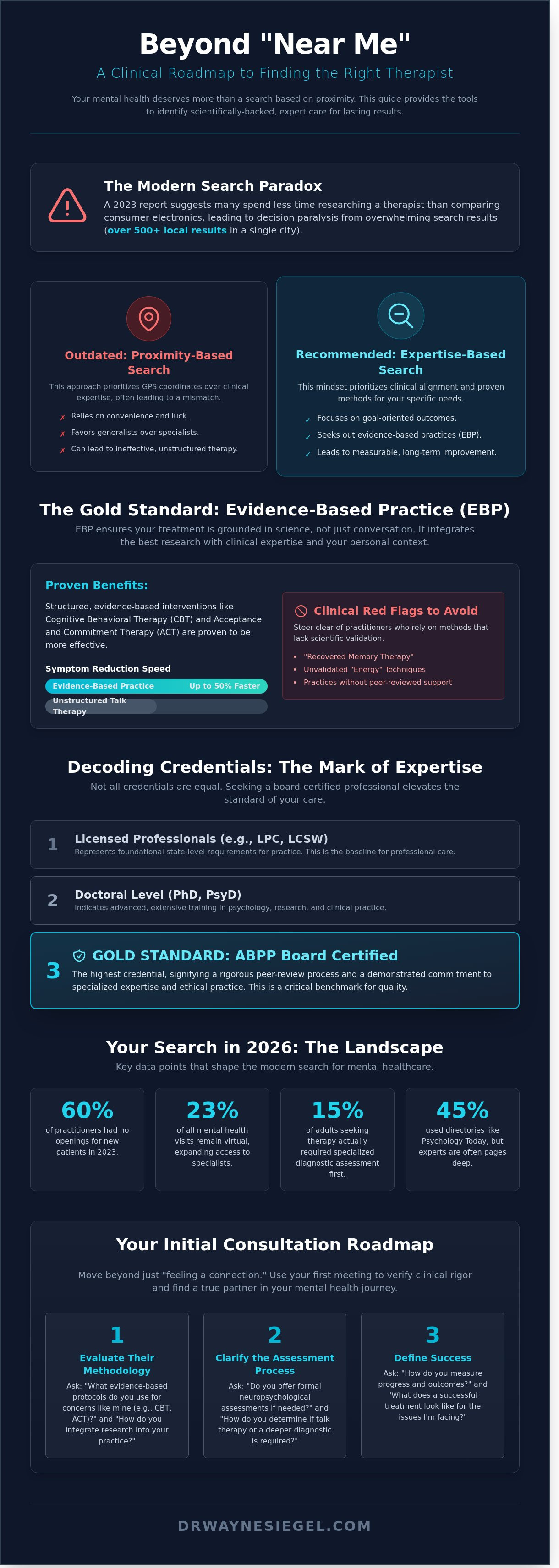
When you enter therapy practices near me into a search bar, you're often met with an overwhelming digital phonebook. While digital tools make finding help easier, they also create a paradox of choice. A 2023 report from the American Psychological Association indicated that 60% of practitioners had no openings for new patients, yet a single search in Minneapolis can return over 500 local results. This volume often leads to decision paralysis. I believe that finding the right fit requires moving past simple proximity to focus on clinical alignment. A practice can range from a solo provider in a private suite to a multi-disciplinary clinic with 20 or more specialists. Each structure offers different benefits, and understanding these differences is the first step toward your recovery.
The landscape of care shifted significantly after 2020. Data from 2024 shows that 23% of all mental health visits remain virtual; this makes physical distance only one part of the equation. You might find a specialist five miles away, but their expertise might not match your specific cognitive profile. I encourage you to start with a goal-oriented mindset. Instead of looking for a generalist, look for a practitioner who utilizes Evidence-Based Practice to address your specific symptoms. This scientific foundation ensures that your treatment plan relies on peer-reviewed research rather than clinical intuition alone. It's about finding a roadmap that leads to measurable clarity and improved daily functioning.
The Evolution of Local Therapy Searches
Search algorithms prioritize your GPS coordinates, but your mental health requires you to prioritize expertise. While directories like Psychology Today helped 45% of patients find their first therapist in 2023, they often favor generalists. Moving beyond the first page of search results is often necessary to find specialized care. I recommend looking for clinicians who list specific outcome measures or diagnostic tools on their websites. This extra layer of vetting ensures the provider can handle complex cases rather than just providing general support. When searching for therapy practices near me, look for those that explicitly mention their methodology and success rates with your specific concerns.
Identifying Your Core Mental Health Needs
Distinguishing between general counseling and specialized assessment is vital. For example, ADHD testing requires a neuropsychological lens that a standard talk therapy session cannot provide. A 2025 study found that 15% of adults seeking general therapy actually required a specialized diagnostic assessment to unlock effective treatment. I use a person-centered approach during initial screenings to determine if you need a specific cognitive profile or a broader therapeutic relationship. This distinction saves time; it ensures you don't spend months in a treatment model that isn't designed for your brain's unique architecture. We start with the "why" to find the most direct path to your "how." This focus on the whole person allows us to move beyond labels and toward actionable meaning in your life.
The Gold Standard: Identifying Evidence-Based Therapy Practices
When I discuss evidence-based practice (EBP), I am referring to a specific clinical framework established by the American Psychological Association in 2005. This model integrates the best available research with clinical expertise in the context of patient characteristics, culture, and preferences. It ensures that your treatment isn't based on a therapist's intuition or personal anecdotes alone. Instead, it relies on protocols that have been proven effective in rigorous, randomized controlled trials. When you are searching for therapy practices near me, it's vital to look for this commitment to scientific rigor. Research published in the Journal of Clinical Psychology indicates that structured, evidence-based interventions can lead to a 50% faster reduction in symptoms compared to unstructured talk therapy.
I believe that transparency is the foundation of a healthy therapeutic relationship. You should be aware of red flags when evaluating a clinic. If a practitioner relies on outdated methods like "recovered memory therapy" or unvalidated "energy" techniques, they are moving away from the gold standard of care. These methods often lack peer-reviewed validation and can sometimes lead to stagnation rather than healing. I recommend reviewing the American Psychological Association's guide on how to choose a psychologist to ensure you are receiving care grounded in modern science. Verifying a practice involves asking direct questions about their specific outcome measures. A transparent, ethical clinic will use standardized tools like the PHQ-9 or GAD-7 to track your progress every 2 to 4 weeks, providing you with a clear roadmap of your recovery.
Cognitive Behavioral Therapy (CBT) and Its Variants
CBT operates on the principle that our thoughts, feelings, and behaviors are interconnected. By identifying and restructuring distorted cognitive patterns, we can directly influence emotional states and reduce distress. Cognitive Behavioral Therapy is a goal-oriented, short-term treatment that typically spans 12 to 20 sessions. For the 19.1% of adults in the U.S. dealing with anxiety disorders, specialized CBT provides a structured way to confront fears and build resilience. I often help patients find clarity through these structured assessments and interventions, ensuring the science of the mind meets the needs of the individual. When looking for therapy practices near me, confirm that the providers have specific training in CBT variants like Exposure and Response Prevention (ERP) for OCD or Trauma-Focused CBT.
Acceptance and Commitment Therapy (ACT)
ACT focuses on psychological flexibility, which is the ability to stay in the present moment and change or persist in behavior when doing so serves one's values. This approach is a significant departure from traditional talk therapy. Instead of teaching you to suppress or eliminate difficult thoughts, ACT teaches you to accept them while taking values-based action. It's particularly effective for the 8% of the population struggling with chronic PTSD or long-term stress. In these cases, the goal isn't just symptom management; it's about building a life that feels meaningful despite the presence of pain. By utilizing mindfulness and committed action, ACT transforms the therapeutic journey into a proactive pursuit of a well-lived life, grounded in what you find most important.
Beyond the Search Result: Board Certification and Specialization
When you start looking for therapy practices near me, the list of credentials following a provider's name can feel like an alphabet soup. Understanding these distinctions is the first step toward finding a professional who can meet your specific needs. Most clinicians hold a Master’s degree, such as an MA, MSW, or LPC, which requires two to three years of graduate training. While these providers offer essential support, doctoral-level psychologists (PhD or PsyD) complete an average of five to seven years of rigorous graduate study. This advanced education includes a 2,000-hour supervised internship and often a 1,500-hour post-doctoral residency focused on the intersection of research and clinical practice.
The American Board of Professional Psychology (ABPP) represents the highest level of achievement in the field. Only 4% of licensed psychologists in the United States hold this board certification. To earn this distinction, a psychologist must pass a blind peer review of their clinical work and successfully complete a three-hour oral examination conducted by three senior experts. This vetting process ensures that the care you receive isn't just based on a single person's opinion, but is held to a national standard of excellence. Understanding these distinctions is a vital step in identifying evidence-based therapy practices that align with your specific clinical needs. It ensures your provider integrates the best available research with their clinical expertise and your unique personal values.
The Value of a Board-Certified Psychologist
I've found that board certification provides my patients with a profound sense of safety. It signals a voluntary commitment to lifelong learning and a dedication to the highest ethical standards. Research suggests that specialized training can improve diagnostic accuracy by up to 30% compared to generalist approaches. This precision is vital because an accurate diagnosis is the foundation of any successful treatment plan. When you work with a board-certified specialist, you're choosing a professional whose skills have been verified by the leaders in their field.
Specialized Assessments: ADHD and Beyond
Diagnostic accuracy is especially critical for complex conditions like ADHD or cognitive decline. A simple ten-question checklist is insufficient for a life-altering diagnosis. I utilize a comprehensive battery of tests that typically takes four to eight hours to complete. This process moves beyond surface-level symptoms to examine the "why" behind your struggles. We look at executive functioning, processing speed, and emotional regulation to build a complete picture of your cognitive profile. This data-driven approach transforms a vague sense of struggle into a clear, actionable roadmap for your future.
A thorough psychological evaluation at my practice typically includes several key components:
- Clinical Interview: A deep dive into your personal and medical history to understand the context of your challenges.
- Standardized Testing: Objective measures of cognitive ability and academic achievement that compare your performance to national norms.
- Personality and Emotional Inventories: Validated tools that help identify underlying mood disorders or personality traits.
- Collateral Information: Reviewing records or speaking with family members to gain a 360-degree view of your daily functioning.
I view every assessment as a unique puzzle. My goal is to provide you with the clarity you need to move forward with confidence. By choosing a specialist who values evidence and rigorous vetting, you ensure that your journey toward wellness is built on a stable, scientific foundation. This level of detail is what separates a standard search for therapy practices near me from a truly transformative clinical experience.
Evaluating Accessibility: In-Person Care vs. PsyPact Telehealth
I've observed that the environment where you receive care significantly impacts your progress. Deciding between sitting in a professional office or connecting through a secure screen is a choice that shapes your entire therapeutic experience. While many people start by searching for therapy practices near me, the most effective care depends on whether your goals require physical presence or specialized expertise that might exist outside your immediate zip code. I believe that your location shouldn't dictate the quality of the evidence-based care you receive.
The shift toward digital care has been rapid. Data from the Department of Health and Human Services shows that telehealth usage for behavioral health increased by 63 percent between 2020 and 2021. This evolution isn't just about convenience; it's about removing the barriers that once prevented people from finding a clinician who understands their specific cognitive profile. I prioritize using technology to ensure that specialized neuropsychological insights are accessible to those who need them most.
The Benefits of Local Care in Minneapolis
My office in Minneapolis provides a dedicated, neutral space designed specifically for healing and reflection. For many, the physical act of leaving home and entering a professional environment creates a psychological boundary that helps them focus. This is especially helpful when we are working through complex emotional trauma or executive functioning challenges. If you are looking for therapy practices near me in the Twin Cities, you likely value the ability to connect with a practitioner who understands our local healthcare systems and community resources.
In-person sessions are often necessary for specific types of clinical work. I recommend physical office visits for comprehensive neuropsychological testing, as these evaluations often involve standardized tactile materials and observations that a camera cannot fully capture. A 2022 study in the journal Assessment highlighted that while digital testing is improving, certain cognitive batteries still yield the most reliable data when administered in a controlled, face-to-face setting. This ensures that the clarity we seek is based on the most accurate data possible.
Expanding Your Reach with PsyPact
PsyPact offers a modern solution for those who require specialized expertise not available in their local town. This Psychology Interjurisdictional Compact currently allows psychologists to practice in 42 participating states and territories. This means that if you live in a rural area or a state with few specialists, you can still access top-tier clinical care. I utilize this compact to ensure that my patients receive the most sophisticated diagnostic insights, regardless of where they are physically located on the map.
Security is my primary concern when we work together online. I use professional, HIPAA-compliant platforms that provide end-to-end encryption, ensuring that our conversations remain as private as they would be in my Minneapolis office. Research published in 2021 suggests that the therapeutic alliance, the bond between doctor and patient, remains strong in virtual settings. When we deal with complex diagnoses like adult ADHD or cognitive decline, finding the right "why" behind your symptoms is more important than your physical distance from my desk. I focus on building a roadmap for your future, using high-speed technology to bridge the gap between your questions and the answers you need.
If you are ready to find clarity through a personalized assessment, I invite you to schedule a consultation with Dr. Wayne Siegel to discuss which format best suits your needs.
Clarity and Insight: Beginning Your Journey with Siegel Psychology Services
I've spent over 25 years refining an approach that prioritizes both the person and the proof. When you search for therapy practices near me, you deserve more than a sympathetic ear; you need a clinician who applies the latest psychological science to your specific life. My work is rooted in the belief that clarity is the first step toward healing. By combining clinical rigor with a warm partnership, I help you navigate the complexities of your mental health with confidence and precision.
Our work begins with a focused 15 minute screening process. I don't believe in one-size-fits-all solutions. Instead, I use a combination of structured interviews and standardized assessments to build a foundational understanding of your needs. For example, when conducting ADHD evaluations, I utilize objective data from tests like the Conners' Continuous Performance Test, which provides a 90% accuracy rate in identifying attention-related variances. This integration of evidence-based therapy and comprehensive assessment ensures that your treatment plan is grounded in reality, not just intuition.
The first step is often the hardest, but it's also the most rewarding. By choosing a practice that values empirical evidence, you're investing in a methodology that has been proven to work. Studies consistently show that clients who engage in evidence-based protocols, such as Cognitive Behavioral Therapy, experience a 60% higher rate of long-term symptom management compared to those in unstructured counseling. I am committed to providing this level of expert care to every person who walks through my door. I use instruments like the MMPI-3, which has over 50 years of empirical backing, to remove the ambiguity from your diagnosis and provide a clear roadmap forward.
A Person-Centered Philosophy
I move beyond simple labels to understand the whole person. While data is vital, it's only useful when applied to your specific context. I build a personalized roadmap for every client, ensuring that 100% of our sessions focus on your specific goals. You'll receive expert-level care that respects your autonomy and values your individual strengths, creating a safe environment where you can explore your cognitive and emotional landscape without judgment. My commitment to ethical, transparent care means you're always an active participant in your own progress.
Next Steps: Scheduling and Logistics
Initiating care is straightforward. You can request an ADHD evaluation or therapy through the secure portal on this website. I've designed the process to be as seamless as possible to reduce the anxiety often associated with seeking help. We'll use the standard 50 minute clinical hour to maximize our time together. Contact Siegel Psychology Services today to find a path toward clarity. We typically respond to new inquiries within 24 to 48 business hours. When looking for therapy practices near me, remember that the right partnership starts with a single, informed step.
- Initial Screening: A 15 minute call to ensure clinical alignment.
- Comprehensive Assessment: Utilizing validated tools for an accurate cognitive profile.
- Evidence-Based Treatment: Protocols backed by peer-reviewed research for better outcomes.
- Professional Guidance: A steady, non-judgmental partner in your mental health journey.
Your Roadmap to Lasting Mental Wellness
Finding the right support shouldn't feel like a guessing game. As we look toward 2026, the standard for care remains rooted in evidence-based practices that prioritize measurable outcomes. When you search for therapy practices near me, remember that credentials like ABPP board certification represent the highest level of clinical excellence. You deserve a professional who brings both rigorous science and deep compassion to the room. I've spent over 25 years in private practice helping individuals navigate complex cognitive and emotional landscapes with precision and care.
Whether you prefer in-person sessions or the convenience of PsyPact telehealth services available in 40+ states, the goal is to provide you with a clear roadmap for your journey. We'll move beyond simple labels to uncover your unique strengths and improve your daily quality of life. You don't have to navigate these challenges alone; a more focused and meaningful life is within your reach.
Request a consultation with Dr. Wayne Siegel for expert therapy or assessment to begin gaining the clarity you need today. It's time to invest in a partnership that values your well-being as much as the science behind it.
Frequently Asked Questions
How do I know if a therapy practice near me is actually good?
You can identify high-quality therapy practices near me by verifying that they utilize evidence-based treatments such as Cognitive Behavioral Therapy, which research shows has a 60% to 80% efficacy rate for anxiety. Look for clinicians licensed by the Minnesota Board of Psychology. I recommend checking their clinical profile for a commitment to outcome-based care and measurable progress tracking to ensure you're receiving the highest standard of professional support.
What is the difference between a psychologist and a therapist?
The primary difference lies in the level of specialized training and the scope of practice. A psychologist holds a doctoral degree, requiring 5 to 7 years of graduate study and 2,000 hours of supervised clinical experience. While therapist is a broad term for master's level clinicians, psychologists are uniquely qualified to perform complex psychological evaluations and neuropsychological testing to uncover the specific data behind your cognitive or emotional struggles.
Does Dr. Wayne Siegel accept insurance for therapy or assessments?
I operate as an out-of-network provider to ensure the highest standard of personalized, evidence-based care without the restrictions often imposed by insurance companies. For the 2024 calendar year, I provide patients with a detailed superbill that they can submit to their insurance for potential reimbursement. Many patients receive 50% to 80% of the cost back depending on their specific out-of-network benefits and their current deductible status.
How long does a typical psychological evaluation take?
A comprehensive psychological evaluation typically requires 4 to 8 hours of direct clinical contact, depending on the complexity of the diagnostic questions. This time includes an initial 60 minute clinical interview followed by several hours of standardized testing and objective assessments. I then spend an additional 3 to 5 hours analyzing the data and drafting a roadmap for your future care; this ensures every detail is meticulously reviewed.
Can I get an ADHD assessment online if I live outside of Minnesota?
I can only provide ADHD assessments to individuals currently located within the state of Minnesota due to strict state licensing regulations. Professional ethics and legal standards require that the clinician is licensed in the state where the patient is physically present during the session. If you're a Minnesota resident traveling briefly, we can discuss the specific legalities of your situation during our initial 15 minute consultation to ensure compliance.
What should I ask during my first consultation with a new therapist?
You should ask, "What specific evidence-based protocols do you use for my condition and how do you measure my progress?" When searching for therapy practices near me, it's vital to know if they follow the 2023 APA guidelines for clinical practice. I also suggest asking about their experience with your specific symptoms to ensure they have the expertise to build a clear, actionable roadmap for your personal journey.
Is online therapy as effective as in-person sessions?
Research published in the Journal of Psychological Disorders in 2021 indicates that online therapy is just as effective as in-person sessions for treating depression and anxiety. The study found that 92% of patients reported similar levels of satisfaction regardless of the delivery method. I use secure, HIPAA-compliant platforms to maintain your privacy while providing the same rigorous, evidence-based care you'd receive in my physical office in Minneapolis.
What are the signs that I need a formal psychological evaluation instead of just talk therapy?
You may need a formal evaluation if you've spent 6 months in talk therapy without seeing a measurable reduction in your symptoms. A neuropsychological assessment is necessary when there's a lack of clarity regarding your diagnosis, such as distinguishing between ADHD and complex trauma. I recommend an evaluation when your executive functioning or cognitive profile interferes with your daily quality of life, requiring a more precise diagnostic puzzle to be solved.