
CBT Techniques for Negative Self-Talk: An Evidence-Based Clinical Guide

What if the most relentless critic you face isn't a person at all, but a set of cognitive distortions that have become your default setting? I've worked with hundreds of patients who arrive at my office feeling paralyzed by an inner voice that treats every fear as a proven fact. You're likely tired of the emotional exhaustion that comes from constant rumination. It's a heavy burden to carry when you can't distinguish between a passing feeling and an objective reality. Learning specific cbt techniques for negative self-talk is often the first step toward reclaiming your peace of mind.
I want to offer you a sense of clinical clarity. Research, including a 2018 meta-analysis published in Cognitive Therapy and Research, consistently demonstrates that these protocols can reduce the intensity of anxiety and depressive episodes by helping you restructure your thoughts. In this guide, I'll provide a clear, repeatable protocol to help you identify these patterns and reframe your internal dialogue. We'll explore the evidence-based steps to move from confusion to a focused roadmap for your mental well-being.
Key Takeaways
- Gain clarity on the clinical origins of Automatic Negative Thoughts (ANTs) and how the Cognitive Triad influences your view of yourself and your future.
- Identify and deconstruct common cognitive distortions using evidence-based cbt techniques for negative self-talk to move beyond biased, black-and-white thinking.
- Learn to apply the "Courtroom Metaphor" to distinguish between objective facts and emotional responses, creating a more balanced and grounded internal dialogue.
- Master actionable protocols like the Triple Column Technique and Socratic questioning to systematically reframe self-limiting beliefs into rational responses.
- Explore how integrating Cognitive Defusion provides a roadmap for long-term resilience, allowing you to observe thoughts with calm stability rather than being overwhelmed by them.
The Cognitive Mechanism of Negative Self-Talk
In my clinical practice, I often describe the internal critic not as a personality trait, but as a series of "Automatic Negative Thoughts" (ANTs). Within the framework of Cognitive Behavioral Therapy, these thoughts are recognized as reflexive, involuntary evaluations that bypass logical reasoning. They aren't based on objective facts; instead, they represent a distorted lens through which we view our daily lives.
Aaron Beck, who pioneered this field in 1967, identified what he called the Cognitive Triad. This model explains how negative self-talk operates across three specific domains: a negative view of the self, the world, and the future. When these three areas are saturated with criticism, it creates a psychological "trap." Clinical research published in the Journal of Abnormal Psychology has consistently linked persistent self-criticism to biological markers of distress, including elevated cortisol levels and heightened activity in the anterior cingulate cortex. This isn't just "in your head"; it's a physiological state that impacts your entire system.
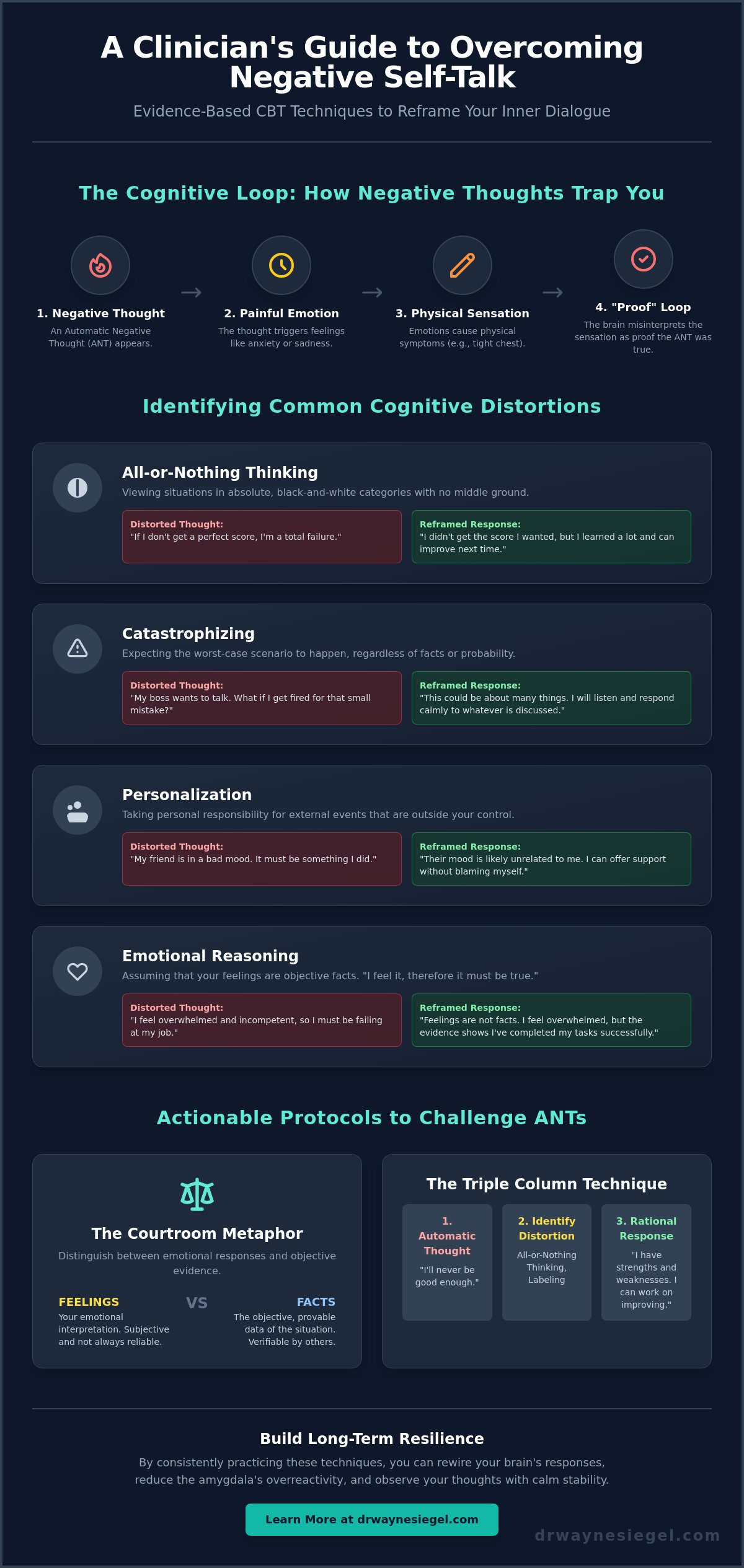
The core of this struggle lies in the "cognitive loop." This is a self-reinforcing cycle where a negative thought triggers a painful emotion, which then manifests as a physical sensation like chest tightness or fatigue. These physical symptoms then "prove" to the brain that the original negative thought was true. Breaking this cycle is the fundamental objective when we apply cbt techniques for negative self-talk to regain emotional clarity.
The Impact on Emotional Regulation
When you engage in harsh self-talk, your brain's amygdala perceives a threat and initiates a stress response. This is the same system that handles physical danger. While healthy self-reflection allows for growth and learning, maladaptive rumination keeps the body in a state of chronic alarm. A 2021 study published in Nature Communications suggests that neuroplasticity allows us to rewire these responses. By consistently practicing cbt techniques for negative self-talk, patients can actually dampen the amygdala's overreactivity and strengthen the prefrontal cortex, which governs logical reasoning.
Why the Brain Defaults to Negativity
The human brain is biologically wired with a "negativity bias." Historically, our ancestors survived by prioritizing threats over rewards; noticing a predator was more vital than noticing a pleasant breeze. Today, this survival mechanism often misfires, turning inward as self-criticism. These patterns are frequently anchored in "core beliefs" developed during early developmental stages. Cognitive Restructuring is the process of identifying and disputing irrational thoughts.
Identifying Common Cognitive Distortions
To effectively apply cbt techniques for negative self-talk, we must first recognize the specific ways our minds misinterpret reality. Cognitive distortions are habitual, biased patterns of thinking that lack objective evidence. These mental filters often lead to increased anxiety or low mood. Research pioneered by Dr. Aaron Beck in 1963 identified these as systematic errors in logic. While everyone experiences them occasionally, they become problematic when they dominate your internal dialogue and cloud your judgment.
These distortions function like a cracked lens on a camera; they warp the image you see of yourself and the world. Understanding the mechanics of these thoughts allows you to challenge them with logic and data. We focus on several primary categories in clinical practice:
- All-or-Nothing Thinking: This involves viewing situations in binary, black-and-white categories. If a performance is not perfect, you see it as a total failure. There's no room for the nuance of the middle ground.
- Catastrophizing: You expect the worst-case scenario to happen regardless of the facts. This often starts with the phrase "what if," leading to a spiral of imagined disasters that have a low probability of occurring.
- Personalization: This occurs when you take responsibility for external events outside of your control. You might assume a colleague's bad mood is a direct result of something you did, ignoring the 90% likelihood that it relates to their own life.
- Emotional Reasoning: You assume that because you feel a certain way, it must be true. If you feel "stupid," you conclude that you are objectively incapable, disregarding your actual achievements and skills.
The Role of Labeling in CBT
Identifying these patterns by name creates immediate psychological distance. This process, known as de-centering, allows you to observe a thought without accepting it as an absolute truth. In many evidence-based CBT protocols, we work on reframing rigid "Should Statements" into flexible preferences. For example, you might reframe "I should never make a mistake" into "I value doing good work, but I accept that errors are part of the learning process." This shift reduces the internal pressure that fuels negative self-talk.
Building Awareness Through Mindfulness
Mindfulness acts as an early warning system for your internal dialogue. It helps you catch distortions before they gain momentum. Using the "Observe and Describe" technique, you learn to note the presence of a thought without judgment. You treat thoughts as transient mental events rather than facts. This objective stance is a core part of cbt techniques for negative self-talk, helping you gain a clearer picture of your cognitive health. Clinical studies indicate that consistent mindfulness practice can reduce the frequency of ruminative thoughts by approximately 30% over an eight-week period.
The Evidence-Evaluation Framework: Facts vs. Feelings
In my practice, I often observe that patients struggle with the pressure to "just think positively." This approach is frequently ineffective because it feels dishonest to the person experiencing distress. Effective cbt techniques for negative self-talk move away from forced optimism and toward evidence-based thinking. We don't want to replace a negative lie with a positive lie. We want to find the truth. This process shifts your perspective from a subjective emotional reaction to an objective analysis of your life.
I utilize the "Courtroom Metaphor" to help patients navigate this shift. Imagine your negative thought is on trial. To reach a fair verdict, you must act as both the prosecution and the defense. You're required to gather external, verifiable facts that support the thought and, more importantly, seek disconfirming evidence that challenges it. This rigorous audit helps you step outside of your emotional state to see your situation with the precision of an investigator. This systematic approach is how we build clinical clarity regarding your actual capabilities and worth.
Evaluating the "Evidence For" and "Against"
When you evaluate a thought, you must distinguish between a feeling and a fact. Emotional intensity is not a valid form of evidence. You might feel 100% like a failure, but that feeling doesn't prove the statement is true. I ask my patients to look for objective, external data. If the thought is "I'm bad at my job," the evidence for might be a single critical comment from a manager on June 15th. The evidence against would include your last three successful projects, your degree, and the fact that you've been employed there for four years without a formal warning.
- Identify specific dates, names, and outcomes.
- Look for "silent successes" that your inner critic usually ignores.
- Ask if this evidence would stand up in a court of law.
The Difference Between Reframing and Toxic Positivity
It's vital to understand that CBT doesn't ignore real problems. Toxic positivity demands that you stay happy regardless of the circumstances, which can be deeply invalidating. In contrast, CBT addresses challenges with realistic logic. We aim for a "Balanced Thought," which is a statement that is both accurate and helpful. If you've experienced a genuine setback, we acknowledge it while also recognizing your resilience and your options for moving forward.
This grounded approach is a central component of ptsd counseling and trauma recovery. Survivors often deal with intense, intrusive negative thoughts that feel like absolute truths. By using cbt techniques for negative self-talk, we can slowly dismantle those distortions. We replace them with a narrative that respects the gravity of the past while highlighting the safety and agency available in the present. This isn't about pretending things are perfect; it's about seeing the whole picture with honesty and compassion.
Actionable Step-by-Step CBT Protocols
I want to provide you with a clear roadmap for change. These cbt techniques for negative self-talk aren't just theories; they're precise instruments used to recalibrate your internal dialogue. We start with the Triple Column Technique. This method requires you to divide a page into three sections: the Automatic Thought, the Distortion Label, and the Rational Response. By identifying the specific distortion, such as "all-or-nothing thinking," you strip the thought of its emotional power. A 2014 study in the Journal of Behavior Therapy and Experimental Psychiatry showed that structured cognitive restructuring can reduce the frequency of intrusive thoughts by up to 35% over a six-week period. Data changes minds.
Behavioral experiments take this a step further by treating your beliefs as hypotheses rather than facts. If you believe "everyone will notice if I make a mistake," I might ask you to intentionally make a minor, harmless error in a social setting. You then record the actual results. Most patients find that 90% of their predicted social catastrophes never materialize. This real-world evidence provides the brain with data it can't ignore; it's the difference between thinking about change and experiencing it.
When catastrophizing takes hold, I recommend a "Best Case/Worst Case/Most Likely Case" analysis. You list the absolute worst outcome, the most ideal outcome, and then the most statistically probable one. Usually, the truth resides in the middle. This exercise forces the brain to move away from the amygdala's fear response and toward the prefrontal cortex's logical processing. It creates a sense of calm stability.
Implementing a Daily Thought Record
I suggest a five-minute daily thought audit to externalize your internal critic. Writing thoughts down creates a necessary distance between your identity and your cognitions. Use this simple structure:
- The Trigger: What happened right before the feeling changed?
- The Thought: What did you tell yourself?
- The Evidence: What facts support or refute this?
The Power of Socratic Questioning
Utilizing cbt techniques for negative self-talk often involves a process called Socratic Questioning. These questions help bypass the emotional brain and engage the prefrontal cortex. When a negative thought arises, ask yourself:
- Is this thought based on facts or feelings?
- What would I tell a friend in this exact situation?
- Is this thought helpful for solving the problem?
Integrating CBT and ACT for Long-Term Resilience
While traditional cbt techniques for negative self-talk focus on restructuring irrational beliefs, Acceptance and Commitment Therapy (ACT) offers a complementary lens. ACT introduces the concept of "Cognitive Defusion," which involves observing thoughts as passing mental events rather than absolute truths. A 2022 study published in the Journal of Contextual Behavioral Science shows that defusion can reduce the emotional distress caused by negative thoughts by up to 40% in clinical settings. Instead of struggling to "fix" a thought, you learn to let it exist without giving it power over your actions.
This integration shifts the focus from constant cognitive monitoring to values-based living. You don't wait for the negative voice to disappear before you start living your life. You acknowledge the thought, label it as a mental event, and move toward what matters to you. This dual approach builds a robust psychological profile. It combines the logical reframing of CBT with the mindful acceptance of ACT, creating a sustainable toolkit for emotional regulation. It's about changing your relationship with your mind rather than just changing the content of your thoughts.
When to Seek Professional Consultation
Self-help strategies are valuable, but they aren't a substitute for clinical intervention when symptoms are severe. If self-criticism results in significant functional impairment, such as missing 4 or more work days a month or persistent social withdrawal, professional guidance is necessary. A clinic for psychology offers a tailored, person-centered approach that goes beyond generic advice. Board-certified psychologists provide the diagnostic precision needed to uncover the root causes of deeply-rooted cognitive patterns. They act as steady guides through complex emotional landscapes, ensuring your treatment plan is grounded in the latest evidence-based science and your unique personal strengths.
A Roadmap to Psychological Clarity
The transition from being a victim of your thoughts to an observer of them is the hallmark of psychological maturity. This journey is iterative. You'll likely revisit these cbt techniques for negative self-talk many times as you face different life stressors. Each repetition strengthens your cognitive resilience and deepens your insight. For those living in psypact states, access to this level of care is more accessible than ever through interjurisdictional telehealth. This allows you to partner with an expert who understands your unique cognitive profile, regardless of physical distance. True clarity comes from understanding that while you can't always control the first thought that enters your mind, you have full control over how you respond to it.
Building Your Roadmap to Cognitive Clarity
Mastering the internal cognitive mechanisms of self-criticism involves more than simple positive thinking; it requires dismantling the specific distortions first identified in Aaron Beck’s 1967 research. By utilizing the evidence-evaluation framework, you can learn to objectively separate fleeting emotional responses from verifiable clinical facts. Implementing cbt techniques for negative self-talk through structured protocols and the integration of Acceptance and Commitment Therapy (ACT) provides a durable foundation for long-term emotional regulation. These methods aren't just theories; they're proven tools that reshape how you process your daily experiences.
Navigating this complex psychological landscape is more effective with professional guidance. Dr. Wayne Siegel is a board-certified clinical psychologist with over 25 years of experience specializing in comprehensive assessments and evidence-based care. His practice offers telehealth services across all 40+ PsyPact participating states, ensuring that geography isn't a barrier to high-quality psychological support. You deserve a clear, actionable path forward that prioritizes your unique cognitive profile and well-being.
Gain clinical clarity and start your journey toward recovery with Dr. Wayne Siegel. You don't have to carry the weight of these thoughts alone; lasting change is possible with the right expertise.
Frequently Asked Questions
What is the difference between negative self-talk and a clinical diagnosis?
Negative self-talk is a cognitive habit, whereas a clinical diagnosis like Generalized Anxiety Disorder requires meeting 3 or more specific criteria in the DSM-5-TR for at least 6 months. I find that while everyone experiences a harsh inner critic, a diagnosis is reserved for when these thoughts cause impairment in 2 or more life domains. We use standardized scales to measure this impact on your daily life.
Can CBT techniques work if I actually believe my negative thoughts are true?
CBT works because it doesn't ask you to ignore your thoughts, but rather to test them as hypotheses using objective evidence. Research from 1979 established that even deeply held beliefs can shift when we examine the data. You'll learn to look at your thoughts with the same precision I use during a neuropsychological evaluation, moving from "I feel this is true" to "What does the record show?"
How long does it take for CBT techniques to show results in reducing self-criticism?
Clinical data from the Journal of Consulting and Clinical Psychology indicates that most people experience a measurable decline in distress within 8 to 12 structured sessions. You'll likely notice the first shifts in your perspective after about 4 weeks of consistent practice. It's a roadmap where each step builds on the last, providing a clear path toward the cognitive clarity you deserve.
Is it possible to completely eliminate negative self-talk?
It's not possible to eliminate every negative thought, as the human brain is naturally wired with a negativity bias for survival. Instead, we aim for a 50% or greater reduction in the intensity and frequency of these thoughts. These cbt techniques for negative self-talk focus on changing your relationship with your inner critic so it no longer dictates your choices or your self-worth.
How do I know if I need a professional psychological evaluation instead of self-help?
You should seek a professional evaluation if your self-criticism leads to an inability to perform at work or maintain relationships for 14 days or longer. If you're experiencing brain fog or persistent fatigue alongside negative thoughts, a neuropsychological profile can provide the clarity you need. I recommend a formal assessment when self-help tools fail to improve your daily quality of life scores significantly.
What is the 'Triple Column' technique in CBT?
The Triple Column technique is a written exercise where you log a distressing thought, identify its specific cognitive distortion, and write a balanced rebuttal. This is one of the most effective cbt techniques for negative self-talk for building immediate awareness. By documenting these three steps, you create a tangible roadmap that transforms abstract worries into manageable, logical challenges that we can solve together.
Can CBT help with negative self-talk related to ADHD or trauma?
CBT is highly effective for these conditions, with a 2018 study in The Lancet showing significant improvement for individuals with ADHD when combined with executive function training. For trauma, we adapt the approach to ensure you feel safe while processing the 4 main clusters of PTSD symptoms. It’s about understanding the "why" behind your thoughts to create a tailored, evidence-based plan for your recovery.
How does Socratic questioning help in challenging my inner critic?
Socratic questioning helps by using 6 specific types of questions to systematically dismantle the logic of your inner critic. Instead of accepting a thought as fact, we'll ask for evidence, alternatives, and real world consequences. This process mirrors the scientific rigor I apply in my practice, helping you gain an objective perspective on your internal dialogue and fostering the long term emotional stability you need.