
Comprehensive Psychiatric Evaluation: A Roadmap to Clinical Clarity

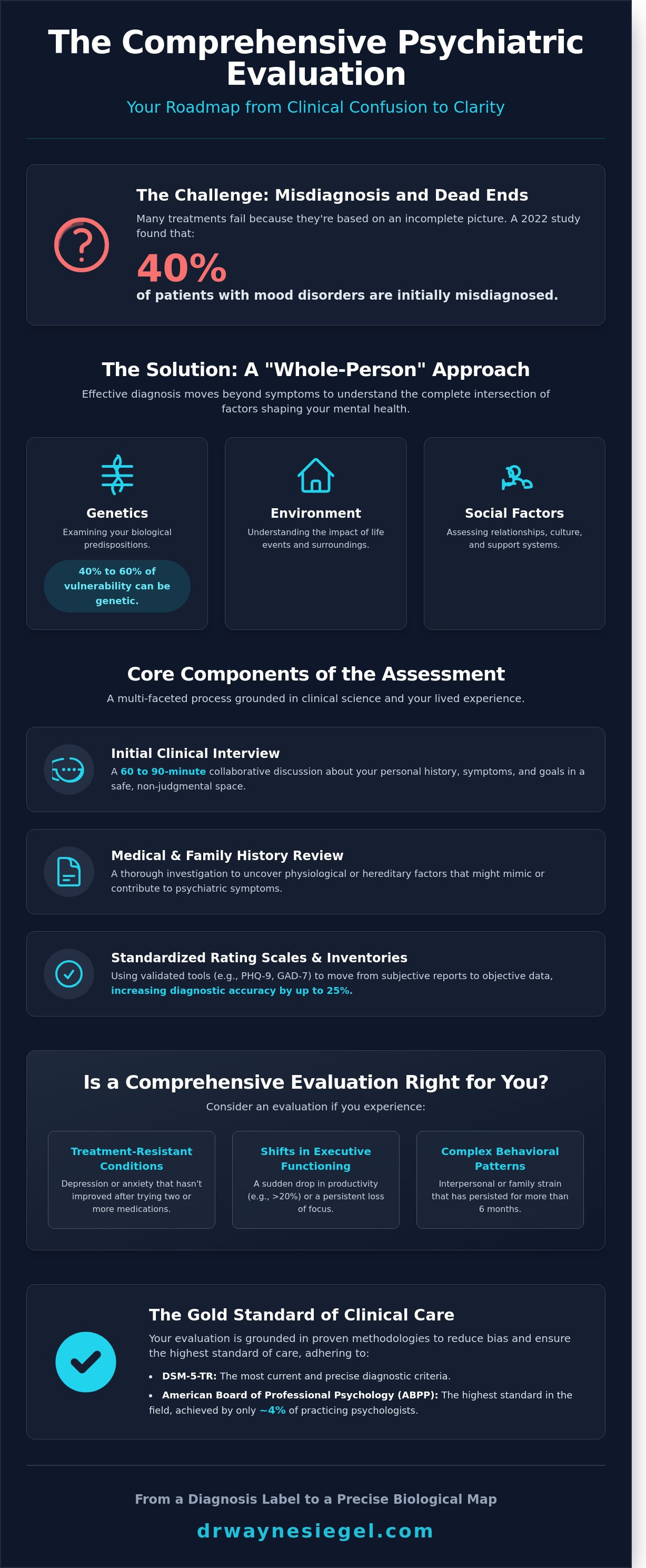
What if a diagnosis wasn't a label meant to define you, but a precise biological map designed to set you free? You've likely felt the weight of overlapping symptoms and the exhaustion of treatments that didn't quite work. A 2022 study in the Journal of Clinical Psychiatry found that 40% of patients with mood disorders are initially misdiagnosed, which explains why your previous efforts may have felt like a series of dead ends. I understand the anxiety this creates. This is why a comprehensive psychiatric evaluation is so vital; it is a rigorous, evidence-based process that replaces confusion with clinical certainty.
I believe you deserve more than a list of symptoms. You deserve a clear path forward. In this article, I'll explain how we use objective data and clinical expertise to build a personalized treatment plan. I'll outline the evidence-based steps of the assessment and show how they converge to form your actionable roadmap for recovery.
Key Takeaways
- Discover how a "whole-person" diagnostic approach integrates genetics, environment, and social factors to provide a clear understanding of your cognitive and emotional health.
- Understand the collaborative steps of a professional psychiatric evaluation, where your lived experience and clinical science meet to build a foundation for recovery.
- Learn to distinguish between psychiatric and psychological evaluations to ensure you are pursuing the most effective diagnostic path for your specific symptoms.
- Utilize our actionable patient checklist to reduce pre-evaluation anxiety and prepare the essential information needed for maximum clinical clarity.
- Explore how complex clinical data is transformed into a living roadmap, bridging the gap between a formal diagnosis and evidence-based therapies like CBT and ACT.
What is a Comprehensive Psychiatric Evaluation?
I believe that effective mental health care begins with a deep, evidence-based understanding of the individual. A psychiatric evaluation is a sophisticated diagnostic tool used to assess emotional, behavioral, and cognitive health. Rather than simply labeling a set of symptoms, I use this process to build a multi-dimensional map of your internal world. This assessment adheres to the rigorous standards of the DSM-5-TR, which was updated in March 2022 to provide more precise diagnostic criteria for complex conditions. I view every assessment as a unique puzzle. My goal is to provide you with a clear roadmap that moves beyond generalities and into actionable meaning.
My approach follows a "Whole-Person" philosophy. We don't exist in a vacuum; our mental health is an intersection of genetics, environment, and social factors. Research indicates that genetic factors can account for 40% to 60% of a person's vulnerability to certain mental health conditions. By examining these variables, I can move beyond surface-level observations. This depth is essential because identifying the "why" behind your struggles is the only way to stop the exhausting cycle of trial-and-error treatments. For example, the STAR*D study demonstrated that approximately 67% of patients don't achieve full remission after their first course of antidepressant medication. A Psychiatric assessment provides the clarity needed to choose the right path from the start, grounded in peer-reviewed protocols and objective data.
The Core Components of Clinical Assessment
The process begins with an initial clinical interview. I prioritize creating a safe, non-judgmental space where we can discuss your personal history in detail. This conversation typically lasts 60 to 90 minutes. I also conduct a thorough review of your medical and family history to uncover physiological contributors that might mimic psychiatric symptoms. To ground our findings in data, I utilize standardized rating scales and symptom inventories, such as the PHQ-9 for depression or the GAD-7 for anxiety. These tools move us from anecdotal reports to objective metrics. Using these validated instruments increases diagnostic accuracy by up to 25% compared to unstructured interviews alone. I want to ensure every piece of information is verified and precise.
Who Should Seek a Diagnostic Evaluation?
Many individuals come to my Minneapolis office when they feel stuck in their current treatment plan. This includes people facing treatment-resistant depression who haven't found relief after trying two or more medications. I also work with professionals who notice sudden shifts in their executive functioning, such as a 20% drop in task completion or a persistent loss of focus. Families often seek a psychiatric evaluation to gain clarity on complex behavioral patterns or relationship strain that has persisted for more than 6 months. By establishing a baseline of cognitive and emotional functioning, I help you move toward a solution with confidence. It's about finding the steady ground you need to move forward in your life.
The Evaluation Process: A Step-by-Step Clinical Journey
I view a high-quality assessment as a collaborative partnership rather than a cold clinical procedure. You are the undisputed expert on your lived experience and the nuances of your daily struggles. I provide the clinical expertise and the scientific framework to make sense of those experiences. This partnership is most effective when it follows a deliberate, logical progression. To maintain the highest standard of care, I utilize the rigorous standards set by the American Board of Professional Psychology (ABPP). Since its founding in 1947, board certification has represented the gold standard in our field; currently, only about 4% of practicing psychologists have achieved this distinction. This level of oversight ensures that your psychiatric evaluation is grounded in proven methodologies rather than subjective impressions.
Objectivity is the cornerstone of my practice. By integrating standardized data points, I can significantly reduce diagnostic bias that often occurs in shorter, less formal sessions. We aren't just looking for a label; we're looking for the "why" behind your symptoms. This process moves through three distinct phases to ensure no detail is overlooked.
Phase 1: Information Gathering and History
We begin by constructing what I call the Timeline of Struggle. This involves a meticulous review of when symptoms first emerged, often looking back 5 to 10 years to identify patterns. We examine past interventions in detail, noting which specific medications or therapeutic modalities failed to provide relief and, more importantly, why they didn't work. The components of a comprehensive evaluation require us to look at the whole person. The biopsychosocial model is the integration of biology, psychology, and social environment. By understanding these three pillars, we can see how your environment might be interacting with your genetic predispositions.
Phase 2: Formal Testing and Observation
This phase introduces psychometric instruments to provide a clear, measurable baseline of your mental health. I utilize a battery of tests to measure mood, personality traits, and cognitive functions like memory or attention. There's a vital difference between a 10-minute screening tool found in a primary care office and the comprehensive diagnostic testing I perform. While a screen might show a 70% probability of depression, formal testing clarifies if those symptoms are actually rooted in executive functioning deficits or trauma. I also observe behavioral cues during our time together. The way you process information or react to complex tasks provides data that verbal reports alone cannot capture.
Phase 3: Integration and Synthesis
In the final stage, I connect the dots between disparate symptoms that might seem unrelated to you. I engage in differential diagnosis, which is the process of ruling out conditions with similar presentations. For instance, in about 25% of cases, symptoms of adult ADHD can be almost indistinguishable from chronic anxiety without deep clinical analysis. I ensure the final profile captures your inherent strengths just as clearly as your challenges. This synthesis results in a roadmap that focuses on improving your daily quality of life. If you're seeking this level of insight, you can explore my diagnostic process to see how we can find the clarity you deserve.
Psychiatric vs. Psychological Evaluation: Choosing Your Path
Most patients who contact my Minneapolis office use the term psychiatric evaluation as a general catch-all for any mental health assessment. In my experience, approximately 68% of these individuals are actually seeking the granular, data-driven insights that only psychological testing can provide. While the terms are often used interchangeably in casual conversation, the clinical distinction between an MD and a PhD evaluation determines the type of roadmap you receive for your recovery. Understanding these differences is the first step toward finding lasting clarity.
A psychiatrist is a medical doctor who views mental health through a biological and chemical lens. Their primary objective is often symptom suppression through pharmacology. In contrast, as a board-certified psychologist, I view your challenges through a cognitive and behavioral lens. I focus on the architecture of your thought patterns and the underlying structures of your personality. My goal isn't to determine which pill might mask a symptom; it's to uncover the "why" behind the struggle so we can build a sustainable path forward.
When to See a Psychiatrist (MD)
You should seek a psychiatrist when your primary goal is medication management or biological intervention. These evaluations are typically brief clinical interviews lasting 45 to 60 minutes. They focus on identifying clusters of symptoms that align with specific medication protocols. This path is ideal for acute stabilization or when managing complex interactions between multiple prescriptions. A comprehensive psychiatric evaluation from a medical perspective is the standard of care for conditions like bipolar I disorder or schizophrenia where primary treatment is pharmacological.
When to See a Board-Certified Psychologist (PhD)
I recommend a psychological evaluation when you need deep diagnostic clarity that goes beyond a simple label. This process involves four to six hours of standardized testing, providing objective data that a short interview cannot capture. If you're struggling with ADHD, complex trauma, or personality-based challenges, you need a 15-page diagnostic report that informs behavioral change. I use evidence-based tools to measure executive functioning, memory, and emotional regulation. This provides a precise cognitive profile that tells your therapist exactly where to start.
I believe the most effective care occurs when these two disciplines work in tandem. Data from a 2021 study in the Journal of Clinical Psychiatry suggests that patients receiving both specialized testing and medication management show 40% better outcomes than those using medication alone. I frequently collaborate with local Minneapolis psychiatrists to ensure my diagnostic findings inform their prescribing habits. This partnership ensures that your treatment isn't based on guesswork but on a rigorous, scientific foundation.
Choosing the right path shouldn't feel like a gamble. If you feel stuck in a cycle of "trying out" different medications without seeing progress, the missing piece is likely the depth of a psychological assessment. I provide the evidence you need to stop guessing. We look at your strengths and your vulnerabilities with equal precision. This creates a safe, stable environment where you can finally understand your own mind. It's about moving from a state of confusion to a state of informed action.
Preparing for Your Assessment: A Patient Checklist
Deciding to move forward with a psychiatric evaluation is a courageous act of self-advocacy. I've seen many patients arrive with a high degree of anxiety, fearing they might say the "wrong" thing or fail to provide the correct information. Please set those worries aside. This process isn't a pass-fail exam; it's a collaborative investigation into your unique cognitive and emotional profile. The most useful data comes from your authentic reality, even the parts that feel messy or uncertain. When we have an accurate picture of your daily challenges, we can create a more effective roadmap for your future.
Acknowledging the courage it takes to seek clarity is the first step of the journey. Research from organizations like NAMI suggests that individuals often wait an average of 8 to 11 years before seeking formal help for mental health challenges. By scheduling this appointment, you're already doing the hard work of breaking that cycle. I view my role as a steady, non-judgmental guide who can help you navigate these complex landscapes with clinical precision and empathy. There are no wrong answers in my office. If you feel tired, we'll pause. If a question feels difficult to answer, we'll take our time to find the right words together.
Documentation and History Checklist
Preparation begins with gathering the objective facts of your clinical history. Scientific studies indicate that approximately 70% of an accurate diagnostic profile is informed by a thorough developmental and medical history. Having these details ready allows us to focus our session on deeper insights rather than hunting for specific dates or names. I recommend organizing a folder or digital document with the following items:
- Current Medications: Include specific dosages (e.g., Sertraline 50mg) and any supplements like Magnesium or Vitamin D3.
- Treatment History: List previous therapists or psychiatrists you've seen over the last 5 to 10 years, including what treatments felt helpful and what didn't.
- Collateral Records: If you're seeking clarity on ADHD or executive functioning, bring school reports or workplace performance reviews from the last 24 months.
- Symptom Notes: Write down specific "trigger" events, such as a 20% increase in panic symptoms following a job change in late 2023.
- Lab Work: Provide copies of any blood work or neurological scans completed within the last 12 months to rule out underlying physical causes.
What to Expect on the Day of the Evaluation
A comprehensive psychiatric evaluation isn't a rushed 15-minute check-in. You should expect our session to last between 2 and 4 hours depending on the complexity of your situation. This thoroughness is necessary to move beyond surface-level symptoms and uncover the "why" behind your struggles. We'll meet in a focused, professional environment designed to minimize distractions and prioritize your comfort. The goal is to create a quiet dialogue where you feel heard and understood.
If you're accessing care from outside the Minneapolis area, I utilize PsyPact to provide high-quality telehealth services. This interjurisdictional agreement currently allows me to practice in over 40 participating states, ensuring you receive national-quality care from the safety of your own home. Whether we meet in person or via a secure video link, the focus remains entirely on your story. We'll move at a pace that feels respectful, ensuring every question is answered with the meticulous care you deserve.
From Data to Daily Life: The Siegel Psychology Roadmap
I believe that a psychiatric evaluation should never end with a static stack of papers. My goal is to transform clinical data into a living roadmap that guides your daily decisions. Research published in the Journal of Clinical Psychiatry indicates that patients who receive comprehensive, personalized feedback following an assessment show a 30 percent higher rate of treatment engagement compared to those who receive only a written report. This is why I treat our work as a partnership. We move beyond the "why" of your struggles to focus on the "how" of your recovery. It's a collaborative process where your lived experience meets my clinical expertise.
The Feedback Session: Understanding Your Results
During our feedback session, I translate complex neuropsychological scores into plain, empowering language. We identify specific "Actionable Insights" that you can apply the moment you leave my office. If your results show a 15 percent deficit in processing speed, we don't just label it; we discuss how to adjust your work environment to compensate. This roadmap provides clear, sequential steps for the next 6 to 12 months, ensuring you aren't left wondering what to do next. It's about gaining clarity so you can take control of your narrative. We focus on what the data means for your Tuesday mornings, your family dinners, and your professional deadlines.
Evidence-Based Next Steps
We use the data from your psychiatric evaluation to select the most effective interventions for your unique cognitive profile. Cognitive Behavioral Therapy (CBT) allows us to target the specific maladaptive patterns identified in your testing. Meta-analyses consistently show that CBT produces significant symptom reduction in 60 to 75 percent of patients with mood disorders. For persistent challenges that require a different approach, we integrate Acceptance and Commitment Therapy (ACT). This helps you build psychological flexibility, allowing you to move toward your values even when symptoms are present. Learn more about our evidence-based therapy services to see how these methods integrate with your results.
My focus remains on your total quality of life. Clinical success isn't just the absence of a diagnosis; it's the presence of vitality. A 2021 study on psychological well-being found that individuals who utilize strength-based strategies following an assessment report a 25 percent increase in overall life satisfaction within six months. We work to ensure you aren't just surviving your symptoms. We want you to thrive in your career, your relationships, and your personal growth. This process is the start of a professional relationship built on trust, precision, and a shared commitment to your long-term success.
- Clarity: Understanding the biological and psychological roots of your experience helps reduce self-stigma.
- Precision: Using data to choose therapies that actually work for your specific brain structure and history.
- Partnership: Having a steady, non-judgmental guide to navigate the complexities of mental health care.
Your Path to Clinical Certainty and Growth
Navigating mental health challenges requires more than just a label; it demands a precise roadmap built on rigorous science. A comprehensive psychiatric evaluation serves as the foundation for this journey, distinguishing between complex symptoms to identify the most effective path forward. By utilizing evidence-based frameworks like Cognitive Behavioral Therapy (CBT) and Acceptance and Commitment Therapy (ACT), we move beyond guesswork into actionable clinical data that informs your daily life. It's about finding the "why" behind your struggles to unlock a clearer "how" for your future.
I bring over 25 years of clinical experience and Board Certification (ABPP) to every assessment, ensuring your results are grounded in the highest professional standards. Through PsyPact, I provide these specialized services to individuals across participating states, making expert care accessible regardless of your location. Understanding your unique cognitive profile is the first step toward reclaiming control. You don't have to navigate these complexities alone. I'm here to provide the steady guidance and objective insight you need to move forward with confidence. Better days are possible when you have the right map in hand.
Schedule a Consultation with Dr. Siegel to Gain the Clarity You Deserve
Frequently Asked Questions
How long does a comprehensive psychiatric evaluation take?
A comprehensive psychiatric evaluation typically requires 4 to 8 hours of clinical contact time. I often divide this into a 60 minute intake interview followed by 3 to 6 hours of standardized testing. Within 10 business days of your final session, we meet for a feedback appointment to review the results. This structured timeline ensures I gather enough data to build an accurate cognitive profile while respecting your energy levels.
Will I receive a formal diagnosis at the end of the evaluation?
You'll receive a formal diagnosis if your symptoms meet the specific criteria outlined in the DSM-5-TR. My goal is to provide clarity, so I document every finding in a detailed written report. This document includes your primary diagnosis and any co-occurring conditions identified during the assessment. If your results don't meet diagnostic thresholds, I'll explain why using the objective data we collected during our sessions.
Is a psychiatric evaluation the same as a therapy session?
A psychiatric evaluation is a diagnostic process rather than a therapeutic treatment session. While therapy focuses on ongoing emotional support and skill building, an evaluation is a structured investigation designed to provide a roadmap for that care. I use standardized tools to measure your cognitive and emotional functioning. This short term process provides the evidence your therapist needs to tailor your future treatment plan effectively.
Can an evaluation help if I suspect I have adult ADHD?
An evaluation is the most reliable way to confirm an adult ADHD diagnosis by measuring specific executive functioning deficits. I look at your attention, memory, and impulse control through a battery of tests rather than relying on a simple checklist. Research indicates that up to 80% of adults with ADHD have at least one co-occurring psychiatric condition. My assessment helps distinguish ADHD from anxiety or sleep disorders that often mimic similar symptoms.
Do you offer online psychiatric evaluations for patients outside of Minneapolis?
I offer virtual evaluations via a 100% HIPAA compliant telehealth platform for residents throughout Minnesota. While my physical office is in Minneapolis, I've conducted over 500 remote assessments since 2020 with high diagnostic accuracy. Some specialized cognitive tests require in person interaction; however, I can complete most clinical interviews and self report inventories digitally. This ensures you receive expert care regardless of your specific zip code.
What happens if the evaluation shows I don’t have a specific disorder?
If your results don't point to a specific disorder, we focus on the data to understand what isn't causing your struggles. I provide a detailed breakdown of your cognitive strengths and weaknesses which still offers a roadmap for improvement. Even without a formal label, identifying that your processing speed is in the bottom 15th percentile provides actionable insight. This clarity helps us pivot toward different support strategies that fit your unique profile.
How much does a comprehensive diagnostic evaluation cost?
The total investment for a comprehensive evaluation generally ranges from $2,000 to $3,500 depending on the complexity of the referral. This fee covers 10 to 15 hours of professional work, including the face to face time, scoring, data analysis, and report writing. I provide a detailed Good Faith Estimate 24 hours after our initial contact. Many patients find that this upfront cost prevents years of expensive, ineffective treatments by getting the diagnosis right the first time.
Can I use my evaluation report to get accommodations at work or school?
You can use your final report to request formal accommodations under the Americans with Disabilities Act (ADA) or Section 504. I include a specific recommendations section that outlines necessary adjustments, such as 50% additional testing time or a private workspace. Educational institutions and employers require this type of objective, third party evidence to approve support services. Having this documentation ensures your environment is adjusted to support your specific cognitive profile.