
What Does a Clinical Psychologist Do? Roles, Science, and Care

What if the most effective way to heal your mind isn't just through conversation, but through a precise, scientific map of how your brain actually functions? You might feel overwhelmed by the 500 different types of therapy currently available or frustrated by a sense that your current sessions lack a clear destination. It's exhausting to search for answers when you aren't even sure if you're talking to the right professional for a complex diagnosis like ADHD or trauma. I understand that the search for clarity can feel like a secondary burden when you're already struggling with cognitive or emotional disarray.
I want to help you understand exactly what does a clinical psychologist do to bridge the gap between your symptoms and a sustainable solution. You'll gain insight into the seven years of doctoral training and 3,000 hours of supervised clinical practice that transform a simple conversation into a structured, evidence-based path toward recovery. We'll examine the diagnostic process, the science behind neuropsychological assessments, and how I create a personalized roadmap to improve your daily quality of life by moving beyond labels to find actionable meaning.
Key Takeaways
- Gain clarity on the unique doctoral-level expertise and rigorous scientific training that distinguishes clinical psychology from other mental health professions.
- Understand exactly what does a clinical psychologist do by exploring how they bridge the gap between proven research and compassionate, person-centered healing.
- Learn how diagnostic assessments uncover the "why" behind your struggles, providing a detailed cognitive profile that serves as a roadmap for your care.
- Discover how a therapeutic partnership transforms clinical data into a secure environment focused on your personal strengths and daily quality of life.
- Identify why seeking a board-certified professional is a critical step in ensuring the highest ethical standards and specialized expertise for your journey.
What is a Clinical Psychologist? Defining the Role
Choosing to seek help is a courageous step toward clarity. I believe that understanding the specific expertise of your provider helps lower the anxiety of that first appointment. When you first ask what does a clinical psychologist do, you might be looking for a sense of safety and direction. At its core, a clinical psychologist is a doctoral-level health professional who has dedicated years to mastering the intersection of human behavior, brain function, and emotional health. I don't just see a set of symptoms; I see a whole person with a unique story that requires a precise, scientific approach to find a path forward.
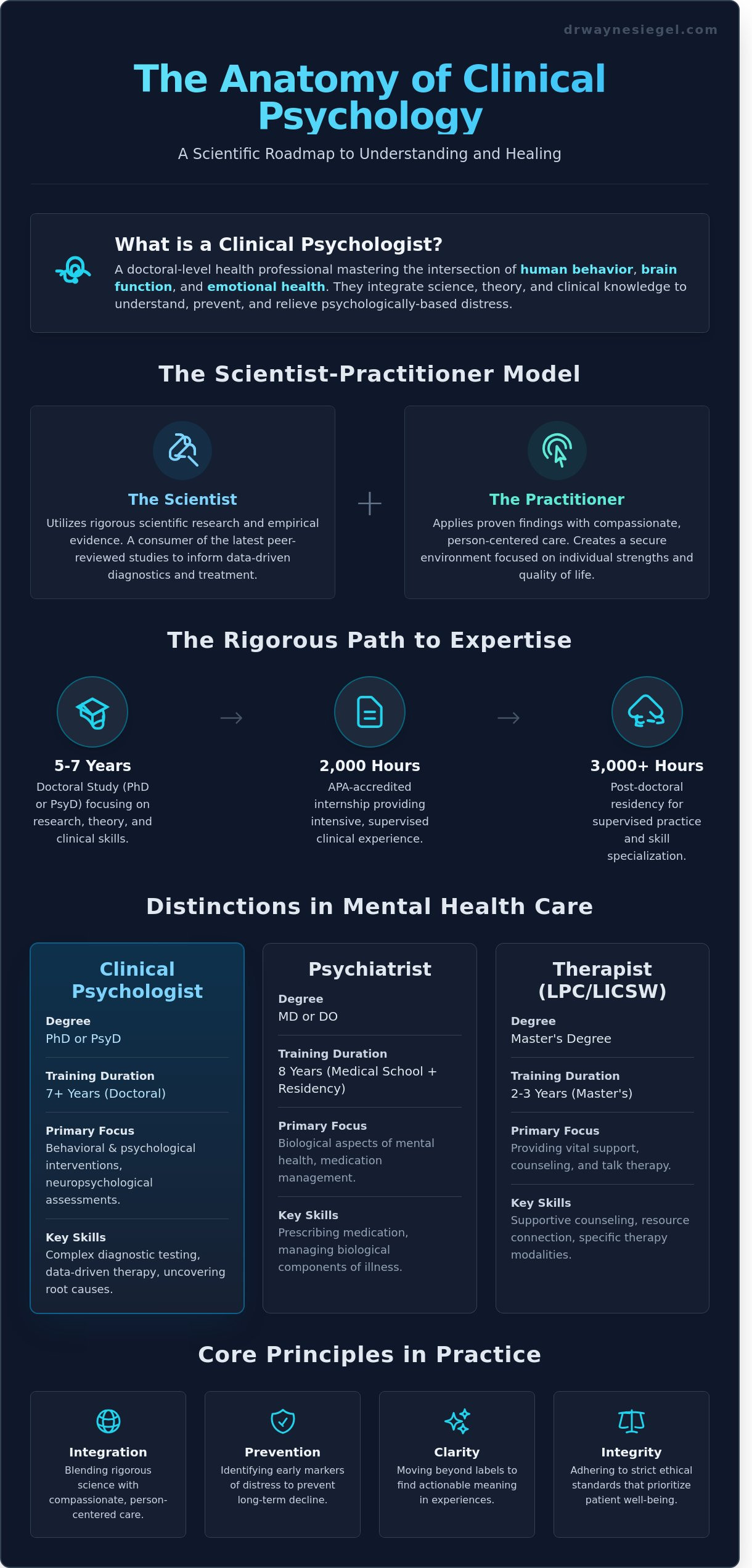
The field of Clinical psychology integrates science, theory, and clinical knowledge to understand, prevent, and relieve psychologically based distress. Unlike other providers, we use empirical evidence as the foundation for every conversation and assessment. To truly understand what does a clinical psychologist do, we must look at the "scientist-practitioner" model. This model, established at the 1949 Boulder Conference, ensures that I am both a consumer of the latest research and a practitioner who applies those findings to your specific life challenges. It's a commitment to using data to provide a roadmap for your well-being.
The distinction between clinical psychology and other mental health professions often comes down to the depth of training and the scope of practice. While Licensed Independent Clinical Social Workers (LICSWs) and Licensed Professional Counselors (LPCs) provide vital support, their training typically involves a two-year or three-year master's degree. My work as a psychologist involves a much longer academic journey, which allows for a deeper focus on complex diagnostic testing and the biological underpinnings of behavior. This level of training is what provides the intellectual curiosity and meticulous attention to detail required to uncover the "why" behind your struggles.
- Integration: We blend rigorous scientific research with compassionate, person-centered care.
- Prevention: We focus on identifying early markers of distress to prevent long-term cognitive or emotional decline.
- Clarity: We provide a structured environment to move beyond labels and find actionable meaning in your experiences.
- Integrity: We adhere to strict ethical standards that prioritize the patient's long-term quality of life.
Education and Rigorous Training Standards
Becoming a clinical psychologist involves five to seven years of doctoral study, resulting in a PhD or PsyD. This includes a 2,000-hour APA-accredited internship and additional residency years to refine specialized skills. I define the doctoral requirement as the essential foundation of clinical expertise that allows for high-level diagnostic precision. This rigorous path prepares us to handle the most complex psychological puzzles with a steady, non-judgmental hand and deep scientific insight.
Psychologist vs. Psychiatrist: Key Differences
While psychiatrists are medical doctors (MDs or DOs) who focus on the biological aspects of mental health and medication management, I focus on behavioral and psychological interventions. We often collaborate on interdisciplinary care teams to provide a holistic approach to your health. My role is unique because I conduct complex diagnostic testing that provides a data-driven roadmap for your recovery. We look at the root causes of distress to find lasting solutions rather than only managing symptoms.
The Science of Healing: Evidence-Based Practices
Understanding the science behind my work is the first step toward feeling secure in the therapy room. When you ask what does a clinical psychologist do, the answer lies in the bridge between laboratory research and human connection. I don't rely on intuition or "gut feelings" alone. Instead, I use evidence-based practices. These are interventions that have survived the scrutiny of controlled clinical trials and peer-reviewed analysis. According to the American Psychological Association, this specialty requires a deep integration of psychological science to address complex human problems across the lifespan.
My role is to act as a curator of these research-backed interventions. Since the 1949 Boulder Conference established the scientist-practitioner model, clinical psychologists have been trained to treat every patient's case with the same rigor as a scientific study. I spend a portion of my week reviewing the latest findings in publications like the Journal of Consulting and Clinical Psychology to ensure my methods haven't grown stagnant. This commitment to staying current means you receive care that is proven to work in 2024, not just theories that were popular decades ago.
Clarity comes from measurement. I use standardized tools to track your progress, moving beyond vague descriptions of feeling "better" or "worse." By utilizing scales that measure symptom frequency or cognitive load, we can see a 20% or 30% reduction in specific challenges over a set period. This data-driven approach provides a roadmap for our sessions. It ensures we aren't just talking, but moving toward a defined destination. If you're looking for this kind of clarity in your own journey, we can begin by looking at the data together.
Cognitive Behavioral Therapy (CBT)
CBT is a structured, goal-oriented approach that I use to help you identify and shift the thought patterns that keep you stuck. It's one of the most heavily researched frameworks in existence. A 2023 meta-analysis confirmed its high efficacy rates for treating generalized anxiety and major depression, often showing results within 12 to 20 sessions. This method provides a practical "here-and-now" focus for patients, meaning we prioritize solving current problems rather than only analyzing the distant past.
Acceptance and Commitment Therapy (ACT)
ACT represents a shift toward psychological flexibility. Instead of fighting against difficult thoughts, I guide you in using mindfulness and behavior change to accept them while still moving toward what matters. It's about value-based living. Research from 2022 suggests that ACT is particularly effective for chronic pain and workplace stress. My role is to help you build a life that feels meaningful, ensuring that symptom reduction is a byproduct of living well rather than the only goal we pursue.
When considering what does a clinical psychologist do, remember that the "clinical" part of the title is a promise of scientific integrity. It means that the support you receive is grounded in a tradition of excellence and a commitment to your measurable well-being. This balance of rigorous data and empathetic listening is what creates a safe space for genuine transformation.
Diagnostic Assessment: Uncovering the "Why" Behind the Struggle
I often meet people who describe their daily lives as a collection of symptoms that don't quite make sense. They feel a heavy fog of fatigue or a constant, buzzing restlessness that they can't name. My role is to move beyond these surface observations. A clinical psychologist uses standardized tests to build a bridge between feeling and fact. These aren't simple quizzes you'd find online; they're validated scientific tools that measure cognitive strengths and emotional patterns. By looking at the data, I can create a cognitive profile that acts as a roadmap for your future care.
In a typical 4-hour evaluation, I might use 5 to 10 different assessment tools. This thoroughness ensures that we aren't just guessing about your mental health. When people ask about the work of a clinical psychologist, they often discover it involves this deep, investigative process. We look for patterns that a 15-minute consultation might miss. This integrity in the evaluation process is what transforms a vague struggle into an actionable plan. It's about finding the "why" so we can focus on the "how" of your recovery.
Understanding your cognitive profile means seeing how your brain processes information in real-time. I look at memory, processing speed, and verbal reasoning to see where your unique strengths lie. If your processing speed is in the 15th percentile but your verbal logic is in the 90th, that gap explains why you feel frustrated in fast-paced environments. What does a clinical psychologist do with this information? I use it to show you that your struggle isn't a character flaw; it's a specific cognitive pattern that we can manage together with the right tools.
Adult ADHD Assessments
Adults often seek my help after years of feeling "lazy" or "unfocused." An ADHD evaluation involves more than just a checklist. I use clinical interviews, standardized questionnaires, and specific cognitive testing to measure attention and impulse control. For example, about 4.4% of adults in the U.S. live with ADHD, yet many are misdiagnosed with simple anxiety. A formal diagnosis is a key that unlocks workplace accommodations and targeted strategies for executive dysfunction. It helps you distinguish between a lack of willpower and a neurobiological difference.
Comprehensive Psychological Evaluations
Sometimes the diagnostic picture is more complex. I conduct comprehensive evaluations to untangle depression, trauma, and personality factors. I use objective data from tests like the MMPI-3 to settle difficult diagnostic questions. What does a clinical psychologist do to ensure these results are useful? I compile every finding into a detailed report. The final document I provide isn't just a list of codes; it’s a 10-page guide for you and your other healthcare providers. This ensures everyone is moving in the same direction, using the same set of facts to support your well-being.
This level of detail provides a sense of safety and order. It allows us to stop throwing solutions at the wall to see what sticks. Instead, we move forward with a clear, evidence-based understanding of who you are and what you need to thrive. Every assessment is a unique puzzle that I solve with care and precision to improve your daily quality of life.
The Therapeutic Partnership: What to Expect in Care
Once we move past the initial diagnostic phase, our work shifts from gathering data to building a personalized, person-centered treatment plan. I view this transition as the moment where the science of psychology meets the art of human connection. We stop looking only at what the symptoms are and start focusing on how you can live more effectively. This phase is built on a personal partnership rather than a cold set of instructions. I am here to guide you through complex emotional landscapes, providing a steady hand as we explore the "why" behind your challenges and the "how" of your recovery.
A central part of my role involves establishing a secure, non-judgmental environment. This safety is the foundation of every session. When you feel protected from criticism, you gain the freedom to explore difficult thoughts with total honesty. If you are wondering what does a clinical psychologist do during these sessions, the answer lies in the balance of empathy and evidence. I use my clinical training to identify patterns you might miss, but I do so as a collaborator. We work together to ensure that every insight we uncover leads directly to a tangible sense of relief and clarity.
The First Session and Goal Setting
Our initial meeting marks the pivot from identifying a struggle to outlining the promise of a solution. I focus on creating a roadmap that includes specific, achievable mental health milestones. We might aim for a 20 percent reduction in daily anxiety triggers or establish three new coping routines for high-stress work environments. This structured approach helps you see exactly where we are going. To learn more about how we begin this journey, you can read about What to Expect in Your First Therapy Session.
Steady Progress and Rhythmic Dialogue
The pace of our therapy is deliberate and respectful. I don't believe in rushing a process as delicate as emotional healing. Instead, we follow a rhythmic dialogue that provides structure for those who feel they are in emotional disarray. Research from the American Psychological Association indicates that about 75 percent of people who enter psychotherapy see significant benefits within 12 to 15 sessions. We use these evidence-based frameworks to ensure your progress is measurable and consistent. The ultimate goal of our therapy is to improve your daily quality of life by giving you the tools to navigate your world with confidence.
I believe that every patient deserves a treatment plan that respects their unique cognitive profile. Whether we are addressing executive functioning issues or deep-seated emotional trauma, my focus remains on your strengths. We use those strengths as the engine for your growth. By the time we conclude our work, you won't just have a list of labels; you'll have a clear understanding of your own mind and a practical strategy for the future.
Finding Quality Care: Board Certification and Accessibility
When you start looking for support, the sheer number of providers can feel overwhelming. While every practitioner must be licensed to practice, the highest mark of specialty expertise is Board Certification through the American Board of Professional Psychology (ABPP). Only about 4% of licensed psychologists in the United States have earned this distinction. It isn't just a certificate on a wall; it represents a rigorous peer-review process that includes a thorough examination of work samples and an oral defense of clinical skills. Choosing a board-certified professional ensures that your care meets the highest ethical and scientific standards in the field.
Understanding what does a clinical psychologist do becomes much clearer when you view it through the lens of this advanced training. At Siegel Psychology Services, I focus on transforming complex diagnostic data into a practical roadmap for your life. We don't just look for symptoms; we look for the "why" behind your challenges. This level of meticulous assessment provides the clarity you need to move forward with confidence. It's about more than a diagnosis. It's about providing a steady, non-judgmental guide to help you navigate your unique cognitive and emotional landscape.
PsyPact and National Telehealth Standards
Access to specialized care shouldn't depend on your zip code. As of May 2024, 40 states and territories have enacted PsyPact legislation. This interjurisdictional agreement allows me to serve patients across state lines legally and ethically through secure telehealth platforms. For individuals in rural areas or underserved communities, this means you can access the same high-level neuropsychological insights as someone living in a major medical hub. Online therapy and assessment sessions are designed to be as personal and rigorous as an in-office visit, ensuring safety and privacy remain the top priorities throughout your journey.
Choosing a Specialist in Minneapolis and Beyond
If you're seeking a specialist in Minneapolis or through telehealth, look for a "person-centered" approach that doesn't sacrifice clinical rigor. A quality evaluation should feel like a partnership rather than a cold medical procedure. You can verify a psychologist’s board status through the ABPP directory to ensure they've met national standards for excellence. My goal is to help you see the whole picture of your strengths and needs, moving beyond labels to find actionable meaning that improves your daily quality of life. I invite you to take the first step toward gaining the insight you deserve.
If you're ready to find answers and create a clear path forward, I'm here to help you navigate the process with care and precision. Schedule a consultation with Dr. Wayne Siegel today to discuss your needs and learn how a comprehensive assessment can provide the roadmap you've been looking for.
Moving Toward Clarity and Lasting Change
You deserve a roadmap that transforms confusion into a clear plan for your well-being. Understanding what does a clinical psychologist do helps you see that high-quality care is more than just conversation. It's a rigorous, evidence-backed process designed to uncover the root of your challenges through precise diagnostic assessments. We've explored how these tools provide the specific "why" behind your struggles and how a dedicated therapeutic partnership creates the stability needed for real growth.
I bring over 25 years of private practice experience to our work together, ensuring your care is grounded in seasoned expertise. As a specialist Board Certified by the American Board of Professional Psychology (ABPP), I'm committed to the highest standards of clinical excellence. My PsyPact authorization allows me to extend this support to patients across 40 different states, making expert care accessible even if you aren't local to my office.
Gain clarity on your mental health; schedule a consultation with Dr. Wayne Siegel today.
You don't have to navigate these complexities alone. I'm here to help you find the answers you need to move forward with confidence.
Frequently Asked Questions
What is the difference between a clinical psychologist and a therapist?
A clinical psychologist holds a doctoral degree, either a PhD or a PsyD, while "therapist" is a broad term for various mental health professionals. When people ask what does a clinical psychologist do, I explain that we focus on the intersection of science and clinical practice. My role involves 4 to 7 years of specialized graduate training to diagnose complex conditions. This depth of education allows me to provide a level of diagnostic clarity that general counseling often doesn't reach.
Can a clinical psychologist prescribe medication?
No, clinical psychologists cannot prescribe medication in 45 out of 50 U.S. states. I focus on psychological interventions and behavioral change rather than pharmacology. If I determine that medication would benefit your journey, I'll collaborate with your psychiatrist or primary physician. This partnership ensures you receive a comprehensive roadmap for your care while I focus on the cognitive and emotional aspects of your health.
How long does a typical psychological assessment take?
A comprehensive psychological assessment typically takes between 4 and 8 hours to complete. I usually break this time into a 90 minute clinical interview followed by 3 to 6 hours of standardized testing. This thorough approach allows me to gather the data needed to understand your unique cognitive profile. We won't rush the process; instead, we'll move at a steady pace to ensure we capture every piece of the puzzle.
Is a clinical psychologist better for ADHD testing than a GP?
Yes, a clinical psychologist provides a more detailed diagnostic picture for ADHD than a general practitioner can. While a GP might use a 1 page screening tool, I utilize a battery of 5 to 10 standardized tests to measure executive functioning. This rigorous process helps me distinguish ADHD from other conditions like anxiety or sleep apnea. Understanding what does a clinical psychologist do in this context helps you see the value of a specialized evaluation.
What does "evidence-based" mean in a therapy context?
Evidence-based practice means I only use treatments that have been proven effective through rigorous scientific research. The American Psychological Association currently recognizes over 75 different treatments as having strong research support. I rely on these proven methods to ensure your time and energy are invested in strategies that work. This commitment to science provides a sense of safety and predictability throughout our work together.
How do I know if I need a psychologist or a counselor?
You should seek a psychologist if you require a formal diagnosis or have symptoms that feel complex and overwhelming. While counselors provide excellent support for life transitions, 90 percent of psychologists are specifically trained to administer and interpret diagnostic tests. I often tell my patients that if they feel stuck in a cycle they can't name, a psychologist's expertise in assessment can provide the clarity they've been missing.
Does a clinical psychologist work with families or just individuals?
I work with both individuals and families, as the goal is always to improve your daily quality of life. Research published in the Journal of Family Psychology indicates that involving family members in 10 to 12 sessions can increase treatment success by 30 percent. Whether we meet one on one or include your loved ones, my focus remains on creating a supportive environment where everyone feels heard and respected.
Is online therapy with a psychologist as effective as in-person?
Yes, online therapy is just as effective as meeting in my office for most mental health concerns. A 2018 study in the Journal of Anxiety Disorders confirmed that online cognitive behavioral therapy is 100 percent as effective as in-person sessions for depression and anxiety. I've found that the digital format often lowers the barrier to care. It allows us to build a strong, professional partnership from the comfort and safety of your own home.