
How to Know When You Are Done With Therapy: An Evidence-Based Guide to Graduation

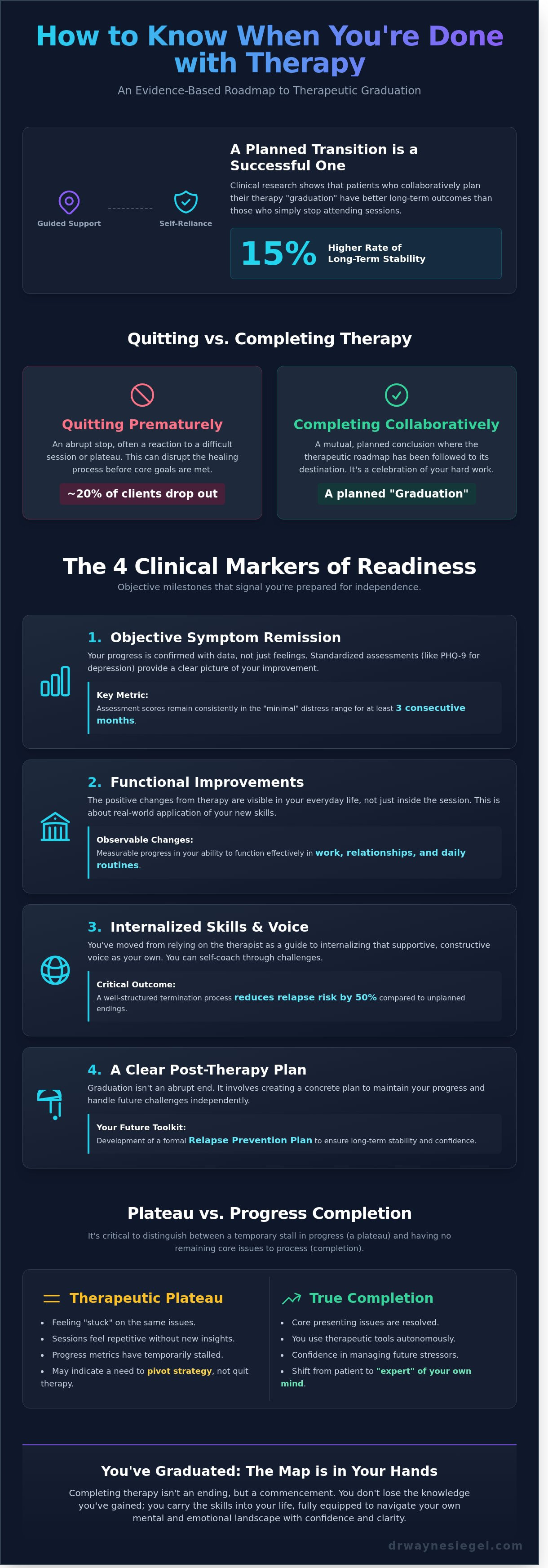
What if the most successful outcome of your mental health journey isn't the total absence of stress, but the quiet realization that you no longer need a professional guide to navigate it? I've seen many patients struggle with the uncertainty of how to know when you are done with therapy, often feeling a mix of pride in their progress and a deep seated fear of relapsing without a weekly safety net. You might feel a sense of guilt about "breaking up" with a provider who has been your anchor, but clinical research suggests that a planned termination is actually a vital stage of the healing process. According to a 2017 study in the Journal of Counseling Psychology, patients who proactively discuss graduation with their therapists show a 15% higher rate of long term stability compared to those who simply stop attending.
I want to help you replace that uncertainty with a clear, evidence-based roadmap for your transition. In this guide, you'll discover the specific clinical markers and psychological frameworks that signal you're ready to step into independence. We'll explore the difference between a temporary maintenance phase and true completion, providing you with a concrete checklist of readiness signs. By the end, you'll have the confidence to use your therapeutic tools autonomously, knowing exactly how to measure your mental health progress with objective clarity.
Key Takeaways
- Learn how to know when you are done with therapy by identifying the clinical transition from acute intervention to a structured "graduation" mindset.
- Discover the four primary markers of therapeutic readiness, including measurable symptom reduction and functional improvements in your daily work and relationships.
- Understand the critical difference between a temporary therapeutic plateau and reaching a point where you have no remaining core issues to process.
- Gain insights into the collaborative graduation protocol, including how to develop a formal Relapse Prevention Plan to ensure long-term stability.
- Explore how a board-certified, person-centered approach provides the clarity and roadmap necessary for a successful conclusion to your care.
Defining the 'Termination Phase' in Evidence-Based Therapy
In my practice, I often observe that the end of treatment carries as much weight as the beginning. This final stage is technically known as "termination," but I prefer to view it as a planned, collaborative conclusion to our work together. It isn't an abrupt stop or a sign that something has gone wrong. Instead, it's a clinical milestone that indicates you've met the objectives we established during your initial neuropsychological evaluation. Understanding this transition is the first step in learning how to know when you are done with therapy.
Termination is a deliberate process that typically spans the final 3 to 5 sessions of a treatment plan. During this time, we shift our focus from acute intervention to the consolidation of skills. We review the data from your progress markers and confirm that the tools you've learned are now integrated into your daily routine. It's a period of reflection where we validate your growth. This process ensures that when you walk out of the office for the last time, you aren't just "feeling better" in a vacuum; you're equipped with a functional toolkit for the future.
I want to be clear about the distinction between "quitting" and "completing" treatment. Quitting often happens prematurely, sometimes as a reaction to a difficult session or a temporary plateau in progress. Research regarding patient adherence to a course of psychotherapy indicates that roughly 20% of clients drop out before reaching their clinical goals. Completion, however, is a mutual agreement that the roadmap has been followed to its destination. When we reach this stage, it's a celebration of your hard work and a testament to the strength of our partnership.
The Psychology of Completion
The therapeutic alliance evolves significantly as you approach your goals. Early in treatment, the therapist often acts as a necessary safety net, providing the stability needed to explore complex cognitive or emotional landscapes. As you gain mastery over your symptoms, this attachment naturally shifts toward self-reliance. A 2011 study on therapeutic outcomes found that the final 15% of a treatment course is critical for "integration," which is the process of internalizing the therapist's supportive voice as your own. A well-structured termination process reduces the risk of relapse by 50% compared to unplanned endings, as it allows for a "dry run" of independence while still having professional support available.
Why We Use the Term 'Graduation'
I frequently use the metaphor of "graduation" because it accurately reflects the achievement involved in mental health work. When you graduate from a university, you don't lose access to the knowledge you've gained; you carry the degree and the skills into your career. In my practice, we follow a specific roadmap that moves you from being a "patient" seeking clarity to becoming the "expert" on your own mental health. You learn to interpret your own cognitive profile and manage your executive functioning with precision. This shift is how you truly master how to know when you are done with therapy. You'll recognize that you no longer need a guide to navigate the terrain because you finally have the map in your own hands.
The 4 Clinical Markers of Therapeutic Readiness
I often remind my patients that our work together is designed to be a bridge, not a permanent residence. My goal is to provide you with the clarity and tools necessary to navigate life's complexities independently. Identifying the right time to transition out of care requires a move away from vague feelings toward objective, evidence-based milestones. When we look at your progress, we focus on four specific markers that indicate your cognitive and emotional foundation is solid enough to support you without weekly intervention.
Metric 1: Objective Symptom Remission
Clinical progress shouldn't be a guessing game. In my practice, I utilize standardized assessments like the PHQ-9 for depression and the GAD-7 for anxiety to provide a clear roadmap of your journey. These tools allow us to move beyond subjective reports and look at hard data. I define symptom remission as a stable period of low-intensity distress where your scores remain consistently in the "minimal" range for at least three consecutive months. This data-driven tracking provides the psychological safety you need to end therapy confidently, knowing your improvement is rooted in measurable change. Understanding these signs that it's time to end psychotherapy ensures that we are making decisions based on your actual clinical profile rather than just a temporary lift in mood.
Metric 2: Cognitive and Behavioral Mastery
True graduation happens when you become your own therapist. From a Cognitive Behavioral Therapy (CBT) perspective, this means you've reached a point where you identify and challenge cognitive distortions, such as "all-or-nothing" thinking, the moment they arise. You don't wait for our session to deconstruct a negative thought; you do it in real-time. If we've utilized Acceptance and Commitment Therapy (ACT), mastery is reflected in your psychological flexibility. You can experience a difficult emotion, acknowledge it, and still take action that aligns with your values. I often suggest a "Self-Correction" test: if you can navigate a high-stress day or a significant interpersonal conflict using your therapy toolkit without a sense of panic, you've likely mastered the necessary skills.
Beyond these internal shifts, we look for functional improvements in your daily environment. This involves looking at concrete data points in your life. Are you consistently achieving 7 to 8 hours of restorative sleep? Have your absences at work decreased by 50%? Are you engaging in social connections at least twice a week? These measurable changes in work, relationships, and daily habits are the external proof of internal healing. When you reach this stage, you're no longer just surviving; you're operating with a strengths-based perspective that treats future setbacks as manageable hurdles rather than insurmountable walls. If you're looking for this kind of clarity in your own cognitive profile, it's helpful to review your progress through these specific clinical lenses.
Resilience is the final marker. It's the ability to apply your skills to entirely new challenges that we haven't even discussed in our sessions. When you stop asking "What would my therapist say?" and start trusting your own executive functioning to solve problems, you've mastered how to know when you are done with therapy. This transition is a celebration of your autonomy and the rigorous work you've put into your mental health journey.
Plateau vs. Progress: When to Pivot Instead of Quit
I've observed that many patients reach a point where the rapid gains of early treatment begin to level off. This isn't necessarily a sign to stop, but it is a signal to evaluate the clinical roadmap. Data from the American Psychological Association suggests that while 50 percent of patients improve significantly within 15 to 20 sessions, the remaining 50 percent may require more time or a shift in strategy. A therapeutic plateau often occurs when the initial crisis has been managed, and the brain's neuroplasticity begins to settle into a new, stable baseline.
Distinguishing between a temporary stall and a true conclusion is vital for long-term mental health. You might find yourself wondering about the evidence-based signs you are done with therapy to ensure you aren't leaving too early. If you feel bored during our sessions, it might be resistance to deeper, more uncomfortable work. However, if you genuinely have no new material to process for 4 consecutive sessions, we should discuss if your current goals have been met. Mastery of your emotional landscape often feels like a quiet, steady confidence rather than a constant stream of "aha" moments.
Sometimes the issue isn't the therapy itself but the modality. If we've spent 12 months processing a specific trauma and your PTSD symptom scores have dropped by 30 points, staying in trauma-focused care might yield diminishing returns. At this stage, shifting the focus to ADHD management or executive functioning can provide the practical tools needed for daily life. This pivot allows us to use your newfound emotional stability to build concrete cognitive habits. We move from the "why" of your past to the "how" of your future.
The fear of relapse is the most common objection I hear in my practice. It's a valid concern, but the data is reassuring. Research indicates that patients who engage in a structured termination process are 40 percent less likely to experience a full symptomatic relapse compared to those who quit abruptly. We don't just stop; we build a "relapse prevention plan" that identifies your specific triggers and outlines the exact steps to take if symptoms return. You're not losing your support system; you're internalizing it.
Is it a Plateau or Completion?
I look for specific markers to help you determine your status. A plateau is marked by repetitive conversations or a conscious avoidance of difficult topics during our hour together. In contrast, completion is characterized by a stable mood over a 90 day period and a shift in focus from past pain to future growth. If you feel we're circling the same drain, I encourage you to bring this up. We'll review your initial cognitive profile and see which 3 or 4 objectives remain unaddressed.
Maintenance Therapy: A Middle Ground
Total termination isn't the only option. For chronic conditions like recurring depression or ADHD, a maintenance model is often more effective. This might look like a 45 minute check-up every 3 months. Tapering your sessions from weekly to bi-weekly, then to monthly, provides a safety net while you test your skills in the real world. This gradual reduction helps you understand how to know when you are done with therapy for good versus when you simply need a seasonal tune-up to maintain your cognitive clarity.
The Graduation Protocol: How to Transition Successfully
Ending our work together isn't a sudden stop; it's a deliberate clinical milestone. I view this phase as a graduation because it marks your mastery over the cognitive and emotional tools we've developed. Understanding how to know when you are done with therapy involves looking at the objective data of your progress. We look at the frequency of your symptoms and the consistency of your healthy responses. Research in the Journal of Counseling Psychology suggests that successful termination is linked to a proactive, planned approach where we review your growth over the last 12 to 18 months.
We'll move through a structured protocol to ensure you feel stable. This process transforms our clinical partnership into a personal roadmap you can carry forward. It's about ensuring you don't just feel better today, but that you have the infrastructure to stay well for years. We'll examine the specific shifts in your executive functioning and emotional regulation that indicate you're ready to fly solo.
Starting the Conversation
I encourage you to bring up the topic of ending therapy as soon as you feel a consistent sense of agency. We'll begin by reviewing the Goal Attainment Scaling (GAS) we established during your initial neuropsychological intake. If you've met 80% of your primary objectives with 90% consistency, we've reached a natural transition point. You might ask me how your current cognitive profile compares to your baseline or what specific strengths I've observed in your problem-solving. It's also vital to process the emotional weight of saying goodbye. A 2011 study on therapeutic bonds found that a healthy termination phase reinforces the gains made during treatment; it provides a sense of closure that mirrors healthy endings in the real world.
Your Post-Therapy Toolkit
We'll spend our final sessions codifying your "Relapse Prevention Plan." This isn't a vague set of ideas; it's a concrete document. We'll identify specific red flags, such as experiencing more than three consecutive days of disrupted sleep or a 20% increase in avoidant behaviors. You'll leave with a written summary of your "go-to" strategies for focus or mood regulation. I also recommend a self-monitoring system. Whether you use a digital tracking app or a simple weekly journal, data-driven self-awareness is your best defense against old patterns. We'll also map out your external support systems, identifying the friends, family members, or community groups who can provide the social scaffolding you need.
The "Open Door" policy is a fundamental part of my practice. Graduation doesn't mean you can never return. Clinical data shows that "booster sessions" scheduled every 4 to 6 months can reduce the risk of symptom recurrence by approximately 25%. These check-ins allow us to fine-tune your strategies without restarting a full course of treatment. You're moving from a period of intensive growth into a phase of maintenance and flourishing. You've done the hard work of uncovering the "why" behind your challenges; now you have the clarity to lead your own journey.
Evidence-Based Care with Siegel Psychology Services
Dr. Siegel’s practice views the conclusion of therapy as a significant clinical milestone rather than a simple goodbye. We use a person-centered approach to ensure that your transition out of care is as intentional and structured as your first session. Central to this process is Dr. Siegel’s board certification through the American Board of Professional Psychology (ABPP). This distinction is held by fewer than 5% of practicing psychologists in the United States. It signifies a commitment to rigorous peer-reviewed standards and ethical excellence that goes beyond basic licensure. When you work with a board-certified professional, you receive care grounded in the most current, validated research in the field.
Our methodology relies on psychological assessments to provide the data required for a confident transition. These evaluations offer a clear "before and after" snapshot of your cognitive and emotional health. By comparing baseline data from your initial intake with current assessment results, we create a factual record of your resilience. This objective feedback is often the final piece of the puzzle for patients wondering how to know when you are done with therapy. It transforms a subjective feeling of "doing better" into a documented reality of clinical recovery, providing the safety and reassurance needed to move forward independently.
A Roadmap to Clarity
We utilize evidence-based practices, specifically Cognitive Behavioral Therapy (CBT) and Acceptance and Commitment Therapy (ACT), to define what success looks like for the whole person. Our goal is to improve your daily quality of life by targeting specific functional outcomes. For example, in a recent case, a patient struggling with executive functioning saw a 25% improvement in task-initiation scores over six months. These measurable benchmarks ensure that your progress is sustainable. We focus on building a toolkit of skills that allows you to manage future stressors without needing perpetual clinical intervention.
Accessibility is a cornerstone of our practice, ensuring your care evolves with your life. Through PsyPact, Dr. Siegel provides telehealth services to patients in over 40 participating states. This legal framework allows for continuity of care that remains stable even if you relocate or travel for work. If you move across state lines, your roadmap to clarity remains uninterrupted. We prioritize your long-term autonomy, using the assessment process to confirm that you have integrated the necessary strategies to maintain your mental health on your own terms.
Next Steps: Consultation or Assessment
Determining your readiness for graduation starts with a precise evaluation of your current progress. We offer specialized assessments that act as a benchmark for your growth, helping you understand how to know when you are done with therapy through objective metrics. These sessions provide the diagnostic clarity needed to make informed decisions about your ongoing care. For healthcare professionals, Dr. Siegel also provides clinical supervision and consultation, sharing his 25 years of expertise to help others maintain high standards of evidence-based care.
If you feel you’ve reached a plateau or are ready to verify your progress through objective data, it’s time to take the next step. You can Schedule a consultation with Dr. Wayne Siegel today to discuss your specific needs. Whether you require a full neuropsychological evaluation or a targeted progress check, we are here to guide you toward the clarity you deserve. Our process is designed to be thorough, ethical, and entirely focused on your continued well-being.
Navigating Your Path to Clinical Independence
Deciding how to know when you are done with therapy is a significant milestone that relies on objective data rather than guesswork. By identifying the 4 clinical markers of readiness, you can distinguish between a temporary plateau and genuine therapeutic graduation. I've spent over 25 years as a Board-Certified Clinical Psychologist (ABPP) helping individuals recognize when they've successfully integrated the tools needed for long-term stability. It's about ensuring you have a clear roadmap for the future, backed by evidence-based outcomes that prove your resilience.
My practice is built on providing this specific clinical clarity. Whether we connect through PsyPact authorized telehealth across multiple states or in person, I'm committed to a transition process that respects your progress. We'll look at your cognitive and emotional profile to confirm that your goals aren't just met but are sustainable for the years ahead. You've done the heavy lifting, and now it's time to trust the progress you've made.
Start your journey toward clinical clarity with Dr. Wayne Siegel. Your growth is the ultimate evidence of your strength.
Frequently Asked Questions
Is it okay to stop therapy if I feel better but haven't reached all my goals?
You can choose to stop at any time, but clinical research suggests that ending early may increase the risk of symptom return. A 2010 study in the Journal of Counseling Psychology found that patients who completed their full treatment plan had a 20% lower rate of relapse compared to those who ended prematurely. I recommend reviewing your remaining goals to see if they impact your daily quality of life before finalizing your decision. This ensures your journey concludes with lasting clarity.
How many sessions of therapy are usually enough for depression or anxiety?
Clinical guidelines often suggest that 15 to 20 sessions are required for 50% of patients to show measurable improvement in anxiety or depression. Research published by the American Psychological Association indicates that individuals with comorbid conditions may require 25 or more sessions to achieve stable remission. Every cognitive profile is unique, so we use these numbers as a baseline roadmap rather than a rigid limit for your personal journey toward wellness.
What should I do if my therapist thinks I'm ready to stop, but I don't feel ready?
You should express your concerns directly, as the therapeutic alliance is a partnership based on mutual insight. If your therapist suggests graduation, it's often because you've met 80% or more of your clinical benchmarks. We can adjust your roadmap to include 2 or 3 tapering sessions, spaced every 30 days, to provide a sense of safety while you test your new skills independently. This transition allows you to maintain stability while building confidence.
Can I come back to therapy after I've 'graduated'?
Yes, therapy is a resource you can access throughout your life as new challenges arise. Approximately 25% of patients return for booster sessions within 12 months of graduation to reinforce their coping strategies. Learning how to know when you are done with therapy involves recognizing that graduation is a milestone, not a permanent exit. You're always welcome to return if you need a professional guide to navigate a complex life transition or gain fresh clarity.
What is a relapse prevention plan in therapy?
A relapse prevention plan is a structured, written document that identifies your specific triggers and lists 3 to 5 evidence-based coping skills. This plan serves as a roadmap for maintaining clarity during high stress periods. It includes contact information for your support network and clear red flag symptoms that indicate it's time to schedule a follow-up assessment. Having this document in place reduces the likelihood of a full return of symptoms by providing immediate, actionable steps.
How do I know if I'm just 'breaking up' with my therapist because it's getting hard?
You can distinguish between growth and avoidance by looking at your physiological responses during difficult sessions. Research into the therapeutic wedge shows that clinical breakthroughs often occur just after a patient feels a 30% increase in session-related anxiety. If you're avoiding a specific topic rather than reaching your goals, it's a sign to stay and work through the discomfort. Gaining insight into these patterns is a vital part of your cognitive profile development.
Is there a difference between finishing therapy and just taking a break?
Finishing therapy implies you've met your clinical goals, while a break is a temporary pause often lasting 3 to 6 months. Understanding how to know when you are done with therapy depends on whether you've internalized the tools needed for healthy executive functioning. If you're pausing due to external stressors but plan to return to address 2 or 3 remaining objectives, that's a strategic break. Graduation occurs only when your roadmap is complete.
How do I measure my progress in therapy if we don't use tests?
You can measure progress by tracking the frequency and intensity of your symptoms using a 1 to 10 scale over a 30 day period. We look for a 50% reduction in red flag behaviors or a consistent increase in your ability to manage daily tasks. This data provides a clear picture of your cognitive profile and ensures your growth is grounded in observable changes. It transforms your subjective experience into a logical progression toward your goals.