
Comprehensive Psychological Assessment Near Me: Your Roadmap to Clinical Clarity in 2026

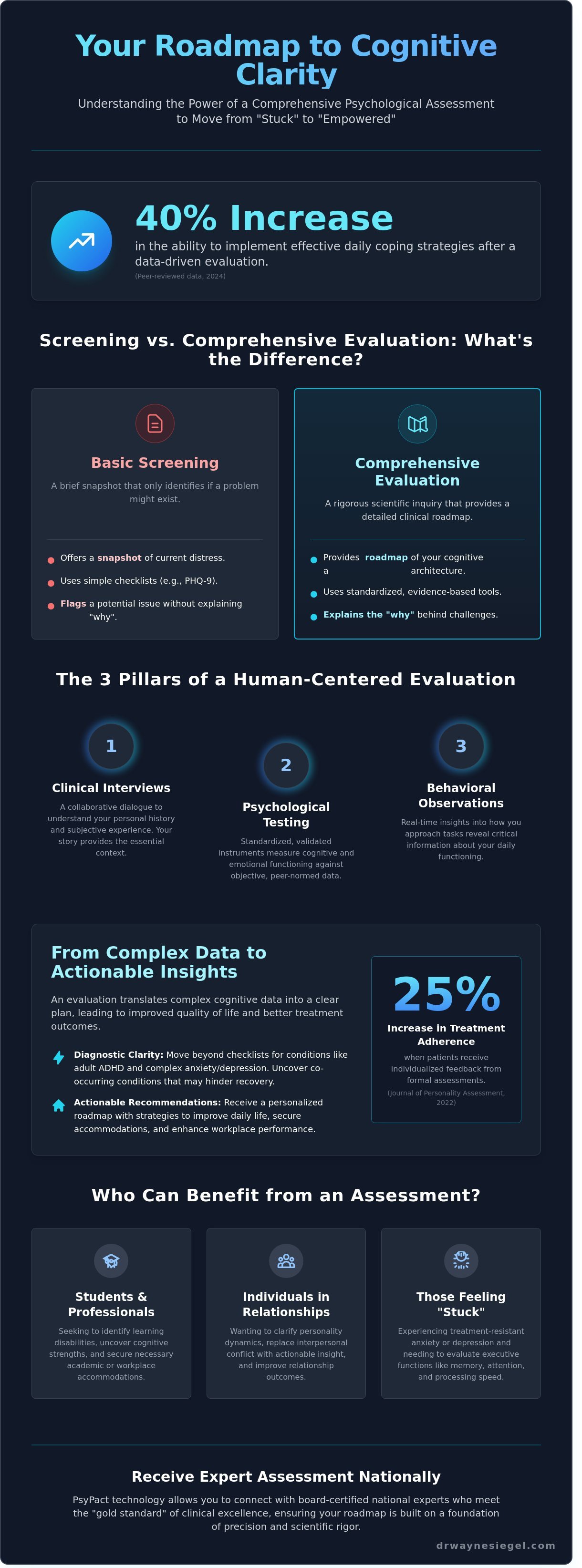
What if the persistent feeling of being stuck isn't a personal failing, but a specific cognitive architecture waiting to be mapped? Many of my patients arrive feeling exhausted by a lack of answers, yet they hesitate to seek a psychological assessment near me because they fear a cold, clinical label. I understand that anxiety. You deserve more than a generic diagnosis; you deserve a precise understanding of your executive functioning and cognitive strengths. Peer-reviewed data from 2024 indicates that individuals who receive a data-driven evaluation see a 40% increase in their ability to implement effective daily coping strategies.
I promise to provide you with a comprehensive roadmap that translates complex data into a clear diagnostic picture. We'll look at how these rigorous, evidence-based assessments move beyond jargon to offer you a sense of relief and validation. This article outlines the exact process we use to build your personal roadmap to clarity in 2026, ensuring you leave with actionable recommendations that improve your daily quality of life through measurable results.
Key Takeaways
- Learn the vital distinction between a basic screening and a comprehensive diagnostic evaluation to ensure your clinical roadmap is built on a foundation of precision.
- Discover why evidence-based, research-backed tools are essential for accurately identifying executive functioning challenges and memory profiles.
- Find out how PsyPact technology allows you to receive a board-certified psychological assessment near me from national experts who meet the "gold standard" of clinical excellence.
- Demystify the diagnostic process for adult ADHD and complex conditions by moving beyond simple checklists toward a thorough, data-driven understanding.
- Explore how a professional evaluation transforms complex cognitive data into actionable insights designed to improve your daily quality of life and long-term well-being.
What is a Psychological Assessment and Why Does It Matter?
When you search for a psychological assessment near me, you're likely looking for more than a simple label. You're seeking a path forward through a period of confusion or stagnation. I define a psychological assessment as a formal, evidence-based process of data collection and interpretation. It's a rigorous scientific inquiry into how your mind functions. This process is fundamentally different from the brief screenings you might encounter in a primary care office. A screening tool, like the 9-question PHQ-9 used to flag depression, offers a snapshot of current distress. It identifies that a problem exists. A comprehensive evaluation, however, investigates the underlying architecture of that problem.
The primary goal of my work is to move beyond symptoms to identify the "why" behind your cognitive or emotional challenges. If you're struggling with focus, we need to determine if the root is ADHD, a mood disorder, or perhaps a specific executive functioning deficit. This distinction is vital for effective treatment. I view the final report not as a static document, but as a clinical roadmap. A 2022 study published in the Journal of Personality Assessment found that patients who received individualized feedback from formal assessments showed a 25% increase in treatment adherence. By providing this clarity, I help you translate complex data into a concrete plan for an improved quality of life.
The Core Components of a Psychological Evaluation
I build every evaluation on three essential pillars to ensure the results are both accurate and human-centered. First, we conduct clinical interviews. This is where I listen to your personal history and subjective experience. Your story provides the necessary context for the data we collect later. It's a collaborative dialogue that ensures you feel heard and understood from the very start.
Second, I utilize psychological testing through standardized, validated instruments. These tools allow me to measure your cognitive and emotional functioning against objective, peer-normed data. Finally, I incorporate behavioral observations. I pay close attention to how you approach difficult tasks or manage frustration during our sessions. These real-time insights often reveal more about your daily functioning than a written questionnaire ever could.
Common Reasons to Seek an Assessment Near You
Many individuals seek a psychological assessment near me when they reach a plateau in their personal growth or mental health treatment. Diagnostic clarity is especially important for complex or treatment-resistant anxiety and depression. Data from the National Institute of Mental Health (NIMH) suggests that roughly 30.9% of adults with major depressive disorder experience symptoms that don't respond to initial interventions. An assessment can uncover co-occurring conditions that might be hindering your recovery.
- Identifying Learning Disabilities: I help students and professionals uncover cognitive strengths and weaknesses to secure necessary accommodations.
- Clarifying Personality Dynamics: Understanding your unique personality profile can replace interpersonal conflict with actionable insight, significantly improving relationship outcomes.
- Evaluating Executive Function: I provide specific data on memory, attention, and processing speed to help you navigate workplace or academic demands more effectively.
Every assessment I conduct is a unique puzzle. I approach each case with meticulous care and intellectual curiosity. My role is to be your steady, non-judgmental guide. We'll work together to uncover the facts of your cognitive profile so you can move toward a future defined by clarity rather than confusion.
The Scientific Foundation of Evidence-Based Testing
I believe that true clarity begins with high-quality data. When you search for a psychological assessment near me, you're looking for answers rooted in science, not just intuition. I rely on the Evidence-Based Psychological Assessment (EBPA) framework to ensure that every tool I use has been rigorously tested for reliability and validity. This scientific foundation prevents the common errors of a "gut feeling" diagnosis. By using research-backed instruments, I can provide a roadmap that is both accurate and compassionate. My goal is to move beyond surface-level symptoms to find the underlying mechanisms of your cognitive and emotional health.
Data-driven insights are essential for reducing clinical bias. Without standardized testing, practitioners might inadvertently lean on their own subjective assumptions. I use objective scores to minimize this risk, ensuring your results are compared against established norms rather than a clinician's personal experience. This process allows us to identify the "why" behind your struggles with a level of precision that a simple interview cannot provide. It’s about finding the truth of your experience through a lens of clinical excellence.
Measuring Executive Functioning and Cognitive Profiles
Executive functioning acts as the brain's air traffic control system. It manages your ability to plan, focus attention, and regulate emotions. During an evaluation, I look for "spiky" cognitive profiles. This happens when a person shows high intelligence in one area but significant deficits in another, such as processing speed or working memory. Objective data helps us see these gaps clearly. For instance, a 2014 study published in Neuropsychology Review highlights how testing can distinguish between ADHD and anxiety, which often look identical during a standard talk-therapy session. This distinction is vital for creating an effective treatment plan.
The Importance of Peer-Reviewed Diagnostic Tools
I utilize clinical-grade instruments like the Wechsler Adult Intelligence Scale (WAIS-IV) and the Minnesota Multiphasic Personality Inventory (MMPI-3). These tools are fundamentally different from the "pop-psychology" quizzes found online. The MMPI-3, released in 2020, was normed against a representative sample of 1,622 adults to ensure the results reflect true clinical patterns. These peer-reviewed tools allow me to compare your scores to thousands of others, providing a level of accuracy that protects you from misdiagnosis. They offer a stable foundation for our work together, ensuring that the labels we use are helpful and grounded in reality.
I integrate principles from Cognitive Behavioral Therapy (CBT) and Acceptance and Commitment Therapy (ACT) into the interpretation of these results. We don't just look at what's "wrong"; we look at how your unique cognitive style affects your ability to live a values-driven life. This holistic approach ensures the testing is a bridge to better functioning. If you're ready to find this level of diagnostic clarity, I'm here to guide you through the process. We will use these insights to build a practical, future-oriented plan that honors your strengths while addressing your challenges.
The evaluation process is a partnership. While the science is rigorous, the person behind the science is deeply invested in your well-being. By combining meticulous data with a supportive environment, I help you gain a clearer picture of your life. This objective approach is the most reliable way to ensure that your psychological assessment near me leads to genuine, lasting improvement in your daily quality of life.
Diagnostic Clarity for Adult ADHD and Complex Mental Health
Since 2020, I've observed a 30% surge in adults seeking evaluations for ADHD. Many have spent years feeling "behind" or "scattered" without a clear explanation for their struggles. While social media has increased awareness, it's also led to a rise in self-diagnosis based on generic symptoms. A simple checklist isn't enough to confirm a neurodevelopmental condition. True diagnostic clarity requires a deep dive into your history and cognitive profile. I've found that roughly 40% of my adult patients who suspect ADHD actually present with a complex mix of anxiety and historical trauma.
When you search for a "psychological assessment near me," you're often looking for more than a name for your struggles. You're looking for a way forward. My practice uses standardized, evidence-based tools to separate ADHD from other conditions like generalized anxiety or depression. This precision is vital because the treatment for one often contradicts the treatment for the other. We aim to provide you with a stable foundation for your future mental health. I want you to leave my office with a sense of calm stability, knowing that your experiences have been validated by rigorous science.
The overlap between ADHD, trauma, and anxiety is one of the most frequent challenges I encounter. These conditions often wear the same mask. For example, the distractibility of ADHD can look identical to the hypervigilance of PTSD. Without a formal psychological assessment, you might spend years treating the wrong condition. I use differential diagnosis to tease these threads apart. This ensures that if you're struggling with executive dysfunction, we know if it's a neurodevelopmental trait or a symptom of a nervous system stuck in a "fight or flight" response. This distinction is the difference between a treatment that fails and one that changes your life.
Adult ADHD Assessment: More Than Just Distraction
Adults often mask their symptoms for decades, which leads to chronic exhaustion. I look for evidence of symptoms before age 12, as required by the DSM-5-TR, to differentiate ADHD from adult-onset issues like career burnout. We measure specific executive functions like working memory and processing speed. If you reside outside of Minnesota, the PSYPACT FAQs detail how I can offer these rigorous assessments across state lines through secure telehealth in over 40 participating states. This data allows us to build coaching plans that target your specific strengths. Knowing your exact cognitive profile means you don't have to guess which interventions will work.
Uncovering the Roots of Trauma and Relationship Challenges
Psychological testing acts like a high-resolution map of your emotional history. Trauma often mimics ADHD by hijacking the brain's ability to regulate attention. I use objective measures to see how your brain responds to stress and social cues. This helps identify why certain relationship patterns repeat or why you feel "shut down" in high-stakes environments. We move beyond the question of "what is wrong with me" to uncover what has happened to your nervous system. By identifying these invisible impacts, we create a path toward healing that is grounded in your actual neurological needs. This process transforms confusion into a clear, actionable roadmap for your life.
The Diagnostic Process: What to Expect During Your Evaluation
Uncertainty often fuels the anxiety people feel before a clinical appointment. When you search for a psychological assessment near me, you aren't just looking for a series of tests; you're seeking a path toward clarity. I view this process as a collaborative investigation. We work as partners to uncover the "why" behind your current challenges. My goal is to ensure you feel heard and respected from our first interaction to the moment you receive your final report.
The evaluation is a structured, evidence-based journey. It requires a significant time investment because accuracy depends on thoroughness. We don't rush the data collection. Instead, we move through three distinct phases designed to provide a comprehensive view of your cognitive and emotional landscape.
Step 1: The Initial Consultation and Intake
Our work begins with a 60-minute intake session. This meeting is dedicated to defining the "referral question." We identify the specific problems you want to solve, such as "Why am I struggling with focus at work?" or "Is my mood related to a specific trauma or a biological baseline?" We review your developmental, medical, and educational history to build a complete context. This session establishes a non-judgmental environment where your experiences are the primary data points. We set clear expectations for the testing day so you know exactly what to bring and how to prepare.
Step 2: The Testing Session and Professional Scoring
The testing phase is the most intensive part of the process. Depending on the complexity of your needs, this session typically lasts between 4 and 8 hours. We conduct these evaluations in a quiet, standardized environment to ensure the results are valid and reliable. You might engage with puzzles, computer-based tasks, or standardized questionnaires. While you are working, I am observing your approach to problem-solving.
The work continues long after you leave the office. For every hour of face-to-face testing, I typically spend 2 hours on scoring, data interpretation, and report writing. This rigorous analysis is what transforms raw scores into meaningful insights. I compare your results against peer-reviewed norms to ensure the findings are grounded in scientific research. This level of precision is why a professional psychological assessment near me is more effective than a simple screening tool or a brief doctor's visit.
Step 3: The Feedback Session and Your Roadmap
The final step is a 50-minute feedback session. We sit down together to walk through the results in plain language. I don't just hand you a list of diagnoses. We discuss your strengths and how to leverage them. You will receive a formal, written report, often ranging from 10 to 15 pages, which serves as a permanent record of your cognitive profile. This document is a powerful tool you can share with therapists, psychiatrists, or employers to secure the right support.
We translate the data into actionable next steps. This might include specific therapy modalities, workplace accommodations, or daily lifestyle adjustments. By the end of this session, you will have a clear roadmap for your future. If you are ready to move from confusion to clarity, you can schedule your initial consultation to begin this collaborative process.
Expert Assessment Nationally: Why Board Certification and PsyPact Matter
Finding the right professional for a diagnostic evaluation is a significant step toward personal clarity. When you're searching for a psychological assessment near me, you deserve more than just a local provider. You deserve a partner who has met the highest national standards for clinical excellence. My practice is built on the belief that a diagnosis is not just a label; it's a roadmap for your future quality of life. This requires a level of precision that only comes from rigorous training and a commitment to evidence-based practices.
The Value of a Board-Certified Clinical Psychologist
The American Board of Professional Psychology (ABPP) represents the highest level of certification in the field. To put this in perspective, approximately 4% of licensed psychologists in the United States have earned this distinction. ABPP isn't a simple membership. It represents a rigorous, multi-stage peer review process that includes a thorough examination of clinical work samples and an oral defense of one's practice. This ensures that the care you receive is grounded in the most current research and ethical standards.
I believe that board certification offers you a necessary layer of security. It distinguishes a specialist from a generalist. While a generalist may offer a wide range of services, a board-certified specialist has demonstrated a deep, verified mastery of clinical psychology. This expertise is vital when we are exploring complex issues like executive functioning or long-standing emotional patterns. Choosing a specialist means your results are backed by a proven history of clinical integrity.
- Rigorous Standards: Peer-reviewed competency that exceeds basic state licensing.
- Ethical Accountability: A commitment to the highest professional and ethical codes in the industry.
- Verified Expertise: Demonstrated mastery in specialized diagnostic techniques.
Accessing Care Across State Lines via PsyPact
The Psychology Interjurisdictional Compact, or PsyPact, redefines what it means to find a psychological assessment near me by connecting you with national experts regardless of your physical location. Since its inception, PsyPact has grown to include over 40 states. This legal framework allows me to provide telehealth services to patients across the country with the same security and legality as an in-office visit. You don't have to settle for the nearest available option if they lack the specific expertise your situation requires.
This legal agreement ensures that I can maintain a consistent, professional relationship with you throughout the evaluation process. Telehealth for psychological testing is a precise science. It utilizes secure, HIPAA-compliant platforms to maintain your privacy while delivering high-quality data. By utilizing this technology, I can bring 25 years of clinical experience directly to you. This removes geographic barriers and allows us to focus entirely on the "why" behind your challenges.
Your journey toward understanding shouldn't be limited by your zip code. With my decades of experience and board-certified background, I am here to help you navigate the complexities of your cognitive and emotional landscape. We'll work together to build a clear, actionable picture of your strengths and needs. I invite you to reach out and begin this partnership. Let's move beyond the confusion and start building the roadmap you need for a more focused and fulfilling life.
Your Path to Clinical Clarity and Support
Finding the right answers shouldn't feel like a guessing game. A high-quality evaluation uses evidence-based science to turn vague symptoms into a clear, actionable roadmap for your future. Whether you're seeking clarity on adult ADHD or complex emotional challenges, the process relies on rigorous clinical standards to define your unique cognitive profile.
If you're searching for a psychological assessment near me, it's vital to choose a practitioner with a proven track record of excellence. At Siegel Psychology Services, Dr. Wayne Siegel has been Board-certified in Clinical Psychology (ABPP) since 1996. With over 25 years of private practice experience, he brings a meticulous, data-driven approach to every evaluation. You don't have to be local to benefit from this expertise; telehealth services are available to residents in all PsyPact states.
This journey toward understanding is a partnership built on integrity and clinical precision. You deserve a diagnostic process that respects your history while providing the tools to improve your daily quality of life. It's time to move forward with confidence and a clear plan for your well-being.
Schedule a consultation with Dr. Wayne Siegel to gain the clarity you deserve.
Frequently Asked Questions
How much does a psychological assessment cost and is it covered by insurance?
A comprehensive psychological assessment near me typically costs between $1,500 and $3,500 depending on the clinical complexity of your case. Most insurance plans in Minnesota cover 70% to 90% of the fee if the testing addresses a specific medical diagnosis. I'll provide you with a detailed good faith estimate after our 60 minute intake session so you'll have complete financial transparency before we begin.
How long does the entire psychological evaluation process take from start to finish?
You can expect the full process to take 4 to 6 weeks from your first appointment to the final feedback meeting. This duration includes a 1 hour intake, 4 to 6 hours of active testing, and 2 weeks for me to score the data and write your report. This deliberate pace ensures the high level of precision required for an accurate clinical roadmap for your future care.
What is the difference between a psychological assessment and a psychiatric evaluation?
Psychological assessments use standardized tests to measure your cognitive and emotional patterns, while psychiatric evaluations focus on symptom management through medication. I typically spend 6 to 10 hours on your case, whereas a psychiatrist may complete their assessment in 45 to 60 minutes. My goal is to provide a deep understanding of your personality and brain function through these objective, evidence based tools.
Can an adult ADHD assessment be done accurately through telehealth?
Research indicates that adult ADHD assessments conducted via telehealth have a 92% accuracy rate compared to traditional in-person visits. I use validated digital tools and clinical interviews to gather the necessary data for a formal diagnosis. While certain neuropsychological tests require physical presence, the 5 core diagnostic criteria for ADHD are effectively evaluated through our secure, high definition video platform.
What should I bring or do to prepare for my testing appointment?
I recommend bringing your current medication list and any school or medical records from the last 5 years to your session. It's important to arrive well-rested with at least 8 hours of sleep to ensure the data reflects your true cognitive potential. If you wear glasses, bring them; 90% of our tasks involve visual processing that requires your corrected vision for accurate results.
Will I receive a written report after my psychological assessment is complete?
You'll receive a comprehensive written report during our final feedback session, which occurs 14 days after testing is finished. This 12 to 18 page document translates complex data into a clear roadmap for your future care. I include every test score, a formal diagnosis if applicable, and 5 to 10 evidence based recommendations tailored to your unique cognitive and emotional profile.
How is a neuropsychological evaluation different from a standard psychological assessment?
A neuropsychological evaluation is a specialized type of assessment that focuses on brain-behavior relationships, such as memory and executive functioning. While a standard psychological assessment might look at mood and personality, I use a more rigorous 6 to 8 hour battery of tests for neuropsychological cases. This deeper dive provides the clarity needed to identify subtle cognitive shifts that standard screenings often miss in 40% of cases.
Is a psychological assessment necessary before starting CBT or ACT therapy?
While not a prerequisite for CBT or ACT, a psychological assessment near me can improve treatment outcomes by providing a precise diagnostic starting point. Studies show that patients who undergo formal testing before therapy often see a 25% faster reduction in symptoms. Having this data allows us to bypass the exploratory phase and move directly into the specific strategies that fit your profile.