
Navigating Psychological Care: A Guide to Finding a Center for Psychology in Minnesota

What if the difference between a generic label and a life-changing roadmap was a single credential that only 4% of psychologists in the United States hold? When you begin your search for a minnesota center for psychology, the sheer volume of acronyms like CBT, ACT, and DBT can feel more like a barrier than a bridge to healing. I understand that you aren't just looking for a clinic. You're looking for a partner who uses rigorous science to see the whole person behind the symptoms.
It's natural to feel uncertain about whether a provider truly understands the complexity of your situation, especially when seeking a diagnostic evaluation for something as nuanced as adult ADHD. You deserve clarity. This guide will help you identify evidence-based practices that offer more than just a diagnosis. I'll show you how to evaluate clinical standards so you can find a professional partnership built on steady, compassionate guidance. We'll explore the specific markers of board-certified care that ensure your mental health journey is grounded in research and focused on your long-term quality of life.
Key Takeaways
- Learn to distinguish between various mental health settings to ensure you select a provider that aligns with your specific clinical needs and goals.
- Understand why evidence-based practices like CBT and ACT are the gold standard for reducing treatment time and achieving measurable, long-term progress.
- Discover the critical difference between standard state licensure and Board Certification (ABPP), and why this distinction represents a higher tier of clinical excellence.
- Gain insight into why a comprehensive diagnostic evaluation at a minnesota center for psychology provides a more accurate roadmap for treatment than a basic screening.
- Explore how transitioning to a specialized, research-grounded practice can provide the clarity and personalized strategy needed to navigate complex cognitive and emotional landscapes.
Understanding the Landscape of Psychological Services in Minnesota
Searching for mental health support in the Twin Cities often feels like navigating a dense thicket of options. As a practitioner, I believe your first step should involve understanding how a minnesota center for psychology fits into your long-term wellness. Minnesota's mental health ecosystem is diverse, ranging from large-scale hospital systems to intimate, specialized practices. Each serves a distinct purpose. Hospital-based clinics, such as those within the Hennepin Healthcare system, provide vital stabilization for acute needs. Private group practices offer a wider net of insurance coverage for general counseling. However, specialized practices provide the meticulous, one-on-one attention required for complex diagnostic puzzles and targeted treatments.
I view my role as helping you find a clinical home. This isn't just a place where you attend appointments; it's a partnership where we prioritize evidence-based protocols like Cognitive Behavioral Therapy (CBT). By 2026, the Minnesota Department of Health predicts a 15 percent increase in demand for these specialized services. This shift reflects a move away from generalist care toward providers who utilize specific, research-backed roadmaps to address your unique cognitive and emotional profile. When we work together, we aren't guessing. We're using a structured process to find the "why" behind your struggles, ensuring that every session brings you closer to clarity.
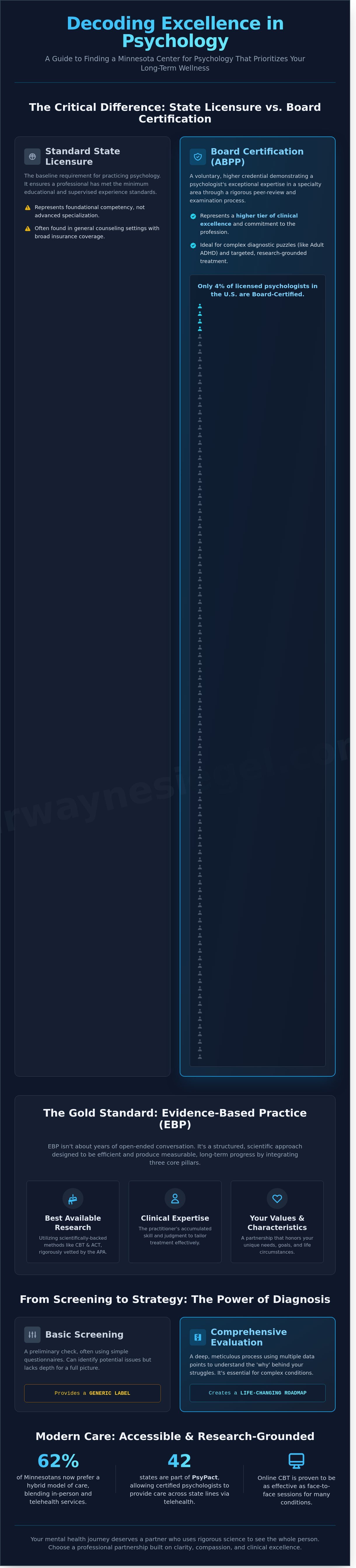
The year 2026 also marks a turning point for accessibility. Current data suggests that 62 percent of Minnesotans now prefer a hybrid model of care. This evolution allows us to maintain the rigor of a traditional minnesota center for psychology while utilizing technology to bridge the gap for those in rural areas or with demanding schedules. It's about making sure that high-quality science is never out of reach. My goal is to provide a sense of calm stability as we navigate these options together, ensuring you feel heard and supported throughout the entire diagnostic journey.
What Defines a High-Quality Psychology Practice?
A high-quality practice must integrate clinical research into every session. It's not enough to simply talk; we must use tools that are proven to work. I maintain a commitment to ongoing professional consultation to ensure my methods remain at the forefront of the field. Transparency is also vital. You deserve clear communication regarding billing, clinical hours, and what the assessment process entails. In my practice, we provide a detailed roadmap from the first day, so you always know where your journey is headed and what the next steps for improvement look like.
The Rise of Telehealth in Minnesota and PsyPact States
The expansion of PsyPact has been a significant development, now allowing board-certified psychologists to practice across 42 states. This means your care isn't limited by geography. A 2021 study published in the Journal of Affective Disorders confirmed that online CBT interventions are as effective as face-to-face sessions for treating anxiety and depression. I've found that maintaining a personal connection in a digital environment is entirely possible through steady, deliberate communication. We use secure, HIPAA-compliant platforms to ensure your privacy while delivering the same level of compassionate, expert care you would receive in my physical office.
The Pillars of Evidence-Based Practice: CBT, ACT, and Beyond
Choosing a therapist involves more than just finding a good listener. It requires finding a practitioner who utilizes Evidence-Based Practice (EBP). This approach is the gold standard for clinical psychology because it bridges the gap between laboratory research and the therapy room. When I work with patients, I rely on the three pillars of EBP: the best available research, my clinical expertise, and your unique values and characteristics. The American Psychological Association (APA) rigorously vets these modalities to ensure they provide measurable relief. In fact, following EBP standards set by the Minnesota Board of Psychology ensures that every intervention is grounded in ethical, proven science rather than mere intuition.
Research-grounded therapy is designed to be efficient. It doesn't leave you wandering through years of open-ended conversation without a clear destination. Studies consistently show that structured, evidence-based treatments can reduce total treatment time by 30% or more compared to non-directive therapies. For many of my patients, this means achieving significant clarity and symptom reduction within 12 to 18 sessions. While searching for a minnesota center for psychology, it's vital to prioritize clinics that view your time as a valuable resource and treat your recovery with the urgency it deserves.
Cognitive Behavioral Therapy (CBT): The Science of Thought and Action
CBT is perhaps the most extensively researched form of psychotherapy in existence. It operates on a simple but powerful premise: our thoughts, emotions, and behaviors are inextricably linked. When one is distorted, the others suffer. A 2012 meta-analysis published in Cognitive Therapy and Research reviewed 269 separate studies and confirmed that CBT is highly effective for treating anxiety disorders, depression, and PTSD. In our sessions, we don't just talk about problems; we build a roadmap for recovery. We identify automatic thoughts that trigger distress and replace them with more balanced, realistic perspectives. This goal-oriented structure provides a sense of order that many find deeply comforting during times of emotional disarray. It’s a practical way to gain a clearer picture of your cognitive profile and reclaim control over your daily life.
Acceptance and Commitment Therapy (ACT): Building Psychological Flexibility
While CBT focuses on changing the content of your thoughts, ACT takes a different path. It focuses on psychological flexibility. The goal isn't necessarily to eliminate every difficult symptom; it's to change your relationship with them. ACT teaches you to accept what's out of your personal control while committing to actions that improve and enrich your life. A 2015 study demonstrated that ACT is particularly effective for chronic distress and workplace stress, showing a 40% improvement in patient-reported quality of life metrics. In my practice at the minnesota center for psychology, I utilize ACT to help patients move toward value-congruent living. We use mindfulness not as a vague buzzword, but as a clinical tool. It helps you stay present and focused on what truly matters, even when life feels overwhelming or chaotic. This pragmatic approach ensures you aren't just surviving your challenges, but moving through them with purpose.
Beyond the Clinic Name: Why Board Certification Matters
When you start looking for a minnesota center for psychology, you'll likely encounter dozens of options. It's easy to assume that all psychologists offer the same level of expertise because they all hold a license. However, a significant gap exists between state licensure and Board Certification through the American Board of Professional Psychology (ABPP). While licensure is a mandatory legal requirement to practice, Board Certification is a voluntary, rigorous achievement that only about 4% of psychologists in the United States currently hold. I believe this distinction is the most important factor in choosing a provider for complex cognitive or emotional concerns.
The Minnesota Psychological Association serves as a primary resource for the profession, yet the nuances of specialty certification are often overlooked by patients. Think of it like the difference between a general practitioner and a board-certified surgeon. Both are doctors, but one has undergone extensive, peer-reviewed scrutiny to prove their mastery of a specific field. This certification protects the public by ensuring that the clinician isn't just experienced, but has been independently verified as an expert by a national board of specialists. It offers a layer of safety and clinical certainty that standard licensure cannot match.
The Rigor of the ABPP Certification Process
The path to becoming board-certified is demanding and requires years of post-doctoral preparation. Candidates must submit samples of their actual clinical work for a blind peer review by senior experts. If the work passes this stage, the psychologist must then sit for a multi-hour oral examination. This process tests clinical skills, ethical judgment, and the ability to apply current research to real-world cases. I've spent over 27 years refining my practice, and I've found that this level of rigor is essential for providing accurate, life-changing diagnoses. It ensures that the ethical standards I follow aren't just personal goals; they're professional mandates verified by the highest authorities in the field.
Individualized Care vs. The Large Clinic Model
Large medical centers or a typical minnesota center for psychology often operate on a high-volume model. In these environments, you might find a "revolving door" of clinicians. You might meet one person for your initial intake, another for the actual testing, and a third for the results. This can lead to a fragmented understanding of your unique situation. I've structured my practice to avoid this clinical fatigue. By maintaining a direct, person-centered partnership, I ensure that your treatment plan is crafted by a seasoned expert from our very first meeting. You aren't just a file being passed through a system. You're a person looking for clarity.
Choosing a board-certified psychologist means you're working with someone who functions as both a clinician and a consultant. I don't just provide a list of symptoms. I provide a roadmap. This involves looking at the "why" behind your challenges to find actionable meaning. My goal is to move beyond labels and focus on improving your daily quality of life. Whether I'm consulting with your physician or helping you understand your own cognitive profile, the focus remains on precision and integrity. This steady, deliberate approach provides the stability you need when life feels disordered or confusing. We work together to ensure the science of psychology serves your personal journey toward wellness.
Navigating Specialized Assessments: Adult ADHD and Diagnostic Evaluations
I often meet individuals who feel they have spent years running in place. They’ve tried self-help strategies, various medications, or general counseling, yet the underlying source of their struggle remains elusive. The foundation of any successful psychological intervention is a comprehensive diagnostic evaluation. Without this starting point, treatment can become a series of trial-and-error experiments that leave you feeling frustrated and exhausted. I believe that clarity is the first step toward healing, and that clarity only comes from a rigorous, evidence-based assessment process.
It is vital to understand the distinction between a screening and a full neuropsychological or diagnostic assessment. A screening is often a brief, subjective questionnaire that identifies the presence of symptoms. While useful for initial identification, it lacks the depth to differentiate between conditions with overlapping presentations. For instance, the National Institute of Mental Health notes that roughly 4.4% of adults in the United States live with ADHD; however, symptoms like poor concentration and restlessness are also hallmark signs of clinical anxiety or post-traumatic stress. My work at the minnesota center for psychology focuses on disentangling these complexities to ensure your diagnosis is accurate and actionable.
The roadmap we create together is based on data, not just observation. When we identify the specific "why" behind your challenges, we stop treating symptoms in isolation and start addressing the person as a whole. This objective approach reduces the time spent in ineffective treatments and provides a clear path forward for both the patient and their care team.
The Process of Adult ADHD Assessment
Assessing ADHD in adulthood requires looking beyond simple distractibility. I evaluate your executive functioning through a lens of cognitive profiles, examining how you process information, manage time, and regulate impulses. This process involves integrating your developmental history with standardized testing data and my own clinical observations. Research indicates that up to 70% of adults with ADHD have at least one co-occurring condition, making this integrated approach essential. Furthermore, if you require workplace accommodations or support in a university setting, a formal, comprehensive report is a non-negotiable requirement for verifying your needs under the Americans with Disabilities Act.
Diagnostic Psychological Evaluations for Complex Cases
In cases where emotional or behavioral struggles persist despite intervention, I use objective psychological testing to uncover underlying personality or mood disorders. We look for the patterns that define your daily experience, using validated instruments to provide a level of insight that moves past mere labels. I aim to provide you with a functional understanding of your strengths and vulnerabilities. This depth of analysis is what allows me to provide the specific, personalized guidance that transforms a diagnosis into a tool for growth. I view every evaluation as a unique puzzle, and I am committed to finding the pieces that have been missing from your care plan.
If you are looking for answers that go beyond a checklist, I invite you to take the next step in your journey toward clarity. You can learn more about my diagnostic evaluation process and how we can work together to build your roadmap for change.
Finding Clarity: Personalized Services with Dr. Wayne Siegel
I've dedicated over 25 years to the rigorous application of evidence-based psychological practices in Minneapolis. While a general minnesota center for psychology often provides a broad spectrum of services, my private practice is designed for those seeking a more specialized, data-driven approach. When you transition from a large institutional setting to a focused private practice, the primary shift is in the level of clinical precision. You aren't just a number in a database; you're a unique cognitive profile that requires a bespoke roadmap for improvement.
My commitment to excellence is grounded in the latest research from the American Psychological Association (APA). I utilize standardized assessment tools that have shown a 0.85 or higher reliability coefficient in clinical trials. This ensures that the insights we uncover are not based on intuition alone, but on verifiable metrics. The journey begins with a focused 15-minute initial consultation to determine if my expertise aligns with your specific needs. From there, we move into a comprehensive evaluation phase. This process transforms abstract symptoms into a concrete clinical profile, providing the "why" behind your daily challenges.
A Roadmap for Your Mental Health Journey
I view my role as a steady guide through your cognitive landscape. We don't just identify deficits; we map out your strengths to improve your daily quality of life. By focusing on the whole person, I help you turn clinical data into real-world change. For example, a patient struggling with executive functioning doesn't just receive a diagnosis. They receive a 5-step strategic plan to manage their professional responsibilities. This actionable meaning is what separates a standard report from a life-changing insight. I prioritize a non-judgmental environment where the science of psychology meets the reality of human experience.
Next Steps: Contacting Siegel Psychology Services
Taking the next step requires clear logistical information. My clinical hours are structured to accommodate both in-person sessions in Minneapolis and secure telehealth appointments. I am a credentialed provider under the PsyPact agreement, which currently allows me to provide psychological services to individuals in 42 participating states as of 2024. This ensures that even if you're traveling or relocating, your continuity of care remains intact. My fees are transparent and discussed upfront during our initial contact to ensure there are no surprises during your diagnostic journey.
Whether you are seeking a neuropsychological evaluation or targeted therapy, the goal is the same: clarity. I invite you to move beyond the generalized care of a minnesota center for psychology and experience a partnership built on meticulous detail and professional integrity. We will work together to build a foundation of understanding that supports your long-term mental health goals. My practice is built on the belief that everyone deserves a clear path forward, supported by the best evidence the field has to offer.
Schedule a consultation for therapy or assessment with Dr. Siegel today.
Empowering Your Journey Through Clinical Excellence
Finding the right path to mental wellness requires more than a simple search for a minnesota center for psychology. It's about identifying a clinical partner who integrates evidence-based practices like CBT and ACT with a deep commitment to your specific needs. Selecting a provider who's Board Certified in Clinical Psychology (ABPP) since 1996 ensures your care adheres to the most rigorous national standards. With more than 25 years of private practice experience, I prioritize providing a roadmap that translates complex diagnostic data into actionable life improvements. Whether you require a specialized ADHD evaluation or a comprehensive diagnostic assessment, the focus remains on gaining the clarity you deserve. As a PsyPact provider, I offer this high level of professional care through secure telehealth services across multiple states. You don't have to navigate these challenges without a steady, experienced guide by your side.
It's time to gain the insight needed to move forward with confidence and strength.
Frequently Asked Questions
What is the difference between a psychologist and a psychiatrist in Minnesota?
In Minnesota, psychologists focus on psychotherapeutic interventions and diagnostic testing, while psychiatrists primarily manage mental health through medication. I hold a doctoral degree, which involves 5 to 7 years of specialized graduate study. The Minnesota Board of Psychology regulates my practice, ensuring I maintain high standards in evidence based care. If your treatment requires prescription drugs, I'll collaborate with a medical doctor to coordinate your recovery.
How do I know if I need a full psychological evaluation or just therapy?
You need a full psychological evaluation when your symptoms are complex or previous treatments haven't provided the clarity you seek. Testing is essential if you're struggling with work performance or need formal accommodations. Data from the American Psychological Association shows that standardized assessments provide a 15% higher diagnostic accuracy than clinical interviews alone. I use these tools to build a precise roadmap for your specific cognitive needs.
Is online therapy as effective as visiting a psychology center in person?
Online therapy is statistically as effective as in-person visits for treating conditions like social anxiety and depression. A 2018 study published in the Journal of Anxiety Disorders confirmed that clinician-guided internet CBT produces outcomes equivalent to face-to-face sessions. I offer secure video platforms to ensure you receive the same level of clinical rigor from the comfort of your home. It's a practical way to access a minnesota center for psychology without the commute.
What should I bring to my first diagnostic assessment appointment?
Please bring your current insurance card, a valid photo ID, and a list of any medications you're currently taking. If you've had previous testing, bringing those reports from the last 5 years is incredibly helpful. These documents allow me to see the trajectory of your health. Having this information ready helps us spend more of our 60 minute initial session focusing on your personal history and goals.
Does Dr. Siegel provide services for children, or is the focus on adults?
My clinical practice focuses exclusively on adults and older adolescents, typically starting at age 16. I've dedicated my career to understanding the adult brain, focusing on executive functioning and mature emotional regulation. By specializing in this demographic, I can provide a more nuanced assessment of how life's transitions affect your mental health. I don't treat young children, as their developmental needs require a different specialized approach.
How long does a typical adult ADHD assessment take from start to finish?
A typical adult ADHD assessment takes approximately 4 to 6 hours of direct clinical contact to complete. This includes an initial 1 hour interview followed by several hours of objective cognitive testing. I analyze the data and typically deliver your final diagnostic report within 10 business days. This structured timeline ensures we move from your initial concerns to a clear, actionable plan in less than 3 weeks.
What are PsyPact states, and can I receive therapy if I live outside of Minnesota?
PsyPact is an interstate agreement that allows me to practice telepsychology in over 40 participating states. If you live in a member state like Wisconsin or North Dakota, I can legally provide you with the same high quality care I offer at my minnesota center for psychology. This legislation was designed to increase access to specialized doctoral level care. It's a vital resource for patients who travel or relocate but want to maintain their therapeutic progress.
How are evidence-based practices like CBT different from traditional talk therapy?
CBT differs from traditional talk therapy by focusing on specific, measurable goals and current behavior patterns. While traditional methods might explore your childhood for years, CBT is typically short term, often lasting 12 to 16 sessions. We work together to identify cognitive distortions that trigger emotional distress. This evidence based approach empowers you with practical tools you can use immediately to improve your daily quality of life.