
Emotional Dysregulation: A Research-Based Guide to Understanding and Management

What if the shame you feel after an intense emotional outburst isn't a reflection of your character, but a measurable neurological response within your brain's executive functioning system? You've likely felt the heavy weight of strained relationships or the exhausting sense of being out of control during a crisis. It's a burden that can feel isolating, especially when you're trying your best to maintain stability. Many patients come to me asking what is emotional dysregulation and why their internal "brakes" seem to fail when they need them most.
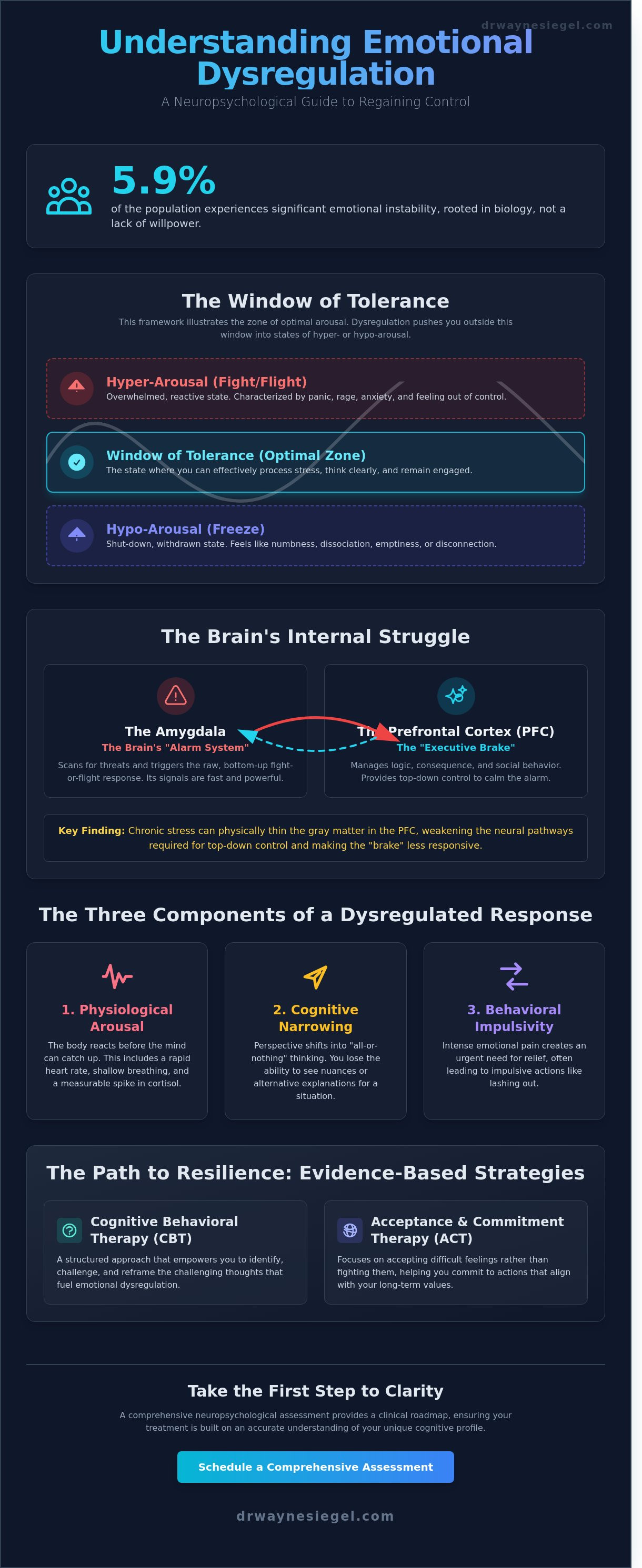
Research published in the Journal of Psychiatric Research indicates that approximately 5.9% of the population meets the clinical criteria for significant emotional instability, proving that these challenges are rooted in biology rather than a lack of willpower. In this guide, I'll provide you with clinical clarity on the mechanisms behind these experiences and offer an evidence-based roadmap to help you regain your footing. We'll explore the neuropsychological roots of these reactions and identify specific, validated tools that can transform how you navigate your daily life.
Key Takeaways
- Understand what is emotional dysregulation through the "window of tolerance" framework, a research-based lens for identifying when responses exceed your capacity to self-soothe.
- Explore the neuropsychological relationship between the amygdala and prefrontal cortex to learn why the brain’s "executive brake" can fail during intense emotional experiences.
- Recognize the specific signs of dysregulation in adults, providing the clarity needed to distinguish between temporary mood swings and deeper emotional patterns.
- Discover how a comprehensive assessment serves as a clinical roadmap, ensuring your treatment plan is built on an accurate understanding of your unique cognitive profile.
- Gain insight into evidence-based strategies like CBT and ACT that empower you to reframe challenging thoughts and foster long-term psychological flexibility.
Defining Emotional Dysregulation: More Than Just "Big Feelings"
Everyone experiences moments of intense frustration or sadness. However, understanding what is emotional dysregulation requires looking beyond temporary mood swings. It refers to a persistent inability to modulate emotional responses to a normative, manageable range. By the 2026 clinical consensus, practitioners now view this as a transdiagnostic feature. This means it's a core mechanism found across various conditions rather than a standalone disorder. When I work with patients, I focus on how this lack of modulation disrupts their daily stability and quality of life.
A helpful way to visualize this is through the "window of tolerance" concept. In research-based psychology, this window represents the zone where you can effectively process and respond to stress. When you experience emotional dysregulation, your nervous system gets pushed outside this zone. You might feel "stuck" in a state of hyper-arousal, characterized by panic or rage, or hypo-arousal, which feels like numbness or dissociation. Healthy emotional expression allows for a return to center; clinical dysregulation keeps you trapped at the extremes.
The Three Components of Emotional Response
Dysregulation is a systemic event that involves more than just a thought. It typically manifests through three distinct channels:
- Physiological Arousal: Your body reacts before your mind can catch up. This includes a rapid heart rate, shallow breathing, and a measurable spike in cortisol levels.
- Cognitive Narrowing: During an episode, your perspective often shifts into "all-or-nothing" thinking. You lose the ability to see nuances or alternative explanations for a situation.
- Behavioral Impulsivity: The intense emotional pain creates an urgent need for relief. This often leads to impulsive actions, such as lashing out or self-soothing in ways that might be harmful in the long term.
Is It a Symptom or a Diagnosis?
It's vital to clarify that dysregulation is usually a symptom of an underlying condition. I frequently observe it in individuals navigating ADHD, Borderline Personality Disorder, or complex trauma. For survivors of trauma, ptsd counseling provides a structured way to address these physiological and emotional triggers. The goal is to move from reactive survival to proactive management. While the intensity of your feelings might be high, I advise against self-diagnosing based on intensity alone. A professional neuropsychological evaluation can offer the clarity you need to understand what is emotional dysregulation in the context of your unique cognitive profile and build a roadmap for recovery.
The Neuropsychology of Emotion: Why the Brain Struggles to Regulate
To understand what is emotional dysregulation from a clinical perspective, we must look at the brain's internal architecture. I often describe the amygdala as the brain’s "alarm system." Its primary job is to scan the environment for threats and trigger the fight-or-flight response. In a balanced nervous system, the prefrontal cortex (PFC) acts as the "executive brake." It evaluates the amygdala’s alarm and determines if the emotional reaction is proportionate to the situation. When these two regions don't communicate effectively, the alarm stays on, leading to the intense reactions we categorize as dysregulation.
This struggle involves two distinct processes: bottom-up and top-down regulation. Bottom-up signals are the raw, sensory surges of emotion that rise from the limbic system. Top-down regulation is the cognitive effort to manage those surges. A 2016 study published in Biological Psychiatry found that chronic stress actually thins the gray matter in the PFC. This physical degradation weakens the neural pathways required for top-down control. For neurodivergent individuals, these pathways may have been wired differently since birth, making the "brake" naturally less responsive.
- The Amygdala: Processes fear and triggers immediate physiological shifts.
- The Prefrontal Cortex: Manages logic, consequences, and social behavior.
- Neural Connectivity: The strength of the "wiring" between these two determines how quickly you can calm down after a trigger.
Executive Functioning and Emotional Control
I like to think of executive functioning as the CEO of the brain. It manages the complex tasks of working memory, focus, and impulse inhibition. When a patient has deficits in working memory, they often experience emotional "flooding." They can't hold onto the "big picture" or remember past coping successes while in the heat of a moment. This is a hallmark of what is emotional dysregulation in adult ADHD. Research by Dr. Russell Barkley suggests that up to 40% of adults with ADHD struggle with significant emotional impulsivity because their brain’s inhibitory systems don't engage fast enough to stop an emotional outburst.
The Impact of Trauma on the Nervous System
Trauma changes the math of the nervous system by sensitizing it to perceived threats. The brain begins to favor the "low road" of processing. This is a subcortical shortcut that sends information directly to the amygdala, bypassing the "high road" of the thinking cortex. While this is helpful for escaping a predator, it's exhausting in daily life. I help patients gain clarity through a roadmap that identifies these sensitized triggers. Neuroplasticity is the brain’s ability to relearn regulation patterns by building new, stronger neural connections over time.
Recognizing the Signs: How Dysregulation Manifests in Adults
When we examine what is emotional dysregulation, we're looking at a breakdown in the brain's ability to modulate its response to stimuli. In my practice, I often see patients who feel as though their emotions have "hijacked" their rational mind. This isn't a character flaw; it's a neurological event where the prefrontal cortex loses its grip on the amygdala. You might notice rapid mood swings that shift within minutes or an intensity of feeling that lingers long after a situation has passed. These "emotional storms" make it difficult to maintain steady relationships, often resulting in cycles of intense conflict or sudden social withdrawal to avoid further pain.
The manifestations of this struggle typically fall into two categories: acting out and acting in. Acting out is often visible, involving verbal aggression or impulsive behaviors. Conversely, acting in is an internalized response where the individual experiences a quiet shutdown, intense self-shaming, or even self-harm. Both patterns are attempts to manage a nervous system that feels overwhelmed. I've found that providing a clear roadmap through a neuropsychological assessment helps patients distinguish these patterns from their core identity, offering a path toward stability.
The "Refractory Period": Why It’s Hard to Calm Down
The refractory period is the biological time lag between an emotional trigger and your return to a calm baseline. Clinical research indicates that once the heart rate exceeds 100 beats per minute, the body is physically incapable of processing logic. During this window, rumination acts as a trap, keeping the "fight or flight" response active. You can identify your own recovery time by monitoring these indicators:
- A heart rate that remains elevated for more than 20 minutes after a conflict.
- Difficulty focusing on any topic other than the perceived slight.
- Muscle tension in the jaw or shoulders that persists for hours.
- A feeling of "fog" that prevents clear decision-making.
Common Triggers in Professional and Personal Life
Triggers are rarely about a single event. They're often the result of cumulative dysregulation. In a professional setting, perceived rejection or a minor critique can feel like a major threat to your safety. I've observed that sensory overload, such as a loud office environment, lowers the threshold for an emotional outburst. Additionally, emotional contagion plays a significant role; you may find yourself absorbing the stress of a dysregulated colleague. Recognizing these triggers is essential to understanding what is emotional dysregulation in your specific life context, allowing us to build a tailored strategy for your daily quality of life.
The Path to Clarity: Why Comprehensive Assessment is the First Step
When you're struggling to manage intense reactions, understanding what is emotional dysregulation provides a helpful initial framework. However, a label by itself doesn't provide a path forward. I believe that effective treatment depends on a precise roadmap of your unique cognitive profile. Without this clinical clarity, individuals often cycle through various therapies or medications that fail to address the underlying cause of their distress.
A psychological assessment near me is designed to differentiate between conditions that often look identical on the surface. For instance, the impulsivity and frustration seen in ADHD frequently mimic the mood instability found in certain depressive or anxiety disorders. As a board-certified psychologist, my role is to look beneath the symptoms to uncover the "why" behind your experiences. We move beyond general categories to find actionable insights that help you regain control over your daily life.
What to Expect in a Professional Evaluation
The evaluation process is a structured journey toward self-understanding. It begins with a detailed clinical interview, where we discuss your history and current challenges. We then move into standardized testing, which may include four to eight hours of direct cognitive and personality measures. This objective data is vital because it reduces the bias often found in self-reporting. While you might feel like you're failing at emotional control, the data might reveal specific deficits in executive functioning or processing speed. We also prioritize identifying your inherent strengths. Knowing what you do well is just as important as identifying where you struggle.
The Benefits of National Telehealth Access
Accessing high-level expert care is now more convenient than ever through psypact states. This interjurisdictional agreement allows me to provide services to patients across dozens of states, ensuring that geographic location isn't a barrier to evidence-based care. These national standards ensure that any psychologist you work with through this system meets rigorous benchmarks for training and ethical practice. I want to reassure you that online assessments are scientifically valid and follow the same strict protocols as in-person visits. You receive the same level of precision and care from the safety and comfort of your own home.
If you're ready to move past the confusion and find a clear path forward, contact my office to schedule your comprehensive evaluation.
Evidence-Based Strategies for Emotional Resilience and Recovery
I believe that moving beyond the initial discovery of what is emotional dysregulation requires a shift from passive understanding to active, skill-based recovery. Emotional regulation isn't a fixed trait that you either possess or lack; it's a physiological and cognitive skill that you can develop through consistent, deliberate practice. In my practice, I find that providing a clear roadmap based on clinical research helps lower the anxiety often associated with starting this journey.
CBT and ACT: Shifting the Cognitive Narrative
Cognitive Behavioral Therapy (CBT) serves as a foundational tool for identifying cognitive distortions before they trigger an emotional explosion. These distortions, such as "catastrophizing" or "all-or-nothing thinking," act as the fuel for dysregulation. By learning to label these patterns, you create a necessary pause between a thought and a reaction. A 2021 meta-analysis suggests that approximately 60 to 75 percent of individuals experiencing mood-related challenges show measurable improvement after a standard 12-week CBT course.
Acceptance and Commitment Therapy (ACT) complements this by focusing on "psychological flexibility." One of the most effective ACT techniques is diffusion, which involves observing your emotions as passing internal events rather than absolute truths. Instead of being consumed by a feeling, you might say, "I am noticing a feeling of frustration," which creates a healthy distance. Evidence-based therapy provides a structured roadmap for change that transforms your relationship with your internal world.
For individuals facing acute or chronic dysregulation, Dialectical Behavior Therapy (DBT) remains the gold standard. Developed by Dr. Marsha Linehan in the 1980s, DBT was specifically designed to help people manage overwhelming emotions that feel impossible to control. It emphasizes the balance between accepting your current state and committing to the hard work of behavioral change.
Practical "In the Moment" Regulation Techniques
When you're in the middle of an emotional storm, you need physiological tools to ground your nervous system. Research into the "window of tolerance" indicates that staying within a manageable range of arousal is key to long-term stability. If you feel yourself drifting into hyper-arousal, you can use the 5-4-3-2-1 grounding method:
- Identify 5 things you can see in your immediate environment.
- Identify 4 things you can physically touch.
- Identify 3 distinct sounds you can hear.
- Identify 2 things you can smell.
- Identify 1 thing you can taste.
Maintaining this window also requires active pacing and self-soothing. This might involve controlled breathing or brief periods of physical movement to discharge pent-up energy. An objective neuropsychological evaluation helps us identify your specific cognitive triggers and strengths, ensuring your roadmap is tailored to your unique brain. Professional guidance accelerates the journey to stability by providing the clarity you need to move forward with confidence.
Moving Toward Clarity and Lasting Stability
Gaining a research-based understanding of what is emotional dysregulation shifts the focus from feeling overwhelmed to finding a solution. It's essential to recognize that these challenges often stem from the brain's executive functioning and specific neuropsychological pathways. I've found that a thorough assessment provides the roadmap needed to navigate these complex emotional landscapes. Since 1996, I've served as a board-certified clinical psychologist, helping individuals apply evidence-based strategies like Cognitive Behavioral Therapy (CBT) and Acceptance and Commitment Therapy (ACT) to improve their daily lives. These tools offer more than just temporary relief; they build a foundation for long-term resilience. My practice offers nationwide telehealth access through PsyPact, ensuring that distance isn't a barrier to receiving specialized care. We'll work together to turn clinical insights into an actionable plan that honors your unique strengths. You deserve a clear path forward and the support to walk it with confidence.
Gain clinical clarity on your emotional health; schedule a consultation with Dr. Siegel today.
Frequently Asked Questions
Is emotional dysregulation a form of mental illness?
Emotional dysregulation isn't a standalone mental illness in the DSM-5; instead, it's a transdiagnostic symptom found in various conditions. It describes a person's inability to manage their emotional responses within a typical range of intensity. I often see this in 15% of the population who struggle with mood stability. It's a clinical feature rather than a specific disease, often acting as a signal that the brain's regulatory systems need support.
How is emotional dysregulation different from bipolar disorder?
The primary difference lies in the duration and triggers of mood shifts. Bipolar disorder requires distinct manic or depressive episodes that last at least 4 days. In contrast, emotional dysregulation involves rapid shifts that occur within minutes or hours. These shifts are usually immediate reactions to external stressors. Understanding what is emotional dysregulation helps us distinguish these brief emotional storms from the sustained, cyclical patterns seen in bipolar disorder.
Can you have emotional dysregulation without having ADHD or BPD?
You can certainly experience these challenges without an ADHD or BPD diagnosis. Research indicates that 20% of cases are linked to trauma, chronic stress, or even severe sleep deprivation rather than personality disorders. It's often a result of a sensitive nervous system or environmental factors. My goal is to help you find clarity on which specific factors are influencing your unique cognitive profile and your daily quality of life.
What is the most effective therapy for emotional dysregulation?
Dialectical Behavior Therapy (DBT) is the gold standard for treatment. Clinical trials demonstrate that DBT reduces emotional volatility in 75% of participants by teaching distress tolerance and mindfulness. This evidence-based approach provides a roadmap for change. It transforms overwhelming feelings into manageable experiences through structured, weekly skill-building sessions that focus on the whole person. This method ensures you gain practical tools for long-term emotional stability and insight.
Can children outgrow emotional dysregulation, or does it persist into adulthood?
While the brain's prefrontal cortex matures until age 25, many individuals don't simply outgrow these patterns without help. A 2018 study found that 40% of children with disruptive mood patterns continue to face challenges in adulthood without professional support. Early intervention is vital. It helps build the executive functioning skills needed to navigate adult life with more confidence. We focus on uncovering the "why" behind these challenges to provide lasting solutions.
How long does it typically take to see improvement with evidence-based treatment?
Most patients begin to notice a shift in their emotional baseline within 8 to 12 weeks of starting evidence-based therapy. A comprehensive DBT program typically spans 24 weeks to ensure skills are fully integrated into your life. I focus on creating a clear roadmap so you can track your progress. Consistent practice of emotional regulation skills leads to measurable improvements in how you handle stress and interpersonal relationships.
Does medication help with emotional dysregulation?
Medication doesn't treat the dysregulation itself, but it can manage the underlying neurochemistry. About 65% of patients find that SSRIs or mood stabilizers help lower the intensity of their emotional spikes. This makes it easier to use the coping skills learned in therapy sessions. I view medication as one tool in a larger journey toward achieving cognitive clarity. It works best when paired with a thorough neuropsychological assessment to identify your needs.
What should I do if my partner struggles with emotional dysregulation?
The most effective step is to practice validation while maintaining healthy boundaries for yourself. You might agree to pause a high-conflict conversation for 15 minutes to allow for a "cool down" period. Supporting a partner involves recognizing their struggle without losing your own stability. When you understand what is emotional dysregulation, it's easier to remain a steady, non-judgmental guide. This partnership helps create a safe environment for their healing journey.