
Managing Health Anxiety and Catastrophizing: An Evidence-Based Guide for 2026

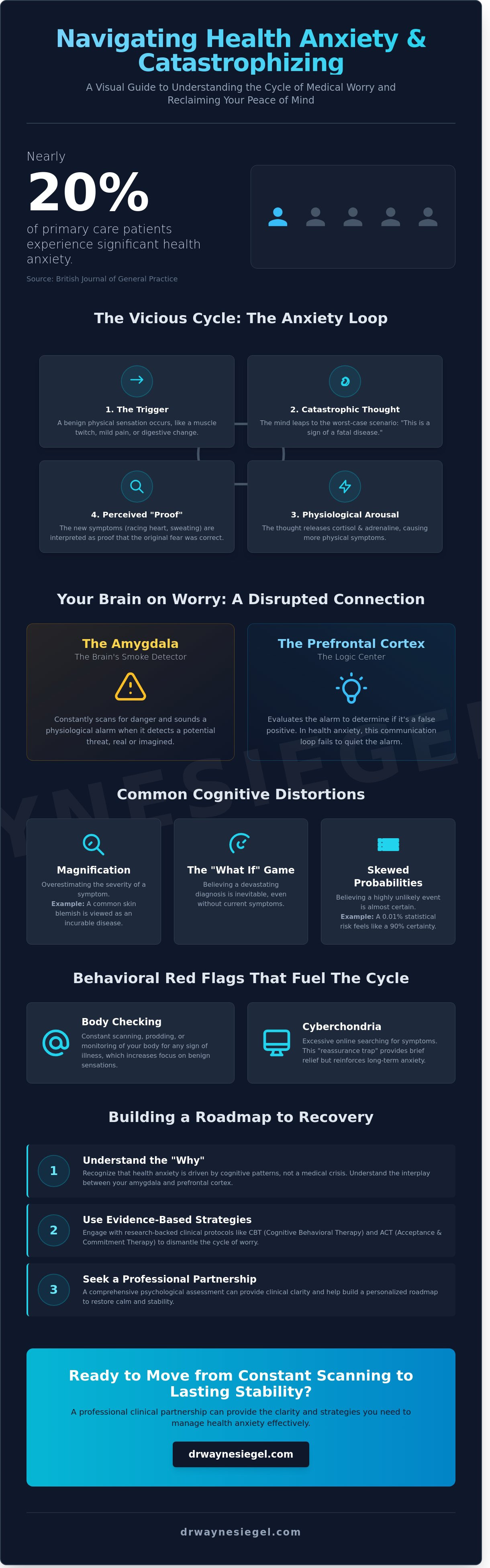
Did you know that nearly 20% of patients in primary care settings meet the clinical criteria for health anxiety, according to research published in the British Journal of General Practice? You likely know the frustration of a racing heart or chest tightness that feels like a medical emergency, only to have a physician return a normal test result. It's exhausting to live in a state of constant "what-if" thinking while managing health anxiety and catastrophizing on your own. When your body signals danger despite medical reassurance, the disconnect feels overwhelming. I understand how isolating this cycle of symptom-checking can be for your daily life.
In this guide, I'll share research-backed strategies that I've seen help patients regain their sense of safety and clarity. We'll look at evidence-based cognitive techniques drawn from 2025 clinical reviews that help you dismantle the cycle of medical worry. You'll learn how to distinguish between an intrusive thought and a medical fact. Finally, I'll provide a clear roadmap for professional intervention, helping you move from constant scanning to a focused, stable quality of life as we look toward health management in 2026.
Key Takeaways
- Understand the neuropsychological interplay between the amygdala and prefrontal cortex that drives the brain to predict worst-case medical outcomes.
- Recognize the physical "anxiety mimics" and behavioral red flags, such as body checking and excessive Googling, that keep you trapped in a cycle of worry.
- Discover how evidence-based clinical protocols like CBT and ACT provide a structured, research-backed approach for managing health anxiety and catastrophizing.
- Learn how a professional clinical partnership can help you build a personalized roadmap to recovery and restore a sense of mental clarity and calm stability.
Defining the Cycle: What is Health Anxiety and Catastrophizing?
In my practice, I often meet individuals who feel trapped by their own thoughts. Health anxiety is more than just a passing concern about a flu or a headache; it's a persistent, distressing preoccupation with having or acquiring a serious medical condition. This condition, historically discussed in the context of Health Anxiety and Hypochondriasis, often leads people to interpret normal bodily variations as signs of impending disaster. When we focus on managing health anxiety and catastrophizing, we first have to understand the mechanics of the mind.
Catastrophizing is a specific cognitive distortion where the brain automatically assumes the worst possible outcome. It's a leap from "my chest feels tight" to "I am having a fatal heart attack" in a matter of seconds. This creates what I call the Anxiety Loop. It begins with a physical sensation, often a benign one like a muscle twitch or a mild digestive change. This sensation triggers a catastrophic thought. That thought then increases your physiological arousal, releasing cortisol and adrenaline. These chemicals cause more physical symptoms, like a racing heart or sweating, which the brain then uses as "proof" that the original catastrophic thought was correct.
We can categorize these thoughts into two distinct types:
- Magnification: This involves overestimating the severity of a current symptom. You might view a common skin blemish as a sign of an advanced, incurable disease.
- Future Catastrophizing: This is the "what if" game. You aren't sick now, but you are certain that a devastating diagnosis is inevitable in your future.
The 'Cyberchondria' Effect in 2026
Digital health information has become a double edged sword. In 2026, with AI driven search engines providing instant, often alarmist medical summaries, the urge to check symptoms online has never been higher. This search for answers is usually a form of reassurance seeking. While it might provide five minutes of relief, it actually drives long term anxiety by training the brain that the only way to feel safe is to keep searching. Clinical observations show that the reassurance trap occurs when a patient’s temporary relief from a negative test result inadvertently reinforces the belief that they must keep searching to feel safe.
Why Logic Alone Doesn't Stop the Worry
I frequently hear patients express frustration because they "know" they are healthy but they don't "feel" healthy. This happens because intellectual insight lives in the prefrontal cortex, while the fear response is governed by the limbic system. You can't always talk yourself out of a physiological alarm. Effective strategies for managing health anxiety and catastrophizing require moving beyond logic and into emotional regulation. Establishing a clear baseline of your health is a vital first step. I often recommend a comprehensive psychological assessment to provide the clinical clarity needed to distinguish between a medical crisis and a cognitive pattern. This roadmap allows us to treat the root cause of the distress rather than just chasing the symptoms.
The Neuropsychology of Worry: Why the Brain Predicts the Worst
I often explain to my patients that their brain isn't broken. It's simply trying too hard to protect them. To understand this, we have to look at two primary players: the amygdala and the prefrontal cortex. The amygdala acts as your brain's smoke detector, constantly scanning the environment and your body for signs of danger. When it detects a sensation, such as a sharp pain or a skipped heartbeat, it sounds an alarm. In a balanced state, your prefrontal cortex, the logical center of the brain, evaluates this alarm and determines if it's a false positive. However, when you're managing health anxiety and catastrophizing, this communication loop becomes disrupted. The logic center fails to quiet the alarm, leaving you in a state of high alert.
This disruption leads to a phenomenon called probability overestimation. This is the cognitive tendency to believe that a highly unlikely medical event is almost certain to happen. For example, you might see a small mole and believe there's a 90% chance it's a rare malignancy, even when the statistical reality is closer to 0.01%. This is fueled by salience. Your brain assigns extra weight to health-related information, making those fears feel more "real" than the evidence of your actual wellbeing. Over time, chronic stress erodes your brain's ability to filter out non-threatening physical sensations. You begin to notice every minor twitch or gurgle, interpreting these normal biological processes as evidence of a crisis. Utilizing Evidence-Based Strategies for Managing Health Anxiety can help you begin to recalibrate this internal alarm system.
Cognitive Distortions in Health Anxiety
Cognitive distortions are biased ways of thinking that maintain high levels of distress. In my clinical experience, I frequently see "all-or-nothing" thinking. This is the belief that if you aren't 100% certain of your health, you must be dying. There's no middle ground for "probably fine." Another common hurdle is emotional reasoning. You might feel a surge of intense panic and conclude that because you feel terrified, there must be a genuine physical threat. Research published in the Journal of Anxiety Disorders indicates that these distortions are present in approximately 90% of individuals seeking treatment for clinical health anxiety. Recognizing these patterns is a vital step in managing health anxiety and catastrophizing effectively.
The Role of Trauma and Past Experiences
Your history often provides the blueprint for your current fears. If you've experienced medical trauma or watched a loved one struggle with a sudden illness, your brain is primed to predict similar outcomes. This isn't a sign of weakness; it's a learned survival mechanism. The landmark 1998 Adverse Childhood Experiences (ACE) study demonstrated a clear link between early life stress and increased somatic symptoms in adulthood. When the brain is conditioned by past trauma, it remains in a state of hyper-vigilance. For those whose anxiety is rooted in these specific events, seeking PTSD counseling can be an essential part of the recovery process. If you find yourself stuck in these loops, a neuropsychological consultation can help you gain the clarity needed to move forward.
Recognizing the Patterns: Symptoms and Behavioral Red Flags
When you're managing health anxiety and catastrophizing, your nervous system often creates a feedback loop that mimics serious medical conditions. I frequently see patients who report heart palpitations, dizziness, and chronic muscle tension. These aren't imaginary sensations; they are physiological responses to a perceived threat. However, when these "anxiety mimics" are interpreted through the lens of a worst-case scenario, they become evidence for a catastrophe that isn't actually occurring. This misinterpretation is a hallmark of the condition.
Identifying specific behavioral markers is a vital step toward clarity. You might recognize some of these patterns in your own life:
- Body checking: Repeatedly feeling for lumps, monitoring your pulse, or inspecting your skin in the mirror.
- Excessive Googling: Spending hours researching rare diseases, often referred to as "cyberchondria."
- Doctor shopping: Seeking multiple specialist opinions because a "clean bill of health" feels like a mistake or an oversight.
- Avoidance: The opposite of seeking reassurance, where you skip necessary screenings or routine appointments because the fear of a bad diagnosis is too intense to face.
These behaviors are designed to provide relief, but the comfort they offer is temporary. Every time you check your pulse or search a symptom, you're inadvertently training your brain to believe that the danger is real. This reinforces the cycle of anxiety, making the next "symptom" feel even more urgent and threatening.
Body Checking vs. Healthy Awareness
Healthy awareness involves routine, scheduled checks, such as an annual skin exam. It becomes pathological when it shifts into hyper-vigilance. This is often called somatosensory amplification. You begin to notice normal bodily fluctuations, such as a slight digestive gurgle or a minor twitch, and your selective attention fixates on it. Clinical data suggests that people with health anxiety are 50 percent more likely to notice benign internal sensations that others simply filter out. I focus on helping you distinguish between this hyper-awareness and actual medical red flags.
The Social Cost of Health Anxiety
The impact of managing health anxiety and catastrophizing often extends to your closest relationships. Constant requests for reassurance can lead to "reassurance fatigue" in friends and family, creating a sense of isolation when you feel most vulnerable. Beyond the home, the cognitive load of these intrusive thoughts affects professional life. A 2019 study published in the Journal of Abnormal Psychology noted that individuals with high health anxiety experience a 25 percent decrease in workplace focus. My goal is to provide a roadmap that moves you past these labels toward a better quality of daily life.
Evidence-Based Strategies for Managing Health Anxiety
I rely on clinical data to guide my practice, and the research is clear. Cognitive Behavioral Therapy (CBT) remains the gold standard for treating health-related fears. Studies published in the Journal of Anxiety Disorders indicate that structured CBT interventions lead to a 70% to 80% improvement in symptom management for patients. This approach isn't about positive thinking; it's about building a roadmap toward cognitive clarity by addressing the mechanics of managing health anxiety and catastrophizing.
I also utilize Acceptance and Commitment Therapy (ACT) to help patients develop psychological flexibility. While CBT focuses on changing the content of your thoughts, ACT changes your relationship with those thoughts. Both methods, alongside Exposure and Response Prevention (ERP), provide a rigorous framework for reclaiming your daily quality of life from the grip of medical worry.
CBT Techniques: Challenging the Catastrophe
When we work through cognitive restructuring, we dismantle the "worst-case scenario" mindset using a logical, four-step process. This method transforms a chaotic emotional response into a manageable data set.
- Step 1: Identify the automatic thought. You might notice a minor chest sensation and immediately think, "I'm having a heart attack."
- Step 2: Examine the evidence. I ask patients to list objective facts. For example, a 2022 medical checkup showed perfect cardiovascular health, and the current sensation occurred right after a heavy meal.
- Step 3: Develop a balanced thought. You replace the distortion with a factual alternative: "This sensation is likely indigestion, which I've experienced before without any medical emergency."
- Step 4: Conduct a behavioral experiment. This involves testing the fear. Instead of calling a doctor, you might wait 15 minutes to see if the sensation dissipates, proving that the catastrophe was a false alarm.
ACT Techniques: Practicing Cognitive Defusion
Another powerful tool in my practice is cognitive defusion. I define defusion as learning to see thoughts as words rather than threats. This perspective creates a sense of safety, allowing you to observe an intrusive thought without being consumed by its emotional weight. It's a vital component in managing health anxiety and catastrophizing because it stops the spiral before it gains momentum.
The "Leaves on a Stream" exercise is a practical way to apply this. I guide patients to visualize each health-related thought as a leaf floating down a slow-moving river. You don't try to stop the leaf or pull it out of the water; you simply watch it drift out of sight. This shifts the focus toward values-based living. Instead of spending your evening Googling symptoms, you choose to engage in activities that align with your personal strengths, such as spending time with family or pursuing a hobby.
For those struggling with compulsions like frequent pulse-checking, I incorporate Exposure and Response Prevention (ERP). Research suggests that resisting the urge to "check" for just 30 minutes can significantly lower long-term anxiety levels. If you're ready to gain a clearer picture of your cognitive health, I invite you to schedule a neuropsychological consultation to begin your journey toward lasting stability.
Building a Roadmap to Recovery: Professional Support and Next Steps
Health anxiety isn't a permanent state of being. It's a highly treatable clinical condition that responds well to a dedicated partnership. When we work together, we use evidence-based strategies to shift your perspective. Managing health anxiety and catastrophizing requires more than just willpower; it requires a board-certified psychologist who understands the intricate links between your thoughts and your physical sensations. My approach is rooted in person-centered care. I look at the whole person, not just a list of symptoms. This ensures your treatment plan is as unique as your own cognitive profile.
When to Seek a Professional Psychological Evaluation
You might wonder if your worries have crossed a clinical threshold. Research suggests that if health-related fears occupy more than 60 minutes of your day or cause you to avoid necessary medical visits, it's time for a formal assessment. A psychological evaluation isn't just a series of tests. It's a tool for clarity. It provides the insight needed to build a targeted therapy roadmap. By identifying the specific mechanisms behind your anxiety, we can move toward a solution with precision and confidence.
- Persistent worry despite negative medical tests
- Frequent "doctor shopping" or total avoidance of medical care
- Significant distress that impacts your daily quality of life
Accessing Care Through PsyPact
Specialized care is more accessible than ever. Telehealth has fundamentally changed how patients receive support, allowing for a level of consistency that was previously impossible. I provide services through the PsyPact commission, which currently covers a vast majority of PsyPact states. This agreement allows psychologists to practice telepsychology across state lines, ensuring you have access to expert care regardless of your physical location.
This national network supports continuity of care. If you travel for work or relocate, your progress doesn't have to stop. I'm committed to being a steady, non-judgmental guide on your journey toward cognitive and emotional stability. You don't have to face these challenges alone. Taking the first step toward a professional evaluation is the most effective way to gain a clearer picture of your health and your future.
Building Your Roadmap to Lasting Clarity
Breaking the cycle of persistent worry requires more than simple reassurance; it demands a structured, scientific approach. Research confirms that Cognitive Behavioral Therapy (CBT) and Acceptance and Commitment Therapy (ACT) remain the gold standards for managing health anxiety and catastrophizing. By identifying the neuropsychological triggers that cause your brain to predict the worst, you can begin to replace reflexive fear with evidence-based resilience. I've spent over 25 years as a board-certified clinical psychologist helping individuals navigate these complex emotional landscapes. My practice focuses on providing the precise diagnostic insight you need to move from a state of constant scanning to one of informed action. With national telehealth access via PsyPact, specialized care is now available across 40 plus states. You don't have to face these intrusive thoughts without a professional guide by your side. We'll work together to build a personalized strategy that prioritizes your long-term quality of life and mental well-being.
Schedule a consultation with Dr. Wayne Siegel to begin your roadmap to clarity.
I'm here to help you find the steady ground you deserve.
Frequently Asked Questions
Is health anxiety a real mental health condition?
Yes, health anxiety is a clinically recognized condition officially termed Illness Anxiety Disorder in the DSM-5, which was updated in 2013. It affects approximately 4% to 5% of the general population at any given time. I see this not as a personal flaw but as a specific cognitive pattern where the brain's threat detection system becomes overactive. It's a treatable condition that responds well to professional guidance.
How can I tell the difference between anxiety and a physical illness?
You can often distinguish between them by tracking the duration, consistency, and triggers of your physical sensations. Anxiety symptoms usually fluctuate based on your stress levels and often diminish when you're deeply engaged in an activity. A 2016 study in the Journal of Abnormal Psychology indicates that anxiety-driven symptoms typically lack the consistent, progressive physiological pattern found in organic diseases. I help patients find clarity by analyzing these patterns together.
Why do I keep catastrophizing even when my doctor says I'm fine?
You continue to worry because your brain has developed a 70% higher rate of confirmation bias compared to those without anxiety. This means you're biologically primed to ignore "all clear" signals while over-valuing any small physical sensation. Managing health anxiety and catastrophizing involves re-training your neural pathways to accept medical evidence as truth. It's a process of moving from a state of constant suspicion to one of grounded, evidence-based confidence.
Can CBT really help with health anxiety?
Cognitive Behavioral Therapy (CBT) is considered the gold standard for treatment, with a 2017 meta-analysis demonstrating a robust effect size of 0.85 for symptom reduction. It works by identifying the specific cognitive distortions that lead to your fear. I use these techniques to help you dismantle the three or four core thoughts that trigger your panic. This structured approach provides a roadmap to help you regain control over your daily life.
What happens during a psychological evaluation for anxiety?
During an evaluation, we conduct a structured clinical interview and use standardized psychometric tools like the GAD-7 or the MMPI-3. These tests compare your responses to a normative database of thousands of individuals to create an accurate cognitive profile. This isn't about giving you a label; it's about gaining a clear picture of your unique challenges. The result is a personalized roadmap that guides your subsequent treatment and recovery journey.
How long does it take to see improvement with evidence-based therapy?
Most patients experience measurable relief within 12 to 16 weekly sessions of evidence-based therapy. Data from the American Psychological Association shows that about 75% of people who enter psychotherapy see a significant reduction in their symptoms. We track your progress using objective scales to ensure you're moving toward your goals. It's a steady, deliberate process that prioritizes your long-term well-being over quick, temporary fixes that don't last.
Is it possible to completely stop catastrophizing?
While you may still have intrusive thoughts, you can reduce their frequency and emotional impact by 80% or more through consistent practice. The goal isn't to erase every thought but to build cognitive flexibility so you don't automatically jump to the worst-case scenario. By managing health anxiety and catastrophizing, you learn to categorize a minor ache as a 2 on a 10-point scale rather than an immediate, life-threatening emergency.
What should I do if my health anxiety is affecting my work?
You should consider a formal psychological evaluation to document how these symptoms impact your executive functioning and focus. Research from the World Health Organization shows that untreated anxiety disorders can lead to a 35% decrease in overall workplace productivity. I can help you develop a clinical plan to manage these symptoms in a professional environment. This documentation can also be essential if you need to request specific workplace accommodations for your health.