
Evidence-Based Lifestyle Changes to Help with Depression in 2026: A Research-Driven Guide

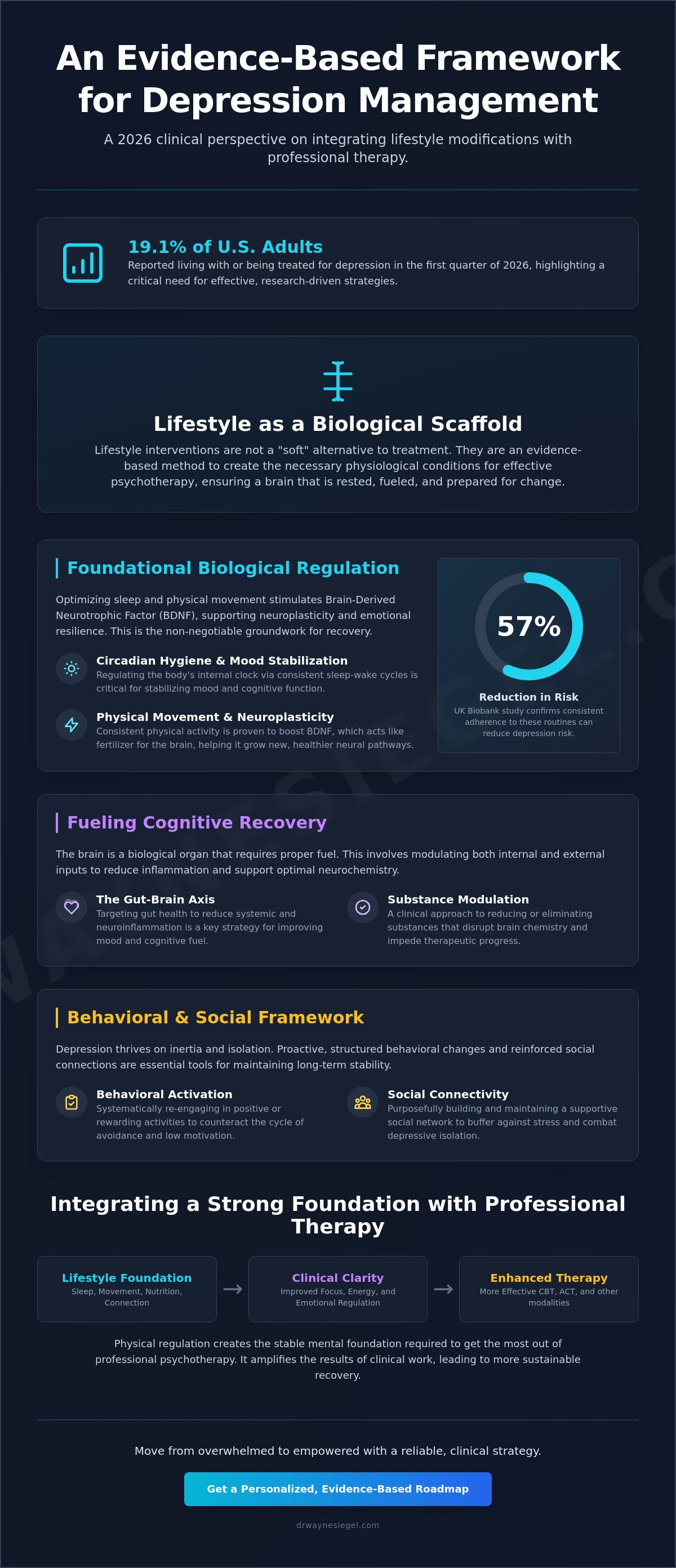
Did you know that by the first quarter of 2026, 19.1% of adults in the U.S. reported they were currently living with or being treated for depression? This rise in diagnoses highlights a critical need for clarity amidst a flood of wellness trends. If you're searching for lifestyle changes to help with depression 2026, you've likely encountered plenty of generic advice that feels impossible to implement when your energy is low. It's frustrating to navigate the gap between social media fads and clinical evidence, especially when you're looking for a structured path toward feeling like yourself again.
I understand that when you're struggling, you don't need more vague suggestions; you need a precise, research-driven framework. In this guide, I'll help you discover how specific lifestyle modifications can biologically and behaviorally support your recovery. We'll examine the latest evidence on at-home neuromodulation devices like the Flow FL-100 and the emerging science of the gut-brain axis. My goal is to provide you with a prioritized list of changes that offer mental lucidity and a clear way forward. By understanding the "why" behind these shifts, you can move from feeling overwhelmed to having a reliable, clinical strategy for your daily quality of life.
Key Takeaways
- Understand how specific lifestyle modifications function as a biological scaffold, creating the necessary conditions for more effective clinical recovery.
- Discover how regulating your circadian rhythm and physical movement can stimulate Brain-Derived Neurotrophic Factor (BDNF) to support neuroplasticity and emotional regulation.
- Learn which research-backed lifestyle changes to help with depression 2026 focus on the gut-brain axis to reduce neuroinflammation and improve cognitive fuel.
- Identify how Behavioral Activation and social connectivity serve as essential tools to overcome depressive inertia and maintain long-term stability.
- Gain clarity on how physical regulation provides the foundation for professional psychotherapy, helping you get the most out of modalities like CBT and ACT.
Beyond the Couch: The Role of Lifestyle in Modern Depression Management
I often tell my clients that therapy doesn't happen in a vacuum. By 2026, the clinical community has firmly moved toward an "adjuvant" model of care. This means that lifestyle interventions aren't just side notes; they are evidence-based tools designed to amplify the results of individual psychotherapy. While many people believe that adjusting your daily habits is only useful for mild low mood, the data suggests otherwise. For those experiencing moderate to severe symptoms, biological regulation is often the very thing that makes the work of therapy possible. It creates a stable foundation, ensuring that the insights we gain during our sessions actually take root in a brain that is physiologically prepared for change.
There's a common misconception that lifestyle changes are a "soft" alternative to clinical treatment. In reality, the 2026 approach to mental health recognizes that your brain is a biological organ. When we address neuroinflammation or circadian rhythm disruption, we aren't just practicing "wellness"; we're engaging in biological regulation. This shift allows us to move beyond mere symptom management toward a more holistic form of recovery. By prioritizing physical health, you gain the mental lucidity required to do the difficult, deep work of unpacking complex emotional patterns. It's about giving your mind the best possible environment to heal.
Lifestyle as a Biological Scaffold for Therapy
I view the body as a scaffold that supports the mind. When your physiology is in a state of constant dysregulation, your brain's ability to process complex emotions or learn new coping skills is significantly compromised. A body that is well-rested and properly fueled creates the "clinical clarity" needed to engage with cognitive-behavioral strategies effectively. This is why gaining a psychological assessment near me is such a vital first step in the process. It provides a transparent roadmap of your unique cognitive and emotional profile, allowing us to tailor lifestyle changes to your specific neurological needs rather than relying on guesswork.
The Limitations of Self-Help vs. Evidence-Based Practice
It's incredibly easy to feel overwhelmed by the flood of wellness trends appearing on social media. My focus, however, remains strictly on peer-reviewed behavioral interventions that offer a structured path forward. The Therapeutic Lifestyle Change program serves as a prime example of how structured, research-backed protocols consistently outperform random self-help habits. In 2026, the threshold for evidence-based lifestyle changes to help with depression 2026 requires that an intervention demonstrates a measurable, replicable impact on neurochemistry or clinical symptom scales in high-quality trials. We don't just want you to do "more"; we want you to do what is proven to work for your specific diagnosis.
Biological Scaffolding: Optimizing Sleep and Physical Movement for Neuroplasticity
When we discuss lifestyle changes to help with depression 2026, we're looking at how to physically retool the brain to support emotional resilience. A recent study on lifestyle habits involving the UK Biobank confirms that consistent adherence to specific biological routines can reduce the risk of depressive episodes by as much as 57 percent. This isn't about willpower; it's about neurobiology. By optimizing sleep and movement, we're essentially building a biological scaffold that allows for neuroplasticity, the brain's ability to form new, healthier neural connections. Without this foundation, the cognitive shifts we aim for in therapy are much harder to sustain.
Circadian Hygiene and Mood Stabilization
Your mood is deeply tethered to your internal clock. The suprachiasmatic nucleus, a tiny region in the hypothalamus, regulates your circadian rhythm by responding to light cues. When this system is disrupted by irregular sleep patterns or excessive blue light exposure before bed, melatonin production drops and cortisol spikes at the wrong times. This dysregulation is a known driver of mood disorders. To stabilize this system, clinical consensus in 2026 suggests obtaining 10 to 15 minutes of direct sunlight within an hour of waking. This simple act resets your internal clock, helping to regulate the emotional processing centers of the brain. Avoiding screens at least two hours before sleep further protects the architecture of your rest, ensuring you reach the deep NREM and REM stages required to process emotional trauma and daily stress.
Movement as a Neurobiological Antidepressant
Physical activity is perhaps the most potent non-pharmacological tool we have for stimulating Brain-Derived Neurotrophic Factor (BDNF). Think of BDNF as "fertilizer" for your neurons. While aerobic exercise, such as brisk walking or cycling, is excellent for cardiovascular health, resistance training has shown unique benefits for executive function and reducing systemic inflammation. In 2026, the "minimum effective dose" for clinical impact is recognized as 150 minutes of moderate-intensity movement per week, ideally spread across five days. This volume is sufficient to trigger neurogenesis in the hippocampus, an area often shrunken in individuals with chronic depression.
Timing matters just as much as intensity. Morning exercise is particularly effective for cortisol regulation, helping to blunt the exaggerated stress response often seen in depressive states. If you're feeling stuck in a cycle of low energy, a structured diagnostic psychological evaluation can help determine if these biological disruptions are contributing to your symptoms. By aligning your movement with your body's natural rhythms, you create a physiological environment where mental lucidity can finally emerge. This structured path forward transforms random habits into a precise clinical strategy for recovery.
The Gut-Brain Axis and Substance Modulation: Fueling Cognitive Recovery
I often observe that the cognitive demands of individual psychotherapy require a significant amount of mental energy. If your brain lacks the necessary biological fuel, engaging in deep emotional work becomes exponentially more difficult. By 2026, research in nutritional psychiatry has clarified that the gut-brain axis is not a wellness trend but a critical physiological pathway. Your intestinal microbiome directly influences neuroinflammation and the production of neurotransmitters like serotonin. When we discuss lifestyle changes to help with depression 2026, we must prioritize the fuel you provide to your central nervous system.
Nutritional Psychiatry: The Evidence for Dietary Intervention
For my clients, I recommend focusing on a Mediterranean-style dietary pattern, which remains the gold standard in clinical research. This approach emphasizes high-quality fats, lean proteins, and complex carbohydrates that provide the precursors for neurotransmitter synthesis. Key nutrients like Omega-3 fatty acids, B-vitamins, and Magnesium are essential for maintaining the integrity of your neural pathways. According to the American Psychiatric Association on lifestyle and mental health, these dietary choices are foundational to preventing and managing depressive symptoms. It's about providing the brain with the raw materials it needs to function at its peak.
The relationship between the gut and the brain is bidirectional. A diet high in ultra-processed foods can trigger systemic inflammation, which often manifests as brain fog or persistent low mood. By choosing anti-inflammatory foods, you are directly supporting the biological environment required for mental lucidity. It's a pragmatic, evidence-based way to ensure your brain is capable of the neuroplasticity we aim for in our sessions. This isn't just about physical health; it's about creating the internal conditions for cognitive recovery.
Managing Harmful Substances for Mental Lucidity
We also need to look at what we remove from the equation to maintain emotional stability. Alcohol is a central nervous system depressant that disrupts sleep architecture and depletes the very nutrients your brain needs for recovery. Even moderate use can interfere with emotional equilibrium, making it harder to regulate your mood between sessions. Similarly, excessive caffeine use can lead to rebound anxiety, creating a cycle of jitteriness followed by a "crash" that mimics depressive lethargy. These fluctuations make it difficult to maintain a steady emotional baseline.
I frame the reduction of these substances as an act of cognitive preservation. It isn't about judgment or restriction for its own sake. Instead, it's about protecting your mental resources so you have the clarity to navigate your emotional landscape. When you modulate these substances, you're choosing to keep your "brain fuel" steady. This is a vital part of the structured path toward long-term stability and a higher quality of daily life.
Behavioral Activation and Social Connectivity: Combatting Depressive Isolation
One of the most significant hurdles in recovery is the physical and mental weight of depressive inertia. It is one thing to identify lifestyle changes to help with depression 2026, but it is another to find the energy to implement them when your motivation feels non-existent. I often see clients struggle because they wait to "feel like" doing something before they act. Clinical evidence suggests that for those living with depression, we must reverse this order. We move from the outside in, using behavior to shift our internal emotional state rather than waiting for the mood to change first.
Behavioral Activation: Moving from Inertia to Engagement
Behavioral Activation (BA) is a core clinical strategy designed to break the cycle of avoidance. When you feel depressed, you naturally withdraw, which leads to fewer opportunities for positive reinforcement, further deepening the low mood. BA breaks this loop by scheduling activities that provide a sense of either pleasure or mastery. We don't start with massive life changes; we start with manageable, values-based actions. Values-based action involves choosing activities that align with your core principles even when your current mood suggests withdrawal. By following a structured schedule rather than your immediate feelings, you create the behavioral momentum necessary to lift the fog of inertia.
The Clinical Impact of Social Scaffolding
Social connectivity is no longer viewed as a "soft" intervention. Following the U.S. Surgeon General’s advisory on the epidemic of loneliness, 2026 research has solidified that social scaffolding is a biological necessity. Data shows that individuals with poor social connection are twice as likely to develop depression and anxiety. This isn't about "socializing" in a generic sense, which can often feel draining. Instead, it's about meaningful connection that triggers the release of oxytocin, a neuropeptide that directly mitigates the body’s stress response and fosters a sense of safety.
Building this support network requires a pragmatic approach, especially when your social energy is low. I encourage clients to look for "low-stakes" interactions that don't require heavy emotional labor. This might mean a brief walk with a friend or a shared activity where the focus is on the task rather than intense conversation. We also must address the impact of digital consumption. Constant social comparison on digital platforms often mimics connection while actually increasing isolation. In contrast, integrating moments of "play" or "silliness" into your day can serve as a powerful emotional regulation tool, lowering cortisol levels and providing a much-needed break from the rigidity of depressive thinking.
If you find that inertia is preventing you from engaging with these strategies, individual psychotherapy can help you build the behavioral momentum necessary for long-term change. By creating a structured path forward, we can move beyond the labels of symptoms to find actionable meaning in your daily life. This focused, step-by-step progression is designed to improve your quality of life by addressing both the biological and behavioral roots of your struggle.
Integrating Lifestyle Interventions with Professional Therapy (CBT and ACT)
I view lifestyle changes to help with depression 2026 as the essential raw data for Cognitive Behavioral Therapy (CBT). In our sessions, we often work to identify and challenge cognitive distortions. However, it's much harder to dispute a thought like "I'm incapable of change" when you're physically depleted. When you implement structured habits, such as regular movement or consistent sleep, you're conducting behavioral experiments in real time. These actions provide objective evidence that your choices can influence your internal state. By tracking the correlation between physiological regulation and cognitive clarity, we convert abstract feelings into manageable data points that fuel the therapeutic process.
Similarly, physical regulation is a cornerstone of Acceptance and Commitment Therapy (ACT). This modality emphasizes psychological flexibility and the ability to stay present with difficult emotions. It's a biological reality that a dysregulated nervous system makes emotional acceptance feel threatening. By prioritizing your physical baseline, you create the "bottom-up" stability required for the "top-down" work of mindfulness. This synergy ensures that you aren't just talking about recovery; you're physically preparing your brain to handle the complexities of deep emotional work. Modern advancements, including online therapy through PsyPact states, mean that this integrated approach is more accessible than ever, allowing for professional guidance across state lines.
When Lifestyle Changes Need Professional Guidance
While the lifestyle changes to help with depression 2026 outlined in this guide are powerful, they aren't a substitute for clinical intervention in severe cases. There are specific "red flags" that indicate habits alone aren't enough. If you're experiencing persistent thoughts of self-harm, a complete inability to function in daily life, or symptoms that feel increasingly unmanageable, professional diagnostic clarity is vital. For those seeking PTSD counseling, somatic regulation becomes even more critical. Trauma often traps the body in a state of hyper-vigilance, and a board-certified clinical psychologist can help you navigate the delicate balance between biological regulation and trauma processing.
Creating a Structured Path Forward
Recovery is rarely a straight line. It's more like a unique puzzle that we solve together with care and precision. By integrating biological scaffolding, behavioral activation, and clinical expertise, we move beyond mere symptom management. This structured path forward isn't about adding more tasks to an already overwhelmed life; it's about identifying the specific levers that will improve your daily quality of life. I invite you to view your challenges as a set of underlying causes to be uncovered rather than just a list of labels. The first step toward this transparent understanding is a comprehensive diagnostic psychological evaluation. This process provides the mental lucidity needed to turn clinical evidence into a personal roadmap for lasting well-being.
Building Your Structured Path to Mental Lucidity
The journey toward recovery involves more than just managing symptoms; it requires a deliberate alignment of your biology and behavior. We've explored how lifestyle changes to help with depression 2026, such as circadian hygiene and nutritional modulation, create a physiological environment where neuroplasticity can thrive. By using behavioral activation to break through depressive inertia and integrating these habits with professional therapy, you transform daily routines into a rigorous clinical strategy. This holistic approach ensures that your body and mind work in tandem to support long-term stability and growth.
As a board-certified clinical psychologist with over 25 years of experience, I specialize in helping individuals navigate this complex landscape through CBT, ACT, and comprehensive diagnostic evaluations. Whether you're seeking clarity on a new diagnosis or looking to optimize your current treatment plan, I'm available to guide you nationally via PsyPact telepsychology. I invite you to request a consultation to build your evidence-based path to recovery. You don't have to navigate these challenges alone. With the right structure and professional support, it's possible to regain a sense of focus and significantly improve your daily quality of life.
Frequently Asked Questions
Can lifestyle changes alone cure clinical depression in 2026?
Lifestyle modifications are highly effective supportive tools, but they rarely serve as a standalone cure for major depressive disorder. I view them as an adjuvant model of care that optimizes your brain chemistry, making professional therapy more effective. While they significantly reduce symptoms, most clinical guidelines suggest combining these shifts with individual psychotherapy for a thorough and lasting recovery.
How long does it take for exercise to start helping with depressive symptoms?
You may feel a temporary mood boost immediately due to endorphin release, but the structural neurobiological benefits take longer. Research indicates that it typically requires consistent effort over several weeks to see a measurable increase in Brain-Derived Neurotrophic Factor (BDNF). This sustained activity is what eventually leads to neurogenesis in the hippocampus and more stable emotional regulation.
What is the most important lifestyle change for someone with severe depression?
Sleep stabilization is frequently the most critical starting point because it resets your circadian rhythm. When you're severely depressed, your internal clock is often dysregulated, which worsens every other symptom. Establishing a consistent sleep-wake cycle provides the mental lucidity and physical energy required to engage with other lifestyle changes to help with depression 2026, such as movement or dietary shifts.
How does diet specifically affect brain chemistry in people with depression?
Your diet provides the essential amino acids and micronutrients that serve as the raw materials for neurotransmitter synthesis. For example, specific proteins are precursors to serotonin and dopamine. Additionally, an anti-inflammatory diet reduces neuroinflammation by supporting a healthy gut microbiome. This bottom-up approach ensures your brain has the chemical fuel it needs to maintain emotional equilibrium and cognitive focus.
Is it possible to make these changes when I have no motivation or energy?
It's possible to make progress by using Behavioral Activation, which focuses on action before motivation. Instead of waiting to "feel like" exercising, you follow a pre-planned schedule of very small, manageable tasks. This approach breaks the cycle of depressive inertia. By starting with just five minutes of an activity, you can gradually build the behavioral momentum needed for more significant changes.
How do I know if I need professional therapy in addition to lifestyle changes?
You likely need professional support if your symptoms interfere with your ability to work, maintain relationships, or care for yourself. If you experience persistent thoughts of self-harm or if lifestyle modifications don't lead to improvement after several weeks, a diagnostic psychological evaluation is the next step. A board-certified professional can help you navigate complex emotional landscapes that biology alone cannot resolve.
Does online therapy work for implementing these lifestyle modifications?
Telepsychology is an excellent medium for implementing these protocols because it allows you to receive structured guidance within your daily environment. Working with a practitioner through PsyPact ensures you have access to specialized clinical expertise regardless of your location. We can use our sessions to create a transparent roadmap, providing the accountability and clinical clarity needed to turn research-backed habits into a personalized recovery plan.
What role does social media play in maintaining depressive states?
Digital platforms often maintain depressive states by promoting social comparison and displacing face-to-face connectivity. These interactions frequently lack the depth required to trigger oxytocin release, which is essential for mitigating the stress response. Reducing passive scrolling is a pragmatic way to protect your mental resources. This choice allows you to redirect your energy toward more meaningful, socially supportive connections that foster genuine resilience.