
Feeling Like a Burden to Others: Understanding the Psychology and Finding Relief

Did you know that a 2025 survey of 2,000 adults revealed that 69% of people who struggle with feeling like a burden to others have stopped reaching out for help entirely? It's a heavy, isolating weight to carry. You might find yourself apologizing for simply existing or withdrawing from friends to protect them from your needs. This persistent internal monologue of self-criticism can make you feel like your presence is a debt you can never quite repay. It's exhausting to live in a state of constant social apology, especially when your brain tells you that your basic human struggles are an imposition on those you love.
I understand how paralyzing this guilt can be, but it's important to recognize that these feelings are often cognitive distortions rather than social facts. In this article, we'll explore the psychological roots of this experience, which are often found in past trauma or anxious attachment styles. We'll examine evidence-based strategies to reclaim your sense of worth and stop the cycle of self-isolation. You'll gain insight into whether these feelings are symptoms of an underlying condition and how seeking clinical clarity through a diagnostic psychological evaluation can provide a structured path toward mental lucidity and a higher quality of life.
Key Takeaways
- Learn the clinical distinction between objective dependency and "perceived burdensomeness," helping you recognize that your feelings may be a cognitive distortion rather than a social reality.
- Identify the psychological roots of feeling like a burden to others, including the links between childhood emotional neglect and the drive for hyper-independence.
- Understand the social paradox of isolation and how withdrawing to "protect" others can inadvertently create the very distance you fear.
- Gain practical, evidence-based tools from Cognitive Behavioral Therapy and Acceptance and Commitment Therapy to challenge self-critical thoughts and re-engage with your support system.
- See how a comprehensive diagnostic assessment offers mental lucidity by identifying the underlying causes of your distress and creating a structured path forward.
What Does It Mean to Feel Like a Burden to Others?
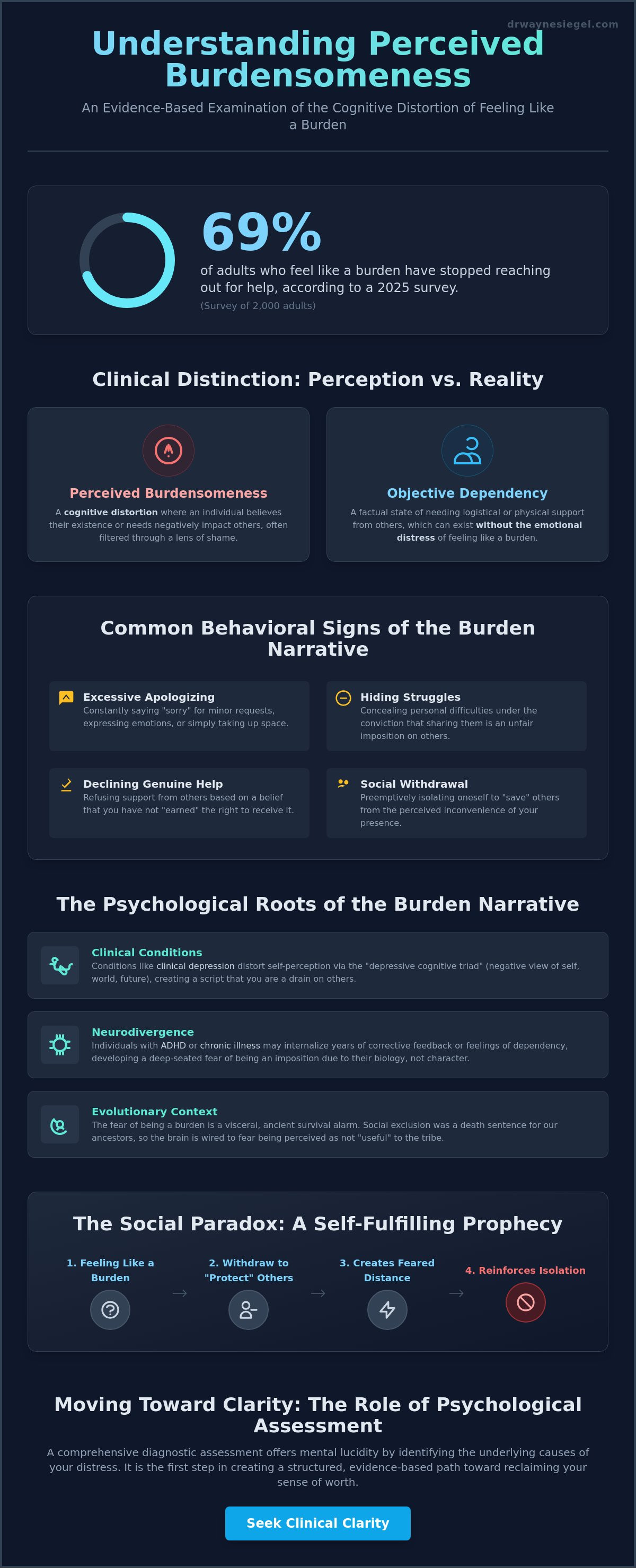
In clinical psychology, we often refer to the persistent sense of being a weight on loved ones as "perceived burdensomeness." This is a psychological construct where an individual believes their existence or needs negatively impact the lives of those around them. It's vital to distinguish this feeling from objective dependency. For instance, a person recovering from a physical injury may objectively depend on a partner for care, yet they can do so without the emotional weight of "being a burden." That specific distress arises only when logistical needs are filtered through a lens of shame, making you feel that your presence is a net negative for the people you love.
This feeling acts as a heavy cognitive filter that distorts every social interaction. If a friend takes a few hours to reply to a text, the filter tells you they're finally exhausted by your presence. If a colleague offers to help with a project, you view it as evidence of your own incompetence rather than their professional support. You might recognize these common signs of the burden narrative in your own life:
- Apologizing excessively for small requests, your emotions, or simply taking up space in a room.
- Hiding your struggles because you're convinced that sharing them would be an unfair imposition.
- Declining genuine help because you feel you haven't "earned" the right to be supported.
- Social withdrawal as a preemptive strike to "save" others from having to deal with you.
The Cognitive Distortion of Burdensomeness
Many clients I work with struggle with "mind reading," a distortion where you assume you know exactly what others are thinking. You might be certain a friend is resentful of your phone call, despite them telling you they're happy to hear from you. This often pairs with all-or-nothing thinking; you believe that if you aren't perfectly independent, you're a total failure. Because the human brain is wired to prioritize negative social cues over positive ones to ensure survival, it's easy to ignore evidence of love and focus entirely on imagined rejection.
Evolutionary Context: Why We Fear Being a Burden
Our ancestors relied on the tribe for survival, and social exclusion was once a literal death sentence. This is why the fear of feeling like a burden to others feels so visceral and dangerous. When you feel you're taking more than you're giving, your brain triggers an ancient alarm system designed to keep you "useful" to the group. However, human relationships are built on a social contract of mutual care. Needing help is a fundamental part of that contract. Recognizing that this alarm is a biological relic rather than a social fact is the first step toward reclaiming your sense of worth.
The Psychological Roots: Why the Burden Narrative Persists
Understanding why you feel this way requires looking beneath the surface of daily interactions. This narrative rarely appears out of nowhere; instead, it's often the result of long-standing psychological patterns or clinical conditions. Clinical depression, for example, often distorts self-perception through what we call the "depressive cognitive triad." This involves a negative view of oneself, the world, and the future. In this state, the brain doesn't just process sadness. It generates a convincing internal script that your presence is a drain on the energy and resources of those you love. I often see this manifest as a total inability to see the value you bring to your relationships.
Neurodivergence also plays a significant role in this experience. Many individuals with ADHD grow up receiving constant corrective feedback about being "too much," "too loud," or "too disorganized." After years of trying to mask these traits to fit in, it's common to develop a deep-seated fear of feeling like a burden to others. You might feel that your executive functioning struggles or your need for stimulation are constant impositions on your partner or friends. Similarly, those living with chronic illness or disability may struggle to separate their objective need for logistical support from their subjective sense of self-worth. This is where a diagnostic psychological evaluation can be incredibly healing, as it helps you understand that your challenges are a result of your biology, not a character flaw.
Attachment Styles and Early Programming
Our early relationships with caregivers set the internal blueprint for how we view our needs. If you experienced childhood emotional neglect, you likely learned that expressing a need was met with silence, annoyance, or rejection. To survive, you may have developed "hyper-independence," a state where you refuse help at all costs because needing someone feels dangerous. In some families, "parentification" occurs, where a child is forced to manage the emotional needs of an adult. This reverses the natural order of care, teaching the child that their own needs are a "nuisance" that disrupts the family's fragile peace.
The Impact of Trauma and PTSD
Trauma can fundamentally shatter your sense of deserving care and support. Many survivors develop what is known as a "fawn" response. This is a survival mechanism where you minimize your own presence and needs to keep others happy and maintain safety. You become an expert at anticipating what others want so you never have to ask for anything yourself. If you recognize these patterns, engaging in PTSD counseling can help you dismantle these old safety strategies. It's a structured way to process the past and realize that taking up space is not only allowed but necessary for a healthy life.
The Social Paradox: How Feeling Like a Burden Causes Isolation
There is a painful irony in the way we handle the sensation of being a weight on others. To understand this, we look to the Interpersonal-Psychological Theory of Suicide developed by Thomas Joiner. His research identifies "perceived burdensomeness" as a critical psychological state where an individual believes their death would be worth more to others than their life. This belief doesn't exist in a vacuum. It often pairs with "thwarted belongingness," the feeling that you're fundamentally disconnected from your social circle. Together, these perceptions create a dangerous social paradox. You withdraw to protect your loved ones from your distress, yet this very withdrawal creates the isolation that reinforces your belief that you don't belong.
This cycle often functions as a self-fulfilling prophecy. When you stop reaching out or decline invitations to "save" your friends from your presence, you inadvertently create actual social distance. Your loved ones may interpret your absence as a lack of interest or a desire for space, leading them to reach out less frequently. When the check-ins stop, your brain uses that silence as evidence that you were right all along. You convince yourself that they're relieved you're gone, when in reality, they're simply respecting the boundaries you unintentionally built. This internal narrative of feeling like a burden to others prevents the very intimacy that could actually dissolve the shame you're carrying.
The Cost of "Protecting" Your Loved Ones
While you might think you're being selfless by hiding your struggles, you're actually increasing the emotional labor for those who care about you. It's exhausting for friends and family to try and guess what you need when you're being opaque. By withholding your truth, you deprive them of the opportunity to be supportive, which is a key component of healthy relationship satisfaction. Vulnerability isn't an imposition; it's a gift that strengthens bonds. It allows others to feel trusted and valued, turning a one-sided struggle into a shared experience of connection.
Identifying the "Burden" Loop
Breaking this cycle requires a step-by-step approach to identify where the logic breaks down. The loop typically follows a predictable path:
- Step 1: You feel low or overwhelmed and assume your needs are too much for others.
- Step 2: You withdraw, stop sharing, or apologize for your emotions to minimize your "footprint."
- Step 3: The resulting lack of connection makes you feel more isolated and more convinced of your burdensomeness.
You can disrupt this by testing small moments of transparency. Instead of disappearing, try saying, "I'm having a hard day and might be a bit quiet, but I'd still like to sit with you." This allows you to remain connected without the pressure to perform "wellness." If you find these cycles are deeply ingrained, choosing a clinic for psychology that focuses on evidence-based assessments can help you identify the underlying clinical drivers of these thoughts. Gaining this type of mental lucidity is often the first step toward building a more transparent and fulfilling life.
Evidence-Based Strategies to Reframe the Narrative
While understanding the roots of your distress is essential, lasting relief comes from applying structured, evidence-based interventions. We often treat our thoughts as absolute truths, but in clinical practice, we view them as mental events that can be observed and managed. By utilizing techniques from Acceptance and Commitment Therapy (ACT) and Cognitive Behavioral Therapy (CBT), you can begin to dismantle the internal script of feeling like a burden to others. These strategies don't aim to "think positive" but rather to achieve a state of mental lucidity where you can see your situation with objective clarity. It's about moving from a place of reactive shame to one of intentional action.
Cognitive Defusion: "I am having the thought that..."
Cognitive defusion is a core component of ACT designed to help you step back from overwhelming thoughts. Instead of engaging in an exhausting argument with your brain, which often makes the thought stronger, you simply label the process. When the thought "I am a burden" arises, try this 3-step process:
- Notice the thought: Recognize it as it appears without judgment.
- Name it: Use the phrase, "I am having the thought that I am a burden."
- Neutralize it: Observe it as a string of words or a mental event rather than an objective fact.
Labeling the thought creates a small but vital space between you and the narrative. This distance prevents the thought from dictating your behavior, such as withdrawing from a social event or avoiding a necessary conversation.
The Evidence-Based Reality Check
CBT provides a framework for fact-checking your perceptions. I often suggest clients create a mental "Evidence For vs. Evidence Against" table. When you examine the evidence for being a burden, you'll likely find it consists of feelings and assumptions. The evidence against it, however, usually includes concrete actions: a friend who continues to call, a partner who expresses love, or the fact that you provide support to them in other ways. Ask yourself: "Would I consider my best friend a burden if they were in my position?" This shift toward the "friend test" leverages Kristin Neff’s framework of self-compassion, reminding you that needing care is a universal human experience, not a personal failing. Reciprocal care over a lifespan means we all take turns being the one who needs support.
Developing a Values-Based Action Plan
Recovery involves moving toward what you value, even when the "burden" thought is present. If you value connection, your action plan might involve sending one text message to a friend today. If you value honesty, it might involve telling a loved one that you're struggling. These small, manageable goals help you re-engage with your support system. Because these patterns can be difficult to break alone, many people find that individual psychotherapy provides the necessary structure to practice these skills. With the expansion of psypact states, accessing specialized care is more convenient than ever, allowing you to work with a practitioner who understands the nuances of your specific cognitive landscape.
Moving Toward Clarity: The Role of Psychological Assessment
Gaining clinical clarity is a vital step in dismantling the persistent belief that you are an imposition on those around you. When you live without a clear understanding of your mental health, it's easy to mistake the symptoms of a condition for permanent character flaws. This confusion often fuels the cycle of feeling like a burden to others. By identifying the underlying drivers of your distress, such as ADHD, depression, or complex trauma, we can shift the narrative from one of personal failure to one of clinical understanding. It's much easier to manage a documented symptom than it is to battle an undefined sense of being "too much" for the people you love.
A formal diagnostic psychological evaluation moves the conversation away from vague feelings of inadequacy toward a precise understanding of your cognitive and emotional architecture. This process isn't about applying a restrictive label; it's about uncovering the "why" behind your behavior. For many, discovering that their social withdrawal is a symptom of a regulated nervous system or executive functioning challenges provides immediate relief. It allows you to stop apologizing for your existence and start utilizing strategies that actually work for your specific brain. Seeking a psychological assessment near me in 2026 provides you with a data-driven roadmap that removes the guesswork from your recovery.
From Labels to Actionable Meaning
The goal of a diagnostic evaluation is to replace the "I am broken" narrative with a "This is how my brain works" perspective. During an assessment, I use standardized testing and clinical interviews to differentiate between your personality and your symptoms. This distinction is crucial. When we identify that your hesitation to ask for help is a learned survival response from past trauma, the shame begins to evaporate. Clinical clarity leads to more effective, evidence-based coping because you're finally treating the right problem with the right tools.
Partnering with a Professional
I view every assessment as a unique puzzle to be solved with care and precision. My role is to act as a steady, non-judgmental guide through your complex emotional landscape, providing a safe environment where your needs are never viewed as an imposition. We work together as partners to gain a transparent understanding of your life. With modern telehealth options, starting this journey is more accessible than ever, allowing you to seek support from the comfort of your own space. If you're ready to move beyond the weight of guilt and toward a life of mental lucidity, you can Contact Siegel Psychology Services to begin your path toward clinical clarity today.
Reclaiming Your Sense of Connection and Worth
The persistent sensation of feeling like a burden to others is rarely an accurate reflection of your social reality. Instead, it's a complex psychological symptom rooted in past programming, neurodivergence, or clinical conditions like depression. By identifying these underlying drivers through a formal diagnostic psychological evaluation, you can move away from reflexive shame and toward actionable meaning. You've seen how evidence-based strategies like cognitive defusion and fact-checking can disrupt the cycle of isolation, allowing you to re-engage with the people who value your presence.
I bring over 25 years of private practice experience as a board-certified clinical psychologist to help you navigate these emotional landscapes with precision. Whether you're seeking individual psychotherapy or a specialized assessment, my goal is to provide you with mental lucidity and a structured path forward. Through the reach of PsyPact telehealth, I provide this professional partnership to individuals across multiple states. You don't have to navigate this weight alone. Schedule a consultation for evidence-based therapy or assessment today to begin restoring your quality of life. You deserve to take up space and experience genuine connection without the shadow of apology.
Frequently Asked Questions
Is feeling like a burden a symptom of depression?
Yes, perceived burdensomeness is a recognized symptom of clinical depression. It often stems from the depressive cognitive triad, which involves a negative view of yourself, the world, and your relationships. This distortion causes you to process help as an imposition rather than an act of care. Recognizing this as a symptom can help you separate the illness from your identity and begin the process of recovery.
How do I stop feeling like a burden to my partner?
You can start by practicing transparency instead of withdrawal. Share your struggle with the feeling itself by saying, "I'm having a hard time today and I'm worried I'm being a weight on you." This allows your partner to provide the reassurance you need while preventing them from having to guess your needs. I also recommend applying the "friend test" to see if you would view them as a burden if the roles were reversed.
Can ADHD make you feel like a burden to others?
Yes, ADHD can frequently lead to feeling like a burden to others due to years of corrective feedback regarding executive dysfunction. If you've spent your life being told you're too disorganized or "too much," you may internalize these criticisms as part of your worth. A formal ADHD assessment can help you understand that these challenges are biological rather than character flaws, allowing you to develop more effective, shame-free strategies.
What is the difference between being a burden and needing help?
The difference lies in the perception of the exchange. Needing help is a logistical reality and a fundamental part of the human social contract. Being a burden is an emotional narrative fueled by shame. While dependency is often situational, the feeling of being a burden is a cognitive filter that persists regardless of the actual level of help you receive. Understanding this distinction is a key step toward mental lucidity.
Why do I feel like a burden even when people tell me I’m not?
This happens because your brain is prioritizing internal narratives over external evidence. When you struggle with cognitive distortions like mind reading, you assume you know what others are thinking despite what they say. Your brain filters out positive reassurance and focuses on imagined cues of resentment. This is why gaining clinical clarity through a diagnostic psychological evaluation is often more effective than simply asking for verbal reassurance from loved ones.
How can I explain my feelings of being a burden to my family?
Try using "I" statements to describe the feeling as a psychological experience rather than a social fact. You might say, "I'm experiencing a symptom of my anxiety that makes me feel like I'm a weight on the family." This helps them understand that the issue is a mental health challenge you're managing, not a reflection of their actual feelings toward you. It invites them to be partners in your care rather than subjects of your guilt.
When does feeling like a burden become a mental health emergency?
This feeling becomes an emergency when it transitions into a belief that your loved ones would be better off if you were no longer here. If you find yourself planning for a future where you are absent to "save" others, please reach out for immediate support. While my practice provides diagnostic psychological evaluations and individual psychotherapy, you should contact a crisis line or your local emergency services for immediate intervention if you are in a state of crisis.
Can therapy actually help me stop feeling this way?
Yes, individual psychotherapy is highly effective at addressing the cognitive patterns that sustain feeling like a burden to others. Techniques from ACT and CBT help you distance yourself from these thoughts and re-engage with your values. Through our work together, we move beyond the symptoms to find actionable meaning and improve your daily quality of life. It's a proactive investment in your long-term mental health and relationship stability.