
How to Stop Ruminating on Negative Thoughts: Evidence-Based Strategies for Mental Clarity

Your brain likely convinces you that replaying a mistake for the hundredth time is a form of productive problem-solving, but research suggests it's actually a cognitive trap. This habit, known as rumination, is a significant risk factor for depression and anxiety, contributing to the fact that 43% of American adults reported feeling more anxious in 2024 than the previous year. If you've spent hours lying awake at night or lost focus during a critical workday, you're likely searching for how to stop ruminating on negative thoughts and regain your mental lucidity.
I understand how exhausting it feels when your mind refuses to rest, turning a simple concern into an endless loop of mental fatigue. It's frustrating to feel like a passenger in your own head when you're simply trying to move forward with clarity. In this guide, I'll share research-driven psychological techniques designed to disrupt these patterns and help you reclaim cognitive control. We'll explore the critical difference between active problem-solving and passive rumination, providing you with a structured, evidence-based path toward a more transparent and focused life.
Key Takeaways
- Identify the "Solving Trap" by applying the Action Test to distinguish between productive planning and the repetitive loops of rumination.
- Discover research-driven techniques for how to stop ruminating on negative thoughts, such as naming the process to create distance between yourself and your cognitive patterns.
- Examine the connection between perfectionism and overthinking to address the maladaptive coping mechanisms that maintain emotional distress.
- Learn when persistent mental fatigue warrants a professional diagnostic psychological evaluation to uncover underlying conditions like GAD or OCD.
Understanding Rumination: The Mechanism of Repetitive Negative Thinking
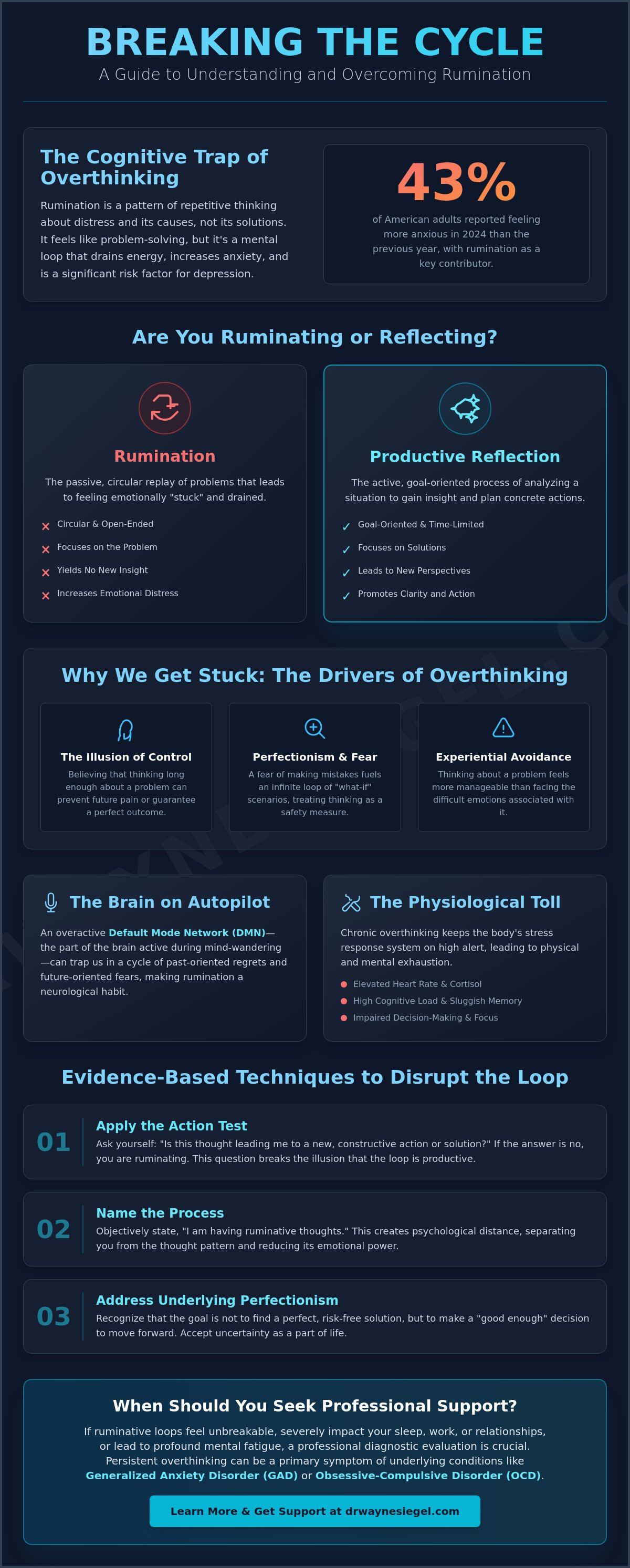
In my clinical work, I often see patients who feel trapped by their own minds. Clinically, Rumination (psychology) is defined as a pattern of excessive, repetitive thinking about one's distress and its causes, rather than its solutions. It's a sustained process that differs significantly from intrusive thoughts, which are fleeting and spontaneous. While it might feel like you're working through a problem, you're actually stuck in a loop that drains your mental energy. Learning how to stop ruminating on negative thoughts begins with recognizing that this cycle is a mechanism of the brain, not a personality flaw.
The psychological "why" behind this habit often stems from a desire to process unresolved emotional distress. Your brain attempts to "solve" a feeling the same way it would solve a math problem, but emotions don't always follow a linear logic. This creates a physiological toll. Chronic overthinking triggers the body's stress response system, keeping your heart rate and cortisol levels elevated long after a situation has passed. This state of constant "high alert" can lead to profound mental and physical exhaustion.
The Difference Between Healthy Reflection and Rumination
The primary distinction lies in the outcome. Reflection is a time-limited, goal-oriented process where you analyze a situation to gain insight or plan a concrete action. Rumination, by contrast, is circular and open-ended. You've likely reached the "tipping point" when your thoughts no longer yield new perspectives, but instead leave you feeling emotionally "stuck." While reflection looks for a way out, rumination only looks deeper into the struggle. It's a shift from active engagement to passive repetition.
How Ruminative Loops Affect Daily Quality of Life
When these loops take over, they severely impact executive functions like decision-making and focus. You might notice that your working memory feels sluggish, as if your brain is running too many background programs at once. Cognitive load represents the total amount of mental effort being used in your working memory at any given moment. High cognitive load from repetitive thinking leaves little room for the tasks right in front of you. This often spills over into your personal life, causing sleep disturbances and social withdrawal. If these loops feel unbreakable, a formal diagnostic psychological evaluation can help determine if this is a symptom of an underlying condition that requires a more structured path forward.
Why We Get Stuck: The Psychological Drivers of Overthinking
Understanding the mechanics of a loop is the first step, but we must also examine why the brain chooses to stay there. Many people I work with in my practice find that their overthinking isn't just a random occurrence; it's often driven by a deeply ingrained need for certainty. This is the "Illusion of Control." We believe that if we just think about a problem long enough, we can prevent future pain or avoid making a mistake. In reality, this drive for "perfect" solutions often acts as the primary trigger for ruminative cycles, making it hard to learn how to stop ruminating on negative thoughts effectively.
Research into the brain's biological framework highlights the role of the Default Mode Network (DMN). This network is active when our minds wander or engage in self-referential thought. When the DMN becomes overactive, it can trap us in a cycle of past-oriented regrets or future-oriented fears. This biological "autopilot" is often exacerbated by past trauma, where the brain remains hyper-vigilant. If you find these cycles are persistent and interfering with your daily quality of life, it may be helpful to seek professional support to identify the underlying drivers.
The Perfectionism and Control Connection
High personal standards and a fear of making mistakes fuel the need for absolute certainty. This creates an infinite loop of "what if" scenarios. You aren't just thinking; you're attempting to solve every possible negative outcome before it happens. This self-critical rumination makes it difficult to understand how to stop ruminating on negative thoughts because the brain views the thinking process as a safety measure. The more we value "perfect" outcomes, the more our mind refuses to let go of unresolved details, turning a simple concern into a heavy cognitive burden.
Rumination as an Avoidance Strategy
In clinical psychology, we call this "experiential avoidance." It sounds counterintuitive, but thinking about a problem can be a way to avoid feeling the raw, underlying emotion associated with it. Analyzing a trauma or an anxiety-inducing event in your head feels safer than actually experiencing the vulnerability or grief involved. While "solving" in your head provides a temporary sense of security, it prevents true emotional processing. The cognitive act of overthinking serves as a shield against the discomfort of the present moment. For those looking for a structured path forward, a diagnostic psychological evaluation can provide the clarity needed to move beyond these avoidance patterns and find actionable meaning.
Rumination vs. Productive Problem Solving: Breaking the Illusion
One of the most persistent hurdles in learning how to stop ruminating on negative thoughts is what I call the "Solving Trap." This is the cognitive illusion that repetitive thinking is a form of mental work. Your brain signals that you're being productive because you're focusing on a problem, yet the process yields no new information. In reality, you're merely revisiting the same data points without reaching a conclusion. This cycle is fundamentally different from productive problem-solving, which moves toward a resolution rather than circling the distress.
To break this illusion, I recommend using the "Action Test." Ask yourself: "Does this thought lead to a concrete next step that I can take today?" If the answer is no, you're likely ruminating. Productive thinking is empowered and expansive, whereas rumination leaves you feeling depleted and narrow-minded. By evaluating the utility of your thoughts, you can begin to see whether you're gathering new insight or simply repeating a known narrative, which is a key step in learning how to stop ruminating on negative thoughts.
The Action-Oriented Framework
Solvable problems have specific parameters and actionable outcomes, such as "How do I prepare for tomorrow's meeting?" Ruminative themes, however, are often abstract and unanswerable, like "Why am I always so awkward?" Shifting your internal dialogue from "Why did this happen?" to "What is my next step?" transforms a circular loop into a linear path. If a complex issue requires deep thought, set a "thinking time" boundary of 15 to 20 minutes to prevent analysis from becoming maladaptive.
Assessing the Evidence for Your Thoughts
We can use Cognitive Behavioral Therapy (CBT) tools to challenge the validity of these repetitive themes. Often, our ruminative thoughts are based on emotional reasoning rather than objective data. To verify the accuracy of a thought, ask yourself if a neutral third party would agree that the evidence supports your conclusion as a proven fact or merely an interpretation. Gaining clinical clarity allows you to move beyond the labels you've placed on yourself and find actionable meaning in your experiences.
Evidence-Based Techniques to Disrupt Ruminative Loops
While understanding the mechanism of overthinking is vital, the practical challenge lies in disrupting the cycle as it happens. Learning how to stop ruminating on negative thoughts requires a shift from content to process. Instead of fighting the thought, we change how we relate to it. This transition from being a participant in the loop to becoming an observer is the foundation of cognitive control. By utilizing research-driven strategies, you can begin to lower your cognitive load and regain mental clarity.
Cognitive Defusion, a core component of Acceptance and Commitment Therapy (ACT), teaches us to observe thoughts without being fused to them. A simple yet powerful technique is "Naming the Process." Instead of stating, "I am a failure," you reframe it to, "I am having the thought that I am a failure." This small linguistic shift creates the mental space necessary to view the thought as a transient event rather than an absolute truth. If you feel overwhelmed by the complexity of your internal landscape, Diagnostic Psychological Evaluations can provide a structured starting point for understanding these patterns.
Cognitive Defusion and Mindfulness Strategies
Creating mental space involves recognizing that thoughts are merely bits of language and imagery passing through your mind. The "Leaves on a Stream" exercise is a helpful visualization where you imagine each ruminative thought as a leaf floating down a slow-moving river. You don't try to stop the stream or remove the leaves; you simply watch them pass. Mindfulness isn't about stopping thoughts, but changing your relationship with them so they no longer dictate your emotional state.
Behavioral Interventions for Immediate Relief
Physical movement and sensory engagement are essential for shifting cognitive states. I often recommend the "Two-Minute Rule" for disrupting a loop. If you find yourself spinning, engage in a task that requires full sensory focus for at least two minutes, such as washing dishes or mindful walking. This reset is often more effective than trying to "think your way out" of the problem. Additionally, shifting your physical environment by moving to a different room can help break the association between a specific space and a ruminative theme.
Another effective containment strategy is Scheduled Rumination. By setting a "worry window" of 15 to 20 minutes each day, you give yourself permission to process concerns within a controlled timeframe. When a negative thought arises outside this window, acknowledge it and gently postpone it until the scheduled time. This practice helps you regain authority over your schedule and prevents overthinking from bleeding into your sleep or work hours.
When to Seek Professional Support for Persistent Overthinking
The strategies we've discussed provide a powerful foundation for self-regulation, yet there are times when the habit of overthinking becomes too deeply entrenched to manage alone. If your efforts to learn how to stop ruminating on negative thoughts feel like they're meeting a wall of mental fatigue, it may indicate that the rumination is a symptom of a broader clinical condition. In my practice, I often see rumination as a transdiagnostic factor. This means it's a core process underlying various challenges, including Generalized Anxiety Disorder (GAD), Obsessive-Compulsive Disorder (OCD), and Depression. Recognizing this distinction isn't about accepting a limiting label; it's about gaining the clinical clarity needed to find a structured path forward.
Working with a board-certified psychologist offers a level of precision that self-help tools cannot always provide. I view every individual's cognitive landscape as a unique puzzle to be solved with care and meticulous attention. A professional partnership transforms a clinical service into a personal invitation to understand the underlying causes of your distress. By integrating rigorous science with a warm, empathetic approach, we can move beyond surface-level symptoms to address the whole person and restore a sense of calm stability.
The Role of Evidence-Based Psychotherapy
Individualized therapy targets the specific cognitive habits that keep you stuck in repetitive loops. While traditional Cognitive Behavioral Therapy (CBT) is effective for challenging distorted thoughts, I also emphasize Acceptance and Commitment Therapy (ACT). This modern approach helps you change your relationship with your internal experiences, teaching you to observe thoughts without letting them control your actions. For those whose overthinking is rooted in past events, integrating PTSD counseling provides a research-based framework for recovery. This specialized care ensures that the methodology is as rigorous as it is compassionate.
Finding Your Path to Mental Lucidity
The ultimate promise of professional consultation is a future-oriented focus on improving your daily quality of life. Moving from a state of emotional disarray toward actionable meaning requires a steady, non-judgmental guide who can navigate complex landscapes with you. We begin by looking past mere labels to understand how your cognitive patterns serve or hinder your growth. Taking the first step toward recovery often involves a comprehensive psychological assessment, which serves as a roadmap to clinical clarity. This process is designed to lower the barrier of anxiety, providing the safety and stability needed to reclaim your focus and move forward with confidence.
Reclaiming Your Cognitive Control
Disrupting a ruminative loop requires more than willpower; it involves a strategic shift in how you engage with your own mind. We've examined how distinguishing between circular thinking and active problem-solving can lower your cognitive load. By applying evidence-based tools like cognitive defusion and behavioral activation, you can move from feeling trapped by repetitive themes to observing them with clinical clarity. Learning how to stop ruminating on negative thoughts is a process of reclaiming your mental lucidity and focusing on a life driven by your values rather than your fears.
If these patterns feel unbreakable, I'm here to offer a steady, non-judgmental guide through the process. As a board-certified clinical psychologist with over 25 years of experience, I specialize in research-driven CBT and ACT approaches designed to solve these complex cognitive puzzles. I provide telehealth consultations across all PsyPact states to ensure you have access to specialized, person-centered care. Schedule a consultation with Dr. Wayne Siegel to gain clinical clarity and break the cycle of rumination. You don't have to manage this burden alone; a structured path toward a more transparent and peaceful life is waiting for you.
Frequently Asked Questions
Is rumination the same thing as overthinking?
Rumination is a specific form of overthinking that focuses almost exclusively on past distress and perceived failures. While overthinking can include future-oriented worries or decision paralysis, rumination is characterized by its circular, repetitive nature regarding things that have already happened. It's a passive process that lacks a goal-oriented resolution, making it distinct from active, analytical thinking.
Can rumination be a sign of a mental health disorder?
Yes, persistent rumination is often a transdiagnostic symptom of conditions like Major Depressive Disorder, Generalized Anxiety Disorder, or OCD. It acts as a bridge that maintains emotional distress across various diagnoses. If you find these loops are unbreakable, a diagnostic psychological evaluation can help clarify whether your thinking patterns are part of a broader clinical condition that requires a structured path forward.
Why do I ruminate more at night than during the day?
Nighttime rumination increases because the brain lacks the external stimuli and present-moment tasks that occupy your cognitive load during the day. When you're lying in bed, your brain's Default Mode Network becomes more active. Without the distraction of work or social interaction, your mind naturally turns inward, often replaying unresolved emotional puzzles or self-referential concerns that were suppressed during your active hours.
How long does it take for CBT or ACT to stop rumination?
The timeline for improvement varies, but many individuals report a significant reduction in the intensity of their loops within 8 to 12 sessions of evidence-based therapy. The goal of these approaches isn't to stop thoughts instantly, but to build the skills needed to disrupt the loop. Consistent practice of techniques like cognitive defusion is essential for achieving long-term mental lucidity and regaining cognitive control.
What is the 'Solving Trap' in negative thinking?
The "Solving Trap" is the cognitive illusion that replaying a mistake is a form of productive mental work. Your brain mistakenly signals that you're working toward a resolution, which makes it difficult to learn how to stop ruminating on negative thoughts effectively. In reality, you're merely revisiting the same data without reaching a conclusion, which drains your mental energy rather than providing a solution.
Can medication help with ruminating thoughts?
Medication can sometimes lower the baseline intensity of the anxiety or depression that fuels overthinking, but it doesn't teach the cognitive skills required to break the habit. My focus is on providing evidence-based psychological strategies like ACT and CBT to help you change your relationship with your thoughts. For those seeking medication, a consultation with a psychiatrist or primary care physician is the appropriate next step.
How do I explain my rumination to a therapist?
Describe your experience as a "mental loop" or a "broken record" that interferes with your ability to focus or sleep. It's helpful to mention specific triggers, such as social interactions or work performance, and explain how the process feels different from your normal problem-solving. This helps me understand your unique cognitive puzzle and allows us to build a person-centered plan for your recovery.
Is it possible to completely stop having negative thoughts?
It's not possible to eliminate negative thoughts entirely, as the brain is biologically hardwired to identify potential threats and past errors. Success isn't defined by the absence of thoughts, but by your ability to notice them without being controlled by them. The goal is learning how to stop ruminating on negative thoughts once they arise, ensuring they remain fleeting rather than becoming sustained, energy-draining cycles.