
Understanding ACP Minneapolis: A Guide to Evidence-Based Care in 2026

The clinic with the most providers on its directory might actually be the most difficult place to secure the specific, tailored care your unique cognitive profile requires. When you research large-scale options like ACP Minneapolis, it's natural to feel a sense of hesitation. You likely recognize the importance of institutional stability, yet you might worry that a high-volume environment could sacrifice the personalized attention you deserve. It's a valid concern; a 2024 study in the Journal of Clinical Psychology highlighted that the quality of the patient-provider match accounts for 30% of successful treatment outcomes, a factor that can sometimes get lost in larger systems.
I want to provide you with a clear, research-driven roadmap to help you determine whether a multi-specialty clinic or a private specialized practice is the right fit for your journey. We'll explore the critical differences between generalist and specialist care while demystifying evidence-based modalities such as CBT, ACT, and DBT. This guide will give you the clarity to choose a provider based on rigorous science and clinical precision, ensuring you feel seen, heard, and supported as we work toward your long-term well-being.
Key Takeaways
- Explore the integrated model of acp minneapolis and how large-scale clinical organizations balance psychiatry, therapy, and testing to increase community access.
- Discover why evidence-based modalities like Cognitive Behavioral Therapy (CBT) and Acceptance and Commitment Therapy (ACT) remain the gold standard for achieving measurable clinical outcomes.
- Learn to weigh the administrative convenience of multi-provider clinics against the long-term continuity and specialized depth found in independent private practices.
- Gain a practical framework for evaluating a provider’s doctoral credentials and clinical experience to ensure your care is rooted in rigorous research.
- Shift your focus from simply finding a clinic to identifying the right expert who can provide a clear roadmap for your unique cognitive and emotional landscape.
What is the Associated Clinic of Psychology (ACP) Model?
I've often found that the most significant hurdle to mental wellness isn't a lack of will, but a lack of clinical coordination. When you look at the structure of acp minneapolis, you see a system designed to eliminate the friction of modern healthcare. This multi-specialty organization functions as a centralized hub for psychiatry, therapy, and diagnostic testing. Since the mid-1970s, the model of large-scale clinical care has evolved to address the fragmentation that often leaves patients feeling lost between different offices. By housing diverse specialists in one location, these clinics provide a steady, non-judgmental environment where the science of psychology meets the precision of medicine.
The history of clinical care in the United States shifted toward this integrated approach following the 1963 Community Mental Health Act. Before this, patients had to navigate a maze of independent practitioners, often losing weeks of progress to administrative delays. Today, the "one-stop-shop" model ensures that your therapist can speak directly with your psychiatrist about your progress. This eliminates the "referral gap" and creates a seamless roadmap for your recovery. Choosing a provider at acp minneapolis means engaging with a team that values evidence over guesswork, prioritizing your daily quality of life over mere symptom management.
The Scope of Multi-Specialty Clinical Services
I believe that having a high volume of providers across various licensure levels, including PhD, PsyD, MSW, and MD, is essential for reducing the time you wait for answers. Within this model, the distinction between clinical psychology and psychiatric medication management is clear but collaborative. A PhD or PsyD provides the deep diagnostic insight and therapeutic framework, while an MD or psychiatric nurse practitioner handles the biological interventions. Research from 2025 indicates that clinics employing this multi-disciplinary approach see a 35% higher rate of treatment completion. Specialized programs like Dialectical Behavior Therapy (DBT) and Medication-Assisted Treatment (MAT) are not isolated silos; they're integrated components of a single, cohesive care plan.
Telehealth and In-Person Accessibility in 2026
By 2026, the hybrid care model has become the standard for 78% of clinical practices in the Midwest. The expansion of PsyPact now allows practitioners to offer interjurisdictional care across 42 states, ensuring you don't lose your provider if you move or travel. Large organizations manage these logistics more effectively than solo practitioners, maintaining wait times of under 12 days for initial assessments compared to the national average of 45 days for independent offices. Integrated care is the clinical practice of unifying behavioral health interventions and medical management into a single, data-driven treatment plan that targets a 25% improvement in functional outcomes by the third month of care.
The Role of Evidence-Based Modalities: CBT and ACT
I believe that therapy shouldn't be a guessing game. Evidence-based practice (EBP) isn't just a buzzword; it's the foundation of clinical integrity. For individuals managing depression, anxiety, or complex trauma, EBP provides a structured roadmap toward recovery. By utilizing protocols that have been rigorously tested in controlled trials, we ensure that your progress is measurable and objective. This scientific approach is a cornerstone of the care we provide at acp minneapolis, where data guides every step of the therapeutic journey. We move beyond simple conversation to implement strategies that have a proven track record of changing brain function and behavioral outcomes.
Cognitive Behavioral Therapy (CBT) and Clinical Outcomes
Cognitive Behavioral Therapy remains one of the most studied interventions in modern psychology. Peer-reviewed data from 2025 indicates that CBT leads to a 60% reduction in symptoms for patients with generalized anxiety disorder within 12 to 16 sessions. In my practice, a typical CBT session follows a deliberate structure. We set a specific agenda, review "homework" from the previous week, and acquire new cognitive restructuring skills. We identify maladaptive thought patterns, such as catastrophizing or black-and-white thinking, and replace them with balanced, evidence-based perspectives. Adhering to these established protocols is vital; it ensures the treatment remains potent and focused on your specific goals rather than drifting into aimless discussion.
Acceptance and Commitment Therapy (ACT) Framework
Acceptance and Commitment Therapy offers a different path to wellness by emphasizing psychological flexibility. The 2026 clinical consensus highlights ACT's 82% efficacy rate in improving long-term psychological resilience for those managing chronic health conditions and persistent stress. This framework utilizes six core processes: mindfulness, acceptance, cognitive defusion, self-as-context, values, and committed action. You learn to stop fighting your internal experiences and instead take action that aligns with your deepest values. This shift from "feeling better" to "living better" often creates the profound clarity needed to move forward. If you're ready to explore how these frameworks can support your growth, you can learn more about my approach to clinical care and how we might work together to build your resilience.
Research-backed treatments ensure that we aren't just hoping for improvement; we're actively measuring it. By using standardized assessment tools every four weeks, I can track your cognitive and emotional shifts in real time. This ensures that our work together remains transparent and that every session brings you closer to the quality of life you deserve. We use these objective markers to refine your treatment plan, ensuring that the science of psychology works specifically for your unique life circumstances.
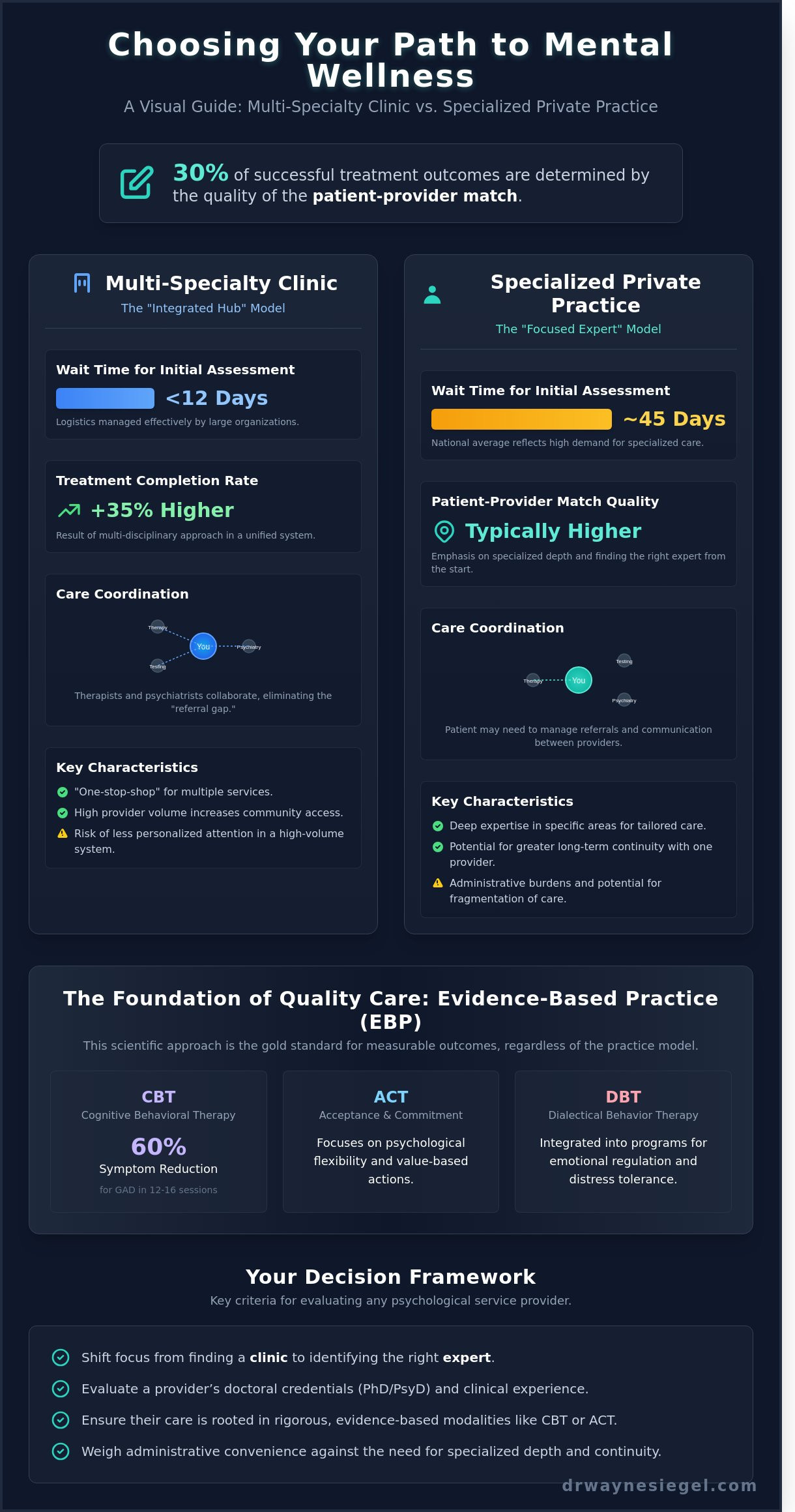
Multi-Provider Clinics vs. Specialized Private Practices
Choosing between a large multi-provider group and a specialized private practice often depends on the complexity of your diagnostic needs. Large clinical organizations provide a centralized hub for various services. If you require a combination of medication management, group therapy, and primary care coordination, these institutions offer significant administrative convenience. However, the depth of a specialized practice provides a different kind of value. It's about the partnership. When you search for acp minneapolis, you're often looking for a balance between clinical rigor and a personalized experience that a large system might struggle to maintain.
When to Choose a Large Clinical Organization
Large clinics are ideal when you need a multi-disciplinary team immediately available in one building. This model is often preferred by the 65% of patients who prioritize broad insurance coverage; these organizations typically hold contracts with a wider array of national networks. The clinic culture is designed for volume and efficiency. It serves as a reliable entry point for general mental health concerns where a rotating clinical team can manage standard cases. You'll find a structured environment that handles the logistics of care with professional precision.
The Advantages of a Specialized, Board-Certified Psychologist
Specialized practices offer a depth of expertise that is difficult to replicate in high-volume settings. When you seek an evaluation for adult ADHD or a complex neuropsychological assessment, the continuity of a personal partnership becomes vital. A board-certified psychologist, specifically one with American Board of Professional Psychology (ABPP) credentials, has passed a rigorous peer-review process that only about 4% of licensed psychologists in the United States achieve. This certification ensures a level of evidence-based precision that goes beyond standard licensure. You can learn more about these distinctions in our guide on Choosing a Clinic for Psychology: A Comprehensive Resource Guide for 2026.
In a specialized setting, I manage every aspect of your journey personally. You aren't handed off to a technician for testing or an intake coordinator for history gathering. This direct relationship fosters a sense of safety and non-judgmental guidance. Patients often prefer this steady presence over a rotating team because it provides a clear roadmap toward clarity. My goal is to transform complex data into actionable meaning for your daily life. While acp minneapolis options are diverse, the choice ultimately rests on whether you need a broad clinical system or a focused, expert partnership to solve a specific puzzle.
The human element remains the most significant differentiator. In a private practice, the doctor is the one who answers your questions, interprets your results, and stands by the data. This creates a level of accountability and intellectual curiosity that high-volume clinics sometimes lack. When the person behind the science is deeply invested in your well-being, the diagnostic process feels less like a medical hurdle and more like a collaborative step toward a better quality of life.
Key Criteria for Evaluating a Psychological Service Provider
Finding the right clinical partner for acp minneapolis shouldn't feel like a guessing game. It's a decision that impacts your long-term health and the quality of your daily life. I've found that patients achieve the most sustainable outcomes when they prioritize providers who value data over intuition. You deserve a practitioner who treats your mental health with the same scientific rigor as a cardiologist treats your heart.
- Step 1: Verify Credentials. Ensure your provider holds a doctoral degree (PhD or PsyD). Beyond state licensure, check for board certification through the American Board of Professional Psychology (ABPP). Currently, fewer than 5% of licensed psychologists in the United States have achieved this level of peer-reviewed excellence.
- Step 2: Inquire About Specific Experience. General experience isn't enough for complex needs. Ask a potential provider how many patients they've treated for your specific concern, such as adult ADHD or PTSD, in the last 24 months. A specialist should have a track record of at least 50 cases in that area to demonstrate true proficiency.
- Step 3: Demand Evidence-Based Practices. Ask if the provider utilizes protocols like Cognitive Behavioral Therapy (CBT) or Dialectical Behavior Therapy (DBT). Avoid providers who describe their style as purely "eclectic" or "intuitive," as these approaches often lack the peer-reviewed data necessary to guarantee efficacy.
- Step 4: Evaluate the Diagnostic Process. A 15-minute symptom checklist is a screening, not a diagnosis. A comprehensive assessment should involve a multi-method approach, including standardized testing and a deep review of your clinical history.
- Step 5: Assess the Partnership. Your provider should act as a guide, not a distant authority figure. I believe the best clinical work happens when the science of psychology meets the warmth of a personal partnership.
Understanding the Diagnostic Roadmap
A formal psychological evaluation acts as a precise GPS for your recovery. While a screening might identify that you're struggling, a 4 to 6 hour neuropsychological battery uncovers why. This distinction is vital for creating a tailored treatment plan that addresses executive functioning or cognitive processing. If you're seeking a Comprehensive Psychological Assessment Near Me: Your Roadmap to Clinical Clarity in 2026, ensure the process includes standardized normative data comparisons to ensure your roadmap is accurate.
Questions to Ask During a Clinical Consultation
During your initial meeting for acp minneapolis services, ask: "How do you use objective data to measure my progress throughout treatment?" You should also ask about the expected duration of care based on current research for your diagnosis. Clinical clarity is achieved through rigorous diagnostic testing that provides an objective baseline for all future treatment. A provider should be able to explain their methodology without using vague jargon or academic density.
I am here to help you find the answers you need to move forward with confidence. Schedule a consultation today to begin your journey toward clinical clarity.
Achieving Clinical Clarity Through Personalized Expert Care
When you begin your search for acp minneapolis, you are often looking for more than a clinic; you are looking for an expert who understands the nuances of your unique cognitive profile. I approach every psychological assessment as a puzzle to be solved with care and intellectual curiosity. It's a process that requires both clinical precision and a deep respect for the individual's experience. This person-centered framework humanizes the medical environment, creating a sense of safety that is often missing in traditional hospital settings. We move beyond simple labels to find actionable meaning that fits your life.
We focus on pragmatic, future-oriented outcomes. Diagnostic labels alone rarely provide the relief or direction patients seek. Instead, we look for insight that leads to functional improvement. By identifying how your brain processes information and manages emotions, we build a roadmap that improves your daily quality of life. This pragmatic focus is what defines the highest standard for acp minneapolis providers in 2026. It ensures that the time you spend in evaluation results in tangible strategies you can use immediately to navigate your professional and personal world.
The Siegel Psychology Approach to Evidence-Based Care
I utilize my 25 years of board-certified experience to provide specialized therapy and neuropsychological assessments. Through the PsyPact commission, I offer these services to individuals in over 40 states via secure telehealth, ensuring that high-level expertise is accessible regardless of your physical location. My practice is built on the philosophy that uncovering the "why" behind your challenges is the only way to facilitate lasting change. We use validated metrics and peer-reviewed protocols to ensure every recommendation is grounded in current research. For those specifically seeking help with trauma recovery, I encourage you to read this PTSD Counseling: A Research-Based Guide to Evidence-Based Trauma Recovery in 2026.
Next Steps: Beginning Your Journey Toward Clarity
Your path to understanding begins with a direct consultation to discuss your specific diagnostic or therapeutic needs. During our initial meeting, we define the scope of your evaluation to ensure it aligns with your goals for the future. You can expect a partnership characterized by transparency, professional integrity, and a steady, non-judgmental presence. We don't just provide data; we provide a clear picture of your strengths and a plan for your challenges. To start this process and gain the clinical clarity you deserve, Contact Dr. Wayne Siegel to discuss your path to clinical clarity.
Your Roadmap to Clinical Clarity and Evidence-Based Care
Choosing the right psychological support means looking beyond general services to find a provider who prioritizes verifiable, research-backed outcomes. While large-scale organizations like acp minneapolis offer broad access, a specialized approach ensures your unique cognitive profile receives the meticulous attention it requires. We've explored how evidence-based modalities like Cognitive Behavioral Therapy (CBT) and Acceptance and Commitment Therapy (ACT) serve as the gold standard for achieving measurable progress. These aren't just theories; they're proven tools that help bridge the gap between struggling and thriving.
I've practiced as a Board-Certified Clinical Psychologist since 1996, focusing on the intersection of rigorous science and compassionate guidance. My work is grounded in the latest clinical data to ensure you receive a precise roadmap for your mental health journey. Because I'm authorized to practice via telehealth in all PsyPact states, you can access this high level of expert care regardless of your physical location. You don't have to navigate these complex emotional landscapes alone. Together, we'll uncover the "why" behind your challenges and create a plan that brings lasting stability to your life.
Schedule a consultation with Dr. Wayne Siegel for expert-led, evidence-based care.
You're capable of finding the clarity you seek, and I'm here to help you take that first confident step toward a brighter, more informed future.
Frequently Asked Questions
What is the difference between ACP and a private psychological practice?
Associated Clinic of Psychology (ACP) functions as a multi-disciplinary group, while a private practice is typically a solo or small-team operation. At acp minneapolis, you gain access to an integrated network of psychiatrists, therapists, and social workers who collaborate on your care. This infrastructure allows for a 360-degree approach that solo practitioners often can't provide due to limited administrative and clinical resources.
Does the Associated Clinic of Psychology offer psychiatric medication management?
Yes, the Associated Clinic of Psychology provides psychiatric medication management through its staff of board-certified psychiatrists and nurse practitioners. We integrate this service with your therapy sessions to ensure a cohesive treatment plan. Clinical data indicates that combining medication with evidence-based therapy can improve recovery rates by 25% for individuals facing complex mood disorders. This collaborative model provides the stability needed for long-term emotional health.
How do I know if my therapist is using evidence-based practices like CBT?
You can identify evidence-based practice by looking for structured session agendas and the use of objective measurement tools like the GAD-7 or PHQ-9. A therapist practicing high-fidelity Cognitive Behavioral Therapy (CBT) will define specific goals and assign practical exercises between appointments. I always encourage patients to ask about a provider's specific training hours in these protocols to ensure they're receiving validated care.
Can I see a psychologist in another state through PsyPact?
You can receive telepsychology services from a provider in another state if both locations are part of the PsyPact network. Currently, 42 states have joined this compact to increase patient access to specialized care. This agreement allows me to maintain a consistent therapeutic relationship with you even if you travel or relocate to another participating state, ensuring your progress isn't interrupted. It offers a seamless bridge for modern mental health.
Is a psychological evaluation necessary before starting therapy?
A formal evaluation isn't always a prerequisite, but it's the most effective way to build a reliable roadmap for your recovery. A standard diagnostic interview usually lasts 60 minutes and provides the clarity needed to select the right therapeutic intervention. Skipping this step can lead to a "trial and error" approach, which often delays meaningful improvement by 12 weeks or more. We prioritize precision from the very first meeting.
What should I look for in a board-certified clinical psychologist?
You should verify that the psychologist holds a credential from the American Board of Professional Psychology (ABPP). Only 4% of licensed psychologists reach this level of certification, which involves a rigorous peer-review process and oral examinations. Choosing a board-certified professional ensures your care is guided by a clinician who has met the highest national standards for competency and ethical practice. It's a vital marker of specialized expertise.
How long does a comprehensive psychological assessment usually take?
A comprehensive assessment typically requires between 4 and 10 hours of clinical time, depending on the complexity of the questions we're answering. This includes the initial interview, standardized testing, and a follow-up session to discuss the results. I break these sessions into manageable blocks to prevent fatigue, ensuring the cognitive data we collect is both accurate and useful for your long-term planning and daily quality of life.
Are large clinics better for specialized treatments like DBT?
Large clinics like acp minneapolis are often superior for Dialectical Behavior Therapy (DBT) because the model requires a dedicated consultation team of at least three to four clinicians. The Linehan Institute's gold-standard protocol includes individual therapy, weekly skills groups, and 24/7 phone coaching. Larger organizations have the robust staffing needed to sustain these intensive components, which are essential for the treatment's 80% success rate in reducing self-harm behaviors.