
Feeling Emotionally Numb and Empty: Understanding the Science of Emotional Detachment

Did you know that approximately 10% of the general population struggles with alexithymia, a condition characterized by a significant difficulty in identifying or describing feelings? If you're currently feeling emotionally numb and empty, it's natural to fear that you're permanently broken or losing your mind. I've often seen patients walk into my office feeling a deep sense of confusion because they can't access grief or joy, even during life's most significant moments. This state isn't a character flaw; it's actually a sophisticated biological defense mechanism designed to protect your psyche from perceived overwhelm.
I want to provide you with the clarity you deserve by exploring the rigorous science behind emotional detachment. You'll learn the biological reasons why your brain might "shut down" and how the 2022 DSM-5-TR differentiates these symptoms from major depression. We'll also preview emerging 2026 evidence-based frameworks, such as Positive Affect Treatment, that offer a roadmap to help you regain your sense of connection. By uncovering the "why" behind your experience, we can move toward a practical path for emotional re-engagement and a better quality of life.
Key Takeaways
- Understand that numbness is a sophisticated biological defense mechanism involving the amygdala and prefrontal cortex, rather than a sign that you're permanently broken.
- Identify why you're feeling emotionally numb and empty by exploring the "Window of Tolerance" and how the brain enters a hypo-arousal state to manage perceived overwhelm.
- Differentiate between emotional blunting in Major Depressive Disorder and the specific patterns of withdrawal often seen in PTSD and moral injury.
- Learn how evidence-based frameworks like Acceptance and Commitment Therapy (ACT) build psychological flexibility to help you safely re-engage with your emotional world.
- Discover how a diagnostic psychological evaluation provides a clear roadmap to uncover the root causes of your symptoms and improve your daily quality of life.
What Does it Mean to Be Feeling Emotionally Numb and Empty?
In my clinical practice, I frequently encounter individuals who describe a profound sense of feeling emotionally numb and empty. This state, clinically referred to as affective blunting, is characterized by a significant reduction in emotional reactivity. It isn't that emotions are entirely absent; rather, the volume has been turned down so low that the world feels distant and muted. While acute stress can cause temporary numbness as a protective measure, chronic states often indicate a more complex underlying condition that requires a structured roadmap to navigate.
The DSM-5-TR, published in 2022, recognizes these symptoms within several frameworks, including Depersonalization Disorder and Post-Traumatic Stress Disorder. Many of my patients worry they're "broken" or uniquely unfeeling. I want to reassure you that this is a recognized psychological response. It often serves as a survival mechanism when the brain determines that the cost of feeling is too high for the current environment.
The Subjective Experience of Emptiness
Patients often describe their daily lives as a "grayed out" version of reality where the peaks of joy and the valleys of pain both disappear. This Emotional detachment often forces a person to "fake" reactions during social interactions, leading to a specific type of cognitive exhaustion from the effort of appearing connected. You might feel like an outside observer of your own life, moving through the motions on "autopilot" while a hollow sensation persists inside. Essentially, emotional numbness is a psychological defense mechanism against overwhelming internal or external stimuli.
Common Signs You Are Experiencing Emotional Detachment
Identifying this state is the first step toward regaining clarity. While everyone's journey is unique, several evidence-based indicators are common:
- Anhedonia: This is the clinical term for a loss of interest in activities that previously provided pleasure. If your favorite hobbies now feel like chores, you're likely experiencing this symptom.
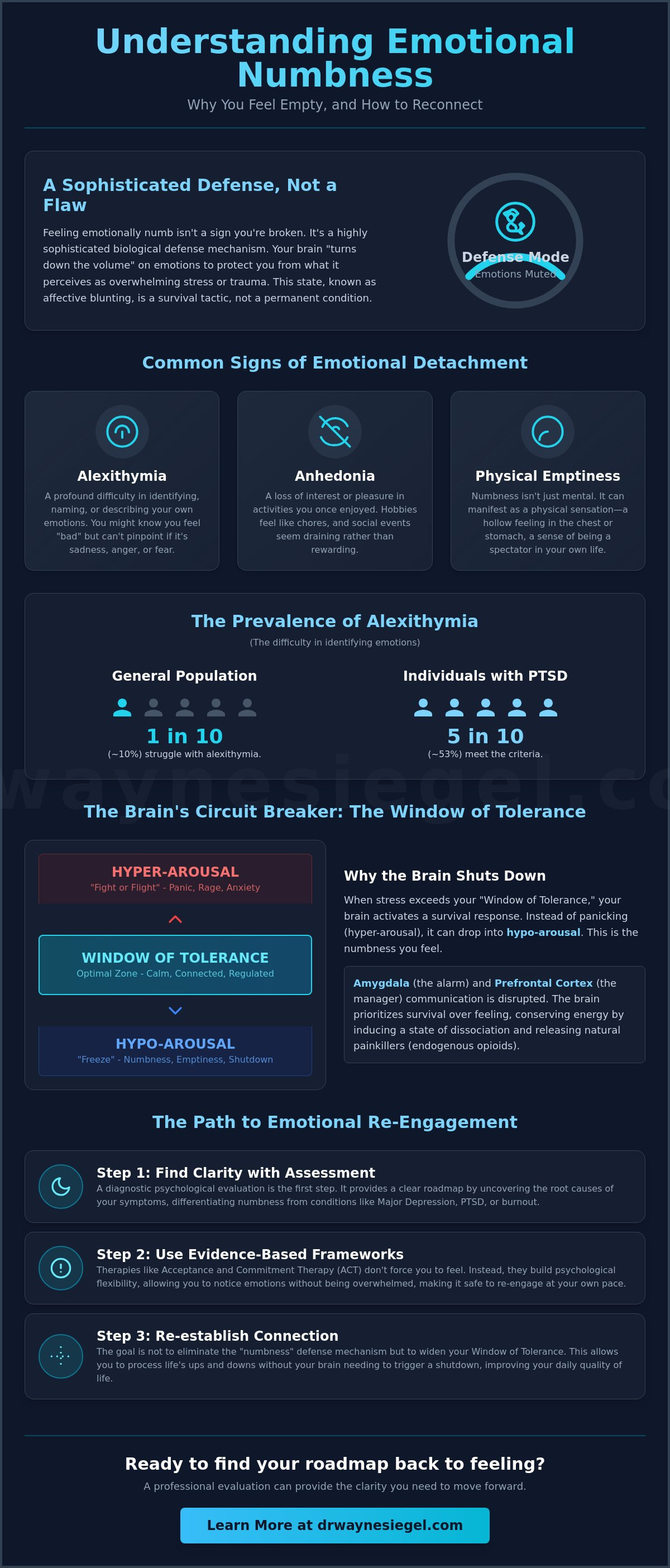
- Alexithymia: A 2026 meta-analysis found that while 10% of the general population meets the criteria for alexithymia, that number rises to 53% for those with PTSD. It involves a specific difficulty in identifying or naming emotions.
- Physical Sensations: Numbness isn't just a mental state. Many report a physical heaviness or a hollow sensation in the chest or stomach, often described as a "void" that won't go away.
If you've spent months feeling emotionally numb and empty, know that this state is often a temporary adaptation rather than a permanent loss of self. Understanding these signs helps us move beyond vague labels toward a comprehensive diagnostic psychological evaluation that uncovers the "why" behind your experience.
The Neurobiology of Numbness: Why the Brain Shuts Down
To understand why you're feeling emotionally numb and empty, we must look at the brain's internal safety protocols. Think of your nervous system as having a "Window of Tolerance." This is the zone where you can effectively manage and process emotions. When stress becomes too intense, your system can go in two directions. It might move upward into hyper-arousal, which feels like panic or rage. Or, it can drop below the window into a hypo-arousal state. This is where numbness lives. It's a biological circuit breaker that trips when the emotional load exceeds what your system can safely carry.
In this state, the communication between your amygdala, the brain's alarm center, and your prefrontal cortex, which handles logic and regulation, shifts significantly. During a freeze or shut down response, the brain prioritizes survival over feeling. It's an ancient tactic. If a threat is perceived as inescapable, the body conserves energy by slowing down. This isn't a failure of will. It's a highly coordinated neurological event that can be identified and understood through a professional diagnostic psychological evaluation.
The Survival Mechanism of Dissociation
When the brain perceives no escape from pain, it initiates a process of dissociation. This involves the release of endogenous opioids. These are the body's natural painkillers. While they're effective at inducing emotional analgesia to protect you from immediate trauma, they also create a sense of being "spaced out" or detached. In cases of chronic stress, this can lead to structural dissociation. This is where the brain effectively isolates traumatic memories from daily functioning to keep you operational. It's a brilliant, though costly, survival strategy that often leaves individuals feeling like observers of their own lives.
The Cost of the Protective Shield
The primary issue with this biological shield is that it isn't selective. The brain cannot numb grief or fear without also dampening your capacity for joy and connection. Over time, this chronic state of feeling emotionally numb and empty leads to a significant loss of clarity and personal meaning. You might feel like you're drifting without a compass. Identifying whether this state stems from trauma, burnout, or a primary depressive disorder is essential for recovery. Seeking a psychological assessment near me can provide the objective data needed to understand your specific neurobiological profile. I often find that once we identify the root cause, we can begin the work of safely expanding that Window of Tolerance again.
Differentiating Numbness from Depression, Trauma, and Burnout
When you're feeling emotionally numb and empty, the lack of a clinical label can increase your anxiety. It's vital to distinguish between these states because the roadmap for treating burnout differs significantly from the one used for clinical depression or trauma. While the subjective experience of "nothingness" feels similar across these conditions, the underlying neurobiological drivers are distinct. A correct diagnosis is the first step toward a personalized plan that addresses the root cause rather than just the symptoms.
I often see patients who confuse burnout with clinical depression. In burnout, the primary hallmark is depersonalization. This is a specific type of detachment where you feel like an observer of your own life, often accompanied by a sense of cynicism or reduced personal accomplishment. Moral injury is another critical factor. It occurs when you witness or participate in actions that transgress your deeply held moral beliefs, leading to a protective emotional withdrawal to manage the resulting shame or guilt.
Numbness in the Context of PTSD and Trauma
In trauma recovery, emotional numbness is a diagnostic criterion under the DSM-5-TR. It serves as a hallmark of the need for specialized ptsd counseling. While many people associate PTSD with "flashbacks" or hyper-arousal, emotional constriction is equally prevalent. This is a hypo-arousal state where the brain limits its emotional range to avoid triggering painful memories. A 2026 meta-analysis confirmed that 53% of patients with PTSD also meet the criteria for alexithymia, making it difficult for them to even name the emotions they're trying to avoid.
Depression vs. The 'Void' of Emptiness
It's important to contrast the "sadness" of traditional depression with the "nothingness" of numbness. In Major Depressive Disorder (MDD), patients often experience melancholic features, which include a near-total loss of pleasure in all activities. Atypical features might involve mood reactivity, where your mood brightens in response to positive events, yet a heavy, "leaden" feeling remains in your limbs. While feeling emotionally numb and empty is a distressing symptom, it's often the secondary result of an underlying, untreated condition. Identifying whether you are experiencing the "void" of depression or the "shield" of trauma requires a meticulous diagnostic approach to ensure you receive the most effective evidence-based care.
Evidence-Based Strategies for Emotional Re-engagement
Re-engaging with your life when feeling emotionally numb and empty isn't about flipping a switch. It's a deliberate process grounded in psychological flexibility. Rather than forcing yourself to feel, we focus on changing your relationship with the absence of feeling. Evidence-based frameworks like Acceptance and Commitment Therapy (ACT) and Cognitive Behavioral Therapy (CBT) provide the structure needed to move from a state of hypo-arousal back into a functional life. These methods don't just target symptoms; they help you build a roadmap toward a more meaningful daily existence.
Grounding techniques are essential for managing acute moments of dissociation. These practices, such as the "5-4-3-2-1" method, help anchor your nervous system in the present environment by engaging your physical senses. While grounding manages the immediate "spacing out," values-based action addresses the long-term sense of hollowness. This involves identifying what matters to you and taking small steps in that direction, even when the emotional reward feels muted. Doing what's important, regardless of how you feel, is often the first step in re-priming your emotional system.
The ACT Approach: Expansion and Acceptance
Acceptance and Commitment Therapy (ACT) introduces the concept of "Expansion." This involves making room for the numb feelings rather than fighting them. When you struggle against numbness, you often inadvertently increase your internal distress, which can lead to further shut-down. Expansion allows you to observe the emptiness without being consumed by it. We also utilize "Defusion" to help you step back from catastrophic thoughts, such as "I will never feel again." By recognizing these as just thoughts rather than absolute truths, you reduce their power over your behavior. Remember that re-engagement is a gradual process that requires patience and clinical precision.
CBT and Behavioral Activation
Behavioral Activation (BA) is a core component of CBT designed to slowly re-prime the emotional pump. It involves tracking "pleasure and mastery" during daily activities. Even if your internal reward system feels offline, we look for small indications of achievement or slight shifts in mood. A 2026 analysis of Positive Affect Treatment (PAT) showed that focusing on rebuilding the capacity for joy, rather than just reducing sadness, is highly effective for treating anhedonia. Accessing this level of care is more accessible than ever. Professional support through psypact states allows you to receive specialized tele-psychology services across state lines. If you're ready to move beyond labels and find actionable meaning, I invite you to learn more about my individual psychotherapy services to begin your journey toward clarity.
Finding Clarity: The Role of Psychological Assessment
When you're lost in the experience of feeling emotionally numb and empty, the most critical asset you can have is a roadmap. Without a clear understanding of the "why" behind your detachment, any attempt at treatment is merely guesswork. I view every diagnostic psychological evaluation as a unique puzzle to be solved with care and precision. My goal is to move beyond surface-level symptoms to uncover the specific neurobiological or psychological drivers behind your state. This process provides the clinical clarity required to build a transition into effective, evidence-based psychotherapy.
The evaluation process is thorough and deliberate. It typically involves a structured clinical interview and standardized assessments that follow the 2022 DSM-5-TR diagnostic standards. We look at your cognitive profile, executive functioning, and emotional regulation patterns to see where the "circuit breaker" has tripped. By identifying whether your numbness is tied to the 300.6 code for Depersonalization/Derealization Disorder or perhaps a Prolonged Grief Disorder, we can stop guessing and start targeting the root cause. This level of meticulous detail ensures that the solution we find is as unique as the challenges you face.
Moving Beyond Labels to Actionable Meaning
Professional insight allows you to stop merely "acting" through your daily routines and start living with a sense of intention. I believe in a whole-person approach that considers your history, your strengths, and your current environment rather than just masking symptoms. This perspective helps us find actionable meaning in the data we collect. If you're ready to seek answers, I recommend choosing a clinic for psychology that prioritizes board-certified expertise and research-driven methodologies. Finding a practitioner who values integrity and thoroughness is the first step in reclaiming your quality of life.
Next Steps: Reaching Out for Professional Guidance
Initiating a consultation is a straightforward, respectful step toward regaining your sense of self. My practice offers a stable, clinical environment where you can feel safe exploring complex emotional landscapes without judgment. I'll act as your steady guide through the assessment process, ensuring you feel heard and supported at every turn. While feeling emotionally numb and empty is a distressing state, it's a state that we can navigate together using the right diagnostic tools and therapeutic support. You don't have to remain in the void; a clearer picture of your life and a path toward re-engagement are entirely possible. I invite you to reach out and begin this journey toward clarity today.
Reclaiming Your Emotional Roadmap to Clarity
You don't have to navigate the void alone. We've explored how feeling emotionally numb and empty is often a protective hypo-arousal state rather than a permanent loss of self. By utilizing the diagnostic standards of the 2022 DSM-5-TR, we can differentiate between trauma, burnout, and depression to create a roadmap tailored to your neurobiological profile. Recovery is a gradual process of expanding your Window of Tolerance through evidence-based practices like ACT and CBT. It's about moving from a state of survival to one of intentional connection.
As a practitioner who has been board-certified since 1996, I'm committed to helping you find the "why" behind your challenges. My practice provides the stability and expertise required to regain clarity through diagnostic evaluations and individual psychotherapy. I provide telehealth across all PsyPact states, ensuring research-driven support is accessible wherever you're located. Schedule a Consultation with Dr. Wayne Siegel for Evidence-Based Support to begin solving the puzzle of your emotional life. You've already taken the first step by seeking understanding; let's work together to turn that insight into a better quality of life.
Frequently Asked Questions
Is feeling emotionally numb a symptom of depression?
Yes, emotional numbness is a recognized symptom of Major Depressive Disorder (MDD) as defined in the 2022 DSM-5-TR. It's frequently associated with anhedonia, which is the inability to experience pleasure in activities you once enjoyed. While some experience depression as intense sadness, others experience a "flat" affect or a total absence of feeling. This state serves as a primary diagnostic indicator when I evaluate the severity of a patient's depressive episode.
Can trauma cause you to feel empty years later?
Yes, trauma can lead to chronic emotional detachment that persists for decades if left unaddressed. This is often a result of the brain's "freeze" response becoming a default setting for the nervous system. A 2026 meta-analysis showed that over 50% of individuals with long term PTSD struggle with identifying and describing their feelings. This delayed response is a survival mechanism that protected you during the initial event but has now become maladaptive.
How long does emotional numbness typically last?
The duration of emotional numbness depends entirely on the underlying cause and the level of professional intervention. Acute numbness triggered by a specific stressful event might resolve within a few weeks as the nervous system returns to its Window of Tolerance. However, chronic states tied to untreated trauma or clinical depression can last for years. I find that seeking a diagnostic psychological evaluation is the most efficient way to establish a timeline for recovery through targeted therapy.
Is emotional numbness the same as being a 'sociopath'?
No, feeling emotionally numb and empty is fundamentally different from Antisocial Personality Disorder, which is the clinical term often associated with "sociopathy." Individuals with ASPD typically lack empathy and remorse as a core personality structure. In contrast, emotional numbness is usually a secondary symptom of distress, trauma, or depression. Most people experiencing numbness are deeply concerned about their lack of feeling, which is a sign of intact moral and social awareness.
Can I get an online psychological assessment for feeling empty?
Yes, I provide diagnostic psychological evaluations through telehealth for individuals located in any of the PsyPact participating states. These assessments are as rigorous as in person evaluations and use validated digital tools to measure your cognitive and emotional profile. This process helps us move beyond vague feelings of emptiness to identify actionable meaning and a clear roadmap for your treatment. It's a convenient way to access board certified expertise from your own home.
What is the first step to take when I feel 'nothing' at all?
The most effective first step is to schedule a comprehensive diagnostic psychological evaluation to identify the biological or psychological "why" behind your state. Understanding if the numbness is a result of burnout, trauma, or a depressive disorder allows for a precision based approach to treatment. I recommend starting with an objective assessment rather than self diagnosing. This provides a stable foundation for any future individual psychotherapy and helps us solve the puzzle of your experience.
Are there specific medications that cause emotional blunting?
Yes, certain medications, particularly Selective Serotonin Reuptake Inhibitors (SSRIs), are clinically documented to cause emotional blunting. A May 2026 study found that up to 60% of patients on SSRIs for major depression reported a reduced range of both positive and negative emotions. While I don't manage psychiatric medications, I can work with you to assess how these side effects impact your daily functioning. We can then use those insights to inform your broader journey toward clarity.
How can I explain my numbness to my partner or family?
I suggest explaining feeling emotionally numb and empty as a biological "circuit breaker" that has tripped to protect you from overwhelm. You might tell them that your brain has temporarily turned down the volume on all emotions to manage high levels of stress. Using clinical terms like "hypo arousal" can help them understand that this isn't a choice or a lack of affection. It's a physiological state that you're actively working to navigate with professional, evidence based support.