
How to Find Motivation When Depressed: An Evidence-Based Clinical Guide for 2026

As of the first quarter of 2026, 19.1% of U.S. adults are currently experiencing or being treated for depression, which represents roughly 51 million people. If you're among them, you're likely searching for how to find motivation when depressed while feeling physically and emotionally paralyzed. It's common to feel a sense of guilt when daily tasks go uncompleted or work emails remain unanswered. You might even label yourself as lazy, but I want to assure you that what you're experiencing is a documented clinical symptom rather than a personal failure.
I understand how exhausting it is to wait for a spark that feels like it may never ignite. In this guide, you'll discover the neurobiological roots of this fatigue and learn research-backed Behavioral Activation and Acceptance and Commitment Therapy (ACT) strategies to reclaim your drive. These methods don't require a high initial burst of energy. We'll explore how to break the depression-motivation loop through value-aligned action and identify when a professional diagnostic evaluation is the necessary next step. While the average delay for seeking treatment is 11 years, this roadmap offers a way to begin your recovery today.
Key Takeaways
- Gain insight into the neurobiology of anhedonia and how the mesolimbic dopamine system influences your capacity for reward.
- Explore why action must precede mood and learn how to find motivation when depressed using the evidence-based "outside-in" framework of Behavioral Activation.
- Define your core values as distinct life directions to ensure you can act effectively even when your energy levels are low.
- Implement practical, low-energy strategies such as "if-then" planning and the 5-minute rule to overcome daily task paralysis.
- Identify the markers that signal a need for professional diagnostic support to clarify your cognitive profile and build a personalized roadmap for recovery.
The Science of Stalled Drive: Understanding Anhedonia and Depression
Anhedonia is more than just feeling "down"; it's the clinical loss of interest or pleasure in activities you once found rewarding. The Science of Stalled Drive: Understanding Anhedonia reveals that this condition is a core diagnostic criterion of Major Depressive Disorder, affecting nearly 90% of those diagnosed as of early 2026. When you are struggling with how to find motivation when depressed, your brain isn't simply being difficult. Instead, the mesolimbic dopamine system, which is responsible for reward processing and the anticipation of pleasure, is functioning at a diminished capacity. This makes the "spark" of interest feel physically out of reach.
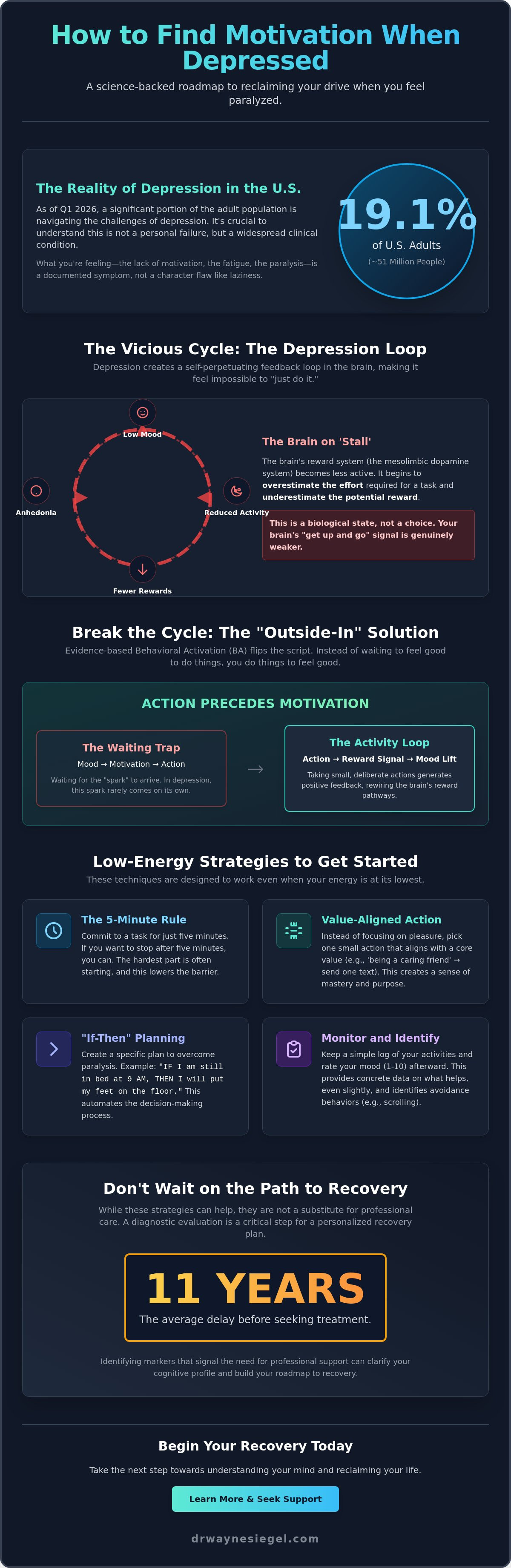
This neurological shift creates a debilitating feedback loop. Low mood leads to reduced activity, which then starves the brain of the positive feedback it needs to produce dopamine. When you stop engaging with the world, your brain receives fewer reward signals, further lowering your baseline mood and energy. Over time, this cycle deepens the sense of paralysis. It's vital to distinguish between being "lazy" and being "unmotivated." Laziness implies a character flaw or a conscious choice to avoid work; clinical lack of motivation is a physiological symptom of a brain struggling to regulate its energy and reward systems.
The Neurobiology of the 'Stuck' Brain
Research highlights that neuroinflammation and neurotransmitter dysregulation significantly impair executive functioning during a depressive episode. The prefrontal cortex, which handles goal-directed behavior and complex decision-making, often becomes underactive. This makes it physically harder to initiate even simple tasks or maintain focus on long-term outcomes. Anhedonia is a core diagnostic criterion of Major Depressive Disorder that signals a disruption in these vital neural pathways, making your struggle a matter of biology rather than willpower.
Why 'Just Do It' Fails in Clinical Depression
The popular "just do it" mantra fails because it ignores the skewed effort-reward calculation in the depressed brain. For a healthy individual, the perceived reward of a task usually outweighs the effort required. In depression, the brain overestimates the effort and underestimates the potential reward. This imbalance, combined with intense cognitive fatigue, results in decision paralysis. You aren't lacking willpower; you're operating with a depleted biological battery that makes high-effort tasks feel insurmountable. This is why learning how to find motivation when depressed requires a clinical approach rather than a simple motivational speech.
Behavioral Activation: Why Action Must Precede Motivation
Most people wait for a spark of inspiration before starting a difficult task. When you're struggling with how to find motivation when depressed, that spark rarely arrives on its own. Behavioral Activation (BA) is a premier evidence-based treatment that flips this traditional "inside-out" model on its head. Instead of waiting for your mood to change your behavior, BA uses an "outside-in" approach. You change your behavior first, which eventually shifts your emotional state. This isn't about willpower; it's about engineering your environment to re-engage with the rewards of life.
The "Depression Loop" is a well-documented cycle where low mood leads to inactivity, which then results in even lower energy and increased guilt. Breaking this requires moving into an "Activity Loop." Research on BA efficacy shows that by intentionally scheduling activities, you increase the opportunities for positive reinforcement from your environment. According to the National Institute of Mental Health, depression involves a persistent loss of interest that makes the "I'll do it when I feel better" mindset a significant barrier to recovery. Waiting for the feeling to arrive is often a recipe for further stagnation.
The 5 Steps of Behavioral Activation
- Step 1: Monitoring. Keep a simple log of your daily activities and rate your mood after each one to see what actually helps.
- Step 2: Identifying Avoidance. Notice "avoidance behaviors" like excessive sleeping or scrolling that temporarily numb pain but maintain the depression.
- Step 3: Ranking. List tasks and rank them by how much pleasure or sense of "mastery" they provide.
- Step 4: Scheduling. Place these "micro-actions" on a calendar, committing to them regardless of your current mood.
- Step 5: Evaluating. Review the mood shift after the activity is done, rather than deciding its value before you start.
The Concept of 'Micro-Actions'
Success in BA depends on breaking tasks down until the resistance disappears. If "cleaning the kitchen" feels impossible, your micro-action might simply be "standing up" or "washing one fork." These "non-zero days" are essential for building the momentum your brain needs to restart its reward system. Clinical trials have demonstrated that BA is as effective as medication for many individuals with moderate depression, providing a powerful tool for those seeking non-pharmacological interventions. If you find yourself unable to move past the monitoring phase, a diagnostic psychological evaluation can provide the clarity needed to understand your specific cognitive profile and help you determine how to find motivation when depressed through a structured roadmap.
Utilizing Acceptance and Commitment Therapy (ACT) to Reconnect with Values
While Behavioral Activation focuses on the "outside-in" approach, Acceptance and Commitment Therapy (ACT) provides a framework for acting effectively even when heavy emotions are present. If you're searching for how to find motivation when depressed, ACT suggests that the feeling of motivation isn't actually a prerequisite for a meaningful life. Instead of trying to "fix" or eliminate the lack of drive, this therapy focuses on psychological flexibility. It helps you change your relationship with your thoughts so they no longer dictate your movements.
A central tool in this process is cognitive defusion. This involves observing your thoughts, such as "I'm too tired to start," as transient mental events rather than absolute truths. When you stop fighting these thoughts or trying to wish them away, you free up cognitive energy for other things. While Behavioral Activation therapy prioritizes the mechanics of movement, ACT provides the "why" that makes that movement sustainable during a clinical episode. It allows you to acknowledge the internal resistance without letting it stall your progress entirely.
Values vs. Mood-Based Living
In clinical practice, I often distinguish between values and goals. Goals are destinations you reach, like getting a promotion or finishing a project. Values are chosen life directions that never end, like being a supportive friend or a curious learner. When depression makes goals feel impossible, your values remain accessible. They act as a compass, guiding you through the "fog" of a low-mood episode. This value-based approach is a cornerstone of recovery in many areas, and research shows that ptsd counseling similarly utilizes these frameworks to help individuals move toward a life of purpose despite the weight of past trauma.
Developing Psychological Flexibility
Psychological flexibility is the ability to stay in the present moment and persist in behaviors that matter to you. This means accepting the "unmotivated" feeling as a passenger in your car, but not letting it take the steering wheel. The "Committed Action" pillar of ACT encourages taking small, measurable steps toward your values. To begin this process, I often recommend evidence-based tools like the "Values Card Sort." This exercise helps you identify what truly matters to you when everything else feels meaningless. By focusing on these core principles, you can determine how to find motivation when depressed by replacing the need for "feeling good" with the commitment to "living well."
Evidence-Based Strategies for Overcoming Daily Paralysis
Practical application is where clinical theory meets the reality of your daily life. Implementation intentions, a concept pioneered by psychologist Peter Gollwitzer in 1999, are powerful "if-then" plans that automate the initiation of a task. By deciding in advance that "if it is 10:00 AM, then I will sit at my desk," you remove the need for active deliberation. This is a vital tool when you're exploring how to find motivation when depressed, as it bypasses the "decision fatigue" that often leads to paralysis. When the brain doesn't have to choose what to do, it's much more likely to follow through on a pre-set instruction.
The 5-Minute Rule is another effective strategy for reducing the psychological barrier to entry. You commit to an activity for exactly five minutes with the explicit permission to stop once the timer ends. This technique works because the perceived effort of five minutes is low enough to overcome the brain's resistance. Often, the momentum gained during those five minutes is enough to keep you going, but even if you stop, you've achieved a "non-zero day." This builds a sense of mastery that is essential for long-term recovery.
Reducing the Cognitive Load
Many people mistakenly believe that looking at the "bigger picture" provides motivation. In a clinical depressive episode, the bigger picture usually leads to immediate overwhelm and shutdown. You should replace broad goals with a relentless focus on the "next small step." Using external prompts like phone alarms or visual cues in your environment can help bypass internal resistance. Body doubling, which involves performing a task in the presence of another person, can also provide the external structure needed to initiate behaviors when your internal drive is low.
Managing Self-Criticism and the 'Shame Spiral'
Self-compassion is a functional clinical tool rather than a mere emotional comfort. Shame is neurobiologically expensive; it activates the sympathetic nervous system's "freeze" response, which further depletes the energy you need for action. When a setback occurs, try to view it as a "data point" in your behavioral activation process. This objective stance allows you to analyze why a specific strategy didn't work without falling into a shame spiral. If you're finding that these strategies aren't enough to break the cycle, a diagnostic psychological evaluation can provide the clarity needed to see if other factors, such as executive functioning deficits, are impacting your progress.
Sensory grounding techniques can also help shift you out of cognitive rumination and back into the present moment. Simple exercises like the "5-4-3-2-1" method encourage you to focus on your physical surroundings, which can lower the intensity of overwhelming thoughts. By grounding yourself in the environment, you create a stable foundation from which you can take the next small, value-aligned action. Understanding how to find motivation when depressed is ultimately about these small, consistent shifts rather than a single massive change.
Navigating the Path Forward: When Professional Support is Necessary
Identifying the source of your struggle is the first step toward effective change. While self-directed strategies like Behavioral Activation provide a strong foundation, there are times when self-help isn't enough to break the cycle. If you've consistently applied these tools and still find yourself asking how to find motivation when depressed, it may be time to seek a differential diagnosis. It's vital to understand whether your lack of drive stems from depressive anhedonia, executive dysfunction related to ADHD, or an underlying medical condition. A generic approach often fails because it doesn't address the specific cognitive or biological barrier standing in your way.
Evidence-based treatments like CBT and ACT differ significantly from general supportive talk therapy. While supportive therapy offers a space to be heard, clinical interventions are structured, goal-oriented, and designed to provide you with a specific set of skills to manage symptoms. In my practice, I prioritize these research-backed frameworks because they offer more than just a listening ear; they provide a clear roadmap for behavioral change. Objective data gathered through formal testing ensures that your treatment plan isn't based on guesswork but on your unique cognitive profile.
Seeking Clinical Clarity through Assessment
In my practice, I view every assessment as a unique puzzle to be solved with care and precision. A formal psychological assessment near me serves as a comprehensive roadmap for your recovery. This process helps distinguish between the "won't" of depression and the "can't" of executive dysfunction often seen in ADHD. For example, a person with ADHD may have plenty of interest but lack the cognitive tools to initiate a task, whereas a person with depression may lack the interest entirely. Utilizing objective data from standardized testing ensures that your treatment plan is built on your specific cognitive strengths rather than a generalized set of symptoms.
Expanding Access to Evidence-Based Care
Accessing high-level clinical care has become significantly easier with the expansion of telehealth. By understanding the role of psypact states, you can work with board-certified clinical psychologists across state lines, ensuring you receive specialized care regardless of your physical location. This interjurisdictional agreement now covers over 40 states as of mid-2026, providing a wider network of experts who specialize in how to find motivation when depressed. If you're ready to move beyond temporary fixes and gain a clearer picture of your life, I invite you to Contact Siegel Psychology Services to begin your journey toward clinical clarity.
Reclaiming Your Drive with Clinical Clarity
Understanding the biological roots of anhedonia is the first step toward breaking the cycle of inactivity. True progress comes from using the "outside-in" approach of Behavioral Activation and aligning your daily actions with your core values rather than waiting for a mood shift. This evidence-based perspective provides a sustainable roadmap for how to find motivation when depressed, even when your energy levels feel depleted. By focusing on micro-actions and psychological flexibility, you can begin to restore the reward systems in your brain and move beyond the paralysis of decision fatigue.
I have been a board-certified clinical psychologist since 1996, and I specialize in applying these evidence-based CBT and ACT frameworks to help patients navigate complex emotional landscapes. Whether you need a formal diagnostic evaluation to clarify your cognitive profile or individual psychotherapy to build momentum, I am here to guide you. With national telehealth coverage through PsyPact, I provide professional support to individuals across more than 40 states. I invite you to schedule a consultation with Dr. Wayne Siegel to gain clarity on your journey. You don't have to navigate this fog alone; a clearer, value-aligned life is within your reach.
Frequently Asked Questions
Is low motivation always a sign of clinical depression?
Low motivation is a clinical symptom, but it isn't always tied to depression. While 19.1% of U.S. adults are currently treated for depression as of early 2026, many others experience similar fatigue due to ADHD, burnout, or medical issues like hypothyroidism. I recommend a diagnostic evaluation to identify whether your struggle is rooted in mood, executive functioning, or a different underlying cause.
Can medication help with the lack of drive in depression?
Certain medications can help by targeting the neurotransmitters responsible for reward and energy, such as dopamine and norepinephrine. While I don't provide psychiatric medication management in my practice, I frequently collaborate with psychiatrists to ensure your therapy and medical care are integrated. This combined approach often yields the best results for individuals struggling with treatment-resistant symptoms.
How long does it take for Behavioral Activation to start working?
Most patients begin to notice a measurable shift in their mood and energy within 4 to 8 weeks of consistent practice. Behavioral Activation is a skill that builds momentum over time rather than a quick fix. I've found that focusing on small, "non-zero days" helps the brain's reward system slowly recalibrate and restart its natural drive.
What should I do if I feel too exhausted to even start a micro-action?
If a micro-action feels impossible, it's a signal that the task hasn't been broken down far enough. I suggest reducing the goal until the internal resistance disappears completely. If walking for five minutes feels like too much, your next step might simply be putting on your shoes or sitting up in bed for sixty seconds.
How can I tell the difference between laziness and depressive anhedonia?
Laziness is a character judgment that implies a choice, whereas anhedonia is a physiological inability to feel pleasure or interest. Research shows that 90% of people with major depression experience this clinical symptom. I view this as a biological barrier that requires a structured roadmap and professional insight rather than a lecture on willpower or discipline.
Can ADHD and depression both cause low motivation at the same time?
Yes, these two conditions frequently co-occur and create a complex hurdle for task initiation. ADHD typically involves executive functioning deficits that make starting a task difficult, while depression impacts the reward you expect to feel. I use diagnostic evaluations to untangle these factors so we can determine how to find motivation when depressed versus when you're struggling with ADHD.
Is online therapy effective for treating low motivation?
Online therapy is highly effective for implementing Behavioral Activation and ACT strategies. As of May 2026, interjurisdictional agreements like PsyPact allow board-certified psychologists to provide specialized care across more than 40 states. This accessibility ensures you can receive high-level clinical support from your home, which is often helpful when your energy levels are at their lowest.
What happens if I try these strategies and they don't work?
If evidence-based strategies don't yield results, it's often a sign that there are "hidden" barriers that haven't been identified. This might include undiagnosed ADHD, complex trauma, or specific cognitive processing issues. I suggest a comprehensive psychological evaluation to gather the objective data needed to adjust your treatment plan and provide the clarity you've been missing.