
How to Find and Prepare for a Neuropsychological Evaluation Near You in 2026

What if the subtle cognitive shifts you've noticed aren't just a sign of stress, but a specific pattern of brain function that we can map with clinical precision? It's common to feel a sense of dread when your memory or focus starts to slip, especially when you're worried about receiving a diagnosis that offers no path forward. If you've been searching for a neuropsychological evaluation near me, you've likely encountered a confusing mix of providers and clinical terms that leave you feeling more overwhelmed than when you started.
I believe you deserve more than a generic label; you deserve clarity. By utilizing evidence-based protocols that have been refined over the last 40 years, we can transform vague symptoms into a clear roadmap for your daily life. In this guide, I'll show you how to secure a board-certified evaluation in 2026 that provides actionable insights rather than just data. We will walk through the preparation steps and the specific differences between types of testing so you can move forward with confidence.
Key Takeaways
- Learn the objective, evidence-based methods used to measure brain-behavior relationships, providing a scientific foundation for understanding your cognitive health.
- Discover the step-by-step lifecycle of a clinical assessment to help you feel prepared and steady throughout the entire testing process.
- Identify the essential criteria for selecting a board-certified expert when searching for a neuropsychological evaluation near me to guarantee professional integrity and accuracy.
- Understand the specialized role of a neuropsychologist compared to general practitioners to ensure you receive the most precise diagnostic clarity available.
- Translate your evaluation results into a personalized roadmap for growth, using proven clinical frameworks to improve your daily quality of life.
Understanding the Role of a Neuropsychological Evaluation
I've found that many people arrive at my office feeling overwhelmed by cognitive symptoms they can't quite name. They describe a mental fog or a sudden inability to keep up with tasks they once handled with ease. A neuropsychological evaluation provides the objective data needed to move past this uncertainty. It's the formal, standardized measurement of brain-behavior relationships. While a regular medical checkup might look at your physical structures, this assessment examines how your brain actually functions in your daily life. If you're searching for a neuropsychological evaluation near me, it's vital to understand that we're looking for clinical clarity rather than just a diagnostic label.
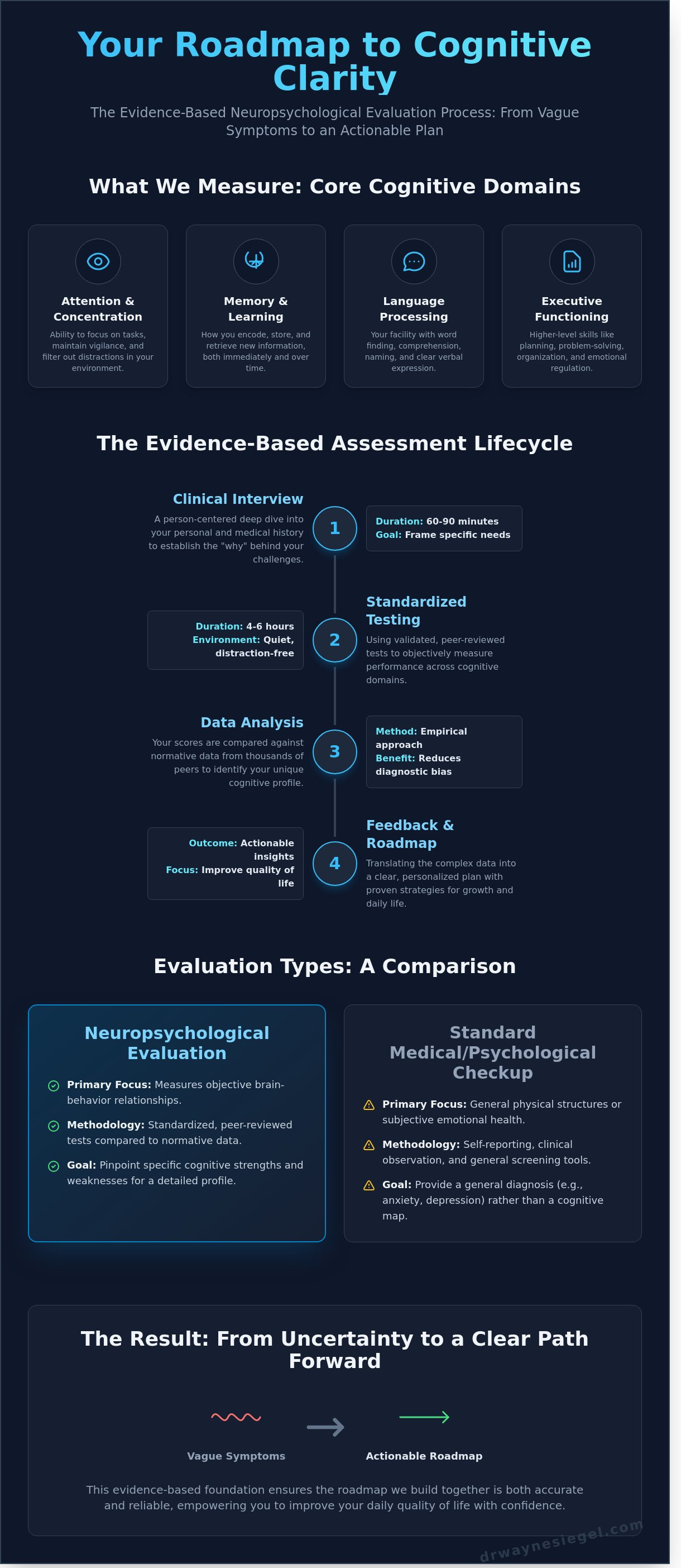
- Attention and Concentration: Your ability to focus on tasks and filter out distractions.
- Memory and Learning: How you encode, store, and retrieve new information.
- Language Processing: Your facility with word finding, comprehension, and verbal expression.
- Executive Functioning: Higher-level skills like planning, organization, and emotional regulation.
This process transforms a confusing set of symptoms into a clear, actionable roadmap. It isn't about fitting you into a box. It's about identifying your unique cognitive profile so we can improve your quality of life.
Who Should Seek a Neuropsychological Assessment?
Adults often seek a neuropsychological evaluation near me when they notice persistent changes in their cognitive performance that interfere with work or social obligations. This includes individuals over age 55 experiencing memory lapses that feel more frequent than "senior moments." I also work with many adults seeking to confirm neurodivergence, such as adult ADHD, which affects approximately 4.4% of the US adult population. Additionally, patients with a medical history involving concussion, stroke, or chronic illnesses like multiple sclerosis find these assessments essential. The data helps us understand how these medical events have shifted your cognitive baseline.
The Value of Evidence-Based Results
Standardized, peer-reviewed tests are the gold standard in modern psychology. These tools allow me to compare your scores against normative data sets containing thousands of individuals in your same age and education bracket. This empirical approach reduces diagnostic bias. It ensures your care isn't based on a clinician's hunch but on hard evidence. I view my role as a steady guide through this complex data. We aren't just looking at raw numbers; we're looking for the "why" behind your struggles. This evidence-based foundation ensures that the roadmap we build together is both accurate and reliable.
The Evidence-Based Process: How a Clinical Assessment Works
The journey toward understanding your brain's unique signature is methodical and grounded in rigorous science. I guide you through a structured lifecycle that transforms subjective concerns into objective data. This process ensures we aren't guessing about your health; we're measuring it. By following an evidence-based framework, I provide you with a high-resolution map of your cognitive landscape, moving from initial questions to clear, actionable answers.
Step 1: The Clinical Interview
I begin every assessment with a 60 to 90 minute clinical interview. This isn't just a checklist of symptoms. It's a person-centered deep dive into your personal and medical history. We establish the "why" behind your current challenges, looking at how your symptoms affect your job, relationships, and daily peace of mind. Understanding the Purpose of a Neuropsychological Evaluation helps us frame your specific needs, ensuring the subsequent testing is tailored to your unique situation. This foundation of safety and trust is essential for an accurate diagnosis.
Step 2: Standardized Testing Procedures
Testing typically spans 4 to 6 hours of active engagement. We work in a quiet, distraction-free environment designed to capture your peak performance. I use a carefully selected battery of standardized tests, including both traditional paper-and-pencil tasks and modern computerized assessments. These tools aren't random; they're designed to target specific brain regions and cognitive networks. For example, some tasks measure executive functioning in the prefrontal cortex, while others assess language processing in the temporal lobes. When searching for a neuropsychological evaluation near me, it's vital to choose a practice that dedicates this level of professional time to ensure the data is reliable and thorough.
Step 3: Interpretation and the Roadmap
After the testing session, I spend approximately 3 to 5 hours scoring the results and synthesizing the data. I look past the raw numbers to build a comprehensive cognitive profile that highlights both your strengths and areas for growth. Normative data is the benchmark for comparing an individual's scores to their age-matched peers. This comparison allows me to determine if a score represents a true deficit or a normal variation. I then translate these findings into a formal evaluation report. This document isn't just a list of scores; it's a personalized roadmap for your future care. We conclude with a feedback session to discuss these results in plain language. If you're ready to find answers, you can request a consultation to begin your path toward clinical clarity.
Comparing Neuropsychological vs. Standard Psychological Evaluations
When you begin searching for a neuropsychological evaluation near me, you'll likely encounter a variety of assessment types. It's easy to feel overwhelmed by the terminology, but understanding the distinction is the first step toward finding the clarity you deserve. A standard psychological evaluation typically centers on your emotional health, personality traits, and diagnostic clarification for mood disorders. These assessments often rely on self-report inventories and clinical interviews to identify why you feel the way you do. I view these as essential tools for understanding your internal emotional landscape.
A neuropsychological evaluation is a more specialized, data-driven deep dive into the physical health of your cognitive processes. While a generalist might ask about your symptoms, a neuropsychologist uses standardized, performance-based tasks to measure how your brain is actually functioning in real-time. This isn't just about how you feel; it's about what your brain can do. In 2026, the technology and normative data we use have become incredibly precise, allowing us to compare your scores against thousands of peers with a high degree of statistical confidence.
Depth of Cognitive Analysis
I often describe a neuropsychological exam as looking under the hood of a vehicle. We aren't just noting that the car isn't running well; we're testing the battery, the alternator, and the fuel line individually. This level of detail is what distinguishes Neuropsychological vs. Psychoeducational Evaluations, as we examine the underlying cognitive mechanisms that drive behavior. We look at specific domains including:
- Executive Functioning: Your brain's ability to plan, organize, and manage time.
- Memory Systems: Distinguishing between encoding issues and retrieval failures.
- Processing Speed: How quickly your brain integrates and responds to new data.
- Visuospatial Skills: How you perceive and manipulate visual information.
Identifying these specific mechanisms is critical for treatment. For instance, if a child struggles with reading, we need to know if it's a phonological processing issue or a working memory deficit. The treatment for each is vastly different, and a precise roadmap prevents months of ineffective intervention.
When to Choose a Neuropsychological Specialist
You should seek a specialist when there's a suspected neurological or medical component to your struggles. If you've experienced a concussion, a stroke, or are concerned about cognitive decline as you age, a standard psychological evaluation near me may not provide the objective data needed for a medical diagnosis. My role is to differentiate between overlapping conditions. For example, anxiety can often mimic the symptoms of ADHD. By using objective testing rather than just checklists, I can determine if a 15% deficit in sustained attention is a result of a neurodevelopmental trait or emotional distress.
If your primary concerns are strictly related to medication management or acute psychiatric symptoms, a psychiatric evaluation might be the appropriate starting point. However, when you need to understand the "why" behind your cognitive performance, a neuropsychological specialist offers the most thorough evidence-based answers. This precision ensures that your time and resources are directed toward the most effective solutions for your unique brain profile.
How to Choose a Board-Certified Neuropsychologist Nationally
Finding the right specialist involves looking beyond a simple map search. While you might start by searching for a neuropsychological evaluation near me, your priority should be clinical excellence and evidence-based practice. I recommend looking for providers who explicitly state they use peer-reviewed assessment tools and standardized protocols. This ensures your results are compared against accurate, modern data sets rather than outdated norms.
The Significance of Board Certification
Board certification through the American Board of Professional Psychology (ABPP) is the gold standard of our field. It represents a level of expertise that goes far beyond basic licensure. Board certification in clinical psychology via the ABPP requires extensive post-doctoral training and a rigorous examination of clinical skills. This process involves a thorough peer review of the doctor's actual work samples. Statistics show that only about 4% to 5% of licensed psychologists in the United States hold this specific certification. Choosing an ABPP-certified professional ensures your evaluator stays current with the latest 2025 and 2026 clinical research updates.
Navigating National Access with PsyPact
In 2026, your physical location doesn't have to limit your access to elite diagnostic care. PsyPact is an interstate compact that allows psychologists to practice across state lines in participating jurisdictions. Currently, 42 states have enacted PsyPact legislation, which means you can work with a specialist who understands your specific needs even if they aren't in your city. This is particularly beneficial for a comprehensive psychological assessment near me because it opens doors to experts in rare cognitive profiles. Telehealth technology now allows us to conduct clinical interviews and certain cognitive screenings with the same precision as in-person visits.
You should always ensure your evaluator provides a dedicated feedback session. A 20-page report is only useful if someone explains what the numbers mean for your daily life. I believe this session is the most vital part of the process. It's where we move from data points to a practical roadmap. We'll discuss your cognitive strengths and identify the specific "why" behind your challenges. Don't settle for a provider who simply mails a report; you deserve a conversation that provides clarity and a sense of direction.
If you're ready to gain a clearer understanding of your cognitive health, you can schedule a consultation with my office today to discuss your evaluation options.
Gaining Clinical Clarity: Your Roadmap with Siegel Psychology Services
I understand that the search for a neuropsychological evaluation near me often begins at a point of frustration or uncertainty. Whether you're struggling with focus, memory, or emotional regulation, you deserve more than a stack of data. With over 25 years of board-certified expertise, I've dedicated my practice to ensuring that every patient receives a roadmap, not just a diagnosis. I integrate rigorous clinical testing with evidence-based frameworks like Cognitive Behavioral Therapy (CBT) and Acceptance and Commitment Therapy (ACT). These tools allow us to move beyond the "what" of your symptoms and focus on the "how" of your recovery and daily management.
My approach is built on the belief that clinical data is most valuable when it's humanized. We use standardized metrics to measure executive functioning and processing speeds, but I interpret those numbers through the lens of your lived experience. This person-centered philosophy ensures that you feel seen and heard throughout the process. We'll work together to transform a period of confusion into a clear, actionable plan for your future in 2026 and beyond.
A Partnership in Discovery
I view every assessment as a unique puzzle that we solve as partners. Your brain doesn't function in a vacuum, so our work won't either. I provide a non-judgmental environment where we can explore complex cognitive concerns without the weight of stigma. We focus on identifying your inherent strengths just as much as your challenges. By the end of our time together, you'll have a deeper self-understanding that serves as a foundation for improving your daily quality of life. We aim for 100 percent clarity in every report I produce.
Next Steps: Scheduling Your Evaluation
Initiating a consultation for ADHD or a comprehensive diagnostic evaluation is a straightforward process designed to reduce your anxiety. I offer national telehealth services, ensuring that high-level clinical care is accessible regardless of your physical location. To make our first clinical hour as productive as possible, please have the following ready:
- A list of current medications and dosages.
- Previous school records or prior psychological testing results.
- A brief summary of your primary concerns and goals for the evaluation.
- Contact information for your current primary care physician or therapist.
It's time to stop guessing about your cognitive health. You can schedule your initial consultation through my secure portal today. I'm ready to help you find the answers you've been looking for through a professional neuropsychological evaluation near me. Let's start building your roadmap to clinical clarity together.
Your Roadmap to Cognitive Clarity and Evidence-Based Insight
Finding a neuropsychological evaluation near me shouldn't feel like a journey through a dense fog. You now understand that a rigorous, evidence-based assessment is the gold standard for uncovering the "why" behind complex cognitive challenges. By prioritizing a board-certified professional, you ensure your results are grounded in the highest clinical standards rather than subjective observation. This process moves beyond simple labels to provide a functional roadmap for your daily life.
Since earning my board certification (ABPP) in 1996, I've dedicated over 25 years of private practice experience to helping patients navigate their unique mental landscapes. I provide these comprehensive services in person and via telehealth across all current PsyPact-participating states. We'll use precise data to transform your uncertainty into a clear, actionable plan for your well-being. You don't have to manage these questions alone; a professional partnership can help you reclaim a sense of order and purpose.
Schedule a Consultation with Dr. Wayne Siegel for Evidence-Based Clarity
I look forward to helping you find the answers you deserve and the steady guidance you need to move forward with confidence.
Frequently Asked Questions
What is the difference between a neuropsychological and a psychological evaluation?
I distinguish a neuropsychological evaluation from a psychological one by focusing on the physical brain-behavior relationship. While a psychological assessment looks at your emotional state, my neuropsychological testing uses 20 to 30 different standardized measures to map your memory and attention. This data-driven approach provides a level of clarity that subjective interviews alone can't reach. It's the difference between assessing a mood and measuring the cognitive engine behind it.
How long does a typical neuropsychological evaluation take to complete?
You can expect your testing session to last between 4 and 8 hours. This timeframe is necessary to collect enough evidence to form a reliable picture of your brain health. I often break these hours into manageable segments. This ensures that fatigue doesn't skew your results; research shows performance can drop by 15% after several hours of continuous mental effort. We'll move at a pace that respects your energy levels.
Can a neuropsychological evaluation diagnose ADHD in adults?
I can definitely diagnose ADHD in adults using objective performance data rather than just checklists. When patients look for a neuropsychological evaluation near me, they're often seeking answers for lifelong struggles with focus. Studies show that 2.5% of the adult population meets ADHD criteria. My assessment identifies the specific executive function deficits that define your unique cognitive profile, providing a roadmap for effective management.
Is a neuropsychological evaluation covered by insurance or a Good Faith Estimate?
I accept many insurance plans for medically necessary evaluations, and I provide a Good Faith Estimate for all other services as required by the 2022 No Surprises Act. This estimate outlines the expected costs for the 15 to 20 hours of clinical work I perform. You'll receive this document at least 3 days before our first appointment. This transparency ensures you won't face any unexpected financial surprises during your journey.
What happens if my evaluation results show cognitive impairment?
If your results show cognitive impairment, I'll provide you with a structured roadmap for your next steps. We won't just look at the deficits; we'll focus on your strengths to bypass those challenges. Evidence suggests that early intervention and cognitive strategies can improve daily life satisfaction by 30%. I'll give you 5 to 10 specific recommendations to share with your medical team to ensure you have the support you need.
Do I need to see a neuropsychologist in person, or is telehealth an option?
I conduct initial interviews via telehealth, but the actual testing must happen in person at my office. Standardized testing protocols require a controlled environment to maintain the integrity of the data. A 2023 study found that remote testing can lead to a 12% variance in scores. Being in the same room helps me catch the subtle nuances of your problem-solving style that a screen might miss.
How should I prepare for my neuropsychological testing day?
I recommend getting at least 7 hours of sleep and eating a balanced meal before you arrive. Please bring your glasses, hearing aids, and a list of all medications you've taken in the last 30 days. It's also helpful to have copies of any previous brain imaging or school records. These details help me piece together your history with clinical precision, ensuring the most accurate results possible.
What information is included in a final neuropsychological report?
Your final report is a comprehensive 12 to 15 page document that outlines your cognitive strengths and weaknesses. It includes every test score, a formal diagnosis, and a personalized roadmap for treatment. I'll meet with you for a 60 minute feedback session to explain the findings. This ensures you leave with total clarity about your brain health and a clear path for your future care.