
Therapy for Situational Depression: Evidence-Based Care for Life Transitions in 2026

What if the heavy fog you're feeling isn't a permanent shift in your brain chemistry, but a manageable response to a life that has suddenly changed its shape? It's common to feel stuck in a cycle of reactive sadness after a major transition like a career change or a loss; you might even worry if you'll ever feel like yourself again. With depression rates reaching a historic high of 18.3% among U.S. adults in 2025, many people find themselves at a crossroads, unsure if they need medication or if talk therapy can provide the relief they seek.
I understand the anxiety that comes with a current crisis. You deserve a clear understanding of your symptoms rather than a vague label. Evidence-based therapy for situational depression, such as Cognitive Behavioral Therapy (CBT) and Acceptance and Commitment Therapy (ACT), provides a research-driven roadmap for overcoming these hurdles. In this article, I'll explain how these clinical approaches offer a steady path to emotional stability and why the latest 2026 healthcare guidelines from the HHS now prioritize these non-pharmacological interventions to help you regain clarity without unnecessary overprescription.
Key Takeaways
- Identify why your reactive sadness may be clinically classified as an Adjustment Disorder and the significance of the 90-day onset window following life stressors.
- Discover how evidence-based therapy for situational depression utilizes CBT and ACT to transform maladaptive thought patterns into psychological flexibility.
- Understand how a diagnostic psychological evaluation provides the clinical clarity needed to rule out underlying conditions like ADHD that may complicate your recovery.
- Learn how interjurisdictional telehealth via PSYPACT allows me to provide you with steady, professional care across state lines with maximum privacy.
- Gain a research-driven roadmap to protect your executive functioning and prevent temporary life transitions from evolving into chronic emotional challenges.
Understanding Situational Depression: More Than Just a Rough Patch
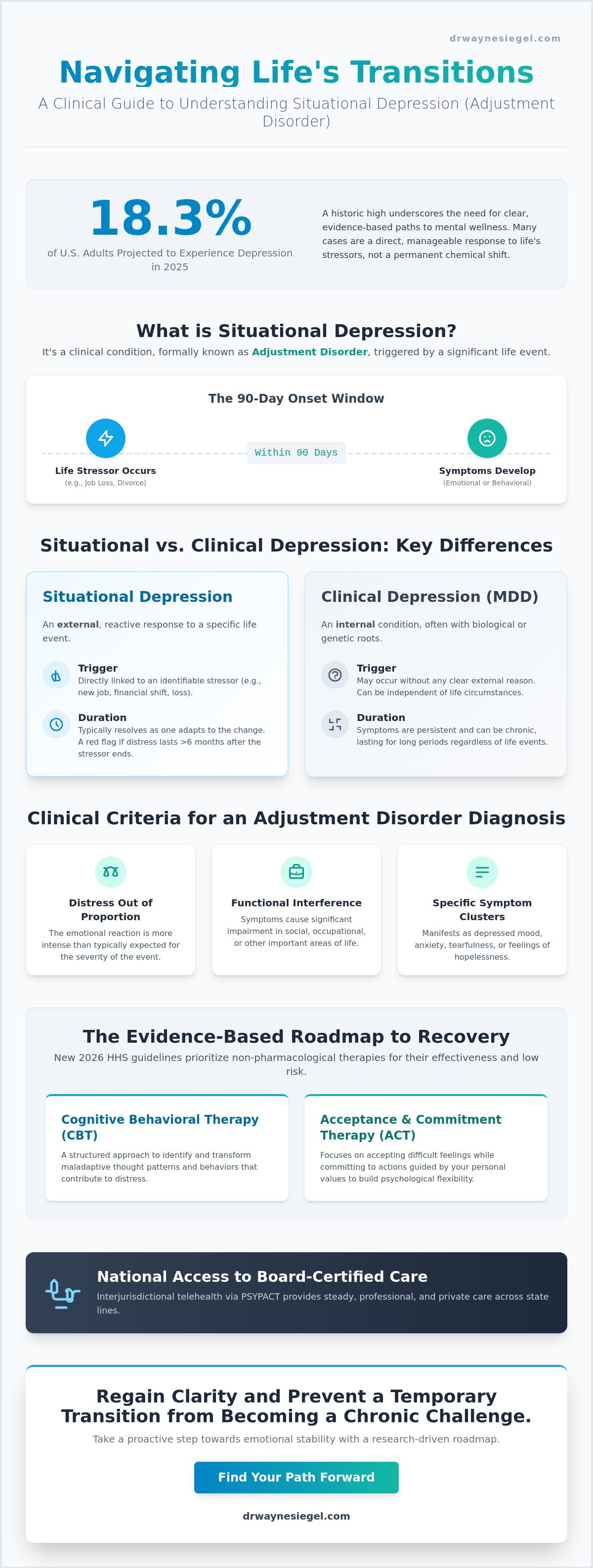
When you face a significant life change, it's natural to feel off-balance. I often see patients who worry that their reactive sadness is a sign of a permanent shift in their personality, but frequently, they're experiencing a specific clinical response to stress. In the diagnostic framework of the DSM-5-TR, what we commonly call situational depression is formally categorized as an Adjustment disorder. This isn't just a "rough patch"; it's a measurable psychological state that begins within 90 days of a clear stressor, such as a divorce, a job loss, or even a move to a new city.
While the symptoms may feel overwhelming, situational depression is defined by its relationship to an external event. Seeking therapy for situational depression is a proactive step toward regaining your footing. It's vital to remember that "short-term" does not mean "insignificant." The distress you feel is clinically real, and it can significantly impair your ability to manage daily responsibilities if left unaddressed. My goal is to help you find the clarity needed to distinguish this temporary state from more chronic conditions.
Situational vs. Clinical Depression: Key Differences
The primary distinction between situational and clinical depression (Major Depressive Disorder) lies in the trigger and the duration. Clinical depression often stems from internal biological or genetic predispositions and can persist regardless of your life circumstances. Situational depression is a direct response to an external stressor. It typically begins to resolve as you integrate the change or as the stressor is removed. However, if the distress lingers past six months after the stressor has ended, it may be a red flag that the condition is evolving into a more chronic depressive episode.
The Clinical Criteria for Adjustment Disorder
A formal diagnosis requires more than just feeling "down." To meet the clinical criteria, your emotional or behavioral symptoms must develop within three months of the stressor's onset. These symptoms often manifest as:
- Distress out of proportion: Your emotional reaction is significantly more intense than what would typically be expected given the severity of the event.
- Functional interference: The symptoms cause marked impairment in your social, occupational, or academic life.
- Specific symptom clusters: You might experience a depressed mood, tearfulness, feelings of hopelessness, or a sense of being unable to plan for the future.
By identifying these markers early, we can build a roadmap for recovery that prevents temporary distress from impacting your long-term quality of life.
Identifying Common Triggers and the Impact of Life Transitions
Transitions often carry a psychological weight that isn't immediately obvious. We usually associate depressive symptoms with tragedy, yet even positive shifts like retirement or a major promotion can trigger a significant depressive response. These transitions can disrupt your executive functioning, making it harder to organize daily tasks, maintain focus, or regulate your emotions. Research indicates that sudden financial shifts or traumatic physical injuries don't just change your circumstances; they disrupt your fundamental self-identity. This disruption creates a high allostatic load, which is the cumulative wear and tear on your brain and body from chronic stress. To manage this burden effectively, many individuals look toward evidence-based depression treatments to build a sustainable path back to their baseline.
When these life changes occur, the brain's ability to adapt is tested. If the stressor is severe or prolonged, the nervous system may remain in a state of high alert, leading to the exhaustion often seen in situational distress. Seeking therapy for situational depression helps lower this allostatic load by providing tools to process the transition and regain a sense of agency.
The Spectrum of Life Stressors
Triggers generally fall into two categories: acute and chronic. Acute events, like a car accident or a sudden layoff, provide a clear "before" and "after" in your life story. Chronic situational strain, such as living in a high-crime neighborhood or navigating a long-term illness, exerts a slower, more persistent pressure on your mental health. You might also experience ambiguous loss, where you lose a sense of normalcy or a relationship without a clear ending or closure. An individual’s unique combination of genetic factors and past experiences ultimately determines how deeply these stressors impact their mental health.
When "Normal" Stress Becomes a Psychological Challenge
It's healthy to grieve or feel stressed after a major change. However, when those feelings prevent you from functioning for weeks on end, the situation has likely moved into the territory of an adjustment disorder. Social isolation frequently acts as a catalyst, turning manageable stress into a profound sense of loneliness that feeds the depressive cycle. This is why early intervention is so critical. Engaging in therapy for situational depression early on helps maintain your daily quality of life and prevents the stress from becoming a permanent fixture in your cognitive profile. If you're feeling overwhelmed by a recent change, a professional consultation can help you determine the best next steps for your emotional well-being.
Evidence-Based Therapeutic Approaches: How CBT and ACT Drive Recovery
Recovery from an adjustment disorder isn't just about waiting for time to pass; it's about active, strategic intervention. Research consistently shows that structured modalities like Cognitive Behavioral Therapy (CBT) and Acceptance and Commitment Therapy (ACT) are highly effective for resolving reactive distress quickly. In my practice, I view these not as rigid protocols, but as a personalized roadmap to help you regain your clinical clarity. By focusing on the "why" behind your emotional response, we can transform a period of distress into an opportunity for long-term growth. This is the core of effective therapy for situational depression.
Those Experiencing Situational Depression often feel as though their thoughts are spiraling out of control. Structured therapy provides the framework needed to halt that spiral. These approaches are inherently person-centered, meaning we prioritize your specific life context and values while applying rigorous, science-backed techniques to your unique situation.
CBT: Reframing the Response to the Stressor
CBT is often considered the gold standard for managing reactive distress because it addresses the mechanics of your thinking. It works by identifying maladaptive thought patterns, such as catastrophizing, where a single negative event feels like an inescapable disaster. I'll help you challenge these distortions with objective evidence. Another core component is behavioral activation. When you're depressed, your world tends to shrink. We'll work together to reintroduce meaningful activities into your schedule, even when your motivation feels low. This process builds a durable toolkit for future resilience, ensuring you're better equipped for whatever life transition comes next.
ACT: Finding Meaning in the Midst of Change
While CBT focuses on reframing thoughts, ACT focuses on changing your relationship with them. This modality centers on the concept of psychological flexibility. Through cognitive defusion, you'll learn to see your thoughts as mere mental events rather than absolute truths. The core pillars of ACT, including acceptance and committed action, allow you to move toward your personal values even if the external situation hasn't changed yet. Mindfulness plays a vital role here too. It reduces the emotional intensity of acute stressors by keeping you grounded in the present moment. This approach ensures that your journey toward stability is guided by your own strengths and what matters most to you.
Gaining Clarity through Diagnostic Psychological Evaluation
I've found that the most effective way to move forward when you're feeling overwhelmed is to gain total clarity about your internal landscape. A psychological assessment near me serves as the first step in creating a personalized roadmap for your recovery. While we've discussed how life transitions trigger distress, an evaluation helps us "uncover the why" behind your specific emotional hurdles. It's about looking at the whole person, not just a list of symptoms, to ensure we aren't missing the bigger picture.
One of the most important functions of this process is differential diagnosis. We need to ensure that what looks like a reaction to a recent event isn't actually being complicated by an underlying condition. For example, a significant career change might feel devastating because of undiagnosed ADHD affecting your executive functioning. Or, what appears to be situational might be a recurring episode of chronic Major Depressive Disorder (MDD). By ruling these out, I can ensure that your therapy for situational depression is targeted, effective, and grounded in your unique cognitive profile.
Moving Beyond the Label to Actionable Insight
A formal evaluation transforms a vague sense of struggle into a clear picture of your cognitive and emotional strengths. I use clinical data to move from the identification of a struggle to the promise of a solution. It's a meticulous process where I view every assessment as a unique puzzle to be solved with care. For some, we might discover that the recent stressor has unmasked a deeper history of trauma, indicating a need for ptsd counseling rather than just short-term adjustment support. This board-certified perspective ensures your care is grounded in clinical precision and integrity.
The Assessment Process: What to Expect
The process follows a logical, step-by-step progression designed to be as reassuring as it is thorough. It begins with a detailed clinical interview where I listen to your history and current challenges. From there, I dedicate specific clinical hours to administering and interpreting psychological tests that measure your cognitive profile and emotional functioning. We'll then sit down to discuss the results in a way that feels like a personal partnership rather than a cold set of instructions. My ultimate goal is to improve your daily quality of life by providing actionable meaning to your experiences.
If you're ready to gain the insight needed to move forward, I invite you to schedule a diagnostic psychological evaluation today.
National Access to Board-Certified Care via Telehealth
I believe that geographic location should never dictate the quality of care you receive, especially when you're navigating the complexities of a major life transition. Through my participation in PSYPACT, I provide evidence-based care to clients across all participating psypact states. This interjurisdictional framework allows me to bring a board-certified clinical perspective directly to you. It ensures that the complex emotional puzzle you're facing is solved with the highest level of professional integrity, regardless of your physical distance from my office.
Telehealth has become a stable and expected standard of care. Data from February 2025 shows that 62.3% of patients with a telehealth claim were seeking help for a mental health condition. This shift is reinforced by the Consolidated Appropriations Act of 2026, which extended essential telehealth flexibilities and solidified permanent Medicare coverage for mental health services delivered in the home. For those seeking therapy for situational depression, this accessibility is vital. It allows you to begin your journey toward clarity from the safety and comfort of your own environment, lowering the barrier of anxiety that often accompanies a major life crisis.
The Advantages of Specialized Online Therapy
Online therapy does more than just offer convenience; it provides a sense of privacy and control during a time when life feels unpredictable. I maintain the same rigorous ethical and security standards in my virtual office as I do in person. This direct, one-on-one virtual connection fosters the personal partnership essential for effective therapy for situational depression. We work together in a quiet, focused dialogue to navigate your cognitive landscape, utilizing the research-driven tools of CBT and ACT to help you regain your footing.
Taking the Next Step Toward Your Roadmap
I encourage you to view therapy as a pragmatic, future-oriented investment in your well-being. It's a way to move beyond temporary labels to find actionable meaning in your experiences. Whether you're navigating a career shift, a loss, or a sudden change in health, my goal is to provide you with a structured roadmap for recovery. We'll start by identifying the specific challenges holding you back and develop the science-backed coping strategies needed to restore your emotional stability and daily quality of life.
You don't have to face these transitions alone. I invite you to reach out and begin the process of regaining your clinical clarity through a professional, individual psychotherapy connection. Schedule a consultation with Dr. Wayne Siegel today.
Move Forward with Clinical Clarity
Navigating a major life transition requires more than just time; it requires a strategic approach grounded in science. By understanding situational depression as a measurable adjustment disorder, you can move beyond the fog of reactive sadness toward a structured recovery. We've explored how diagnostic evaluations provide the necessary insight to rule out underlying conditions; this ensures your path is built on an accurate understanding of your unique cognitive profile. Utilizing evidence-based therapy for situational depression, such as CBT and ACT, allows you to transform these challenges into a durable toolkit for future resilience.
I've been board-certified since 1996 and have spent over 25 years in private practice helping individuals solve these complex emotional puzzles. Whether you're local or located in one of the many participating PsyPact states, my goal is to provide a steady, non-judgmental guide for your journey. You deserve a professional roadmap that leads to emotional stability and an improved quality of life. It's time to gain the clarity you need to move forward with confidence.
Begin your roadmap to clarity with Dr. Wayne Siegel
Frequently Asked Questions
What is the primary difference between situational depression and clinical depression?
Situational depression, formally known as an adjustment disorder, is a direct reaction to a specific life stressor, whereas clinical depression often involves a persistent biological or genetic predisposition. While symptoms like sadness and fatigue overlap, situational distress typically begins within 90 days of an event and resolves as you adapt. Clinical depression can persist regardless of external circumstances. Understanding this distinction is the first step toward gaining clarity about your journey.
How long does situational depression typically last without treatment?
Situational depression usually resolves within six months after the stressor has ended or you've learned to adapt to the new situation. However, without professional intervention, the distress can interfere significantly with your executive functioning and daily quality of life. If symptoms persist beyond this window, it may indicate that the reactive state is evolving into a more chronic condition that requires a deeper diagnostic look.
Can situational depression turn into major depressive disorder?
Yes, situational depression can evolve into Major Depressive Disorder (MDD) if the initial distress is not effectively managed. When a person remains in a state of high allostatic load for too long, the brain's ability to regulate mood can become compromised. Engaging in therapy for situational depression early helps prevent this transition by providing science-backed tools to process the stressor and restore emotional equilibrium before the condition becomes chronic.
Is medication necessary for treating situational depression or adjustment disorders?
Medication is not always necessary for treating adjustment disorders; many individuals find significant relief through evidence-based psychotherapy alone. In fact, the U.S. Department of Health and Human Services (HHS) released an action plan in May 2026 promoting non-pharmacological interventions like CBT as a primary response to situational distress. I focus on helping you build a toolkit of coping strategies that address the root of your reactive symptoms without relying on psychiatric medication.
How do I know if I need a formal psychological assessment or just talk therapy?
You may benefit from a formal diagnostic psychological evaluation if your symptoms are complex or if you're unsure why you're struggling to recover. While talk therapy provides ongoing support, an assessment offers a comprehensive view of your cognitive profile and rules out underlying issues like ADHD. This process provides the actionable meaning needed to ensure your subsequent care is targeted and efficient, rather than a series of trial-and-error sessions.
What happens if the stressor causing my situational depression cannot be changed?
If the external stressor is permanent, such as a chronic health diagnosis or the loss of a loved one, we focus on psychological flexibility through Acceptance and Commitment Therapy (ACT). We work together to help you move toward your values even in the presence of pain. The goal is to change your relationship with the situation, allowing you to live a meaningful life despite circumstances that are outside of your direct control.
Are telehealth sessions as effective as in-person therapy for adjustment disorders?
Research confirms that telehealth is just as effective as in-person therapy for treating adjustment disorders and situational distress. As of 2026, virtual care has become a standard of care that offers increased privacy and accessibility. My participation in PSYPACT allows me to provide board-certified care across state lines, ensuring you receive a high level of clinical expertise from the comfort of your own home during a difficult transition.
How does Cognitive Behavioral Therapy (CBT) specifically address situational triggers?
Cognitive Behavioral Therapy (CBT) addresses situational triggers by helping you identify and challenge maladaptive thought patterns, such as catastrophizing or overgeneralization. We use behavioral activation to reintroduce meaningful activities that the depression has pushed aside. This evidence-based approach to therapy for situational depression provides a practical toolkit for managing current triggers and builds a roadmap for resilience against future life transitions.