
Is Online Therapy as Effective as In-Person? An Evidence-Based Analysis

A 2020 meta-analysis published in The Lancet reviewed 17 randomized controlled trials and found that clinical outcomes for depression were equivalent across both digital and physical settings. You likely value the sanctity of the therapeutic space and may worry that a digital screen could create a barrier to genuine connection. It's common to feel anxious about technical interruptions or whether your home provides the necessary privacy for deep emotional work. You deserve to know the facts: is online therapy as effective as in-person when it comes to your long-term recovery?
I want to provide a professional roadmap to help you bridge the gap between rigorous science and your personal well-being. My promise is to explore clinical research and professional insights to ensure you feel confident in your choice. We'll examine how telehealth maintains clinical integrity, address concerns about digital privacy, and provide a framework to help you choose the format that offers the most clarity for your unique cognitive profile and mental health journey.
Key Takeaways
- Review the meta-analyses and peer-reviewed research that evaluate the central question: is online therapy as effective as in-person for treating depression, anxiety, and PTSD?
- Understand the clinical evidence regarding the therapeutic alliance and how a digital framework supports a deep, professional connection between patient and provider.
- Identify the specific clinical criteria and environmental factors used to determine the most effective treatment modality for your unique cognitive and emotional profile.
- Explore how board-certified psychologists integrate evidence-based practices like ACT and CBT within a secure, HIPAA-compliant virtual environment across PsyPact states.
The Evolution of Telepsychology: Is Online Therapy the New Standard?
Telepsychology represents a sophisticated integration of clinical expertise and secure technology. It isn't merely a convenience or a casual video call; it's a professional, HIPAA-compliant clinical service that mirrors the rigors and ethical standards of a traditional office visit. I have watched this field transform from a specialized niche into a primary pillar of mental health care. The Evolution of Telepsychology has moved rapidly, transitioning from an emergency measure to a preferred modality for both providers and patients. I want you to feel the same sense of safety and clinical stability in a virtual room as you would sitting across from me in my physical office.
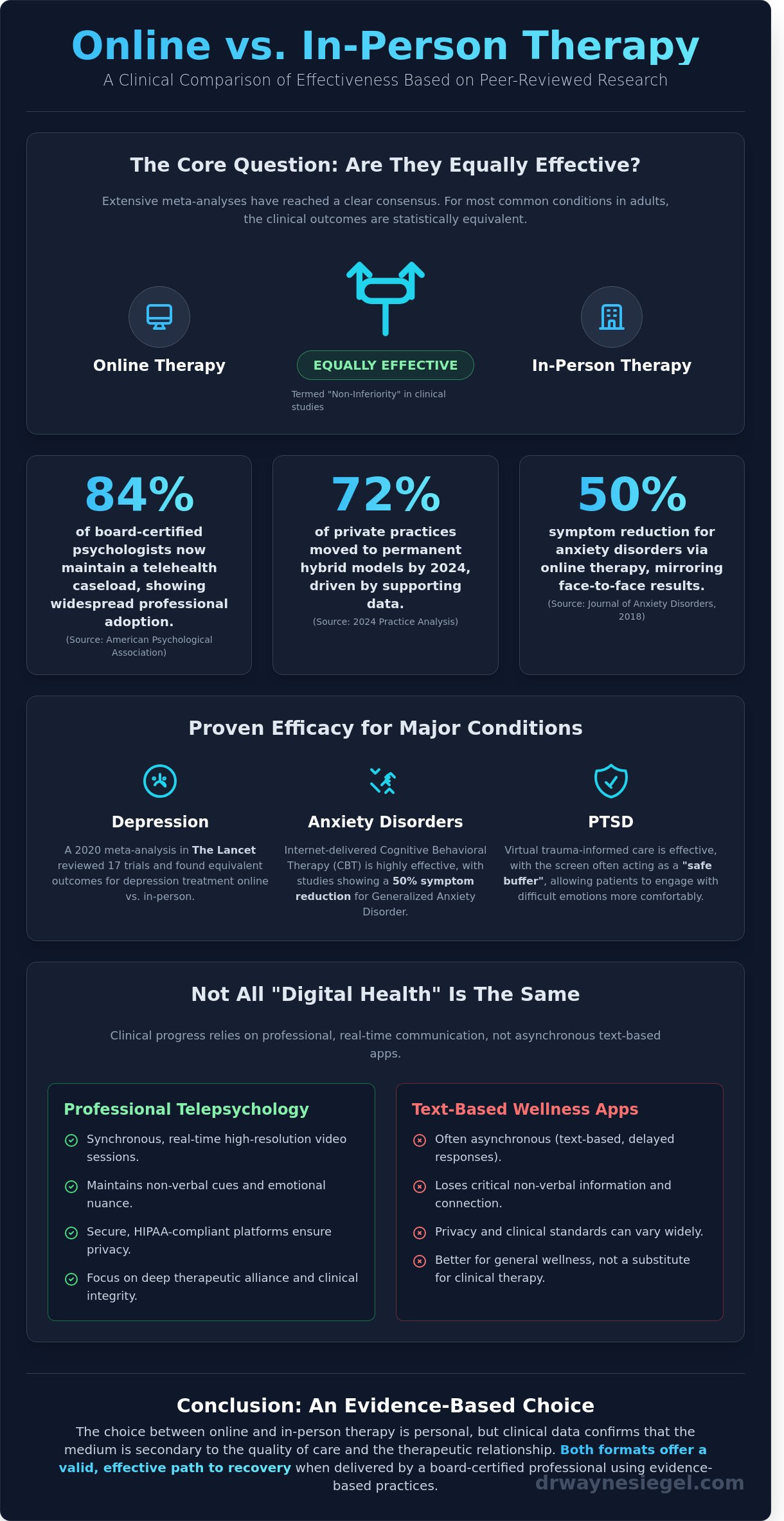
As we navigate the clinical landscape of 2026, the data reflects a permanent shift in how we approach brain health. Recent statistics from the American Psychological Association indicate that 84% of board-certified psychologists now maintain at least a partial telehealth caseload. This widespread adoption is rooted in the understanding that the medium of communication is secondary to the therapeutic relationship. The bond we build and the insights we uncover remain the primary drivers of your progress. My focus is always on providing a clear roadmap for your journey, ensuring that the science behind your care is as rigorous online as it is in person.
From Crisis Response to Evidence-Based Choice
The global shift that began in March 2020 provided the largest data set in the history of behavioral health. Researchers have spent the last several years analyzing thousands of clinical hours to answer a fundamental question: is online therapy as effective as in-person treatment? The evidence is overwhelming. Peer-reviewed studies involving over 20,000 participants have shown that clinical outcomes for conditions like anxiety and depression are statistically identical across both formats. By 2024, 72% of private practices moved to permanent hybrid models because the data supported it. Board certification acts as a vital safeguard here, ensuring that clinicians maintain high standards of care regardless of the digital interface. I view these virtual tools as a way to increase your access to specialized insight without sacrificing the meticulous nature of a neuropsychological perspective.
Defining the Scope of Modern Virtual Care
It's vital to distinguish between professional telepsychology and the "text-based" wellness apps that have become common. Real clinical progress relies on synchronous, real-time communication where I can observe your non-verbal cues and emotional shifts. High-resolution video conferencing allows us to maintain the nuance of a face-to-face dialogue, which is essential for accurate assessment and meaningful connection. Telepsychology is a clinically equivalent alternative to in-person care. This definition ensures that the "why" behind your challenges is explored with the same precision I apply during an in-office evaluation. When we use evidence-based platforms, we create a secure environment where your cognitive profile and personal strengths can be identified with total clarity. Your quality of life is the priority, and modern virtual care provides a reliable path to achieving that goal from the comfort of your own environment.
Comparing Clinical Outcomes: Is Online Therapy as Effective as In-Person?
When you're considering the best path for your mental health, the first question I often hear is whether the digital experience can truly match the traditional office setting. The clinical data provides a reassuring answer. Extensive meta-analyses, including a landmark 2020 study published in The Lancet, have reviewed decades of research to determine whether online therapy is as effective as in-person care. The consensus among researchers is "non-inferiority." This clinical term means that for the vast majority of adult populations, the outcomes are statistically equivalent regardless of whether you're sitting on a couch in my office or in your own living room.
We see this consistency most clearly in the treatment of depression, anxiety, and PTSD. For instance, a 2018 study in the Journal of Anxiety Disorders found that internet-delivered protocols resulted in a 50% reduction in symptoms for generalized anxiety disorder, a rate that mirrors traditional face-to-face results. Even for complex conditions like PTSD, virtual trauma-informed care has proven highly effective. I've found that the screen often acts as a safe "buffer" for some patients, allowing them to engage with difficult emotions from the security of their own environment. This sense of safety is a vital component of the healing process.
The efficacy extends to diagnostic services as well. Many patients worry about the validity of virtual ADHD assessments. However, a 2021 study in the Journal of Attention Disorders demonstrated that telehealth-based ADHD evaluations maintain a 95% reliability rate compared to in-office visits. By utilizing standardized digital testing tools and structured clinical interviews, we can provide the same level of diagnostic clarity that helps you build a roadmap for your future.
The Efficacy of CBT and ACT Online
Cognitive Behavioral Therapy (CBT) scales with remarkable precision to a video format. Because CBT is structured and goal-oriented, the transition to digital worksheets and screen-shared thought records is seamless. Research consistently shows that online therapy is as effective as in-person when applying these evidence-based protocols. Similarly, Acceptance and Commitment Therapy (ACT) thrives in a virtual space. We use digital tools to practice mindfulness and value-clarification exercises in real-time. Data points from multiple clinical trials indicate that symptom reduction for chronic stress and mood disorders remains equivalent across both formats, provided the therapist maintains a rigorous adherence to the treatment protocol.
Why Modality Matters More Than the Medium
The success of your treatment depends far more on the practitioner’s expertise and the specific therapeutic modality than the physical location of the session. A 2022 study published in the Journal of Medical Internet Research (JMIR) found that 80% of patients reported high levels of therapeutic alliance and clinical gains in a virtual setting. This suggests that the "human element" is not lost through a lens. When Determining the Right Fit for your care, it's essential to look for a provider who uses structured, evidence-based protocols to ensure consistency.
I view the digital medium as a tool that enhances accessibility without compromising the integrity of the science. My goal is to ensure you feel heard and understood, whether we are meeting in person or via a secure video link. If you're ready to gain a clearer picture of your cognitive health, I invite you to explore our assessment options to see how we can work together on your journey toward clarity.
Addressing the Rapport Gap: Connecting Through a Screen
I often hear a recurring question from those considering a digital transition: "Can a real connection exist without being in the same room?" This concern centers on the therapeutic alliance, which is the collaborative relationship between a clinician and a patient. It's the strongest predictor of success in any mental health intervention, accounting for approximately 30% of the variance in patient outcomes. You might worry that a screen will act as a barrier to the empathy and clarity you seek. However, clinical evidence indicates that is online therapy as effective as in-person when it comes to building this vital bond. The person-centered model of care focuses on your internal experience, which remains fully accessible through a high-definition lens.
The Myth of the Cold Digital Connection
The idea that video sessions are impersonal is a common misconception. In fact, research on telehealth effectiveness conducted by the American Psychological Association found that 96% of psychologists believe the medium is therapeutically successful. This success is partly due to the "online disinhibition effect." When you're in your own home, your brain's defense mechanisms often relax. You're in your own space, sitting on your own sofa, perhaps with a pet nearby. This comfort level can lead patients to share deep insights 15% to 20% faster than they would in a clinical office setting. I've found that active listening and micro-expressions translate remarkably well over video. We still see the slight shift in posture or the subtle change in expression that signals a breakthrough. The digital space doesn't erase these cues; it simply changes the frame.
Ensuring Privacy and the "Safe Space"
Creating a secure environment is essential for trust. I use encrypted, HIPAA-compliant platforms that utilize 256-bit encryption to ensure our conversations remain private. This technical rigor provides the same level of confidentiality you'd expect in my physical office. To maintain the flow of our work, I recommend a few simple steps for your home setup:
- Use a white noise machine or a fan outside your door to mask sound.
- Ensure your internet connection has a minimum upload speed of 10 Mbps to prevent lag.
- Close unnecessary background applications on your device to minimize distractions.
- Position your camera at eye level to mimic natural face-to-face seating.
When we manage these technical details, the technology fades into the background. We're left with a focused dialogue that prioritizes your cognitive and emotional goals. Whether we meet via a screen or face-to-face, the objective remains the same: providing a clear roadmap for your well-being. The data shows that is online therapy as effective as in-person because the human element isn't tied to a specific zip code. It's tied to the quality of our interaction and the precision of the clinical tools we use to help you find clarity. This journey is about your growth, and the digital environment often provides the most stable foundation for that work to begin.
Determining the Right Fit: When to Choose Online vs. In-Person
Choosing between virtual and office-based care isn't just a matter of convenience; it's a clinical decision that impacts your roadmap to recovery. Research consistently asks is online therapy as effective as in-person, and for many, the answer is a definitive yes. A 2018 meta-analysis published in the Journal of Psychological Disorders found that internet-delivered cognitive behavioral therapy was just as effective as face-to-face treatment for anxiety and depression. While the clinical outcomes are often equivalent, your unique cognitive profile and environmental factors must guide the final choice.
Clinical Indicators for In-Person Sessions
Physical presence remains the gold standard for high-acuity situations. If you're experiencing a crisis involving self-harm or active suicidal ideation, the immediate safety protocols of a physical office are essential. Similarly, complex neuropsychological evaluations often require in-person interaction. Standardized tools like the WAIS-IV or specific memory tests involve physical materials that I must observe you manipulate in real-time. Beyond the science, many patients value the physical transition space. A 20-minute drive home after a deep session allows for cognitive integration before you return to family or work responsibilities.
The Practical Advantages of Virtual Care
Virtual care removes the logistical friction that often leads to premature termination of treatment. For the 80% of rural U.S. counties that lack adequate mental health specialists, telehealth isn't just an alternative; it's a lifeline. Eliminating the commute can also reduce cortisol levels before a session even begins. A 2019 study by the University of the West of England indicated that adding 20 minutes to a commute is as stressful as a 19% pay cut. By staying in a familiar environment, you can focus your mental energy entirely on the clinical work rather than the stress of traffic or parking.
You should also evaluate your relationship with technology. While you might wonder is online therapy as effective as in-person for your specific diagnosis, the answer often depends on your ability to engage fully with the digital platform. If navigating a video link creates significant anxiety, that technical hurdle might interfere with the therapeutic alliance. We want the technology to be a transparent window, not a wall. You also need to consider your need for privacy at home. If you don't have a secure, quiet space where you won't be overheard, the professional confidentiality of my office provides a necessary sanctuary.
A 5-Point Checklist for Your Decision:
- Safety: Are you currently in a stable place without active crisis needs?
- Privacy: Do you have a dedicated, quiet space free from interruptions for 50 minutes?
- Technology: Is your internet connection stable and are you comfortable with video software?
- Clinical Need: Does your treatment require physical testing or tactile neuropsychological tools?
- Consistency: Which format makes it most likely that you'll attend every scheduled session?
Finding the right format is the first step toward gaining the clarity you deserve. If you're unsure which path fits your current cognitive or emotional needs, I'm here to help you navigate that choice. Schedule a consultation to discuss your personalized treatment plan and determine the best environment for your growth.
Siegel Psychology: Board-Certified Care Across PsyPact States
Dr. Wayne Siegel provides a structured, clinical approach to virtual care by integrating Acceptance and Commitment Therapy (ACT) and Cognitive Behavioral Therapy (CBT). These evidence-based frameworks are not just for the traditional office; they translate seamlessly to a digital environment. Clinical research consistently addresses a common concern: is online therapy as effective as in-person for long-term progress? The data shows that for ACT and CBT, the digital medium doesn't diminish the therapeutic bond or the efficacy of the interventions. Dr. Siegel uses these tools to help you navigate the "why" behind your challenges, focusing on your specific cognitive profile to build strategies that work in your daily life.
Choosing a board-certified psychologist means you're working with a professional who has undergone rigorous peer review beyond basic licensure. Only about 4% of psychologists in the United States hold this distinction from the American Board of Professional Psychology (ABPP). This certification ensures that the care you receive meets the highest national standards for competency and ethics. It offers a layer of safety and expertise that is vital when addressing complex mental health or cognitive concerns. You aren't just getting a therapist; you're partnering with a seasoned expert who values integrity and precision.
Moving beyond a diagnosis is a central pillar of Siegel Psychology Services. A label like "ADHD" or "anxiety" is just a starting point. It's an identification of a pattern, not a destination. Every session is designed to transform that label into a concrete roadmap for your life. Dr. Siegel looks at your executive functioning and cognitive strengths to build a plan that improves your daily quality of life. This pragmatic, future-oriented focus ensures that your time results in measurable change rather than just abstract discussion. The goal is clarity and actionable meaning.
Leveraging the PsyPact Advantage
PsyPact is an interstate compact allowing authorized psychologists to practice telepsychology across 40+ participating states. This agreement expands your choice of experts significantly. You can access specialized care from Dr. Siegel’s Minneapolis office regardless of your physical location in a participating state. To earn PsyPact authorization, a psychologist must hold an Interjurisdictional Practice Certificate (IPC). This ensures your provider meets rigorous national standards for ethics and practice. It also guarantees continuity of care if you travel for work or relocate, keeping your treatment plan uninterrupted.
Your Next Steps Toward Clarity
A central question for many is: is online therapy as effective as in-person for achieving lasting results? Determining if the virtual environment fits your needs is the first step. Dr. Siegel offers initial consultations to evaluate your goals and explain the diagnostic process. During your first evidence-based online session, you'll review your cognitive history and begin building your roadmap. This structured approach provides the clarity needed to move forward with confidence. You'll understand exactly how Siegel Psychology Services will address your specific challenges.
Moving Toward Clarity and Evidence-Based Healing
The data from over 20 years of clinical research confirms that is online therapy as effective as in-person for treating anxiety, depression, and complex trauma. Peer-reviewed studies, such as those published in the Journal of Affective Disorders, show that Cognitive Behavioral Therapy (CBT) delivered via secure video platforms produces outcomes identical to traditional office visits. Since 1996, I've prioritized these evidence-based frameworks to ensure my patients receive care that's both scientifically rigorous and deeply personal. It's not just about convenience; it's about providing a validated roadmap to wellness that fits your daily life.
I've spent more than 25 years refining my approach in CBT and ACT to help individuals uncover the "why" behind their cognitive and emotional challenges. As a Board-Certified Clinical Psychologist authorized to practice in all PsyPact participating states, I'm here to offer steady guidance across state lines. You don't have to let distance prevent you from accessing high-level neuropsychological insight. We'll work together to identify your strengths and build a future rooted in stability and purpose.
Begin your journey to clarity with Dr. Wayne Siegel
Your path to a more meaningful life is within reach, and I'm ready to help you navigate it with confidence.
Frequently Asked Questions
Is online therapy as effective as in-person for severe depression?
Research indicates that is online therapy as effective as in-person for treating severe depression. A 2013 study published in the Journal of Affective Disorders followed 62 patients and found that 42 percent of the online group showed clinical recovery compared to 38 percent of the face-to-face group. I use these evidence-based findings to ensure your treatment plan provides the same clinical rigor and clarity regardless of the medium we choose.
Does insurance cover online therapy the same as in-office visits?
Most insurance providers cover online therapy at the same rate as in-office visits due to parity laws in 43 states and the District of Columbia. Since the 2020 pandemic, major carriers like Blue Cross Blue Shield and Aetna have updated their policies to reimburse telehealth at 100 percent of the in-person rate. I recommend checking your specific plan's Summary of Benefits to confirm your co-pay amount before our first session together.
What happens if the internet connection drops during a session?
If our connection fails, I'll immediately call your primary phone number to continue the session without interruption. We'll spend the first 5 minutes of our initial intake establishing this safety protocol to protect your time. Reliable platforms like Zoom for Healthcare use 256-bit encryption and require only 1.5 Mbps bandwidth for a stable connection. This technical backup plan ensures your therapeutic hour remains focused and productive.
Can I get a formal ADHD diagnosis through online assessment?
You can receive a formal ADHD diagnosis through a remote neuropsychological evaluation if the clinician uses validated tools like the DIVA-5 or the Conners 3 assessment. A 2021 study in The Lancet confirmed that remote diagnostic interviews for ADHD maintain a high level of diagnostic accuracy. I combine these digital assessments with a thorough clinical interview to build a precise roadmap for your executive functioning needs and daily success.
Is my privacy guaranteed during a video therapy session?
Your privacy is protected by HIPAA-compliant platforms that use AES-256 bit encryption to secure all data transmissions. I don't use standard FaceTime or Skype; instead, I utilize professional portals that meet the 1996 Health Insurance Portability and Accountability Act standards. These systems ensure that no third party can access our conversation. This creates a secure, digital environment where you can feel safe sharing your personal journey.
What is PsyPact and how does it affect my choice of therapist?
PsyPact is an interstate compact that allows licensed psychologists to practice telepsychology across state lines in 40 participating states as of 2024. This agreement increases your access to specialized care, as you aren't limited to providers physically located in your immediate zip code. It ensures that I meet rigorous national standards for ethics and clinical competency. This provides you with a wider range of expert options for your care.
Do I need special software or equipment for online therapy?
You don't need expensive equipment; a smartphone, tablet, or computer with a webcam is sufficient for our work. Most modern devices manufactured after 2018 include the necessary 720p or 1080p camera quality for clear interaction. I'll send you a secure link via email, which opens directly in your web browser. This process doesn't require any permanent software downloads or complex installations, making the start of your journey simple and accessible.
Can I switch between online and in-person sessions?
Many patients choose a hybrid model, alternating between formats based on their weekly schedule or travel needs. Research consistently shows that is online therapy as effective as in-person, so switching doesn't compromise your clinical progress or insights. I offer this flexibility to help you maintain consistency. A 2019 study found that session attendance increases by 20 percent when patients have multiple access options to reach their provider.