
How to Know When You Are Done with Therapy: Clinical Signs of Completion

What if the most significant milestone in your mental health journey is the moment you realize you no longer need a professional guide to navigate it? It's natural to feel a sense of hesitation or even guilt when considering an end to our sessions. You might worry that therapy has become a crutch or fear that you'll lose the progress you've made without weekly support. Many patients struggle with how to know when you are done with therapy, especially when they've built a strong, trusting relationship with their clinician.
I want to reassure you that reaching the end of care is a success to be celebrated, not a risk to be feared. This guide will provide you with the evidence-based indicators and clinical milestones, such as a 50 percent reduction in symptom severity on standardized assessments, that signal you're ready to transition. You'll learn a clear framework to evaluate your own growth and a roadmap for a healthy termination process. By looking at the objective data of your own progress, we can ensure you feel fully equipped to manage your life with confidence and independence.
Key Takeaways
- Learn to distinguish between temporary symptom remission and the clinical resolution of your underlying goals to ensure lasting stability.
- Identify the internal indicators of self-efficacy, such as the shift from reactive stress to the proactive use of evidence-based coping strategies.
- Understand the clinical signs of how to know when you are done with therapy versus the unconscious urge to avoid challenging work through a "flight into health."
- Discover why a structured termination phase-typically spanning two to four sessions-is essential for consolidating your therapeutic gains and finalizing your roadmap.
- Establish a sustainable maintenance routine and learn the value of periodic check-ups to maintain long-term clarity and alignment with your values.
Defining Therapy Completion Through a Clinical Lens
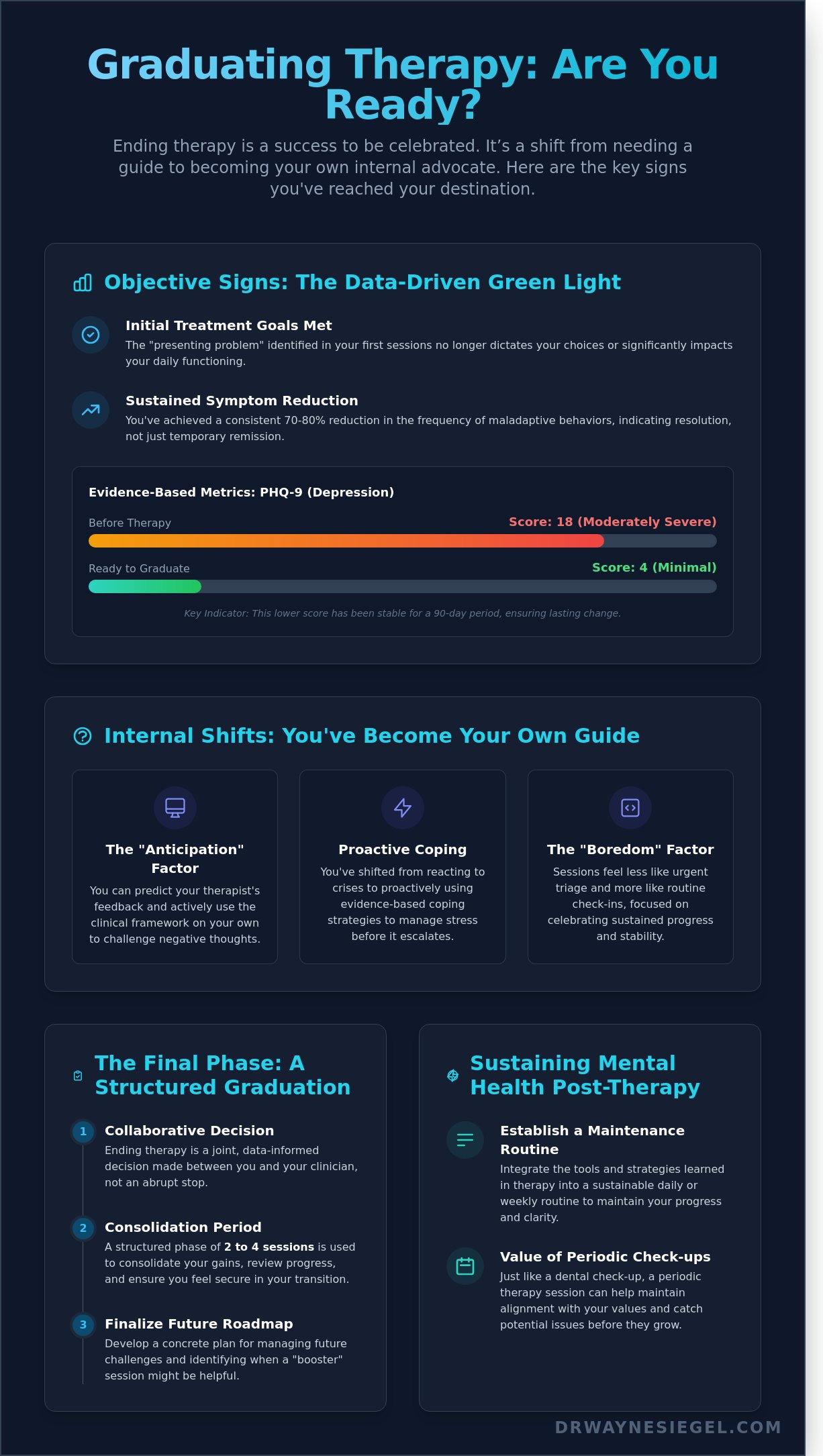
Therapy isn't meant to be a permanent fixture in your life. It's a structured, purposeful process with a clear beginning, middle, and end. When I work with patients, I frame the conclusion of our sessions as a graduation rather than a goodbye. This phase represents the moment where clinical goals are met and you demonstrate sustained self-efficacy in your daily environment. It's a shift from needing a professional guide to becoming your own internal advocate. This transition is a sign of health and growth, not a failure of the therapeutic bond.
We must distinguish between "symptom remission" and "resolution of the underlying clinical focus." You might feel a sense of relief after just 4 sessions because the immediate crisis has passed. That is remission. However, true resolution involves addressing the core cognitive patterns or emotional triggers that led to the distress in the first place. I look for a 70% to 80% reduction in the frequency of maladaptive behaviors before we discuss ending care. The termination phase of therapy is the final chapter where we solidify these gains. It's a positive clinical outcome that confirms you've integrated the tools necessary for long term stability.
Understanding how to know when you are done with therapy requires looking back at our starting point. We use your initial treatment plan as the primary benchmark. This document isn't just paperwork; it's a roadmap that defines what success looks like for your specific cognitive profile. When the "presenting problem" identified in your first month no longer dictates your choices, we know the clinical work is nearing its natural conclusion.
Meeting Your Initial Treatment Goals
I begin every therapeutic journey with a comprehensive review of the specific objectives set during your diagnostic psychological evaluation. We look at concrete markers. For example, if your goal was to manage social anxiety, we evaluate if you can now attend a 2 hour gathering without experiencing a panic response. We assess whether your challenges still significantly impact your daily executive functioning, such as your ability to focus at work or manage household responsibilities. Clinical resolution is the point where symptoms no longer meet diagnostic criteria. Once you consistently meet these benchmarks, you've gained the clarity needed to move forward independently.
Using Evidence-Based Metrics to Track Progress
I rely on data to provide a clear picture of your progress. Standardized tools offer objective proof of your growth that goes beyond just "feeling better." We utilize several metrics to ensure your readiness:
- PHQ-9 (Depression): Moving from a "moderately severe" score of 18 down to a "minimal" score of 4 over 5 consecutive months.
- GAD-7 (Anxiety): Achieving a score of 5 or lower, indicating that anxiety is no longer a primary driver of your behavior.
- Functional Assessment: Tracking a 60% increase in participation in "valued life activities" compared to your baseline.
By comparing your current functioning against the baseline established in your initial psychological assessment, we remove the guesswork. These declining scores provide a data-driven green light for ending care. This objective approach is a reliable way for how to know when you are done with therapy, giving you the confidence that your recovery is built on a solid, measurable foundation. We look for stability in these numbers over a 90 day period to ensure the change is permanent and not just a temporary peak in mood.
Internal Indicators of Sustainable Self-Efficacy
I often tell my patients that the ultimate goal of our partnership is to make my role redundant. One of the most reliable signs that you've reached this stage is the "anticipation factor." You might find yourself sitting in your car before a session, already knowing exactly what I'll ask. You've internalized the clinical framework we built together. When you can accurately predict my feedback or the specific probing questions I'd use to challenge a cognitive distortion, you're no longer just a participant in therapy; you're the facilitator of your own growth. This internal shift demonstrates that the roadmap we created has become part of your natural thought process.
The "boredom" factor is another clinical marker I look for during our 50-minute sessions. In the early stages of treatment, sessions often feel like urgent triage. We're processing acute stressors or managing high-intensity emotional "fires." As you heal, the rhythm changes. You might find yourself searching for topics to discuss or spending the majority of the hour providing general life updates rather than seeking deep emotional processing. If your sessions feel less like a lifeline and more like a routine check-in, it's a strong indicator of signs it's time to end psychotherapy and transition to independent maintenance.
From Therapist-Led to Self-Directed Coping
True self-efficacy is defined by your ability to apply evidence-based strategies in real-time. I monitor how patients use Cognitive Behavioral Therapy (CBT) to identify and dismantle automatic negative thoughts without my prompting. You've moved beyond the "How do I fix this?" phase and entered the "I know how to handle this" stage. For example, during a high-stress period at work, you might notice yourself using Acceptance and Commitment Therapy (ACT) principles to stay value-aligned rather than being swept away by anxiety. You're effectively acting as your own clinician, which is a core component of how to know when you are done with therapy.
Decreased Symptom Interference in Daily Life
We look for objective, measurable improvements in your daily functioning to validate your progress. This isn't just a feeling; it's a data-driven shift in your baseline. I look for specific metrics, such as achieving 7 to 8 hours of restorative sleep at least five nights a week or a 40% increase in self-reported work productivity. Social engagement often returns to pre-struggle levels, where you're actively participating in community events rather than observing from the sidelines.
A return to a stable cognitive profile is also essential. If a previous neuropsychological assessment identified deficits in executive functioning due to depression or trauma, we should see those scores stabilize as your emotional load lightens. You'll notice you can experience difficult emotions, like grief or frustration, without becoming "fused" with them. You observe the emotion, acknowledge its presence, and continue with your day. If you're looking for more clarity on your cognitive profile, we can review your initial assessment data to see how far you've come. Understanding how to know when you are done with therapy involves recognizing that you now possess the tools to maintain this stability on your own. This transition is a celebration of the hard work you've invested in your well-being.
Distinguishing Between "Done" and "Avoiding the Work"
Clinical practitioners often observe a phenomenon called "flight into health." This occurs when a patient suddenly reports a total absence of symptoms just as the work begins to touch on deep-seated emotional pain. It's an unconscious defense mechanism. You might feel a sudden, intense urge to stop sessions right after a difficult breakthrough or a particularly heavy emotional discovery. This isn't usually a sign of completion. Instead, it's a sign that we've reached a critical layer of your cognitive profile that requires more attention, not less. Determining how to know when you are done with therapy involves recognizing whether your desire to leave is based on reaching your goals or escaping the discomfort of the next phase of growth.
Fear of relapse often keeps individuals in the clinical cycle for 6 to 12 months longer than necessary. A 2019 study published in The Lancet Psychiatry suggests that while many patients worry about losing their "safety net," staying in a protective environment without active goals can actually lead to stagnation. I focus on creating a roadmap that transitions you from clinical support to self-reliance. If you've maintained your gains for 12 to 16 weeks without a significant setback, you're likely ready to transition. The goal of appropriately terminating psychotherapy is to ensure you leave with a toolbox of evidence-based strategies, not just a temporary reprieve from symptoms.
Resistance is a natural part of the therapeutic process. It often mimics the desire to quit, making it difficult to discern your true progress. When you hit a wall, it’s easy to blame a lack of rapport or feel the current modality has reached its limit. However, 15% to 20% of patients experience a mid-treatment plateau where the work feels repetitive. This is often where the most significant psychological integration happens. We must look at the data of your journey to see if you're actually stuck or if you're simply in a period of consolidation before the next leap forward.
The Difference Between Plateauing and Progress
I look for the "small talk trap" during our sessions. If we spend more than 60% of our time discussing your weekly schedule instead of your core values or executive functioning goals, we've reached a plateau. This doesn't mean you're done, but it might mean the current modality is exhausted. Staying in therapy solely for comfort can stall your psychological maturity. We must evaluate if your initial 2023 goals still serve your current reality or if it's time to pivot or graduate.
Identifying Resistance vs. Genuine Resolution
Distinguishing between resistance and resolution requires looking at the timing of your urge to leave. Did the thought occur during a period of stability, or did it follow a session with a high distress rating? I encourage you to bring this urge into the room openly. Discussing the desire to end therapy provides the clarity needed to see if you're avoiding a specific topic. Use mindfulness to observe if the thought of leaving feels like a "light" sense of readiness or a "heavy" desire to run away. This is a vital step in how to know when you are done with therapy.
The Termination Phase: How to End Therapy Effectively
Termination isn't an abrupt stop or a sign that something has gone wrong. It's a planned clinical intervention that provides a logical conclusion to your hard work. Evidence-based practices suggest that a structured termination phase typically spans 2 to 4 sessions. This timeframe ensures that your clinical gains are consolidated and that you feel prepared to maintain your progress independently. Understanding these clinical markers helps you understand how to know when you are done with therapy. During these final meetings, we focus on reviewing the specific cognitive and emotional tools you've added to your mental health roadmap. We analyze which strategies worked best for managing your symptoms, ensuring these skills are deeply ingrained.
We also dedicate time to processing the emotional impact of the ending. The therapeutic relationship is a unique partnership; concluding it can stir up feelings of uncertainty or even a sense of loss. By discussing these emotions openly, we ensure a healthy goodbye that reinforces your personal growth. A vital part of this process is establishing a formal relapse prevention plan. This document identifies three to five early warning signs, such as a 20% increase in irritability or three consecutive nights of disrupted sleep. We then pair each sign with specific action steps, like re-engaging with a particular breathing exercise or scheduling a brief check-in. This level of detail transforms a vague intention into a functional tool for long-term stability.
Initiating the Conversation with Your Psychologist
You might feel hesitant to suggest ending treatment, but an ethical, board-certified psychologist views your desire for independence as a clinical success. You can start the dialogue by saying, "I've been noticing I feel much more capable lately and want to discuss our endgame." This transparency is a key indicator for how to know when you are done with therapy. We will collaboratively review your journey, looking at objective data points since your initial ADHD assessment or diagnostic intake. We compare your current functioning against your baseline scores to confirm your primary objectives are met. This data-driven approach removes the guesswork and provides you with tangible proof of your resilience.
The Tapering Method: Transitioning to Maintenance
A successful transition often involves a tapering method rather than an immediate cessation of care. We don't just stop. We taper. This involves moving from weekly sessions to bi-weekly meetings for approximately 60 days, followed by a monthly check-in. This schedule allows you to test your self-efficacy in real-world scenarios while still having a professional safety net. Monitoring your functioning during these longer gaps builds the confidence needed for long-term success. We also maintain an open door policy. Ending therapy now signifies that your current goals are met; it doesn't mean you can't return if you face new hurdles in the future. This flexibility provides a sense of security as you move forward.
Schedule a follow-up consultation to discuss your treatment goals.
Sustaining Mental Health Clarity Beyond the Clinical Hour
Graduation from clinical support is a significant milestone that reflects your hard work and emotional growth. I often remind my clients that the ultimate goal of our partnership is to provide you with the tools to become your own best advocate. Understanding how to know when you are done with therapy involves recognizing that you can now maintain your psychological equilibrium independently. This transition isn't an end to your growth; instead, it's the beginning of a self-directed maintenance phase where you apply therapeutic insights to your daily life.
To keep your progress steady, I recommend establishing a consistent maintenance routine. Research published in Health Psychology Review suggests it takes an average of 66 days to solidify a new habit. Your routine might include 20 minutes of daily mindfulness to regulate your nervous system or a structured journaling practice to process complex emotions. I also suggest scheduling a mental health check-up every 6 to 12 months. These brief sessions allow us to review your cognitive profile and ensure your current actions still align with your core values, much like a physical exam monitors your bodily health.
Building Your Post-Therapy Roadmap
Your roadmap is a personalized document that synthesizes the evidence-based strategies we've practiced. If we utilized Cognitive Behavioral Therapy (CBT), your roadmap should detail your common cognitive distortions and the specific "thought records" that help you neutralize them. For those who focused on Acceptance and Commitment Therapy (ACT), your plan will highlight your primary values and the "defusion" techniques you use to handle difficult internal dialogues. Identifying your strengths-based profile helps you leverage your natural executive functioning to navigate future hurdles. A structured roadmap serves as a psychological anchor that prevents the revolving door of therapy by transforming abstract insights into a concrete, repeatable sequence of actions.
When to Consider a Return to Care
It's vital to distinguish between a temporary "bad day" and a clinical setback that requires professional intervention. A bad day is typically a fleeting reaction to a specific stressor, whereas a setback involves a persistent pattern of symptoms lasting two weeks or longer that interferes with your daily quality of life. If you experience a major life transition, such as a career change or the loss of a loved one, returning to therapy is a sign of high emotional intelligence rather than a failure of your previous work. Modern tools make this transition easier than ever. Through telehealth and PsyPact, I can provide continuity of care across more than 40 participating states, ensuring you have quick access to familiar support when life becomes complex. Seeking a "booster session" demonstrates that you value your clarity and are committed to maintaining the progress you've worked so hard to achieve.
Ultimately, the process of how to know when you are done with therapy is about trust. You've spent months or years developing a deep understanding of your own mind. When you can look at a challenge and realize you already have the specific strategy needed to solve it, you're ready. I view every assessment and session as a way to build this internal compass. As you move forward, carry your insights with the confidence that you possess the resilience and the roadmap to navigate whatever comes next.
Embracing Your Path Toward Lasting Self-Efficacy
Deciding to end treatment is a significant milestone that should be guided by measurable progress and clinical markers. We've explored how sustainable self-efficacy and the successful navigation of the termination phase serve as evidence-based indicators of readiness. It's about more than just feeling better. It involves mastering a specific toolkit of CBT and ACT strategies that remain effective long after the final session. Recognizing these signs helps you distinguish between genuine growth and the natural urge to avoid difficult work. Understanding how to know when you are done with therapy allows you to transition into a new chapter of self-reliance with total confidence.
As a board-certified clinical psychologist with over 25 years of experience, I've helped countless patients achieve this level of clinical clarity through rigorous, research-backed practices. I specialize in providing a structured roadmap for those navigating complex emotional landscapes. Siegel Psychology Services is authorized to provide telehealth in all PsyPact participating states, ensuring accessible care grounded in professional integrity. Ready to gain clarity on your mental health journey? Contact Siegel Psychology Services today.
You've done the hard work of self-discovery. Now, it's time to trust the tools you've built and move forward into a future defined by your own strengths.
Frequently Asked Questions
How many sessions does it usually take to be "done" with therapy?
Most patients require 15 to 20 sessions for 50 percent of individuals to show measurable clinical improvement according to research from the American Psychological Association. Short-term protocols like Cognitive Behavioral Therapy often conclude in 12 to 16 weeks. Your specific timeline depends on the complexity of your cognitive profile and the goals we established during your initial assessment. I'll work with you to track these metrics using standardized outcome measures to ensure we're moving toward your graduation.
Is it normal to feel anxious about stopping therapy?
It's normal to feel anxiety, as approximately 40 percent of patients report some level of apprehension during the termination phase of treatment. This transition represents a shift from a structured clinical environment to independent management of your mental health. I view this as a sign of the value you've placed on our partnership. We'll spend 2 to 3 sessions reviewing your roadmap and reinforcing the tools you've acquired to manage this transition successfully and with confidence.
What happens if I stop therapy and then realize I still need it?
You can return to treatment at any time, as approximately 20 percent of patients utilize booster sessions within 6 months of their initial graduation. I maintain your records and progress notes to ensure we don't have to start from scratch. If you find your daily quality of life scores decreasing on a 10 point scale, we'll simply re-evaluate your current needs. This isn't a failure; it's a strategic adjustment to your long-term wellness plan and personal growth.
Can I just stop going to therapy without a final session?
You have the right to end treatment at any time, but I recommend at least one final session to consolidate your gains. Research indicates that a formal termination process increases the likelihood of long-term success by 30 percent compared to abrupt cessation. This final meeting allows us to gain clarity on your journey and document the specific executive functioning strategies that worked best for you. It ensures you leave with a clear, actionable roadmap for your future.
How do I know if I’m just "chatting" with my therapist instead of doing work?
You'll know you're chatting if your sessions lack a specific agenda or if you aren't applying new skills between appointments. To understand how to know when you are done with therapy, we look for a shift where you're solving 90 percent of your weekly challenges using tools learned in session. If 45 minutes pass without discussing your core goals or behavioral data, it's time to re-evaluate our focus. I prioritize using every minute to improve your outcomes.
What is the difference between being "cured" and being "done" with therapy?
Being done means you've achieved the specific clinical benchmarks we set, while cured is rarely a term used in evidence-based psychological practice. Instead, we look for remission, where symptoms no longer meet diagnostic criteria for 6 consecutive months. You're ready to graduate when you have the insight and tools to manage your cognitive profile independently. My goal is to empower you with a roadmap so you can navigate life's complexities without ongoing clinical intervention or support.
Should I stay in therapy just to maintain my current progress?
You don't need to stay in weekly therapy for maintenance if you've sustained your progress for 8 to 12 weeks. Understanding how to know when you are done with therapy involves recognizing when your maintenance can happen through monthly check-ins or independent practice. Data suggests that tapering sessions from weekly to bi-weekly, then monthly, helps 75 percent of patients maintain their gains. I'll help you transition to a less frequent schedule when your metrics remain stable.