
The Clinical and Ethical Benefits of Private Pay Psychotherapy in 2026

What if the insurance card in your wallet is the single greatest barrier between you and the high-quality, evidence-based care you deserve? By 2026, the growing disparity between insurance mandates and clinical best practices has led many top-tier psychologists to adopt a direct-pay model. You've likely felt the frustration of waiting 16 weeks for a specialist intake only to discover that your insurer limits your treatment to a predetermined number of sessions that doesn't reflect your actual progress. It's a common struggle that often forces a choice between affordable care and effective care.
I believe you shouldn't have to make that compromise. In this guide, I'll explain the clinical and ethical benefits of private pay psychotherapy, showing you how this approach preserves your clinical integrity and ensures your private health information remains truly confidential. We'll explore how removing the middleman allows us to focus entirely on your journey using gold-standard treatments like CBT and ACT; providing a clear roadmap toward the clarity and relief you're seeking without the burden of restrictive diagnostic labels or external interference in your recovery.
Key Takeaways
- Learn how an out-of-pocket model preserves the integrity of evidence-based treatments like CBT and ACT by removing the clinical constraints of insurance-mandated session caps.
- Discover the essential benefits of private pay psychotherapy in safeguarding your privacy and preventing the long-term implications of a permanent mental health diagnosis on your clinical record.
- Explore practical strategies for funding specialized care, including the use of Superbills for out-of-network reimbursement and the strategic application of HSA or FSA funds.
- Understand the significant return on investment when partnering with a Board-Certified psychologist to achieve diagnostic clarity and a personalized roadmap for your well-being.
Understanding Private Pay Psychotherapy in the Modern Healthcare Landscape
Choosing the right path for mental health care involves more than just finding a name in a directory. I've found that the most significant hurdle for many patients isn't the therapy itself, but the administrative framework surrounding it. Private pay psychotherapy, often called the out-of-pocket model, operates independently of the constraints found in standard insurance contracts. While the traditional insurance model relies on a third-party payer to dictate the terms of your care, private pay establishes a direct, transparent relationship between you and your psychologist. This clarity is essential when Understanding Psychotherapy and its long term impact on your well-being. By 2026, industry projections suggest a 15% increase in boutique clinical practices as patients prioritize specialized care over the generalized "one size fits all" approach common in larger networks.
By opting out of insurance panels, many board-certified psychologists can focus entirely on clinical excellence rather than administrative compliance. I've seen how this shift allows for a higher standard of care; practitioners can invest in advanced certifications and spend more time on case conceptualization for each individual. One of the primary benefits of private pay psychotherapy is the removal of the "medical necessity" trap. Insurance companies typically require a formal diagnosis that proves you're "ill enough" to warrant treatment. In 2024, many major insurers require this DSM-5 diagnosis within the first 45 minutes of an initial intake. This creates a rush to label a patient before a full understanding of their unique cognitive or emotional profile is even established.
The Role of the Managed Care Model
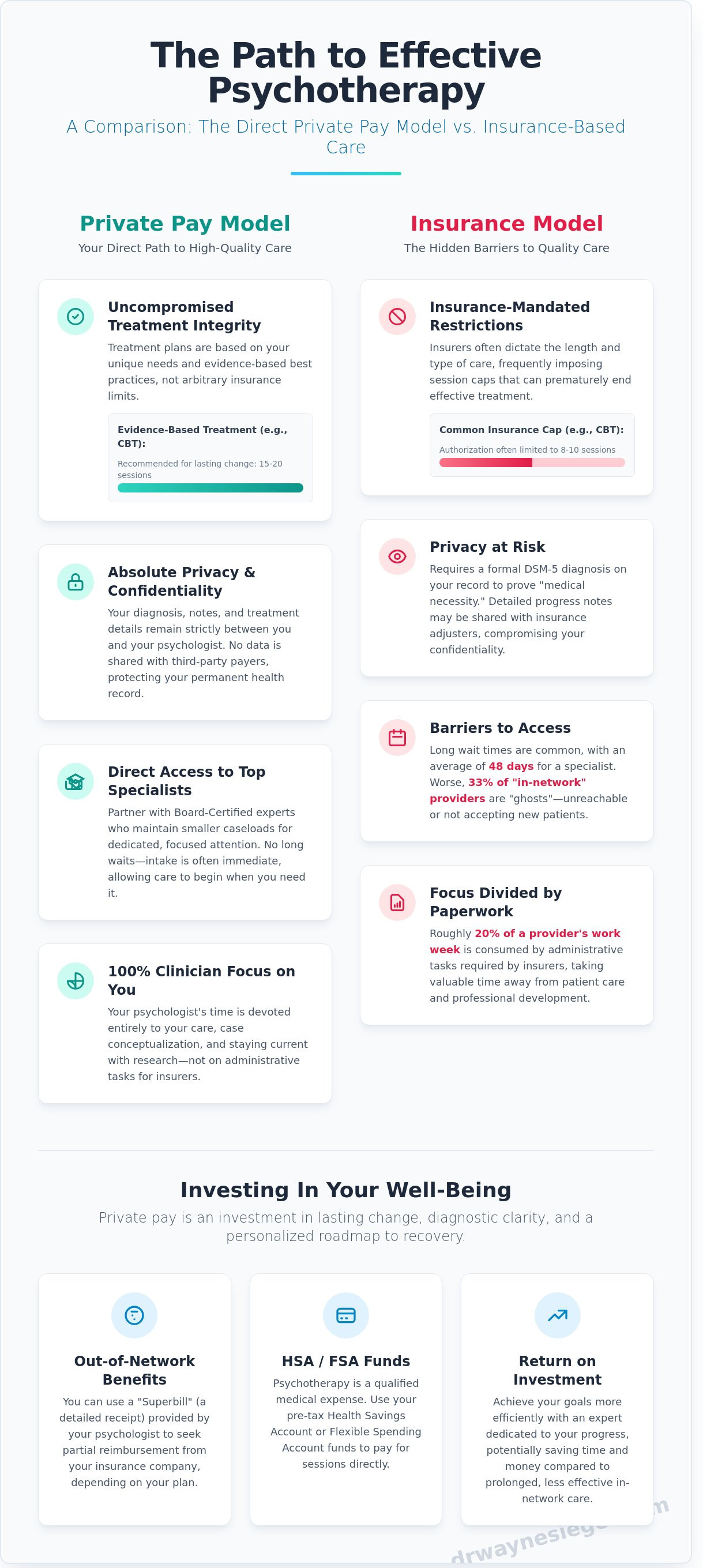
Managed care is a healthcare delivery system designed to reduce costs by influencing the type and frequency of services provided to patients through administrative oversight. This model prioritizes cost-containment, often at the expense of clinical depth. When a psychologist works within this system, they're frequently required to submit detailed progress notes to insurance adjusters who may have no clinical training. This administrative burden consumes roughly 20% of a provider's work week, taking time away from direct patient care and research. It forces a focus on short-term symptom reduction rather than the comprehensive, insight-oriented work that leads to lasting change.
Why 'In-Network' Doesn't Always Mean 'Accessible'
The promise of an in-network provider often falls short when you actually try to book an appointment. A 2023 study by the Senate Finance Committee revealed that 33% of providers listed in "in-network" directories were "ghosts," meaning they were unreachable, no longer accepted the insurance, or weren't taking new patients. For those who are reachable, the average wait time for an in-network specialist in urban areas reached 48 days in 2023. This delay can be detrimental when you're seeking immediate clarity for complex cognitive or emotional challenges.
Private pay eliminates these barriers by allowing for immediate intake and a more consistent therapeutic bond. You aren't limited to a specific number of sessions or forced to switch providers if your employer changes insurance carriers. This continuity is a cornerstone of effective treatment. Additionally, the benefits of private pay psychotherapy include access to highly specialized experts who have opted out of insurance to maintain smaller caseloads. This ensures that when we sit down together, you have my full, undivided attention, backed by a level of expertise that isn't diluted by the high-volume requirements of managed care panels.
How Private Pay Enhances the Efficacy of Evidence-Based Treatments
I've seen how the benefits of private pay psychotherapy manifest in the consistency and depth of our clinical work. One of the primary advantages is the ability to maintain the strict integrity of evidence-based protocols. When we utilize Cognitive Behavioral Therapy (CBT), research from organizations like the American Psychological Association suggests that a standard course for moderate anxiety or depression typically requires 15 to 20 weekly sessions to achieve lasting change. Insurance providers frequently cap authorizations at 8 or 10 sessions. This artificial ceiling forces a difficult choice between stopping treatment prematurely or "watering down" the intervention to fit a shorter window. By choosing private pay, we ensure the treatment adheres to the dose-response relationship proven in clinical trials, giving you the best chance at a full recovery.
Adhering to Clinical Protocols vs. Insurance Constraints
Clinical outcomes improve when the therapist and patient determine the pace of care. For individuals seeking Acceptance and Commitment Therapy (ACT), the process of developing psychological flexibility doesn't always fit into a quarterly billing cycle. I've observed how removing session caps allows for intensive work, such as twice-weekly sessions during acute life transitions or crises. This level of care is often restricted by managed care organizations that prioritize cost-containment over clinical necessity. In complex cases like ADHD assessments or trauma recovery, we need the space to integrate comprehensive diagnostic tools without waiting 14 to 30 days for a prior authorization. This autonomy ensures that your cognitive profile is built on thorough, real-time data, providing a clearer roadmap for your growth.
Privacy also plays a significant role in the therapeutic process and the efficacy of the treatment. When you use insurance, the carrier requires a formal diagnosis and often detailed progress notes to justify "medical necessity" for their records. By paying privately, you maintain greater control over who accesses your sensitive information. Understanding the federal standards for Protecting Your Clinical Record is a vital step in feeling safe enough to do the deep work therapy requires. This sense of safety allows us to focus on you as a whole person, rather than just a collection of symptoms to be managed for a third-party payer.
Focusing on Long-Term Clarity and Functioning
We aim for more than just a temporary reduction in distress; we strive for a measurable improvement in executive functioning and daily quality of life. In a 2021 study on patient-centered care, researchers found that patients who felt they had more control over their treatment plan showed a 25% higher rate of long-term recovery compared to those in highly restricted environments. This "roadmap" approach allows us to address the underlying "why" behind your challenges. We can spend three sessions on organizational strategies or five sessions on emotional regulation without worrying about an auditor's checklist. This flexibility is one of the key benefits of private pay psychotherapy, as it allows the therapy to evolve as you do.
I believe that your mental health journey deserves a level of precision that isn't dictated by corporate policy. This personalized pacing is especially crucial for neurodivergent adults who may need extra time to process insights or build new cognitive habits. If you're ready to explore a more tailored approach to your well-being, you can learn more about my clinical philosophy and how we can work together to achieve lasting clarity. We'll move at a speed that respects your unique cognitive profile, ensuring that every session contributes to a more stable and fulfilling life.
The Privacy Paradox: Protecting Your Clinical Record from Insurance Surveillance
When you use insurance for mental health services, you're entering a system that prioritizes data over personal nuance. Insurance providers operate under a strict medical necessity framework. This means I'm required to assign you a formal psychiatric diagnosis from the DSM-5-TR to justify your claims. Without a documented disorder, your insurance company won't reimburse the cost of care. One of the primary benefits of private pay psychotherapy is that we can focus on your personal growth and clarity without the need for a clinical label that stays on your record forever.
A permanent mental health diagnosis can have long term consequences. While the 2008 Mental Health Parity and Addiction Equity Act improved access, it doesn't protect you from every financial hurdle. I've observed how these records impact my clients in unexpected ways:
- Higher life insurance premiums: In a 2023 study of underwriting practices, individuals with documented mood disorders faced premium increases of 25% or more.
- Security clearance delays: Background investigators often flag psychiatric labels for additional review, which can stall career advancement for months.
- Professional licensing: Certain medical and legal boards still require disclosures that can be triggered by insurance billing records.
The HIPAA Minimum Necessary rule is designed to protect you, but the reality of insurance audits is more invasive. During a 2024 routine compliance review, insurers can demand access to entire clinical files to verify that the treatment is necessary. This surveillance compromises the sanctity of our work together. In my practice, I prioritize your privacy by keeping your records outside of these massive corporate databases. This ensures absolute confidentiality, which is especially vital for high profile professionals or those managing sensitive cases where any leak could be catastrophic.
Choosing to pay out of pocket is an investment in your future autonomy. One of the most significant benefits of private pay psychotherapy is the empowerment that comes from owning your own clinical data. We work together to decide what's documented and how it's used, ensuring your journey toward health doesn't become a liability in the future.
The Permanence of Electronic Health Records (EHR)
Most insurance data is fed into the Medical Information Bureau (MIB) database, which is accessed by over 400 member insurance companies. This data sharing leads to diagnostic overshadowing, where future medical doctors might dismiss physical symptoms as psychological based on your history. By choosing private pay, your records remain strictly between us. This ensures your neuropsychological profile is used only for your benefit, providing a roadmap for your future rather than a hurdle for your healthcare.
Ethical Considerations of Data Privacy in 2026
By 2026, the AI healthcare market is expected to reach $188 billion, with insurers increasingly using algorithms to audit therapy notes for cost cutting opportunities. I'm committed to meticulous record keeping that resists this digital intrusion. You should own your clinical data. When we work together privately, you gain the clarity of a professional assessment without the risk of your personal journey being reduced to a data point in an AI driven audit. It's about maintaining your dignity in a digital age.
Navigating the Logistics: Out-of-Network Benefits and PsyPact
Choosing to step outside the traditional insurance grid doesn't mean you're walking away from financial support. It means you're taking control of how your healthcare dollars are spent. One of the primary benefits of private pay psychotherapy is the ability to access high-level expertise while still utilizing specific insurance mechanisms like Out-of-Network (OON) benefits. This approach allows you to prioritize clinical fit over a list of preferred providers.
Many clients successfully offset the cost of care by using Health Savings Accounts (HSA) or Flexible Spending Accounts (FSA). These accounts use pre-tax dollars to pay for medical expenses. Depending on your tax bracket, using an HSA can effectively reduce your therapy costs by 20% to 30%. Because these funds are already set aside for healthcare, they provide a seamless way to invest in your mental health without impacting your monthly take-home pay.
Maximizing Your Out-of-Network (OON) Reimbursement
If you have a PPO insurance plan, you likely have OON benefits. Most plans reimburse between 50% and 80% of the "allowed amount" for mental health services after you meet your deductible. To verify your coverage, call the number on the back of your insurance card and ask three specific questions. First, ask what your OON deductible is for outpatient mental health. Second, confirm your reimbursement rate for CPT code 90837, which represents a 60-minute individual therapy session. Third, ask if there's a limit on the number of sessions allowed per calendar year.
Our practice provides a monthly document called a Superbill. This is a specialized invoice that includes all the necessary clinical data, such as a diagnostic code and a procedure code, that insurance companies require. You submit this document directly to your insurer through their member portal. This process keeps the clinical relationship between you and Dr. Siegel while allowing you to recover a significant portion of your investment. It's a transparent system that respects your privacy and your budget.
The PsyPact Advantage for National Care
Accessing a specialist used to be limited by geography. Dr. Siegel participates in PsyPact, an interstate compact that currently allows him to provide telepsychology services to clients in 42 states plus the District of Columbia. This legislation was designed to increase public access to care by allowing licensed psychologists to practice across state lines. If you live in a participating state like Illinois, Texas, or Virginia, you can receive the same level of neuropsychological expertise as a local client.
PsyPact is particularly valuable for individuals who travel for work or students who move between home and university. It ensures that your treatment roadmap remains consistent. You don't have to start over with a new provider just because you crossed a state line. Private pay is the most efficient way to utilize these inter-jurisdictional benefits. Insurance companies often have complex, state-specific billing rules that can lead to denied claims when a provider is located elsewhere. By paying directly, you bypass these administrative hurdles and maintain uninterrupted care.
The decision to choose private pay is a cost-benefit analysis centered on efficiency. While a standard insurance copay might be lower, it often connects you with generalist providers who may have high caseloads. Investing in a specialist ensures that every clinical hour is focused on a precise, evidence-based strategy tailored to your cognitive and emotional profile. This often leads to faster progress and more sustainable outcomes. To begin your journey toward clinical clarity, schedule a consultation with Dr. Siegel today.
Investing in Specialized Care: The ROI of Board-Certified Expertise
Choosing a psychologist is a significant decision for your long-term health. When you seek care, the distinction of Board Certification from the American Board of Professional Psychology (ABPP) serves as a critical benchmark. Only 4% of practicing psychologists in the United States have earned this credential. It requires a rigorous process of peer review, work sample defense, and oral examination that goes far beyond standard state licensing requirements. This certification ensures that your provider operates at the highest level of clinical competency and ethical standards.
One of the most meaningful benefits of private pay psychotherapy is the freedom to prioritize this level of expertise over insurance network availability. While the initial out-of-pocket cost may seem higher, the return on investment is found in the quality and efficiency of the care you receive. Specialized practitioners utilize evidence-based protocols that are proven to work, often leading to faster stabilization and more durable results. It's a shift from managing symptoms to investing in a permanent change in your quality of life.
The financial impact of mental health extends into every area of your life. Research consistently shows that effective, specialized treatment for trauma or anxiety can significantly increase workplace productivity and reduce long-term medical spending. By engaging in targeted interventions like Cognitive Behavioral Therapy (CBT) or Acceptance and Commitment Therapy (ACT), you're addressing the root causes of distress. This proactive approach prevents the compounding costs of chronic stress, which is often linked to expensive physical health complications over a lifetime.
The Value of a Precise Diagnosis
Precision is the foundation of effective treatment. A comprehensive Adult ADHD Assessment or diagnostic evaluation acts as a roadmap for your entire therapeutic journey. By identifying the specific cognitive profile of an individual, we can bypass the months or years of trial and error therapy that often occurs when a diagnosis is incomplete. My evaluations are person-centered and strengths-based; they don't just provide a label. They offer clarity on how your brain functions, allowing us to build a strategy that utilizes your natural talents while supporting your challenges. This clarity saves you time, money, and emotional energy by ensuring every session is focused on the right goals.
Starting Your Journey with Siegel Psychology Services
I believe that therapy should be a transparent and collaborative partnership. My approach is direct and professional, yet rooted in deep empathy for the challenges you face. I don't view you as a set of symptoms to be managed, but as a whole person seeking a clearer path forward. Whether you're looking for a definitive diagnostic assessment or specialized therapy to navigate life’s complexities, my goal is to provide you with the insight and tools necessary for a functional, empowered future. We'll work together to transform confusion into a structured plan for growth.
Taking the first step toward specialized care is an act of self-advocacy. If you're ready to move beyond temporary fixes and toward lasting clinical insight, I invite you to reach out. We can discuss your specific needs and determine how a tailored, evidence-based approach can help you achieve the clarity you deserve. You can Schedule a consultation for evidence-based private pay therapy through my website to begin this process. Let's work together to build a foundation for your long-term well-being.
Prioritizing Your Privacy and Clinical Outcomes
Choosing how you invest in your mental health is a decision that directly impacts your long-term clarity. The benefits of private pay psychotherapy center on a commitment to clinical integrity and absolute confidentiality. By removing the constraints of insurance surveillance, I'm able to apply over 25 years of clinical experience toward evidence-based treatments that focus on your specific needs rather than a provider's billing code. My status as a Board Certified professional through the American Board of Professional Psychology (ABPP) ensures your care meets the highest standards of rigorous, peer-reviewed practice. We'll work together to create a precise roadmap for your progress.
This specialized approach is accessible across the country. I'm authorized through PsyPact to provide telehealth services in 40+ states, bringing high-level expertise directly to your home. When you opt for private pay, you're investing in a partnership that values your data security and diagnostic accuracy above all else. I'm ready to help you navigate this process with the professional care you deserve. Schedule a Consultation with Dr. Siegel to begin your journey toward lasting insight. You don't have to navigate these complexities alone.
Frequently Asked Questions
Why is a diagnosis required for insurance but not always for private pay?
Insurance companies require a formal diagnosis from the DSM-5 or ICD-10 to establish medical necessity before they authorize payment. When you choose private pay, I don't have to assign a diagnostic label if your concerns don't meet specific clinical criteria. This flexibility allows us to focus on your personal goals or life transitions without creating a permanent record of a mental health disorder in a centralized insurance database.
Can I get reimbursed by my insurance if I pay out-of-pocket for therapy?
You can often receive reimbursement if your plan includes out-of-network benefits, which are common in PPO policies. I provide a monthly superbill that includes the necessary CPT codes and clinical information for you to submit to your carrier. Many patients receive between 60% and 80% of the session cost back once they meet their annual deductible, making high-quality care much more accessible than it first appears.
What are the specific benefits of seeing a Board-Certified psychologist?
Board certification through the American Board of Professional Psychology ensures you're working with a clinician who has passed rigorous peer review and specialty examinations. Only 4% of licensed psychologists in the United States achieve this distinction. This credential serves as an objective marker of expertise, giving you confidence that your care is grounded in the most current, evidence-based neuropsychological standards available today.
How does private pay therapy provide better privacy for my medical records?
Private pay therapy protects your privacy by ensuring your clinical records remain strictly between us, rather than being shared with insurance auditors. One of the primary benefits of private pay psychotherapy is the elimination of third-party data mining. Insurance companies can request full access to your session notes at any time to justify coverage; however, paying out-of-pocket keeps your sensitive information entirely confidential and secure.
Is private pay therapy more expensive in the long run than using insurance?
Private pay can be more cost-effective because it allows for a customized treatment plan that isn't restricted by insurance company time limits. While a co-pay is cheaper per visit, insurance often requires fail-first protocols that can delay effective treatment for months. By using targeted, evidence-based interventions from the start, we often achieve your goals more efficiently, reducing the total number of sessions you'll need over your lifetime.
What is PsyPact and how does it affect my ability to see Dr. Siegel?
PsyPact is an interstate agreement that allows me to provide telepsychology services to patients located in 42 participating states. This legislation, established to increase access to care, means you can maintain continuity with me even if you travel or move within the compact's jurisdiction. It removes the traditional geographic barriers that previously limited patients to seeing only those doctors licensed in their specific home state as of 2024.
Can I use my HSA or FSA to pay for private pay psychotherapy?
You can use your Health Savings Account or Flexible Spending Account to pay for sessions, as psychotherapy is a qualified medical expense under IRS Publication 502. This allows you to use pre-tax dollars, which effectively reduces your out-of-pocket cost by your marginal tax rate, often 20% to 30%. These funds provide one of the significant benefits of private pay psychotherapy by making specialist care more financially manageable for your family.
How do I know if I have out-of-network benefits for mental health?
To determine your coverage, call the member services number on your insurance card and ask specifically about out-of-network benefits for outpatient mental health. You'll want to ask what your out-of-network deductible is and what percentage they reimburse for CPT code 90837. Having these specific numbers helps us create a clear financial roadmap for your care so there aren't any surprises during our work together in the office.