
Is It Depression or Just Sadness? A Research-Based Guide to Clinical Clarity in 2026

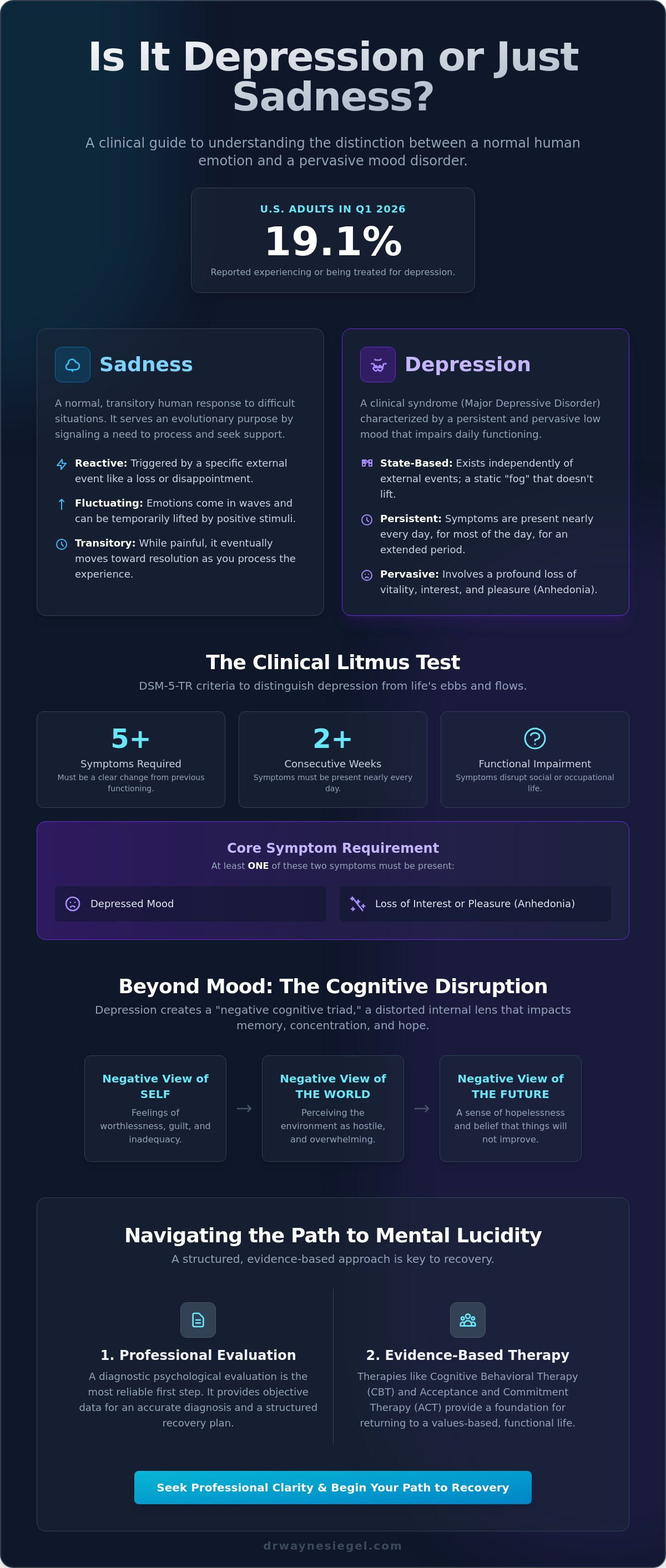
In the first quarter of 2026, 19.1% of U.S. adults reported currently experiencing or being treated for depression. If you find yourself feeling persistently low, you might feel a confusing mix of guilt and uncertainty. You may wonder if your struggles are valid enough for a clinical diagnosis or if you are simply having a human reaction to a difficult season. You are likely asking a fundamental question: is it depression or just sadness? It's a question I hear often in my practice, and it deserves a precise, evidence-based answer.
I understand the fear of being over-diagnosed or, conversely, having your pain dismissed. My goal is to provide you with a clear framework for self-evaluation grounded in the latest psychological research. You'll learn the clinical distinctions between temporary emotional states and the functional impairment associated with Major Depressive Disorder as defined by the DSM-5-TR. We will explore how these conditions impact your daily quality of life and provide the clarity you need to decide if a professional diagnostic psychological evaluation is the right path forward for your mental lucidity.
Key Takeaways
- Define the specific clinical markers that separate situational emotional responses from the pervasive syndrome of Major Depressive Disorder.
- Identify how depression functions as a cognitive disruptor, creating an executive function gap that impacts your daily memory and concentration.
- Apply a research-based framework to help you determine if is it depression or just sadness by evaluating symptom duration and the presence of anhedonia.
- Understand why a professional diagnostic psychological evaluation is the most reliable path toward mental lucidity and a structured recovery plan.
- Explore how evidence-based therapies like CBT and ACT provide a foundation for returning to a values-based, functional life.
Is It Depression or Just Sadness? Understanding the Emotional Spectrum
When you ask yourself, is it depression or just sadness, you are looking for a boundary between a normal human emotion and a clinical condition. I find that many individuals struggle with this distinction because both experiences share a similar emotional vocabulary. However, the difference lies in the origin and the persistence of the feeling. Sadness is typically reactive, meaning it has a clear external trigger like a loss or a disappointment. Depression is often state-based, existing independently of your current circumstances and persisting even when life events are objectively positive.
In Understanding the Emotional Spectrum, we see that while sadness is a vital component of the human experience, Major Depressive Disorder (MDD) is a pervasive clinical syndrome. It isn't just a bad day or a difficult week; it's a change in the very fabric of how you process the world. Depression is a multifaceted mood disorder requiring specific clinical criteria, including duration and functional impairment, to be accurately diagnosed.
Defining Sadness as a Transitory Human Response
Sadness serves an important evolutionary purpose. It's a signal to slow down, process a loss, and seek social support. If you're experiencing situational low mood or healthy grieving, your emotions will likely fluctuate. You might feel a heavy weight in the morning but find yourself able to laugh at a friend's joke by evening. This responsiveness to positive stimuli is a hallmark of healthy emotional processing. While painful, this type of sadness is transitory and eventually moves toward resolution as you integrate the experience.
Clinical Depression: More Than a Low Mood
Clinical depression feels less like unhappiness and more like a profound loss of vitality. It involves a fundamental shift in how your brain processes reward, energy, and self-perception. This biological dysregulation means that "pulling yourself together" isn't a matter of willpower; it's a biological impossibility when the neural pathways responsible for motivation are compromised. When considering is it depression or just sadness, look for a sense of emptiness that remains static. This state-based heaviness feels like a fog that does not lift, regardless of external changes or attempts to "cheer up." It's a complex cognitive and physiological state that requires a structured, evidence-based approach to resolve.
The DSM-5-TR Criteria: Distinguishing Symptoms from Life Stressors
To move beyond the surface level of "feeling down" and answer the question is it depression or just sadness, clinicians rely on the Diagnostic and Statistical Manual of Mental Disorders, Fifth Edition, Text Revision (DSM-5-TR). This manual provides a rigorous framework that prevents us from over-pathologizing normal human grief while ensuring that clinical syndromes aren't overlooked. A formal diagnosis requires the presence of at least five symptoms within the same two-week period, and these symptoms must represent a clear change from your previous level of functioning. At least one of these must be either a depressed mood or a profound loss of interest or pleasure in daily activities.
According to research on Evidence-Based Pathways to Recovery, these symptoms aren't just isolated feelings; they are a cluster of cognitive, emotional, and physical shifts. Depression often involves a "negative cognitive triad," a term coined by psychologist Aaron Beck to describe a persistent, distorted view of yourself, the world, and the future. This internal lens makes it difficult to see solutions or hope, even when they are present. If you find these patterns resonate with your current experience, a Diagnostic Psychological Evaluation can provide the objective data needed to move forward with clarity.
Duration and Persistence: The Critical Timeline
The two-week threshold is a primary clinical marker used to distinguish a major depressive episode from the natural ebbs and flows of life. While everyone has "bad days" or a difficult weekend, clinical depression requires symptoms to be present nearly every day, for most of the day. This persistence is what disrupts your ability to function in social or occupational settings. When you are evaluating is it depression or just sadness, look at the timeline. Sadness often comes in waves, frequently interspersed with moments of relief; depression is a steady, unrelenting state that does not easily yield to external changes.
The Pervasiveness of Anhedonia and Fatigue
Anhedonia, or the inability to feel pleasure, is a core diagnostic pillar that often separates MDD from situational sadness. It isn't just feeling bored; it's a physiological inability to derive joy from things you previously loved, such as hobbies, food, or social connection. This often pairs with clinical lethargy, which is distinct from being "tired." This type of fatigue feels heavy and pervasive, often accompanied by psychomotor agitation or retardation. You might feel like you are moving through molasses, or conversely, find yourself unable to sit still due to a restless, internal tension. These physical manifestations are measurable indicators that your nervous system is struggling to maintain its equilibrium.
The Functional Impact: How Depression Disrupts Daily Life
When you ask yourself, is it depression or just sadness, the answer often reveals itself in your ability to manage daily life. While sadness might make a task feel heavy, depression can make that same task feel cognitively impossible. This isn't a failure of character; it's a measurable disruption in how your brain processes information and regulates effort. Understanding this functional shift is essential for moving past self-blame and toward an accurate clinical understanding of your experience.
The American Psychiatric Association highlights that The DSM-5-TR Criteria require symptoms to cause significant distress or impairment in social and occupational areas. In my practice, I see this manifest as a breakdown in the brain’s executive control center. It’s the difference between being unhappy at work and being unable to sequence the steps required to finish a simple report. This functional decline is one of the most reliable markers I use to help clients distinguish between a difficult emotional season and a clinical disorder.
Cognitive Fog and Executive Dysfunction
Depression impacts the prefrontal cortex, the area responsible for higher-level thinking and decision-making. This often results in a working memory deficit, where you find it difficult to hold and manipulate information in your mind. You might walk into a room and forget why you're there, or find yourself reading the same paragraph four times without comprehension. A comprehensive psychological assessment near me can utilize standardized neurocognitive tests to objectively measure these cognitive shifts and quantify the degree of functional impairment you are experiencing.
The Erosion of Social and Occupational Ties
Social withdrawal in depression is distinct from the healthy solitude we seek when we're sad. When we're sad, we often reach out for support; when we're depressed, we tend to pull away. This happens because the effort required for social engagement feels insurmountable. This creates a feedback loop of isolation that deepens the depressive state and makes recovery feel more distant. In the workplace, this often leads to presenteeism, which is being physically present but mentally absent. You're at your desk, but your productivity is halved because of the internal cognitive load you're carrying. Recognizing these patterns helps you understand that is it depression or just sadness isn't just about how you feel, but how you function within your community.
Navigating the Path Forward: Assessment and Self-Reflection
If you have used an online screening tool like the PHQ-9, you've taken an important first step toward understanding your mental health. These tools are designed to flag potential issues, but they lack the nuance required to differentiate between complex clinical states. As of 2026, the FDA has increased its scrutiny of digital mental health apps, distinguishing between simple wellness tools and software that functions as a medical device. This highlights a critical point: a single score cannot capture the full picture of your cognitive and emotional life. When you are assessing is it depression or just sadness, a screening is merely a signal that further investigation is needed.
A comprehensive psychological assessment near me offers a much deeper level of diagnostic clarity. This process is essential because depression rarely exists in a vacuum. In many cases, what looks like a mood disorder is actually a complex interaction with other conditions, such as ADHD or generalized anxiety. For example, the executive function gaps found in ADHD can often lead to a secondary depression when daily tasks become insurmountable. Identifying these co-occurring patterns is the only way to achieve true mental lucidity and create a roadmap that actually works for your specific brain chemistry.
The Role of a Diagnostic Psychological Evaluation
Professional testing moves beyond surface-level symptoms to uncover the underlying causes of your distress. While a 15-minute screening might identify that you're feeling low, a clinical evaluation explores your neurocognitive functioning, personality traits, and history. This rigorous methodology ensures your diagnosis is accurate, providing the foundation for an effective treatment plan. It transforms a vague sense of struggle into a structured path forward. This clarity is vital for ensuring you don't spend years treating the wrong issue.
Identifying Triggers vs. Endogenous Mood Shifts
I work with clients to analyze the "why" behind their mood, distinguishing between biological factors and situational stressors. This is a critical step in deciding is it depression or just sadness. A psychologist differentiates between the natural, healthy process of grief and an endogenous shift that doesn't respond to life changes. We look at your personal history and individual assets as part of the puzzle. Every assessment is a unique opportunity to find actionable meaning. If you are ready to gain a more transparent understanding of your life, I invite you to learn more about my diagnostic psychological evaluations.
Evidence-Based Pathways to Mental Lucidity and Recovery
Once we've moved past the initial question of is it depression or just sadness through a formal evaluation, we can begin the work of recovery. I believe that a diagnosis is not a label, but a roadmap. It allows us to select the clinical methodology that best fits your specific cognitive and emotional profile. The synergy between a structured assessment and individual psychotherapy ensures that we aren't just treating surface-level symptoms, but addressing the underlying architecture of your distress. This transition from evaluation to intervention is where you begin to regain a sense of agency over your life.
CBT and Behavioral Activation
Cognitive Behavioral Therapy (CBT) remains a gold standard for treating moderate to severe depression. In our sessions, we focus on identifying and challenging the "internal critic," that voice that reinforces negative cognitive triads about your self-worth and your future. This clinical methodology targets the distorted patterns that keep you stuck in a loop of hopelessness. We don't just talk about your feelings; we analyze the objective evidence for and against your negative beliefs. We also utilize behavioral activation to break the cycle of lethargy. By slowly reintroducing activities that provide a sense of mastery or pleasure, we help your brain's reward system begin to recalibrate. This isn't about "staying busy." It's a precise intervention designed to reverse the withdrawal that characterizes clinical states.
ACT: Finding Actionable Meaning
Acceptance and Commitment Therapy (ACT) offers a different lens. Instead of only fighting negative thoughts, we use mindfulness to change your relationship with them. You learn to observe difficult emotions without being consumed by them. We work together to identify your core values—the things that truly matter to you—and use them to guide your daily decisions. This focus on psychological flexibility allows you to move toward a meaningful life even on days when your energy is low. It shifts the primary goal from "not feeling bad" to "living well." Research shows that ACT can significantly improve quality of life and functional capacity, providing a steady path toward mental lucidity.
Finding a practitioner who balances clinical expertise with this level of specialized assessment can be a challenge. However, the expansion of telehealth has made expert care more accessible than ever. Through my participation in PsyPact states, I can provide diagnostic clarity and therapeutic support to individuals across a large portion of the country. This interjurisdictional reach ensures that you can access high-level clinical guidance regardless of your physical location. Deciding is it depression or just sadness is the first step toward a future where you feel like yourself again, supported by a structured, evidence-based plan for recovery.
Achieving Clarity and Restoring Your Quality of Life
Determining if your current struggle is it depression or just sadness requires a transition from subjective worry to objective clinical insight. We've examined how the DSM-5-TR provides a rigorous framework for this distinction, emphasizing the persistence of symptoms and the functional disruption of your cognitive life. While sadness is a natural response to life's challenges, clinical depression is a syndrome that requires a structured, research-based intervention. Moving beyond mere labels to find actionable meaning is the most reliable way to reclaim your daily quality of life.
As a board-certified clinical psychologist with over 25 years of experience, I provide a steady, non-judgmental space to navigate these complex emotional landscapes. By utilizing evidence-based CBT and ACT approaches, I help clients challenge negative thought patterns and move toward values-based living. My practice offers national telehealth availability via PsyPact, ensuring you can access specialized diagnostic evaluations and psychotherapy from nearly anywhere. Schedule a consultation with Dr. Wayne Siegel to gain clinical clarity and a structured path forward. You don't have to navigate this uncertainty alone; mental lucidity and a return to your personal assets are entirely possible.
Frequently Asked Questions
Can I be depressed if I don't feel 'sad' all the time?
Yes, you can be clinically depressed without experiencing constant sadness. Many individuals primarily experience anhedonia, which is a profound loss of interest or pleasure in activities they once enjoyed. Others might feel a sense of emotional numbness, persistent fatigue, or increased irritability. When you are trying to determine is it depression or just sadness, it's important to look for these other diagnostic markers that impact your baseline functioning and energy levels.
How long does a typical depressive episode last without treatment?
Untreated major depressive episodes typically last between six and twelve months, though the duration varies significantly between individuals. While some episodes may eventually resolve on their own, the risk of recurrence is high without clinical intervention. Approximately 50% of people who experience one episode will have a second. Seeking a formal diagnostic psychological evaluation can help shorten the episode's duration and provide you with a structured plan to prevent future relapses.
What is the difference between grief and clinical depression?
Grief usually occurs in waves and is specifically tied to a loss, such as the death of a loved one or a major life transition. In grief, your self-esteem is usually preserved, and you can still experience moments of joy. Clinical depression is more pervasive and often includes feelings of worthlessness or self-loathing that aren't present in typical grieving. While significant loss can trigger depression, the two are distinct experiences that require different types of support.
Is depression a chemical imbalance or a reaction to life events?
Depression is rarely caused by a single factor; it's a complex interaction of biological, psychological, and social variables. While changes in brain chemistry and neurotransmitter regulation play a role, life stressors and cognitive patterns are equally significant. This biopsychosocial model is why I focus on a comprehensive assessment to understand your unique situation. It's a combination of how your brain functions and how you navigate the world around you.
When should I seek a professional psychological evaluation?
You should seek a professional evaluation if your symptoms persist for more than two weeks and interfere with your ability to function at work, home, or in your relationships. If you find that is it depression or just sadness is a question that's constantly on your mind, a formal assessment can provide the clarity you need. Early intervention is the most effective way to address cognitive fog and prevent symptoms from becoming more chronic.
Can online therapy be as effective as in-person sessions for depression?
Research consistently shows that online therapy is as effective as in-person sessions for many individuals, particularly when using evidence-based approaches like CBT. The convenience of telehealth can lower the barrier to starting care, especially when you are struggling with low energy or social withdrawal. I provide specialized telehealth services across many states, ensuring that you can access high-level clinical expertise from the comfort of your own home.
What happens if I ignore my symptoms and don't seek help?
Ignoring symptoms can lead to a more chronic or severe state of depression that is harder to treat later. Over time, untreated depression can erode your interpersonal relationships, lead to occupational setbacks, and even impact your physical health, such as increasing the risk of cardiovascular issues. It's much easier to restore mental lucidity and your daily quality of life when we address these challenges before they become deeply entrenched patterns.
How do I explain the difference between my sadness and depression to others?
You can explain that sadness is a temporary reaction to a specific event, while depression is a pervasive clinical state that affects your entire system. You might describe it as a "biological low-power mode" that impacts your sleep, appetite, and concentration regardless of your circumstances. Framing it as a health condition rather than a mood helps others understand that it isn't something you can simply "snap out of" through willpower alone.