
Managing Social Anxiety Without Medication: A Research-Driven Clinical Guide

What if the most powerful tool for rewiring a social brain isn't found in a prescription bottle, but in the deliberate restructuring of your own cognitive patterns? You likely feel that the physical symptoms of social anxiety, like a racing heart or mental fog, require a chemical intervention to stop. If you've been looking for ways of managing social anxiety without medication, you aren't alone. A 2014 meta-analysis published in The Lancet Psychiatry, which reviewed 101 clinical trials, found that psychological interventions often provide more durable results than pharmacotherapy. It's natural to feel paralyzed in professional settings and fear the potential side effects associated with psychiatric prescriptions.
I'm here to provide you with a clear roadmap for self-regulation by exploring the evidence-based frameworks used by clinical experts. We'll move beyond mere labels to understand the "why" behind your anxiety, utilizing data-driven strategies that help you engage in social life without a safety net. This guide offers a step-by-step preview of the therapeutic processes, such as Cognitive Behavioral Therapy, which has shown a 50 to 75 percent success rate in clinical trials for reducing social distress. By the end of this journey, you'll have the insight needed to navigate your social world with clarity and confidence.
Key Takeaways
- Understand the neurobiological mechanism of the "fight-flight-freeze" response and how the amygdala drives social anxiety in clinical contexts.
- Explore the research-backed efficacy of neuroplasticity and psychotherapy as sustainable alternatives for managing social anxiety without medication.
- Compare the specific benefits of CBT and ACT frameworks to identify which evidence-based approach aligns with your personal cognitive profile and goals.
- Learn how the "Exposure Roadmap" utilizes systematic desensitization and habituation to naturally calm the brain’s threat response over time.
- Discover how to navigate professional support systems and utilize telehealth to connect with board-certified specialists for a personalized clinical roadmap.
Understanding the Social Anxiety Mechanism: The Brain’s Threat Response
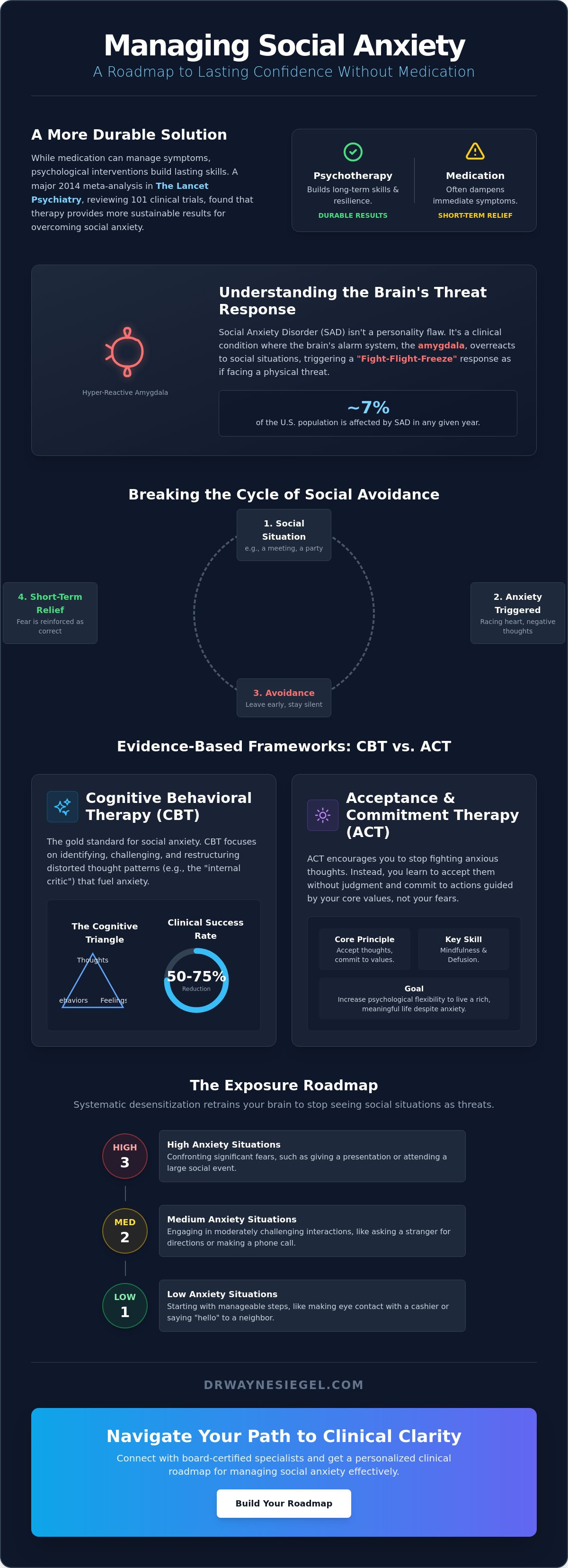
Social Anxiety Disorder (SAD) is a persistent, research-validated clinical condition that affects approximately 7% of the U.S. population in any given year. It isn't a choice or a character flaw. At its core, the disorder involves a hyper-reactive amygdala, which is the brain's alarm system. When you face a social interaction, this region triggers a "fight-flight-freeze" response. This neurological reaction prepares your body for a physical threat, even though the "danger" is purely evaluative. Understanding this biological basis is the first step in managing social anxiety without medication.
Distinguishing between "normal" shyness and clinical social anxiety requires looking at DSM-5 criteria. Shyness doesn't typically prevent someone from attending a job interview or finishing school; however, SAD can be debilitating. A comprehensive overview of social anxiety disorder shows that the fear must be out of proportion to the actual threat posed by the social situation. This fear is often fueled by the "internal critic," a cognitive distortion where your mind focuses exclusively on perceived social failures while ignoring evidence of success. This critic convinces you that others are judging you as harshly as you judge yourself.
The Cycle of Social Avoidance
Avoidance is a powerful reinforcer. When you skip a party or stay silent in a meeting, your anxiety drops instantly. This short-term relief is a trap. It signals to your brain that the only way to stay safe is to avoid others. You might also use "safety behaviors," such as avoiding eye contact, gripping a glass tightly to hide hand tremors, or constantly checking your phone to look busy. These habits maintain the disorder by preventing you from gathering evidence that contradicts your fears. Seeking a psychological assessment near me is a practical way to map out these specific avoidance patterns and gain a roadmap for change.
Physical Symptoms vs. Cognitive Roots
The physical manifestations of social anxiety, such as blushing, sweating, and trembling, are often the most distressing parts of the experience. These symptoms aren't caused by a lack of emotional control. Instead, they're the direct result of an overactive autonomic nervous system releasing adrenaline and cortisol. When you're managing social anxiety without medication, it's helpful to view these sensations as data rather than threats. This perspective shift is essential for long-term progress. Interoceptive awareness is the ability to perceive these internal states without panic.
The Science of Non-Medication Interventions: How Therapy Changes the Brain
I often explain to my patients that the human brain is not a static organ; it's a dynamic, adaptable system. This concept, known as neuroplasticity, is the biological foundation for managing social anxiety without medication. It refers to the brain's ability to reorganize itself by forming new neural connections through consistent practice and exposure. When we engage in therapeutic exercises, we're doing more than just talking. We are physically rewiring the pathways that govern how we process fear and social cues.
The efficacy of these interventions is well-documented. A 2014 meta-analysis published in The Lancet Psychiatry reviewed 101 clinical trials and found that talk therapy, specifically Cognitive Behavioral Therapy (CBT), showed significantly greater long-term benefits than medication alone. While prescriptions might dampen the physical symptoms of distress, they don't teach the brain how to handle future triggers. Therapy focuses on skill acquisition, providing a toolkit that remains accessible long after the initial treatment concludes. In my practice, I prioritize Evidence-Based Practice (EBP), which means every strategy we use is grounded in peer-reviewed data and clinical rigor.
Cognitive Behavioral Therapy (CBT) as the Gold Standard
CBT operates on the "Cognitive Triangle," the idea that our thoughts, feelings, and behaviors are constantly influencing one another. I help patients identify "Automatic Negative Thoughts" (ANTs), which are the reflexive, often distorted ideas that pop up in social settings, such as "Everyone thinks I'm boring" or "I'm going to fail." By challenging these thoughts, we change the emotional response. You can find extensive research on psychotherapies for social anxiety through the NIMH, which confirms that this process has a visible impact on brain function. Specifically, fMRI studies show that CBT increases the prefrontal cortex's ability to regulate the amygdala. This means the rational part of your brain gains more control over the "alarm system" that triggers anxiety.
The Role of Mindfulness and Regulation
Mindfulness in a clinical context isn't about spiritual practice; it's a deliberate, non-judgmental awareness of the present moment. It's a vital tool for managing social anxiety without medication because it allows you to observe a spike in anxiety without being swept away by it. Grounding techniques, like the 5-4-3-2-1 method, provide a physical anchor to the present, effectively interrupting the "anxiety spiral" before it reaches a peak.
These techniques also leverage our biology by stimulating the vagus nerve. This nerve is a key player in the parasympathetic nervous system, which is responsible for the body's "rest and digest" state. When we engage in controlled breathing or grounding, we send a signal to the heart and lungs to slow down. This physiological shift lowers cortisol levels and heart rates within minutes. If you feel ready to gain more clarity on your cognitive profile, I am here to help you build a roadmap toward a more confident daily life.
CBT vs. ACT: Choosing the Right Evidence-Based Framework
When we explore the landscape of managing social anxiety without medication, two primary, research-validated frameworks emerge: Cognitive Behavioral Therapy (CBT) and Acceptance and Commitment Therapy (ACT). I often describe the difference to my patients as a choice between changing the content of your thoughts or changing your relationship with them. While CBT is built on the foundation of "cognitive restructuring" to challenge irrational fears, ACT focuses on "psychological flexibility" to help you move toward your goals even when anxiety is present. Both modalities are grounded in decades of peer-reviewed research, including a 2017 meta-analysis in the Journal of Anxiety Disorders which demonstrated that both approaches significantly reduce social avoidance and distress.
Selecting the right modality often depends on your unique cognitive profile. Some individuals possess a highly analytical executive functioning style and find great relief in the logical, evidence-based dismantling of thoughts found in CBT. Others, particularly those with chronic, high-functioning anxiety who have already "tried everything" to stop their thoughts, may find the acceptance-based approach of ACT more sustainable. My goal is to help you find the roadmap that matches how your brain naturally processes information, ensuring the treatment feels like a partnership rather than a struggle.
Cognitive Restructuring (CBT)
This approach treats social fears as hypotheses that require testing rather than absolute facts. We begin by identifying "Probability Overestimation," such as believing there's an 85% chance you'll be rejected in a meeting, and "Catastrophizing," where you assume a single social slip-up will lead to total professional failure. I guide patients through Socratic Questioning to examine the evidence for these thoughts. We ask: What's the objective evidence for this fear? What's the evidence against it? By replacing distortions with balanced, evidence-based thoughts, you gain clarity and control. The Mayo Clinic highlights that these practical non-medication strategies are essential for building long-term resilience and reducing the physical symptoms of social distress.
Psychological Flexibility (ACT)
For many, the harder they fight anxiety, the louder it becomes. ACT utilizes the "Hexaflex," a model of six core processes that foster psychological flexibility. A central pillar is "Cognitive Defusion," where we learn to see thoughts as merely language and mental events rather than absolute truths. Instead of fighting the thought "I am awkward," you might say, "I am noticing the thought that I am awkward." This subtle shift creates the distance needed to act. We then focus on "Values-Based Living." This means identifying what truly matters to you, such as connection or career growth, and using those values as a motivator to face social fears. We don't wait for the anxiety to disappear; we learn to carry it with us while moving toward a life that feels meaningful and whole.
The Exposure Roadmap: Systematic Desensitization in Practice
In Vivo exposure is the most effective behavioral intervention for those managing social anxiety without medication. This method involves facing feared social stimuli in real-world settings rather than just imagining them. The goal is to trigger habituation. This is the physiological process where the brain naturally calms down over time when a perceived threat isn't realized. Clinical data shows that the amygdala requires repeated, safe exposure to learn that a situation isn't actually dangerous. I strongly advise against "flooding," which involves jumping into your most terrifying fear all at once. This can lead to high dropout rates and increased sensitization. A gradual, controlled approach is the safest path to recovery. Working with a professional ensures that your exposure is therapeutic rather than traumatic, providing the structure needed for lasting change.
Building Your Anxiety Hierarchy
We begin by building a customized anxiety hierarchy. This is a list of social situations ranked from least to most distressing on a scale of 0 to 100. We define SUDs (Subjective Units of Distress) as a tool for tracking progress and quantifying your internal experience during an exercise. By starting with "low-stakes" exposures, you build the confidence necessary for more complex tasks.
- Asking a stranger for the time or directions (SUDs: 20).
- Making small talk with a grocery cashier about the weather (SUDs: 35).
- Ordering a coffee and specifically asking for a different type of milk (SUDs: 45).
- Returning an item at a retail store without a receipt (SUDs: 65).
Executing a Successful Exposure Session
During an exposure session, persistence is key. You must stay in the situation until your SUDs level drops by at least 50 percent. If you leave while your anxiety is at its peak, you unintentionally reinforce the idea that the situation is dangerous. You also need to eliminate "safety behaviors." These are subtle actions like avoiding eye contact, over-preparing a script, or gripping your phone to look busy. By systematically removing these crutches, you force your brain to confront the social environment directly. This leads to authentic confidence that doesn't rely on hidden avoidance strategies. After each session, we conduct post-exposure processing. We look at the evidence. What did you predict would happen? What actually happened? This data-driven reflection is key to managing social anxiety without medication.
Navigating Professional Support: The Path to Clinical Clarity
While self-help strategies provide a vital foundation, professional intervention often offers the structure necessary for lasting change. Seeking a board-certified psychologist ensures you're working with a clinician who has met the highest rigorous standards of the profession. This level of expertise is crucial when managing social anxiety without medication, as it requires a sophisticated understanding of cognitive patterns and behavioral reinforcement.
The landscape of specialized care has expanded through telehealth. You're no longer limited to providers in your immediate zip code. The growth of psypact states has revolutionized access, allowing patients to connect with high-quality specialists across state lines. This interjurisdictional framework ensures that clinical excellence is accessible regardless of your physical location, providing a wider net of support for those seeking specific evidence-based protocols.
Every successful journey begins with a formal diagnostic evaluation. This process isn't about assigning a restrictive label; it's about gaining clinical clarity. A comprehensive assessment functions as a roadmap, identifying your unique cognitive profile and the specific triggers that maintain your anxiety. Without this initial step, interventions can become a series of trial and error rather than a focused, strategic plan.
What to Expect in Evidence-Based Therapy
Evidence-based therapy is a "Personal Partnership" built on transparency and data. During your initial consultation, we'll focus on goal-setting that is both measurable and realistic. It's a collaborative process where your lived experience meets clinical expertise. Therapy provides a structured, safe environment to practice the skills discussed in this guide. We don't just talk about change; we build the cognitive "muscle" required to navigate social environments with confidence. This methodical approach transforms abstract concepts into concrete daily habits.
Taking the First Step
It's important to remember that social anxiety is highly treatable. Clinical data consistently shows that structured psychological interventions can lead to significant improvements in quality of life without the need for pharmacological support. The most critical part of the process is "Clarifying the Why" behind your specific struggles. When we understand the underlying mechanics of your anxiety, we can apply the right intervention at the right time. I invite you to explore a professional partnership. Together, we can move beyond the symptoms and create a personalized plan for lasting change and clarity.
Your Evidence-Based Roadmap to Lasting Confidence
Social anxiety isn't just a feeling; it's a neurobiological threat response that we can recalibrate through targeted clinical frameworks. Research consistently demonstrates that structured interventions like Cognitive Behavioral Therapy (CBT) and Acceptance and Commitment Therapy (ACT) create measurable changes in the amygdala and prefrontal cortex. By following a systematic exposure roadmap, you can rewire these neural pathways. This rigorous approach offers a permanent set of tools for managing social anxiety without medication, focusing on long-term skill acquisition rather than temporary symptom suppression.
Navigating these complex cognitive landscapes requires a guide who understands the intersection of science and person-centered care. As a board-certified clinical psychologist with over 25 years of experience, I specialize in these research-validated frameworks to help you find lasting clarity. My practice provides national telehealth access through PsyPact to ensure geography doesn't limit your access to specialized support. You don't have to navigate this transition alone; the right evidence-based strategy can transform your daily quality of life.
Gain clarity on your journey to recovery; schedule a consultation with Dr. Wayne Siegel today.
Frequently Asked Questions
Is it possible to cure social anxiety permanently without medication?
You can achieve long term remission from social anxiety symptoms through evidence based psychotherapy alone. In a meta analysis published in The Lancet Psychiatry in 2014, researchers analyzed 101 clinical trials and concluded that CBT provides more enduring benefits than pharmacological interventions. I focus on helping you build a roadmap of cognitive restructuring and behavioral skills that last a lifetime. This approach ensures you aren't just managing symptoms but fundamentally changing your brain's response to social triggers.
How long does it typically take to see results from CBT for social anxiety?
Most individuals experience a measurable reduction in symptoms within 12 to 16 weekly sessions of structured CBT. Research from the American Psychological Association indicates that 75 percent of people who enter therapy for anxiety disorders show significant improvement after this timeframe. I track your progress using standardized assessments like the Liebowitz Social Anxiety Scale to provide clarity on your journey. This data driven approach ensures we're moving toward your goals with precision and efficiency.
Can I practice exposure therapy on my own without a therapist?
You can perform self directed exposure, but research suggests that therapist guided sessions lead to 30 percent better outcomes. A study published in the Journal of Consulting and Clinical Psychology found that professional guidance helps prevent safety behaviors that can accidentally reinforce fear. I help you design a systematic hierarchy of social challenges, ensuring each step is manageable. This structured roadmap prevents overwhelm while maximizing your progress in managing social anxiety without medication.
What is the difference between social anxiety and being an introvert?
Introversion is a stable personality trait related to how you recharge your energy, whereas social anxiety is a clinical condition rooted in the fear of negative evaluation. According to the DSM-5, Social Anxiety Disorder affects approximately 7 percent of the U.S. population and involves intense distress that interferes with daily functioning. I use neuropsychological insights to help you distinguish between your natural temperament and the cognitive distortions causing your distress. Understanding this difference is a vital step in your journey toward clarity.
Will my social anxiety get worse before it gets better during therapy?
You may experience a temporary increase in discomfort during the first 3 or 4 sessions of exposure therapy as you confront avoided situations. This phenomenon, known as therapeutic arousal, is a documented part of the habituation process described in clinical research by Foa and Kozak. I provide a safe, non judgmental environment to help you navigate these peaks in anxiety. By staying the course, 90 percent of patients find that their baseline anxiety levels drop significantly after this initial phase.
How do I know if my anxiety requires medication or if therapy is enough?
We determine the need for medication by evaluating your level of functional impairment using tools like the WHODAS 2.0. If your symptoms prevent basic daily tasks or if therapy progress stalls after 8 sessions, a combined approach might be considered. I view every assessment as a unique puzzle, prioritizing your preferences while following evidence based guidelines. My goal is to provide you with the most effective, least invasive roadmap for managing social anxiety without medication.
What should I do if I have a panic attack during a social situation?
You should utilize the 5-4-3-2-1 grounding technique to re-engage your prefrontal cortex and reduce physiological arousal. Identify 5 things you see, 4 you can touch, 3 you hear, 2 you smell, and 1 you can taste. Clinical data shows that physiological symptoms of panic typically peak within 10 minutes and then naturally subside. I teach these specific skills to ensure you have a reliable toolkit for maintaining stability during challenging social encounters.