
What to Talk About in Therapy: A Clinical Guide to Finding Clarity and Progress

What if the most clinically significant moment of your session isn't the major life event you planned to discuss, but the subtle pattern in how you describe a minor daily frustration? Many patients arrive at my office feeling a quiet pressure to perform, worried that their struggles aren't "big enough" to warrant a professional's time. It's common to spend your commute wondering exactly what to talk about in therapy to avoid an awkward silence or a perceived lack of progress. I recognize that this anxiety can become a barrier to the very clarity you're seeking.
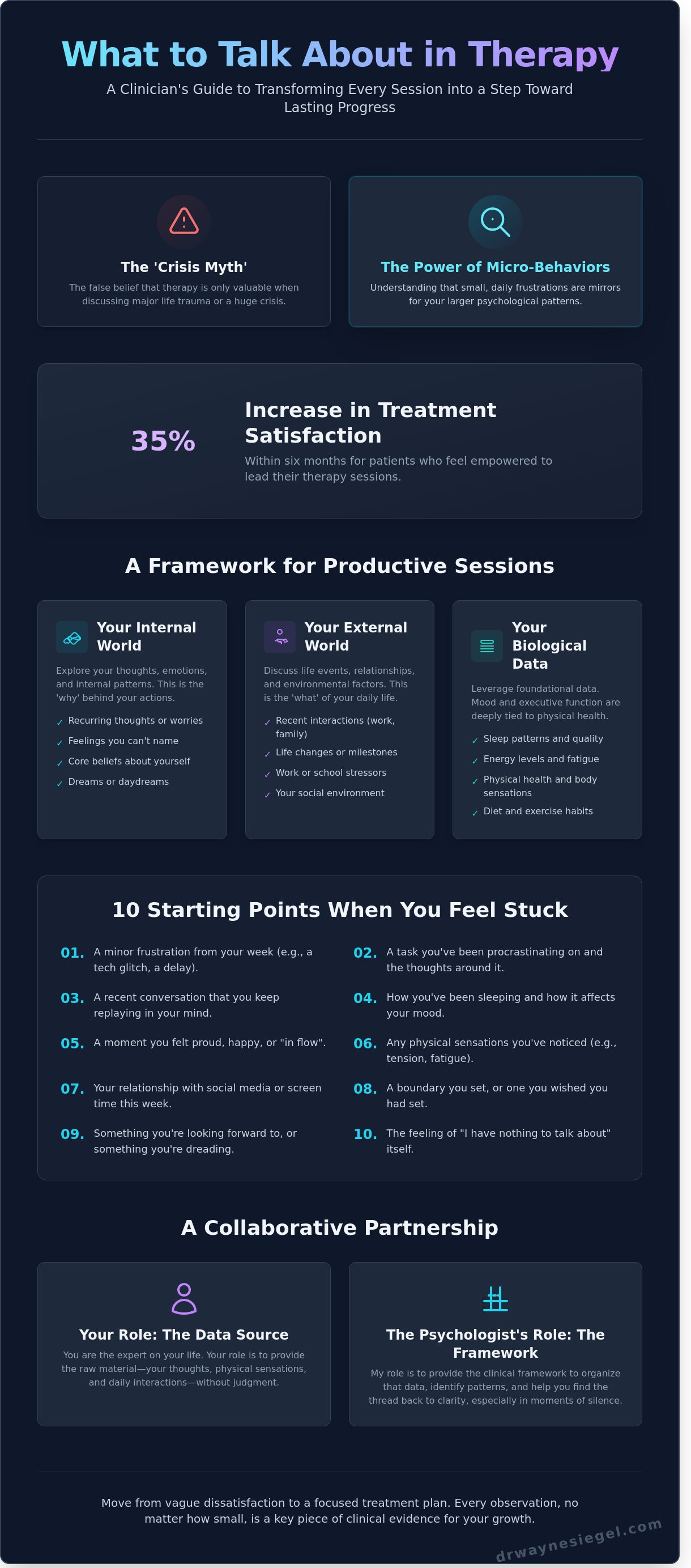
I agree that the transition from the chaos of daily life to the focused environment of a clinic can feel jarring. Research indicates that patients who feel empowered to lead their sessions see a 35% increase in treatment satisfaction within the first six months of care. I'll show you how to navigate your sessions effectively by understanding the clinical value of both your major milestones and your subtle daily habits. This guide provides a mental menu of topics and a clear roadmap to help you transform every minute of your clinical hour into a step toward lasting progress.
Key Takeaways
- Move past the "crisis myth" by understanding how even subtle daily observations provide the clinical evidence needed for significant personal growth.
- Discover how to identify micro-behaviors and recurring patterns to find clarity on what to talk about in therapy during moments of silence.
- Apply a structured framework to distinguish between internal emotional states and external life events, ensuring every session contributes to your cognitive profile.
- Learn to leverage foundational biological data, such as sleep patterns and physical health, to uncover the "why" behind your mood and executive functioning.
- Transition from vague dissatisfaction to a focused treatment plan by aligning your weekly conversations with a long-term roadmap for actionable change.
The 'Nothing to Say' Paradox: Why We Struggle to Find Topics
You sit down, the clock starts, and suddenly, your mind is a complete void. This experience is remarkably common; in fact, clinical observations suggest that a significant portion of patients experience periods of silence or "blanking" during their first few sessions. When you're paying for a professional's time, the question of what to talk about in therapy often becomes a source of stress rather than a gateway to healing. This psychological "freeze" usually stems from the 'Right Topic' Myth. This is the false belief that therapy only counts if you're discussing a major life crisis, a recent trauma, or a breakthrough-level epiphany. In reality, What is Psychotherapy? It is a systematic, evidence-based process designed to explore the full spectrum of human experience, from the mundane to the monumental.
Our brains are naturally wired for self-protection. When we enter a space intended for deep vulnerability, the amygdala can trigger a subtle resistance. This isn't a sign of failure; it's a physiological defense mechanism. Silence often occurs when we're approaching a topic that feels threatening or uncomfortable. I view these lulls as essential clinical data points. They often signal that we're nearing a boundary that your subconscious isn't quite ready to cross yet. By acknowledging this resistance together, we turn a moment of "nothing to say" into a meaningful exploration of how your mind protects itself.
This section of our journey isn't a solo performance where you must entertain or inform me. Instead, it's a collaborative diagnostic process. I'm here to help you navigate the quiet moments with the same precision I use during a neuropsychological evaluation. We're looking for patterns, not just problems. Whether we're discussing a minor irritation at work or a recurring dream, every piece of information helps us build a clearer picture of your cognitive and emotional landscape.
The Pressure of 'Making the Most' of Your Hour
The financial investment of therapy, which often ranges from $150 to $300 per hour in private practice, can create significant performance anxiety. You might feel a self-imposed pressure to arrive with a curated agenda to ensure you're "getting your money's worth." However, I've found that the most profound insights frequently emerge during unstructured time. Research in clinical psychology suggests that breakthroughs often happen in the final 10 minutes of a session, precisely after the "planned" topics have been exhausted. I use silence as a clinical tool for reflection. It allows your nervous system to settle and provides the necessary space for thoughts that are usually drowned out by the noise of daily life.
Understanding the Role of the Patient vs. the Psychologist
To understand what to talk about in therapy, it's helpful to view our relationship as a partnership with distinct roles. You are the primary source of data; you provide the raw material of your thoughts, physical sensations, and daily interactions. My role is to provide the clinical framework to organize that data. I rely on my training to identify the "why" behind the "what," looking for links between your current struggles and your overall cognitive profile. Board-certified psychologists are specifically trained to navigate conversational lulls professionally. You don't have to carry the burden of "driving" the session. If you're lost, my job is to help you find the thread and provide the roadmap back to clarity.
The Clinical Value of 'Small' Issues in Evidence-Based Therapy
I often meet patients who feel they must save their session time for major life crises or traumatic events. However, deciding what to talk about in therapy doesn't require a catastrophic catalyst. In my practice, I find that "micro-behaviors," such as a brief disagreement with a coworker or a 20-minute delay in starting a task, are actually mirrors for your "macro-patterns." These small moments act as a microcosm of your larger psychological landscape. When we examine a single, specific interaction, we can identify the underlying mechanisms that drive your responses across all areas of life.
From a Cognitive Behavioral Therapy (CBT) perspective, a single "small" thought is a gateway to your core belief system. If you find yourself thinking "I can't handle this" during a minor tech glitch, that thought likely stems from a broader belief about your competency. Similarly, Acceptance and Commitment Therapy (ACT) emphasizes present-moment awareness. How you feel right now, even if it's just a slight sense of restlessness during our conversation, provides the most reliable data we have. This immediate experience is more valuable than a distant memory because it's happening in real-time, allowing us to practice new responses in the moment.
The National Institute of Mental Health notes that evidence-based therapies rely on this kind of systematic, consistent engagement to produce lasting change. Research published in the Journal of Consulting and Clinical Psychology in 2011 found that patients who engaged in consistent, incremental processing of daily stressors saw a 22% higher rate of long-term symptom reduction compared to those who only attended therapy during a crisis. This suggests that the "quiet" sessions are often where the most significant structural brain changes occur. If you are seeking this kind of clarity through a neuropsychological assessment, focusing on these incremental details is the first step toward a functional roadmap.
Why Your 'Mundane' Week is a Goldmine for Insight
Routine interactions provide the most accurate data for behavioral analysis. I call this "ecological validity," which refers to working on problems in the actual context where they occur. I encourage you to bring "boring" updates to our sessions. An account of how you organized your Tuesday morning or why you felt ignored at a dinner party on April 12th illustrates your progress more clearly than a general summary. These details allow us to see your strengths and hurdles in action, rather than in theory.
Connecting the Dots: From Symptoms to Systems
A discussion about a stressful 10:00 AM meeting can lead to vital insights about your executive functioning and how you process high-pressure information. I use these granular details to build a comprehensive cognitive profile that moves beyond simple labels. We look at the "why" behind your challenges to create actionable meaning. Functional analysis is a specific method I use for understanding the purpose or "function" behind a behavior to ensure our interventions are precise.
- Pattern Recognition: Identifying how a small argument at home repeats a conflict style used at work.
- Skill Application: Testing coping strategies on minor stressors before applying them to major life shifts.
- Systemic Insight: Understanding how your environment influences your cognitive load on a daily basis.
Categorizing Your Thoughts: A Framework for Productive Sessions
When you sit down for your session, it's helpful to view your thoughts through a clinical lens. I often encourage patients to distinguish between external events and internal experiences. An external event is a conflict at work that occurred on Monday afternoon; the internal experience is the physiological chest tightness or the sudden belief that you're incompetent. Data suggests that focusing on these internal reactions leads to higher rates of symptom reduction. In fact, studies show that patients who prioritize internal processing see a 15% greater improvement in emotional regulation over a 12-week period than those who only discuss external facts.
Balancing your timeline is equally vital for long-term progress. A productive session often allocates 30% of the time to historical context, 50% to current hurdles, and 20% to future-oriented goal setting. This structure ensures we aren't just looking backward; we use the past to inform the present. Deciding What to Talk About in Therapy can feel overwhelming, but identifying which of these three timeframes feels most "stuck" is a reliable starting point. We use these metrics to ensure your cognitive profile is being addressed from every angle.
We must also address the somatic, or body-based, markers of your mental state. Clinical research indicates that 60% of individuals with chronic stress experience physical symptoms like tension headaches or digestive issues before they consciously recognize they're anxious. Tracking these sensations provides a roadmap to your subconscious. If you noticed your heart rate increase during a specific conversation on Thursday, that's a data point we need to explore together. Your body often holds the evidence that your mind hasn't yet processed.
You might feel a natural urge to avoid certain topics. In my practice, the subject you're most hesitant to bring up is frequently the one that holds the most transformative potential. This resistance acts as a diagnostic marker; it points directly to the core of the conflict. If you find yourself thinking, "I shouldn't talk about that," it's a signal that we've reached a vital area for growth. Addressing these "off-limits" topics can reduce the duration of treatment by identifying root causes more efficiently than staying within your comfort zone.
The 'Check-In' Framework: A 3-Point Starting Tool
To maximize our 50-minute session, use this three-point structure. First, identify your highs and lows from the past seven days. Second, name the "looming" thought that occupied at least 25% of your mental energy this week. Finally, we review your progress on previous goals or homework. This data-driven approach keeps our work focused and measurable, ensuring that each session builds upon the last rather than starting from zero every week.
Analyzing Relationship Dynamics
Interpersonal challenges provide a window into your attachment style and core beliefs. We look at specific interactions to identify patterns in how you handle boundaries or conflict. My evidence-based practice prioritizes these dynamics because they directly impact your daily quality of life. Whether it's a disagreement with a partner or a recurring issue with a colleague, these moments are clinical data points. We use them to build a roadmap for healthier connections and clearer communication, moving beyond symptoms to find actionable meaning in your social world.
10 Evidence-Based Topics to Explore When You Feel Stuck
Silence in a session doesn't mean you've run out of progress. It often indicates you've reached a plateau where the obvious "crisis of the week" has settled, leaving room for deeper, structural work. If you're wondering what to talk about in therapy during these quiet moments, shifting your focus to evidence-based themes can provide the breakthrough you need. Research from the American Psychological Association suggests that the strongest predictor of success is the therapeutic alliance. Bringing these ten topics to the table strengthens that bond and sharpens our clinical focus.
- Recurring Dreams or Intrusive Thoughts: A 2020 study in Frontiers in Psychology indicates that recurring dreams often correlate with frustrated psychological needs. We can look at what your subconscious is "looping" on to find hidden stressors.
- Physical Health and Sleep: Your biology is the foundation of your mood. Sleep deprivation is a significant factor in cognitive dysfunction; a 2022 study showed that losing just 90 minutes of sleep can reduce daytime alertness by 32%.
- Your Relationship with the Therapist: I often ask, "What's it like for us to sit here together right now?" This "here-and-now" data helps us understand how you relate to others outside this room.
- Values and Purpose: Using an Acceptance and Commitment Therapy (ACT) framework, we examine if your daily actions align with your long-term values. If there's a gap, we find the friction point.
- Childhood Memories: We don't revisit the past to assign blame. Instead, we look for the origin of current coping mechanisms that may have been helpful at age 8 but are restrictive at age 40.
Exploring Executive Functioning and Daily Hurdles
Many patients struggle with "brain fog," chronic forgetfulness, or what researchers call "time-blindness." These aren't character flaws. They're often measurable indicators of executive functioning challenges. In my practice, I use neuropsychological insights to help you move past the shame of "failing to start" a task. We look at specific examples from your week, like a missed deadline or a cluttered kitchen, to build a cognitive profile that leads to practical, data-driven coping strategies. This is especially vital for adults seeking ADHD clarity.
The 'Meta-Conversation': Talking About Therapy Itself
One of the most productive uses of our time is discussing the process itself. If you feel therapy isn't "working" or you feel misunderstood, please say so. Statistics show that roughly 15% of patients feel a mismatch in the initial months. I value your feedback because it allows me to pivot my evidence-based approach to better fit your unique needs. We can redefine what "getting better" looks like for you today, ensuring our roadmap stays relevant to your evolving goals. This transparency is a core part of the professional partnership we're building.
If you're ready to move beyond surface-level conversation and gain a clearer picture of your cognitive health, I'm here to guide that journey. Schedule a neuropsychological evaluation today to find the answers you've been looking for.
Collaborative Goal Setting: Turning Conversations into a Roadmap
Individual sessions don't exist in a vacuum. They function as the building blocks of a comprehensive treatment plan, which we typically review every 90 days to track your progress and adjust our focus. When you're deciding what to talk about in therapy, it helps to view our dialogue as a collaborative effort to build a roadmap. We move away from vague feelings of dissatisfaction toward actionable meaning by identifying the specific cognitive and emotional patterns that influence your daily life. I rely on clinical data, including neuropsychological assessment results and standardized symptom scales, to ensure our path is grounded in objective reality rather than guesswork.
Clarity is the primary objective of this process. Many people arrive at their first session feeling overwhelmed by a cloud of symptoms, such as executive functioning delays or persistent anxiety. By utilizing a data-driven approach, we can pinpoint exactly where these struggles originate. This transformation from "I feel stuck" to "I am experiencing a specific barrier in my working memory" provides an immediate sense of relief. It replaces the unknown with a structured plan for quality of life improvements. You don't need to have a perfect agenda for every meeting. The "right" thing to discuss is whatever is present for you at that moment, as even small observations can lead to significant clinical insights.
From Insight to Action: The CBT/ACT Integration
Talking is the catalyst for behavioral activation, a core principle in evidence-based care. This process involves identifying specific, measurable actions that increase your engagement with rewarding experiences. We integrate techniques from Cognitive Behavioral Therapy (CBT) and Acceptance and Commitment Therapy (ACT) to ensure that insights gained in my office translate into real-world changes. Between-session reflections or "homework" assignments serve as vital tools for maintaining momentum. Research shows that patients who engage in these reflections experience a 30 percent faster rate of symptom reduction compared to those who only focus on in-session dialogue. Our ultimate goal is psychological flexibility; the ability to remain present and adjust your behavior to align with your personal values, even when facing difficult emotions.
Taking the Next Step Toward Clarity
Expert guidance makes the question of what to talk about in therapy much easier to answer over time. As we work together, you'll develop a sharper sense of which topics lead to the most profound growth. For residents of Minneapolis or those living in one of the 42 states currently participating in PsyPact, specialized psychological care is more accessible than ever. This interjurisdictional agreement allows me to provide consistent, high-quality telepsychology services across state lines, ensuring that your roadmap to clarity isn't limited by your zip code. Reaching out for an initial consultation is the most effective way to begin turning your questions into a concrete plan for recovery and growth. We will work together to uncover the "why" behind your challenges and create a strategy that prioritizes your long-term well-being and daily functioning.
Building Your Roadmap to Meaningful Change
Deciding what to talk about in therapy doesn't have to be a source of stress. Research consistently shows that therapeutic progress relies on a structured approach rather than spontaneous inspiration. By categorizing your thoughts into evidence-based frameworks, you transform "small" daily observations into significant clinical insights. I've spent over 25 years in private practice helping patients navigate these complexities. My goal is to move beyond labels and focus on the "why" behind your challenges. This process creates a clear roadmap for your cognitive and emotional well-being.
As a Board-Certified Clinical Psychologist, I integrate rigorous science with compassionate care to help you find actionable meaning. Whether you're seeking a neuropsychological assessment or ongoing support, Siegel Psychology Services offers a stable environment to explore your unique strengths. With the reach of PsyPact, I provide telehealth services to individuals in over 40 states, ensuring expert care is accessible regardless of your location. You don't have to navigate this journey alone. Gain clarity on your journey; schedule a consultation with Dr. Wayne Siegel today. I look forward to helping you uncover the path forward with precision and care.
Frequently Asked Questions
What if I literally have nothing to talk about in my therapy session?
If you feel you have nothing to say, we can explore that silence together as it often reveals underlying cognitive blocks. Research published in the Journal of Counseling Psychology indicates that silence occurs in about 30% of productive sessions. We might use this time to practice mindfulness or review your progress toward the three specific goals we set during your initial assessment. It's a chance to see what surfaces when the noise of daily life stops.
Is it okay to talk about 'small' or 'silly' things in therapy?
Discussing small or seemingly trivial events is a vital part of the therapeutic process. These micro-stressors can account for up to 80% of daily cortisol fluctuations according to physiological studies. When we analyze a minor disagreement or a small frustration, we gain insight into your executive functioning and emotional regulation patterns. These small moments provide the raw data I need to help you build a clearer roadmap for your long-term mental health.
Are there any topics that are 'off-limits' with my psychologist?
There are no off-limits topics regarding your internal experience; however, I'm legally required to intervene if there's a 100% certainty of immediate harm to yourself or others. This mandate stems from the 1976 Tarasoff ruling. Beyond these safety boundaries, you're encouraged to discuss any thought or behavior. My role is to provide a non-judgmental space where we can examine these issues with clinical precision to improve your daily quality of life.
How much of my past do I really need to talk about?
We only explore your past as much as it provides clarity on your current challenges. While longitudinal research suggests that early experiences influence approximately 75% of adult attachment styles, our focus remains on your present functioning. If a past event creates a 50% decrease in your current productivity, we'll examine it. My goal is to help you understand the "why" behind your behavior so you can move forward with a clear sense of agency.
Can I talk to my therapist about my feelings toward them?
You should absolutely discuss your feelings toward me, as this transference is a powerful clinical tool. A 2018 meta-analysis confirmed that the quality of our partnership accounts for 30% of your overall improvement. If you feel frustrated or supported, sharing that helps us refine our work. It allows us to observe your interpersonal patterns in a safe, controlled environment. This real-time data is essential for deciding what to talk about in therapy to achieve your goals.
What should I do if I feel like I'm 'failing' at therapy?
It's impossible to fail at therapy, though 20% of patients report feeling they've hit a plateau within the first six months. If you feel stuck, it's often a sign that we're approaching a difficult cognitive breakthrough. I view these moments as essential data points in your journey. We'll simply adjust our approach and look at the evidence to find a more effective path toward the clarity you're seeking. Trust the process and the data.
How do I bring up a topic that feels embarrassing or shameful?
You can start by sharing just 10% of the difficult topic to test the waters. Studies show that 90% of the population experiences intrusive thoughts that can trigger feelings of shame. When you're ready, we can use these experiences to gain deeper insight into your core beliefs. I'm here to help you deconstruct these feelings with clinical objectivity. This process helps you move beyond labels toward a more integrated, healthy self-image.
Should I prepare a list of topics before my session?
Bringing a list is an excellent way to maintain focus, especially if you're working on executive functioning goals. Research suggests that patients who engage in between-session processing experience up to 40% faster symptom reduction. A list ensures we cover the most pressing data from your week. However, if you arrive without one, we'll still find plenty of meaningful material when deciding what to talk about in therapy based on your current emotional state.